The Langlois Eteveneaux cottage, Akaroa

The Langlois Etevenaux cottage, built in c. 1843, as it stands in 2016. The cottage is one of the oldest buildings in Canterbury and the only building constructed by French colonists that still stands in Akaroa. Image: L. Tremlett.

The Langlois Eteveneaux cottage, built in c. 1843, as it stands today. The cottage is one of the oldest buildings in Canterbury and the only building constructed by French colonists that still stands in Akaroa. Image: L. Tremlett.

The front door to the cottage. Note the ventilation grate partly hidden behind the front step and the arrow decoration in the transom above the door. Image: L. Tremlett.

The front door to the cottage. Note the ventilation grate partly hidden behind the front step and the arrow decoration in the transom above the door. Image: L. Tremlett.

Langlois Etevenaux cottage

A close up of the arrow detail in the transom. “Enter here”, perhaps? Image: L. Tremlett.

One of the two original exterior windows, with an inward opening casement. In our humble opinion, this is a superior example of a casement window. Again, note the arrow motif above the window itself. Image: L. Tremlett.

One of the two original exterior windows, with an inward opening casement. In our humble opinion, this is a superior example of a casement window. Again, note the arrow motif above the window itself. Image: L. Tremlett.

Close up of the arrows above the window. Look at the detail in the fletching! Image: L. Tremlett.

Close up of the arrows above the window. Look at the detail in the fletching! Image: L. Tremlett.

A close up of the decorative lion’s head found above the window. Image: L. Tremlett.

A close up of the decorative lion’s head found above the window. Image: L. Tremlett.

Decorative corbels beneath the sill of the same exterior window. Image: L. Tremlett.

Decorative corbels beneath the sill of the same exterior window. Image: L. Tremlett.

The window from the interior, set off by floral wallpaper and a shining autumn day. Image: L. Tremlett.

The window from the interior, set off by floral wallpaper and a shining autumn day. Image: L. Tremlett.

Looking out, with Akaroa beautifully framed in the background – the view from this cottage for at least the last century. Image: L. Tremlett.

Looking out, with Akaroa beautifully framed in the background – the view from this cottage for at least the last century. Image: L. Tremlett.

Hinges! This is a barrel door hinge from a door in the southern part of the cottage – it’s a type of hinge rarely seen in other Canterbury cottages, especially with the shaped ends. Image: L. Tremlett.

Hinges! This is a barrel door hinge from a door in the southern part of the cottage – it’s a type of hinge rarely seen in other Canterbury cottages, especially with the shaped ends. Image: L. Tremlett.

Another rare hinge! This one is known as an ‘HL’ hinge, with plain ends – also unusual in Canterbury cottages we’ve seen to date. Image: L. Tremlett.

Another rare hinge! This one is known as an ‘HL’ hinge, with plain ends – also unusual in Canterbury cottages we’ve seen to date. Image: L. Tremlett.

So, this is particularly cool. It’s the front door lock to the cottage, but if you look closely you’ll see that the door lock, key hole and escutcheon are upside down. On top of this, the hinge strike plate is shaped like a key, just to keep it all in theme. Image: L. Tremlett.

So, this is particularly cool. It’s the front door lock to the cottage, but if you look closely you’ll see that the door lock, key hole and escutcheon are upside down. On top of this, the hinge strike plate is shaped like a key, just to keep it all in theme. Image: L. Tremlett.

The maker’s mark on the front door lock. It reads “No. 60, Jas. Carpenter, Patentee” on the lower half with the British crest on the upper half. James Carpenter was a well-known locksmith based in Willenhall, England, from the late 18th century until his death in 1844 (his business continued after his death under the name of Carpenter and Tildesley). The No. 60 was a famous patent of Carpenter’s, patented in 1830 and popular around the world, including in the United States. Such locks are often found on buildings constructed in the 1830s and 1840s (Garvin 2001: 84), so that fits! Image: L. Tremlett.

The maker’s mark on the front door lock. It reads “No. 60, Jas. Carpenter, Patentee” on the lower half with the British crest on the upper half. James Carpenter was a well-known locksmith based in Willenhall, England, from the late 18th century until his death in 1844 (his business continued after his death under the name of Carpenter and Tildesley). The No. 60 was a famous patent of Carpenter’s, patented in 1830 and popular around the world, including in the United States. Such locks are often found on buildings constructed in the 1830s and 1840s (Garvin 2001: 84), so that fits! Image: L. Tremlett.

Lastly, an image of the cottage in the 1960s, before it was repainted. The timber pilasters which frame the door and windows are an interesting stylistic feature originating from Ancient Greek and Roman architecture – a nice compliment to the Louis-Phillipe style of furniture with which the cottage was furnished. Image: L. Tremlett.

Lastly, an image of the cottage in the 1960s, before it was repainted. The timber pilasters which frame the door and windows are an interesting stylistic feature originating from Ancient Greek and Roman architecture – a nice compliment to the Louis-Phillippe style of furniture with which the cottage was furnished. Image: L. Tremlett.

Jessie Garland and Luke Tremlett

References and acknowledgements

Christchurch City Council.

Garvin, J., 2001. A Building History of Northern New England. University Press of New England, New Hampshire.

Insight Unlimited.

Death and Taxes

Link

He is bed maker to the dead. The pillows which he lays never rumple. The day of interment is the theatre in which he displays the mysteries of this art.

Thomas Lamb 1811.


Nothing in this would can be certain except for death and taxes. Benjamin Franklin’s proverb was never more true than in the case of John C. Felton, a cabinet maker/undertaker from Rangiora who went bankrupt just before the turn of the 20th century. In fact, a site that I was working on recently was occupied by a string of undertakers who moonlighted as carpenters of some description during the 19th and early 20th centuries. The men in question – George Dale, John C. Felton, and J. M’Auliffe – left little evidence of their macabre craft behind, save a chisel and a few nails and bolts. But this was not unexpected – it isn’t often that we find artefacts which form an obvious link to a more ephemeral business like undertaking (we do find the odd ‘mummified’ cat underneath demolished houses, but that’s a bit different). In cases like these, we rely heavily on historic records of land ownership and newspaper reports to connect archaeological assemblages to their 19th century owners.

New Zealand Tablet 2/2/1894: 32

New Zealand Tablet  2/2/1894: 32

Despite the fact that humans have been dying for as long as they have been alive, ‘the undertaker’ is a relatively new profession. Before the mid-19th century the term ‘undertaker’ referred to anyone who undertook a task or enterprise, and the ‘laying out’ of a corpse in preparation for burial was a task generally carried out by female family members of the deceased, or by individuals with other nurturing roles, such as mid-wives. This role eventually transitioned into a male dominated one, in conjunction with the rise of the ideas of feminine sensibility and Victorian female respectability (Burrell 1998).


The profession developed as a part-time industry, associated largely with cabinet makers and carpenters, who used their skills to build coffins on the side – Dale and Felton were also both cabinet makers/carpenters – and because of the early undertaker’s associations with furniture dealing, these individuals were probably more familiar to their clients and neighbours as handymen rather than being associated exclusively with death. This early picture of the undertaker developed as populations and commercial specialisation grew – as a result, undertakers were able to dedicate all of their time and effort to the one profession (Burrell 1998). As mourners required evermore elaborate funerary displays, as characterised by the mourning obsessed Victorian era, livery men joined the funerary procession. This group of merchants acted as the suppliers of the horses and carriages to transport the deceased. This in turn gave rise to the hearse bearing undertaker (Polites 2011).

Typical turn of the century Brisbane undertaker (1902).

Typical turn of the century Brisbane undertaker (1902). Image: Polites 2011

All of this sounds relatively profitable, right?  Multifaceted business ventures in an industry which theoretically had a steady and very reliable stream of potential clientele – particularly as the world was still coming to grips with the concept of germ theory (Tremlett 2016)… But alas, John Courtney Felton went bankrupt nonetheless (Star 20/11/1899: 2). One can only speculate as to why his business was unsuccessful.

Figure 3. Hard times for the undertaker (New Zealand Herald 15/09/1923: 3)

Hard times for the undertaker (New Zealand Herald 15/09/1923: 3)


The same fate was not met by another notable 19th century Christchurch undertaker – a prosperous business man: Herman Franz Fuhrmann, who was German. We have met Herman Franz Fuhrmann on the blog before, and it’s possible that his business success could be related to the catchiness of his name – it sounds like it was just made for a jingle! – but regardless, he managed to expand his own undertaking and cabinet making business to include a saddler, branched out into insurance, and made a killing in the sale of the Molesworth station in Marlborough.


Figure 4. Rhyming makes ads cooler (Free Lance 29/03/1902: 21 ) - Is it just me or do the finials on this hearse look like shrunken heads on spikes to anyone else? Creepy!

Rhyming makes ads cooler (Free Lance 29/03/1902: 21 ) – Is it just me or do the finials on this hearse look like shrunken heads on spikes to anyone else? Creepy!

This more capitalist version of undertaking brings us a little closer to some of the more recent attitudes toward modern funerary directors. Exposés starting in the 1960s tackled the controversy of the idea of the modern undertaking and funeral industry as a profit-driven empire – making a commodity out of death, and manipulating mourning people at their most vulnerable (Mitford, 1983). This is a large and complex debate that won’t be covered here. No price lists were found for any of the undertaking services of Felton, Dale or M’Auliffe, and their advertisements and others like them from this era seemed to focus more on being sanitary, speedy and available on short notice.


M’Auliffe is the only one of the three undertakers in question who also advertises an embalming service (Press 3/07/1903: 8). The idea of embalming corpses (the science of preserving human remains intact, for the sanitation, presentation and preservation), can be traced to at least 5000-6000 BC and the Chinchorro culture in present day Chile and Peru (Brenner 2014). Modern embalming began in the 17th century but really didn’t take off until the American Civil War, which saw soldiers dying far from home and their families wishing their bodies to be returned home for burial. The long journeys presented the need to slow down decomposition, and led to injecting various solutions into arteries of a corpse to prevent this natural process (Chiappelli, 2008). During the 19th century, arsenic was the most favoured embalming fluid, although it was eventually replaced with less toxic chemicals in the 1900s. This occurred in order to alleviate growing concerns about ground contamination from buried embalmed bodies seeping into local water supplies – not to mention the possibility of homicide cover-ups in which any evidence of arsenic poisoning could be disguised by embalming fluid (Mettler 1890). Formaldehyde eventually replaced arsenic as the favourite solution and is still used today.


M’Auliffe’s multifaceted service also appeared to have run more successfully than his predecessor Felton’s, although he also had his share of hiccups. M’Auliffe may have been a funerary director who harboured a death wish, as he was charged with riding bicycle in the street in the dead of night without a light, and a mysterious fire broke out at his premises in 1912 (also in the middle of the night), destroying his house and workshop. Luckily, the property was insured (Star 21/10/1902: 3, North Otago Times 16/10/1912: 3). Dazzling reports described a scantily-clad Mrs M’Auliffe having to make her way to the ground by a rope fire escape, “with a three-year-old child clinging to her neck. Fortunately, before making her descent she had the presence of mind to throw down a mattress, otherwise the child, who let go its hold when eight or ten feet from the ground, might have met with injury” (Star 15/10/1912: 3). I can only imagine how creepy it would have been to witness the local funeral home or mortuary burning down at the start of the 20th century!

Here’s a picture of another enterprising dame escaping from a building via bedsheet rope- not the same incident, but you get the idea.

Here’s a picture of another enterprising dame escaping from a building via bedsheet rope- not the same incident, but you get the idea. Image: The Amateur Examiner

But even without the burning building, why do we generally find the concept of an undertaker creepy, particularly one from ‘olden times’? When I hear the word ‘undertaker’ or ‘mortician’, the picture of a solitary guy in black and white, with a bit of a mad scientist vibe comes to mind. Pop culture, through the horror novel and film industry, is probably largely to blame for the demonisation of the profession, but the concept of ostracising those who handle the dead is not a new one. It can also be explained by human desire and the need to survive by disassociating one’s self with dead bodies and death. The idea has been explored by acclaimed social anthropologists such as Bronislaw Malinowski, making reference to the Philadelphia yellow fever epidemic of 1793, where the townsmen charged free blacks with the responsibility for picking up the dead and then “shunned them as infected, vilified them as predatory” (Burrell 1998).


Well that brings me to the end of this undertaking… Until next time…


                                                                                                                                                                Chelsea Dickson.


References


Burrell, D. 1998. Origins of Undertaking: How antebellum merchants made death their business. Seminar in Early American History.

Brenner, E. 2014. “Human body preservation – old and new techniques.” Journal of Anatomy. Vol. 224: 316-344.

Chiappelli, J. 2008. “The Problem of Embalming”. Journal of Environmental Health 71 (5): 24.

Lamb. T. 1811. “On Burial Societies, and the Character of an Undertaker.” The Reflector: A Collection of Essays on Miscellaneous Subjects of Literature and Politics. Vol. 2. London: 1812. 143.

Free Lance. [online] Available at www.paperspast.natlib.govt.nz. [Accessed June 2016].

Mettler, L. Harrison. “The Importance, from tire Medico-Legal Standpoint, of Distinguishing Between Somatic and Molecular Death.” Medico-Legal Journal 8 (1890): 172-79.

Mitford, J. 1983. American Way of Death. Fawcett.

New Zealand Herald. [online] Available at www.paperspast.natlib.govt.nz. [Accessed June 2016].

New Zealand Tablet. [online] Available at www.paperspast.natlib.govt.nz. [Accessed June 2016].

North Otago Times. [online] Available at www.paperspast.natlib.govt.nz. [Accessed June 2016].

Polites, T., M. 2011. The Undertaker Undertakes [online] Available at: http://taylorpolites.blogspot.co.nz/2011/11/undertaker-undertakes.html. [Accessed June 2016].

Press. [online] Available at www.paperspast.natlib.govt.nz. [Accessed June 2016].

Star. [online] Available at www.paperspast.natlib.govt.nz. [Accessed June 2016].

Tremlett, L. (2016). Medical Buildings and Medical Theory: An Archaeological Investigation of Ashburton Hospital, New Zealand. MA Thesis, University of Otago.

Talking treasure

Words. Words, words, words. Words[1].

We’ve been talking about words this week. Specifically, the words and phrases associated with archaeology (and heritage) in the public sphere that we – as a profession – can find problematic. Even more specifically, the use of the word ‘treasure’ to describe the things we find, especially when we’re talking about them in a non-archaeological context (like an exhibition).

Much of this conversation arose following the opening of the pop-up archaeology exhibition we’ve been involved with curating (created by the fantastic Heritage Rescue team, currently at The Commons in Christchurch, Saturdays and Sundays 11 am-4 pm, go and see it!). The exhibition is called ‘Buried Treasures’, which is both an excellent and evocative name for a display and a term that, from a purely archaeological perspective, has some troubling associations.

Our exhibition, thanks to the excellent people behind the Heritage Rescue TV show. Also, some excellent clouds. Everybody go and see it!

Our exhibition, thanks to the excellent people behind the Heritage Rescue TV show. Also, some excellent clouds. Everybody go and see it! Image: J. Garland.

Treasure immediately brings to mind several other words and meanings, many of which are not only inaccurate from our perspective, but potentially damaging to the archaeological record. In an attempt to make sense of what is, frankly, a somewhat circular and confusing topic we have once again turned to our friends in the Hundred Acre Wood. Because everything makes more sense when it’s being said by talking animals. And Christopher Robin.

So let us go then, you and I, to where the evening is spread out against the sky (thanks T. S. Eliot) and our friends Owl, Tigger and Christopher Robin are once again embroiled in archaeological discussion. I’ll leave you in their capable hands….

It was a situation not dissimilar to this. Image:

Let’s just say that Christopher Robin’s behind the camera and Owl is lurking on a branch…

“Right,” says Owl, with purpose and no small amount of pomposity. “Treasure. I have thoughts. I have many thoughts.”

Tigger bounces in anticipation. Christopher Robin waits patiently.

“The heffalump[2] in the room is the immediate association with treasure hunting, which leads on to things like fossicking and site destruction. The thrill of adventure and discovery and all that. I think the biggest problem with a term like treasure, though, is the different perspectives on value that underpin the use of the word. We can all agree that treasure is something valuable, it’s just that definitions of valuable diverge.”

“Hmm,” says Tigger. “Even though that’s a perfectly cromulent–“

“Cromulent!” Owl hoots, rudely interrupting. “Good word.”

“–use of the word,” continues Tigger. “I think the heffalump[3] in the room is more that treasure brings to mind images of shining coins spilling out of chests and gold jewellery and the like.”

“Ah, yes,” says Owl. “Pirates and dragons and hoards of gold.”

The results of a Google image search for 'treasure.' Image: Google.

To be fair to Tigger, this is what you get from a Google image search for ‘treasure (for the record, the overall first result is a Bruno Mars song – I was not expecting that). Image: Google.

“Exactly,” says Tigger. “It makes me think of that film, National Treasure, where the treasure isn’t really the Declaration of Independence – a really significant historical document – but an actual roomful of gold and junk that they spent the whole movie looking for. In that movie, it’s the gold and statuary that’s most important and the priceless one-of-a kind dusty old piece of paper that’s just the means to an end.”

“That’s a terrible movie,” says Owl, darkly.

“But widely seen!” exclaims Tigger, standing strong against avian judgement. “So the message, whether or not it was intentional, was far reaching.”

Own continues to frown and exude cinematic outrage. It’s a skill.

“If you search for archaeological treasure on Google,” continues Tigger, blithely ignoring Owl, “the results are all sunken Spanish galleons, shipwrecks full of Blackbeard’s ill-gotten gains and Mycenean gold burial goods. It’s ALL gold and hoards and jewellery.”

“All things that fit a modern, capitalist definition of ‘valuable’ in the monetary sense,” says Christopher Robin, thoughtfully.

Again, this is what google thinks when you search for archaeology treasure. Image:

Again, this is what Google thinks when you search for “archaeology treasure”. Image: my computer screen. And Google.

“I wonder if we do that – that immediate, unconscious valuation of artefacts by economic means – because that’s the easiest and most obvious way for people to wrap their heads around the significance of something in today’s society,” says Tigger.

“I hope not,” says Owl. “That’s a depressing thought.”

“There’s a lack of understanding of the cultural value of heritage on its own,” continues Tigger, “so people turn to something they’re familiar with, which is monetary value. I’m biased, of course, but I do think that this is a problem. You don’t see it with natural heritage, though. People don’t look at a baby kiwi or the view from a mountain in a national park and wonder how much money it’s worth.”

“Not to be cynical,” says Owl, “but they kind of do. Especially with views. Real estate prices on the coast, anyone?”

Both Tigger and Christopher Robin make a face at that.

Just because. Image:

Just because. Image: Jesse Rhodes, Smithsonian Magazine.

“We do place value on archaeological objects,” muses Christopher Robin. “It’s just not necessarily value that has anything to do with money or gold.”

“Yes,” says Owl, emphatically. “From my perspective, the ‘treasure’ to be found through archaeology isn’t physical things, it’s the information they offer and the window into our heritage that they provide. Knowledge is treasure! That said, although ALL artefacts have value as sources of information – collectively and individually – there are some that we value more as physical objects than others, because they’re rare enough or cool enough that they help us share the excitement of what we do with everyone else. I still don’t put a price on them, though. It’s a use value rather than a currency value.”

“Does treasure have to have a monetary value?” asks Christopher Robin, slightly plaintively. “If we’re talking about children’s impressions of treasure, for example, is it always associated with monetary worth?”

“I think it does, for the most part,” replies Tigger. “Blame the dragons and pirates and treasure hoards.”

“There’s another popular meaning of the word, though,” says Owl, ponderously. “In the sense of something treasured, something with sentimental value.”

“That’s still a problematic meaning, from an archaeological perspective,” says Christopher Robin. “We – at least here in Christchurch – don’t really find things that were treasured like that. People look after their valuable possessions – both those of monetary and sentimental value.”

“Unless they’re lost or broken,” says Owl, with just a hint of melancholy. “Sometimes I think that should be our professional motto. ‘Archaeology: it’s all just lost and broken things.’ Sounds about right.”

Christopher Robin and Tigger pause, as they consider how to respond to that.
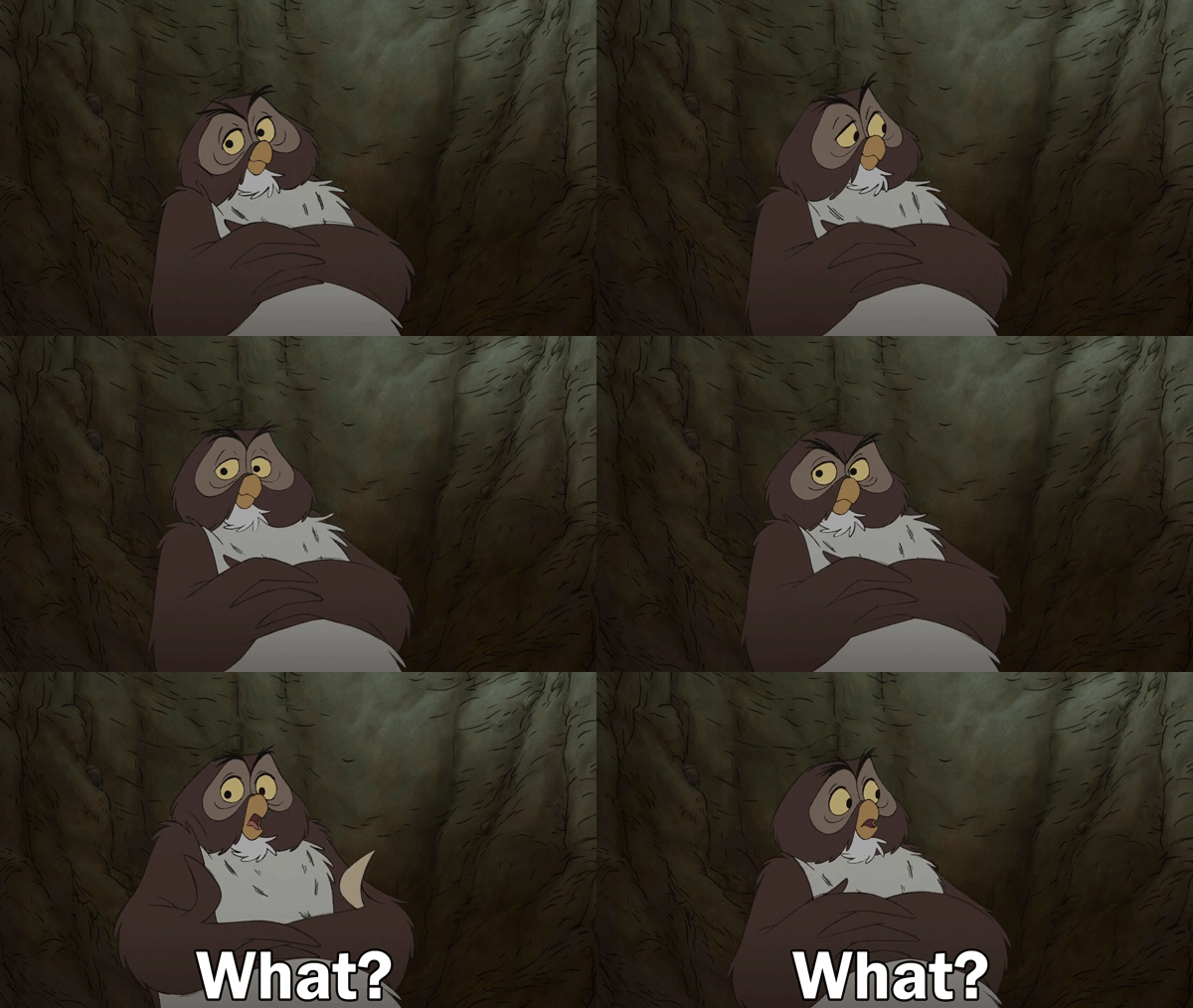
“Moving on,” says Christopher Robin, quickly. “What about the things of your own that you value? Would you call them treasures? I don’t think I would, simply because I relate the term to pirates and treasure hunting.”

“I wouldn’t either,” says Tigger. “Sentimental, sure, but not treasured.”

“There are things that I’d rescue in the event of a fire, or things that I might consider family heirlooms,” Christopher Robin continues, “but I’d never refer to them as treasures. Precious items, maybe.”

“Hmm,” says Owl. “I would never use precious, because I equate it with gemstones and Gollum. It’s just a different frame of reference.”

“This is the problem, isn’t it?” says Tigger. “It’s word association. We have to use terminology carefully – especially in science communication – where we want the word we’re using to match the meaning that people will think of when they hear it.”

“And with something like treasure, there’s a dissonance between the two,” agrees Owl.

Tigger continues, “I think, if you’re using a word in a different sense to the way most people will think of it, it’s probably not an effective word to use. Like, in some places in America, they use ‘space archaeology’ to refer to the study of spatial relationships between things – what sensible people call ‘spatial archaeology’ or ‘landscape archaeology. Space archaeology immediately conjures up images of moon landings and floating fields of historical debris around the planet and just sets people up for disappointment when they discover what it actually is.”

“Aha!” says Owl. “But if a word manages to excite and interest people in the topic at hand, even if it’s somewhat inaccurate, isn’t it still effective? Is it more important to make archaeology accessible and of interest to everybody than it is to use technically accurate terminology? Where do you draw the line?”

Christopher Robin nods. “I do wonder if we’re being precious about the term, or if we should just embrace it. Perhaps, through our use of the term, we’re also helping to show other people that these ordinary things are also a kind of treasure (and therefore worthy of protection and study).”

“And sharing our own valuation of those treasures,” adds Owl. “Because they are important and valuable, even if neither pirates nor dragons would think so.”

“So we take back the term?” asks Tigger. “Use it with clear emphasis on heritage values, on information potential, on treasures in the cultural sense?”

“I think so,” says Owl. “It does make the exhibition sound exciting[4].”

“The odd blog post explaining our thoughts on the topic can’t hurt either,” says Christopher Robin, pointedly.

“True,” says Owl. “I’ll get right on that.”

Winnie-the-pooh-characters-movie-photo-09-550x550

Owl, Christopher Robin and Tigger

[1] The more you write and/or say words, the weirder it is.

[2] “A heffalump! Did you hear that, Pooh! A heffalump!” Piglet can be heard saying excitedly in the distance.

[3] “There is it again, Piglet! It must be nearby. A heffalump, Piglet, a heffalump! Let’s go!”

[4] And it IS exciting. You should all go and see it.

Acknowledgements

A. A. Milne, of course.

Majestical mountains

In the beginning there was no Te Wai Pounamu or Aotearoa. The waters of Kiwa rolled over the place now occupied by the South Island, the North Island and Stewart Island. No sign of land existed.

Before Raki (the Sky Father) wedded Papatūānuku (the Earth Mother), each of them already had children by other unions. After the marriage, some of the Sky Children came down to greet their father’s new wife and some even married Earth Daughters.

Among the celestial visitors were four sons of Raki who were named Aoraki (Cloud in the Sky), Rakiroa (Long Raki), Rakirua (Raki the Second), and Rārakiroa (Long Unbroken Line). They came down in a canoe which was known as Te Waka o Aoraki. They cruised around Papatūānuku who lay as one body in a huge continent known as Hawaiiki.

Then, keen to explore, the voyagers set out to sea, but no matter how far they travelled, they could not find land. They decided to return to their celestial home but the karakia (incantation) which should have lifted the waka (canoe) back to the heavens failed and their craft ran aground on a hidden reef, turning to stone and earth in the process.

The waka listed and settled with the west side much higher out of the water than the east. Thus the whole waka formed the South Island, hence the name: Te Waka o Aoraki. Aoraki and his brothers clambered on to the high side and were turned to stone. They are still there today. Aoraki is the mountain known to Pākehā as Mount Cook, and his brothers are the next highest peaks near him. The form of the island as it now is owes much to the subsequent deeds of Tū Te Rakiwhānoa, who took on the job of shaping the land to make it fit for human habitation.

Ngāi Tahu Claims Settlement Act 1988: Schedule 80: Tōpuni for Aoraki/Mt Cook


Welcome to Aoraki Mt/Cook, a place of breath-taking beauty and – as with any landscape – many layers of human history, the imprint of which is present in both tangible and intangible ways.

Surprisingly, I've no (digital) photographs of Aoraki/Mt Cook. Instead, I offer you the De La Beche Ridge, with the Tasman glacier in the foreground. Image: K. Watson.

Surprisingly, I’ve no (digital) photographs of Aoraki/Mt Cook. Instead, I offer you the De La Beche Ridge, with the Tasman glacier in the foreground, taken from the Ball track. Image: K. Watson.

This is the first in an occasional series of posts about places Christchurch residents would have holidayed in the past – and still do today. They also happen to be places I’ve been lucky enough to visit while doing work for the Department of Conservation (sometimes people forget that DOC is as much about protecting and preserving our cultural heritage as our natural heritage). These places tell us about the outdoor recreation and tourism opportunities available to Christchurch residents, and about the development of these spheres, because outdoor recreation and tourism weren’t really a particularly big deal when New Zealand was settled by Pākehā.

Let’s start at the beginning (from a human point of view, at least – I’m not getting into the geology). Aoraki/Mount Cook is so significant to Ngāi Tahu it is recognised with Tōpuni status under the Ngai Tahu Settlement Claims Act. For Ngāi Tahu, Aoraki/Mount Cook is the most sacred of their ancestors and is critical to their identity. There are no recorded Māori archaeological sites in the immediate vicinity of the mountain, there are further afield in the Mackenzie country, and these are a tribute to the resources of the area, particularly the stone and the food. Ngāi Tahu’s associations with the area also survive in the names used for landmarks in the area, from the lakes to the mountain itself.

The early European history of the area is a seemingly romantic one, with tales of rugged, intrepid men and women exploring and marvelling at the wilderness, with seemingly endless time to explore, retiring at night to the warmth and conviviality of either the Hermitage or Ball hut (or, later, Malte Brun hut), with the Hermitage in particular renowned for its egalitarian atmosphere (McClure 2004: 79-80). Glorious black and white photographs capture this era.

This was the first Hermitage, built in 1884 and destroyed by floods in 1913. You can still see the building site today and there was an excavation there in the early 1980s. In the early 2000s, I excavated the remains of the Hermitage stables. Unsurprisingly, we found a lot of horseshoes - as well as building remains. The Hermitage, Mount Cook. Ross, Malcolm 1862-1930 :Photographs by Malcolm Ross of New Zealanders in the Great War, Maori, mountaineering, New Zealand scenery, etc. Ref: 1/2-022364-G. Alexander Turnbull Library, Wellington, New Zealand. http://natlib.govt.nz/records/23121689

This was the first Hermitage, built in 1884 and destroyed by floods in 1913. You can still see the building site today and there was an excavation there in the early 1980s. In the early 2000s, I excavated the remains of the Hermitage stables. Unsurprisingly, we found a lot of horseshoes – as well as building remains.
Inage: The Hermitage, Mount Cook. Ross, Malcolm 1862-1930 :Photographs by Malcolm Ross of New Zealanders in the Great War, Maori, mountaineering, New Zealand scenery, etc. Ref: 1/2-022364-G. Alexander Turnbull Library, Wellington, New Zealand. http://natlib.govt.nz/records/23121689

Ball hut, 1907. Earlier photographs indicate that it was built without a fireplace, or the capacity to capture rainwater. The archaeological remains indicate that the hut expanded a lot before being destroyed by an avalanche in 1925. Image: Gifford, Algernon Charles, 1862-1948. Gifford tramping party at Ball Hut, Mt Cook. Gifford, Algernon Charles, 1862-1948 : Albums and photographs. Ref: 1/2-060503-G. Alexander Turnbull Library, Wellington, New Zealand. http://natlib.govt.nz/records/22583972

Ball hut, 1907. Earlier photographs indicate that it was built without a fireplace, or the capacity to capture rainwater. The archaeological remains indicate that the hut expanded a lot before being destroyed by an avalanche in 1925.
Image: Gifford, Algernon Charles, 1862-1948. Gifford tramping party at Ball Hut, Mt Cook. Gifford, Algernon Charles, 1862-1948 : Albums and photographs. Ref: 1/2-060503-G. Alexander Turnbull Library, Wellington, New Zealand. http://natlib.govt.nz/records/22583972

What this romantic vision ignores is the exclusion of Ngāi Tahu from the area and the literal walking on their most sacred ancestor, the disadvantaged position of women in this world (climb and explore they did, but in voluminous skirts or culotte-type garments and they had to battle against the social norms of the day, which frowned on the relationship between women and their male guides) and the fact that tourism in this period was the preserve of the wealthy. The rest of society simply did not have the time or money to travel in this way: initially, the journey from Fairlie to the Hermitage took three days by coach, with the horses having to be changed five times. The wheel ruts from this original dray track survive in parts of the Mackenzie country (and are difficult to photograph!) and are testament to what must have been a bone-shaking journey (and they used pigeons – yes, pigeons! – to send information to the Hermitage about the number of guests on the way). More to the point, however, if the journey took at least three days in each direction, you were going to want to spend a decent amount of time at the destination. And then there was the matter of hiring guides and/or horses, and the cost of the accommodation itself. Nonetheless, what was noteworthy about the Hermitage was that the guides were required to divide their attention equally between regular tourists and serious mountaineers (McClure 2004: 79-80).

This is just possibly the remains of Mannering and Dixon's camp on Ball Flat, to the north of the remains of the first Ball hut, described by Mannering (2000: 72) as their "well-known Ball Glacier camp" and built c.1886. Image: K. Watson.

This is just possibly the remains of Mannering and Dixon’s camp on Ball Flat, to the north of the remains of the first Ball hut, described by Mannering (2000: 72) as their “well-known Ball Glacier camp” and built c.1886. Image: K. Watson.

The government spent a lot on this elite tourist venture, helping to fund the construction of the road from Glentanner station to Aoraki/Mt Cook, financially supporting the operation of the Hermitage and constructing roads, huts and tracks in the area, including Ball hut and Ball track, which ran above the Tasman glacier from the Hooker River to Ball glacier. It was not until the involvement of one Rodolph Wigley, however, that the area became a serious tourist destination.

On the old road to Aoraki/Mt Cook. This road, built in partnership by the government of the day and the Mt Cook Road Board in late 1883, remained in use until the mid-late 20th century. Image: K. Watson.

On the old road to Aoraki/Mt Cook. This road, built in partnership by the government of the day and the Mt Cook Road Board in late 1883, remained in use until the mid-late 20th century. Image: K. Watson.

The Ball track, 1907. Image: On the track to Ball Hut, Mt Cook. Gifford, Algernon Charles, 1862-1948 : Albums and photographs. Ref: PA1-o-186-07. Alexander Turnbull Library, Wellington, New Zealand. http://natlib.govt.nz/records/22916634

The Ball track, 1907. Image: On the track to Ball Hut, Mt Cook. Gifford, Algernon Charles, 1862-1948 : Albums and photographs. Ref: PA1-o-186-07. Alexander Turnbull Library, Wellington, New Zealand. http://natlib.govt.nz/records/22916634

Scrabbling along the remains of the Ball track today (well, actually, in 2010). Image: I. Hill.

Scrabbling along the remains of the Ball track today (well, actually, in 2010). I’m standing on that track, and you can make out the line of towards the centre left. Image: I. Hill.

It’s a bit of a chicken-and-egg situation with Wigley and Aoraki Mt Cook: was he the catalyst that drove the development, or was he just the right man at the right time? Or a bit of both? Whatever the case, it is impossible to separate him from the story of Aoraki Mt Cook. Wigley was the man behind the Mt Cook Motor Company, which took over the lease of the (second) Hermitage in 1922, and set about opening up the area to a much broader sector of (Pākehā) society, by reducing costs, improving access and improving facilities. Wigley offered wooden floored tents as a cheaper form of accommodation and set out to offer a range of attractions beyond just the scenery, including golf. One of the key factors underlying Wigley’s success was the increasing popularity of exploring the outdoors, and the increasing availability of leisure time for the middle and working classes, a theme that will be returned to in another of these posts. The other was the motor car, and this underlay one of the key components of Wigley’s vision: the Ball Road.

The fantastic stone work that remains in situ along sections of the Ball Road. Image: K. Watson.

The fantastic stone work that remains in situ along sections of the Ball Road. Image: K. Watson.

The Ball Road was an ambitious plan to connect the Hermitage to (the second) Ball hut by motor car, enabling less mobile/athletic visitors the opportunity to get up close and personal with the alpine region, and also to promote the skifield he established on the Ball glacier. Nature, however, had other ideas and today the remains of the road are a testament to the power of Wigley’s vision, and to his ambition to make Aoraki/Mt Cook the site of domestic tourism for the masses. Not for any altruistic reason, one assumes, but very much driven by the profit motive – the two, of course, do not have to be mutually exclusive.

Ball Road, disappearing under collapsing moraine. Image: K. Watson.

Ball Road, disappearing under collapsing moraine. Image: K. Watson.

By the 1970s, keeping the road open was becoming increasingly difficult and by 1989 it had been closed for good. You can still walk the road today but one day the glacier will claim it for good, if the avalanches don’t get it first. I can’t urge you strongly enough to do so – it’s an easy walk, and a beautiful one. As you walk it, think of all those who have gone before you: Ngāi Tahu; Green, Emil Boss and Ulrich Kaufmass (who, in the first attempt on the summit of Aoraki/Mt Cook, came within 60 m – an amazing feat); Mannering and Dixon; Peter Graham; Freda du Faur; Hillary; and the thousands of others who’ve travelled this route to appreciate the beauty that is Aoraki/Mt Cook.

Ball Road, with the lateral moraine from the Tasman glacier looming above it, perilously close to collapsing into the glacier itself. Image: K. Watson.

Ball Road, with the lateral moraine from the Tasman glacier looming above it, perilously close to collapsing into the glacier itself. Walk it now, while it’s still there. Image: K. Watson.

Katharine Watson

References

Mannering, G., 2000. The Hermitage Years of Mannering and Dixon. GM Publication, Geraldine.

McClure, M., 2004. The Wonder Country: Making New Zealand tourism. Auckland University Press, Auckland.

Tool academy: Māori artefacts from Redcliffs

Kia ora,

Recently we had some great finds from Te Rae Kura/Redcliffs.

Unbeknownst to many folks making their daily commute along the Port Hills’ Main Road, a nationally significant Māori archaeological site lies beneath their car wheels, capped by hard fill and asphalt. Despite the many years of residential development in the area since the arrival of Pākehā, archaeologists are still uncovering significant finds. Like these beauties.

A flake core of obsidian (left), and basalt adze (right). Image: Jessie Garland.

A flake core of obsidian (left), and basalt adze (right). Image: Jessie Garland.

To the untrained eye, these may seem like simply rocks or glass, but to archaeologists they have the potential to provide a greater understanding of Māori life before they first encountered Europeans.

The first artefact is a flake core of obsidian, a volcanic glass known to Māori as tuhua. The dormant volcanoes of the South Island don’t produce much in the way of obsidian, perhaps because they were never given much support from their parents in their youth, and still struggle with expressing their creativity. Therefore, when we find it in South Island sites, it’s a sign of the extensive trade networks that operated between iwi groups, bringing obsidian and other trade goods down from the North Island in exchange for South Island goods like pounamu. The greenish tinge on this particular piece when you hold it to the light suggests it’s from one of the most important sources, Mayor Island in the Bay of Plenty (and not that I need corrective eye surgery, Matt).

Smaller flakes would have been removed from this core by hitting it with a hammerstone, and then used as cutting tools. This is a pretty hard-core (sorry not sorry) form of technology that was employed by all of our ancestors, and was the dominant technology throughout 99% of human history, as shown in a helpful and very professional image below produced by a very intelligent and super handsome individual. Obsidian produces amazingly sharp cutting tools, and is still used today in surgeries, because flaked obsidian is essentially sterile and produces an edge finer than steel.

An approximate, and highly abridged timeline of human history.

An approximate, and highly abridged timeline of human history.

The basalt toki/adze below may be made of local materials, from a currently unidentified source of fine grained basalt among the volcanic rock of Horomaka/Banks Peninsula. Adzes were important tools: in essence a wood-cutting tool like an axe, but hafted sideways, in a fashion similar to a modern grubber or mattock. This tool would have been used in the construction of whare, and the waka that plied the waters of the estuary and the surrounding ocean. Adzes were so important that ceremonial versions were held by rangatira, much in the same way that modern bogans advertise their status through impressive spoilers and exhausts, and popes do so with big as hats. Status among modern archaeologists is similarly established through use of oversized ceremonial trowels.

Side view of basalt adze (left), and an image showing hafting techniques (right), from Hiroa, 1949: 185.

Side view of basalt adze (left), and an image showing hafting techniques (right), from Hiroa, 1949: 185.

Caption

A modern archaeologist chief performing a traditional ritual with a ceremonial trowel.

This stubby little toki, however, has reached the end of its life as an adze head, having likely been resharpened many times and has begun to be recycled. The flake scars on the side of the tool show where sections have been removed for re-use as other tools, and there is crushing on the butt end that suggests that it was further used as a hammerstone for working and shaping of other stone tools (Witter, D. pers comm). This kind of recycling is quite common within the Māori tool kit, and shows that our forebears ascribed to the ‘number-8 wire’ mentality as much as we do today.

The butt end of the adze-turned hammerstone, showing: A) a faint line where the stone has been pounded smooth by repetitive impact, evidence of hammer dressing; B) pitting, where impact has removed sections of the stone; C) a scar I got from a turtle at the Taronga Zoo one time. Image: Tristan Wadsworth.

The butt end of the adze-turned hammerstone, showing: A) a faint line where the stone has been pounded smooth by repetitive impact, evidence of hammer dressing; B) pitting, where impact has removed sections of the stone; C) a scar I got from a turtle at the Taronga Zoo one time. Image: Tristan Wadsworth.

In addition to the artefacts, the site has yielded considerable shell midden, and a fragment of moa bone, providing insights into the diet of Redcliffs Māori (surf and turf), and suggesting that the artefacts, which were found in close association, date to the period prior to moa extinction around 1450 AD (Holdaway and Jacomb, 2000).

A distal (closest to ground) fragment of a tibiotarsus (shin bone/drumstick) of a moa (big old bird). Image: John Megahan, Giant Haast’s eagle attacking New Zealand moa.

A distal (closest to ground) fragment of a tibiotarsus (shin bone/drumstick) of a moa (big old bird). Image: John Megahan, Giant Haast’s eagle attacking New Zealand moa.

Although limited in number, these artefacts each have a story to tell about past use of the area, and add to the greater known context of Māori occupation of this great land. If you want to know more, feel free to adze us your questions in the comments below. Har har har har.

References

Hiroa, Te Rangi, 1949. The Coming of the Māori. Whitcombe and Tombs Ltd.

Holdaway, R. and Jacomb, C. 2000. Rapid extinction of the moas (Aves: Dinornithiformes): model, text and implications. Science 287:2250-54.