“He’s jist sharpening his teeth”

One of the exciting things about being an archaeologist in Christchurch at the moment is that we’re digging up lots and lots of artefacts. And the more artefacts you dig up, the more chances there are of finding something rare or unusual. Sometimes the rarity relates to the monetary or sentimental value of the artefact, such as the fobwatch we talked about a couple of weeks ago. And sometimes the unusual artefact is something pretty ordinary.

Like a toothbrush.

Toothbrush

Bone toothbrush handle found on an archaeological site in Christchurch. This was made by S. Maw, Son & Thompson. Their trademark is impressed on the handle, along with the words “ALPASS LIVERPOOL” (Photo: K. Webb).

This teardrop-shaped bone toothbrush handle was found during archaeological work on an historic hotel site in Christchurch, along with a ceramic toothpaste pot (below) and other personal artefacts. We were pretty excited to find it, since toothbrushes (or even parts of them) aren’t often found on 19th century archaeological sites in New Zealand. Our research suggests that this may be a result of vastly different attitudes towards oral hygiene at this time, not only in New Zealand but throughout the world.

toothpaste-pot-copy

John Gosnell and Co. cherry toothpaste pot and lid found along with the toothbrush. The lid is decorated with a polychrome transfer print that features the image of a young Queen Victoria. More information about Gosnell’s products is available here.

The humble bristle toothbrush originated in China, although ‘toothsticks’ and the like are known to have been used for thousands of years. These earliest bristle toothbrushes weren’t so humble, being made of expensive materials like ivory, gold (imagine!), silver or precious wood. So only the very wealthy could afford them, although there were some cheaper toothbrushes around. In Europe, however, people cleaned their teeth using sticks or rags… Toothbrushes were available in England from at least the 17th century but weren’t common until a certain William Addis was thrown in jail in 1780 for starting a riot. At least, that’s how the story goes. Whatever the truth of the matter, Addis is credited with introducing cheap bone-handled toothbrushes to England, and no doubt kick-starting a revolution in dental hygiene. Addis’s toothbrushes were typically made from animal bones and the bristles also came from animals. Badger bristles were apparently the most expensive but pig bristles were more common.

Pages from Maw and Sons Book of Illustrations to S. Maw & Son’s Quarterly Price-Current.

We know that from c.1850 on many toothbrushes were imprinted with trademarks, slogans or details of the manufacturer and our toothbrush is no exception. It’s stamped with the mark of S. Maw, Son & Thompson (see photo above). From this, we know that the toothbrush was made between 1870 and 1901, when this firm was in operation.

The Maw firm was the largest pharmaceutical wholesaler in Britain and was actually a distributor of toothbrushes, not a manufacturer (i.e. a middleman). From 1870-1901, they sold toothbrushes made by William Addis & Son Brushworks, the company founded by William Addis almost a century earlier and continued by his son. The words “ALPASS LIVERPOOL” were also stamped on the handle and probably indicate the place of manufacture: Alpass Road in Liverpool, England. The number ’29’ stamped below the head indicates the manufacturer’s model number.

So why are toothbrushes – and toothpaste pots – so rare on 19th century archaeological sites in New Zealand, given that they’re such everyday items today (not to mention items that are thrown out pretty regularly)? Lots of chemists and druggists in New Zealand were advertising toothbrushes for sale, so they were definitely available.

We think that the rarity reflects a lack of awareness of the importance of dental hygiene, and possibly also that a rag – which would always be readily available and would cost nothing – would do the job just fine, thanks. And dentists in the 19th century had a pretty fearsome reputation, so anything to do with dental hygiene may have been a little suspect. But there might have been some other factors too, including the cost of toothbrushes.

So who used our toothbrush? It could have been the proprietor of the hotel, or a guest. If it was the proprietor, however, we might have found more toothbrushes, given that probably even 19th century toothbrushes needed to be replaced regularly. Our guess, then, is that it was used by a guest. We don’t know for certain that the same guest left the toothpaste pot behind, but it seems reasonably likely, given the rarity of both artefacts in 19th century archaeological sites in New Zealand. And who knows, maybe a hotel servant who chanced to see this guest brushing their teeth thought the guest was in fact sharpening his teeth.

Kirsa Webb

Bibliography
  • Mattick, B., 2010. A Guide to Bone Toothbrushes of the 19th and early 20th Centuries. Barbara E. Mattick, USA, available from Xlibris Corporation.
  • Maw, S & Son, 1869. Book of Illustrations to S. Maw & Son’s Quarterly Price-Current. Butler & Tanner, London. Available at: http://archive.org/details/bookofillustrati00mawsuoft.
  • Press, 18 February 1874, page 3.
  • Taranaki Herald, 1 November 1880, page 4.
A small thing forgotten: tall tales from tiny things

In the 1970s, an American archaeologist by the name of James Deetz coined the phrase ‘in small things forgotten’ when he wrote a book that discussed how the smallest or most ordinary of objects could illustrate the histories of people and places in ways we might not expect. To this day, as discussed in our opening post a couple of weeks ago, this idea remains an important part of what we, as archaeologists, do when we record and investigate the small details of the site as well as the big ones.

Here in Christchurch, the artefacts we recover from archaeological sites often have connections to the international world as well as to local people and events. The tiniest object can be part of a much bigger story, which can take us out of our own city, across the world and into the lives of people with diverse backgrounds and places in history.

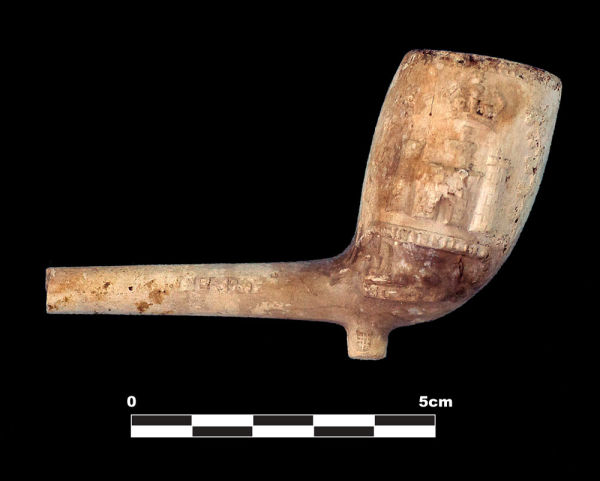
No doubt this will be a theme evident in many of the entries found on this blog, but this week it is especially obvious in the story of a clay tobacco pipe that we found during earthworks on the site of a former theatre in Christchurch. The pipe, although broken, is decorated on the bowl with the insignia of the Royal Iniskilling Fusiliers, an Irish infantry regiment with a history going back over 300 years.

Inniskilling-pipe

The clay smoking pipe found on a site in Christchurch. Although broken at the stem, the pipe is complete enough to see the raised relief of a castle and crown above the image of a sphinx on both sides of the bowl. The name of the regiment is stamped across this design, while ‘EGYPT’ is stamped below the sphinx and ‘DERRY’ is stamped into the stem of the pipe.

Known colloquially as ‘Tiffins’ after an early colonel, Zachariah Tiffins, the Royal Inniskilling Fusiliers formed in 1689 to stand against James II following the ‘Glorious Revolution’ in England the previous year. During the following centuries they were stationed all over the world, from the West Indies to Spain, and fought in numerous battles, including the Siege of Namur (1695), the Battle of Culloden (1745) and the Battle of Falkirk (1746), the Seven Years War (1756-1763), the Battle of Alexandria (1801) and the Battle of Waterloo (1815).

By all accounts, they had a fierce reputation and were awarded numerous battle honours during their long history of service – the sphinx image and reference to Egypt impressed on the bowl of our tobacco pipe represent honours awarded to the regiment for the battle against the French at Alexandria in 1801.

10th Royal Inniskilling Fusiliers on the march to Londonderry, May 1915

10th Royal Inniskilling Fusiliers on the march to Londonderry, May 1915. Photo: Gardiner S. Mitchell. 

The regiment went on to fight in both world wars, with their participation in WWI leading to the creation of nine ‘New Army’ battalions (in addition to the two existing battalions) recruited between 1914 and 1918 and later disbanded. Our pipe is associated with the 10th Battalion, who were formed from the Derry Volunteers in Omagh in September 1914  and consequently became known as ‘The Derrys’. They fought in the Middle East and the Battle of the Somme and were part of the Battle of Gallipoli in 1915, before being eventually disbanded on 21 January 1918, in France.

complete pipe

A complete example of a smoking pipe decorated with the symbols of the Royal Inniskilling Fusiliers 10th Battalion. The design would have been carved or raised on the inside of the mould used to make the pipe – this kind of moulded decoration was common on clay pipes from the late 16th century onwards and often had designs relating to organisations, places or prominent people as well as to their original manufacturers.
Photo: Gardiner S. Mitchell.

We know, then, that our pipe must have been made after 1914 and buried before 1929, when the building under which it was found was built. This gives us a clear date for its origins and arrival in Christchurch, but still doesn’t explain how or why it ended up in Christchurch. The Royal Inniskilling Fusiliers were never stationed in New Zealand and we found no trace of a connection between them and our site.

Still, there are many possible explanations for its presence. Perhaps a veteran soldier from the regiment moved to New Zealand in the early 20th century and brought it with him; maybe the child or family of a soldier did the same; a New Zealand solider serving in WWI may have met someone from the 10th Battalion during their time overseas (at Gallipoli perhaps) and exchanged or been given the pipe; it could have changed hands multiple times throughout the world, until, eventually, it was dropped or lost or thrown out here in Christchurch. However it came to be here, the pipe reminds us that Christchurch was just as connected to the wider world in the past as it is today.

Jessie Garland

Bibliography

For more information on the Royal Inniskilling Fusiliers, see:

–  The Irish Brigade: the story of the 38th (Irish) Brigade in the 2nd World War

The Long Long Trail: The British Army in the Great War of 1914-1918

The Inniskillings Museum

Three Cheers for the Derrys!, a book by Gardiner S. Mitchell on the history of the 10th Battalion can be found here. Our thanks go to Gardiner for his assistance with research on the history of the pipe and the Battalion.

Telling time in days gone by

A little while ago, archaeologist Matt Carter was investigating a brick-lined basement on a site in Christchurch when he came across what turned out to be a small 19th century pocket-watch (below). You can imagine his surprise (and excitement) – artefact finds like this are rare in archaeological excavations, since people tended to hold onto and take care of valuable items like watches (as we do now).

pocketwatch

Engraved gilt-metal pocket watch found in a buried basement in Christchurch. This watch is currently on display as part of the Canterbury Museum’s Quake City exhibition. Photo: K. Webb.

Of course, our watch didn’t look quite like this when Matt found it. Although it’s been cleaned carefully since being excavated, the corrosion on the watch means it’s difficult to make out many characteristics that would help us identify it further. What we know so far is that it’s likely to have been gold-plated and it has an engraved fish scale-like pattern on the back and a decorative engraved floral pattern on the gilt face. It’s just possible to distinguish the black enamel numbers on the face. We think that the watch probably used a keyless wound lever mechanism: such mechanisms were introduced to watches during the 1850s and 1860s to replace winding methods that required a separate key to work.

3D CT scan of the pocket watch found on the wreck of the Swan. (Image: National Museums Scotland.)

Computerised tomography (CT) scanning may be able to reveal engraved maker’s marks or manufacturing dates on the watch. This technique has been used successfully for a pocket watch found on the wreckage of the Swan, which sank in 1653 in the Sound of Mull, off the coast of Scotland. The resulting images revealed not only the type of mechanism but also the name of the maker – “Niccholas Higginson, Westminster” – engraved on the back.

Gilt-metal ‘clock watch’ by German watchmaker Peter Henlein, dated c. 1510.  (Image: Wikipedia.)

The first watches evolved after the coiled spring was introduced as an alternative form of motive power to the pendulum. This meant that timepieces no longer needed to be big enough to house the pendulum, but could be made small enough to be carried unobtrusively.

Some of the earliest watches have been attributed to the maker Peter Henlein of Nuremberg. An example of one of his watches is kept at the Germanisches National Museum, Nuremberg, Germany. Dated 1510, this ‘clock watch’ is contained in a gilt metal drum-shaped case with a single hand indicating the time on an engraved gilt metal dial. These early examples were designed to be hung around the neck by a cord rather than carried in the pocket.

Some early examples of watches have been depicted in contemporary paintings such as this untitled painting attributed to Tommaso Manzouli dated c. 1560. (Image: Science & Society Picture Library.)

Around the time of the introduction of pockets to clothing during in the first quarter of the 17th century, when a pocket was a fabric pouch worn underneath your petticoat or tied around your wrist or belt, watches developed into the form we know today in order to be carried in the pocket. The watch was housed in a case and a crystal or glass cover was added to protect the hands and dial.

The site where our watch was found was once the property of Herman Franz Fuhrmann, an affluent German immigrant, who owned the section until his death in 1907. Fuhrmann was an undertaker and cabinet maker and had established himself in Christchurch by 1869, having arrived by way of Melbourne. In 1873 Fuhrmann expanded his business to include a saddler and the following year became involved in the insurance industry. He also made profits buying and selling Molesworth station (in Marlborough).

A newspaper article advertising a watch similar to that found in the Christchurch basement.

From the small size of our watch (just 3 cm in diameter) we know that it was probably owned by a lady. She must have been a lady of some wealth – intricately detailed gilt pocket watches such as this were not cheap, although they were available in Christchurch from at least the 1860s and were advertised in local newspapers of the time.

What we don’t know is why the watch was discarded. Watches such as these were repairable and a quick search of Papers Past indicates that watchmakers were well represented in Christchurch so it is unlikely that it was broken. Was it thrown out deliberately? Was it lost accidentally? These are the kind of questions archaeologists seek to answer every day, to help us better understand the lives of those who came before us.


 Kirsa  Webb


Bibliography


I am an archaeologist

I am an archaeologist. I’m not interested in dinosaurs. Or rocks. I don’t look for gold. And I’m no more interested in the pyramids than most people.

But I’m fascinated by people, and our past, and the lives of those who went before us, especially here in Christchurch. I want to know how people have dealt with the area we know as Christchurch since Māori first arrived. I want to know what people ate, how they set their table, the medicines they took, the alcohol they drank, how they furnished their houses, what sort of houses they lived in. And more than that, I want to know how Christchurch’s 19th century settlers viewed their world. What did they make of this place they’d come to? How did they deal with the challenges it provided, and a life so far from all that was familiar and comfortable? How did Māori deal with these new settlers from so far away, who brought so much that was new and different with them? And how did these decisions build the city we live in today?

bottles

Black beer bottles. Although they may have originally contained beer it is likely that the bottles were reused for other liquids. Photo: K. Webb.

I’m an historical archaeologist. That means that as well as looking at the physical remains of an archaeological site – such as buildings, garden features, rubbish pits, artefacts and the vast array of other material that might be found on an archaeological site – I use documents to help me understand these sites. So I look at photographs, maps, plans, old newspapers, diaries, letters, account books, etc. But so often, these documents don’t tell me what people were eating for dinner or how they treated their cold. Or, they might lie, or embellish, or miss out details that seem ordinary or boring. For me, archaeology’s power is its ability to reveal those ordinary, everyday details, because by pulling together those details, we can learn so much more about our past, and about who we are today.

DSC_0370

Transfer printed porcelain bowl made by the Staffordshire pottery firm W. T. Copeland in the 1850s. Photo: K. Webb.

To me, the artefacts we find provide us with a direct connection to the people who made Christchurch. I can hold the fragments of a china bowl in my hand that was someone’s treasured possession, brought with them all the way from England. And when I hold that bowl, it makes me stop and think about how brave they were to start a new life in a new settlement, knowing that they might never see the rest of their family again. And that whenever they used that bowl, they thought of their family back home, of all they had left behind, and all that they had gained since arriving in Christchurch.

I’ve worked in Christchurch as an archaeologist since 2000. Since the earthquakes of 2011, the volume of archaeological work in the city has increased dramatically. This blog is a long-held dream of mine, a way to share our discoveries and to show you the power and importance of archaeology. So, take a look around, sign up to get our news feeds, follow our Facebook page and join us as we discover more about this Christchurch of ours!

Katharine Watson

power-house1

Archaeologist Katharine Watson with Paul Thomas discussing the remains of the power house in Reefton. Photo: K. Burnett.