Pieces of the Past

This week on the blog we’re sending you over to Pieces of the Past, an online exhibition we’ve curated as part of Beca Heritage Week here in Christchurch. The exhibition features the staff of Underground Overground Archaeology and their favourite artefacts. There’s a wealth of different objects and stories there (and a suspicious number of caffeine related biographies for our archaeologists), from a sheep hoof on a stick to pocket watches, spinning tops and poems about cowboys.

In fact, we may have been so excited about it that we modified (or butchered, depends on your point of view) a famous song in our excitement.

Glass eyes on skulls and sheep hooves on sticks,
Old broken watches and bright orange bricks,
Upright pianos, still with their strings,
These are a few of our favourite things.

Lost spinning tops and pointy bone hooks,
Cheese jars and Marmite and Rantin’s old books,
Cowboys and boats and small figurines,
These are a few of our favourite things.

When the trowel scrapes,
When the glass breaks,
When we’re feeling bored,
We simply remember our favourite things,
And then we don’t feel so bad.

Check it out here. 

A poetic reflection on heritage buildings

As building archaeologists we record and analyse the form, structure and ornamentation of 19th century dwellings to learn about the lives led by past occupants.

The Victorian era was a time of invention and achievement. Society was dominated by middle-class morality as they relentlessly pursued comfort and material wealth. Their houses expressed the energy and exuberance of this time, as they presented their best face to the public.

These efforts can be directly observed through the choice of internal linings used in 19th century dwellings. Wealthy homes were commonly lined with timber laths and lime plaster, while poorer houses used roughly sawn butted sarking boards. When we recorded a modest workman’s cottage in the Avon Loop we uncovered some of these roughly sawn butted sarking boards in the parlour, a room purposely decorated for public display.

Roughly sawn butted sarking boards used in parlour of workman's cottage. Image: F. Bradley.

Roughly sawn butted sarking boards used in parlour of workman’s cottage. Image: F. Bradley.

Over time, however, seven layers of wallpaper had been applied to this room to disguise the poor lining material.

Original layer 1

The first layer of wallpaper applied was a mid-Victorian pattern design of purple and light brown diamond shapes dating to between the 1860s and 1870s. Image: F. Bradley.

Layer 2

Applied on top of the original layer was a brown wallpaper with a blue flowers and leaves pattern design, dating to the 1880s. Image: F. Bradley.

Layer 4

The fourth layer of wallpaper dated to the 1850s and had design elements of the Edwardian period, with green diamond shapes and pink roses. Image: F. Bradley.

top layer 7

The last layer was a pearlescent wallpaper with a design pattern of white, pink and yellow flowers, dating to between the 1920s and 1930s. Image: F. Bradley.

When we record these historic dwellings, we try decipher the social conventions at play during the Victorian era and how they influenced the way in which their dwellings were decorated. But when it came to recording this workman’s cottage in the Avon Loop, we were confronted with the juxtaposition of how 19th century society decorated their houses and a very unique way one 21st century occupant had decided to decorate her humble abode.

IMGP6129

Street-facing elevation of workman’s cottage in the Avon Loop. Image: F. Bradley.

In its irreparable state the creative owner of this house took to it with a fine paint brush and turned its rough-cast plastered walls into a mural of poetry.

The street-facing south elevation bore the words of Percy Shelley’s sonnet ‘Ozymandias’.

IMGP6135

Percy Shelley’s poem ‘Ozymandias’ painted on the street-facing south elevation. Image: F. Bradley.

Ozymandias – Percy Bysshe Shelley

I met a traveller from an antique land
Who said: “Two vast and trunkless legs of stone
Stand in the desert. Near them on the sand,
Half sunk, a shattered visage lies, whose frown
And wrinkled lip and sneer of cold command
Tell that its sculptor well those passions read
Which yet survive, stamped on these lifeless things,
The hand that mocked them and the heart that fed.
And on the pedestal these words appear:
`My name is Ozymandias, King of Kings:
Look on my works, ye mighty, and despair!’
Nothing beside remains. Round the decay
Of that colossal wreck, boundless and bare,
The lone and level sands stretch far away”.

(Source: Wikipedia, 2001).

‘Ozymandias’ was one of English romantic poet Percy Bysshe Shelley’s most famous works, first published in 1818. Shelley’s works often attracted controversy as they spoke out against oppression, convention and religion (Source: Wikipedia, 2001).

His poem ‘Ozymandias’ acts as a a metaphor for the ephemeral nature of political power. Its central theme explores the indiscriminate and destructive power of history, by contrasting all leaders’ pretentions to greatness and their inevitable decline. It is a powerful statement about the insignificance of human beings to the passage of time (Wikipedia, 2001).

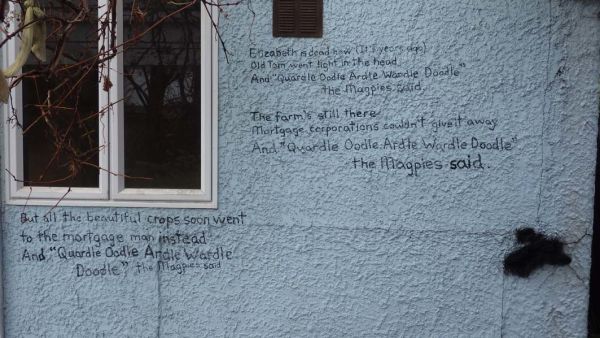
Along the north elevation of the cottage were the words of Denis Glover’s iconic New Zealand poem ‘The Magpies’.

IMGP6145

Denis Glover’s poem ‘The Magpies’ painted along the north elevation of the cottage. Image: F. Bradley.

IMGP6139

First section of ‘The Magpies’. Image: F. Bradley.

IMGP6142

Second section of ‘The Magpies’. Image: F. Bradley.

The Magpies – Denis Glover

When Tom and Elizabeth took the farm
The bracken made their bed,
And Quardle oodle ardle wardle doodle
The magpies said.

Tom’s hand was strong to the plough
Elizabeth’s lips were red,
And Quardle oodle ardle wardle doodle
The magpies said.

Year in year out they worked
While the pines grew overhead,
And Quardle oodle ardle wardle doodle
The magpies said.

But all the beautiful crops soon went
To the mortgage-man instead,
And Quardle oodle ardle wardle doodle
The magpies said.

Elizabeth is dead now (it’s years ago)
Old Tom went light in the head;
And Quardle oodle ardle wardle doodle
The magpies said.

The farm’s still there. Mortgage corporations
Couldn’t give it away.
And Quardle oodle ardle wardle doodle
The magpies say.

(Source: Xyphir, 2011).

‘The Magpies’ by Denis Glover is one of New Zealand’s most famous poems, first published in 1941. This poem relates to the passage of time as it laments the fate of farmers in hard economic times (Wikipedia, 2006). The hard-working farming couple become victims of an oppressive social system that exploits the working man. In this poem, the cruel and impartial nature of time is personified by the distinctive caw of the magpies, as they watched the farmers struggle away (Shieff, 2008).

As architectural styles and their decorative features can help us understand the conditions of bygone generations, the choice of poetry used here to decorate this workman’s cottage may be a reflection on the current post-quake social condition of Canterbury. Or perhaps the owner was merely commenting on the passage of time and its indiscriminate treatment of her home. Who knows, as archaeologists we can only speculate…

IMGP6137

Words of wisdom painted next to the dwelling’s front door. Image: F. Bradley.

Francesca Bradley.

References

Wikipedia, 2001. Ozymandias. [online] (22 September 2015) Available at: https://en.wikipedia.org/wiki/Ozymandias [Accessed 1 October 2015].

Xyphir, 2011. The Magpies – Denis Glover. A poem a day, [online] 26 April 2011. Available at: http://nzpoems.blogspot.co.nz/2011/04/magpies-denis-glover.html [Accessed 1 October 2015].

Wikipedia, 2006. The Magpies. [online] (2 May 2015) Available at: https://en.wikipedia.org/wiki/The_Magpies [Accessed 1 October 2015].

Shieff, Sarah, 2008. Denis Glover, 1912 – 1980. [online] Wellington: Victoria University. Available at: file:///Users/Shebitch/Downloads/716-622-1-PB%20(1).pdf [Accessed 1 October 2015].


In which a fortune is made, an Oddfellow is not a type of mint, and archaeology happens

Earlier this year, we excavated a site on Armagh Street that revealed not only a large quantity of artefacts, but also a historical and material narrative set in the swampy bowels of a fledgling city, a tale of politics, commerce, secret societies, nefarious happenings and BETRAYAL (cue ominous music). Well, maybe not those last two.  And maybe not quite as melodramatic as all that.

This story, told in turns by the objects and features we found on site and the records of those who owned them, included everyone from Oddfellows and Freemasons (even the United Ancient Order of Druids) to radicals (free radicals, even!) and liberals and some of the prominent voices of early Christchurch. Among the many figures whose history formed a part of the tale of this site, one who stood out was a Mr Edward Hiorns, tinsmith, hotelier, victualler, and protagonist of this particular post.

Excavating an archaeological feature filled with artefacts at a site on Armagh Street. Image: K. Bone.

Excavating an archaeological feature filled with artefacts at our site on Armagh Street. Image: K. Bone.

Mr Hiorns first arrived in Christchurch in 1862 on board the Victoria. A plumber, tinsmith and metal-worker, he operated a business from premises on Armagh Street East during 1860s and 1870s. By 1872, however, he had branched out into hotel-keeping, becoming the proprietor of the Central Hotel (later the Masonic), located on the corner of Colombo and Gloucester streets. He seems to have had something of a colourful time as a hotel proprietor, appearing in the courts several times as plaintiff and defendant in cases ranging from stolen watches to bail forfeit, forgery and the inappropriate sale of alcohol.

Edward Hiorns, the man himsef. Image: Wikimedia Commons.

Edward Hiorns, the man himsef. Image: Wikimedia Commons.

Like so many of Christchurch’s early residents Hiorns was a man of many hats, not just in terms of how he made a living, but also in regard to his involvement in the community. Among other things, he was a prominent member of the Licensed Victuallers Association (yes, this was a thing) from the 1870s onwards, as well as involving himself in local politics, both successfully and unsuccessfully. In 1875, he ran for the city council but only managed to finagle 21 votes, a meagre offering when compared to the winning candidate’s 634. Not one to be easily put off, though, he ran again successfully in the 80s and 90s. Hiorns was also a member of the Canterbury Freehold Land Association in the 1860s, a liberal organisation that aimed to assist working men with the purchase of land (an important part of socio-political independence and status at the time).

A description of the Canterbury Freehold Land Association from 1866, when they were first formed. Image:

A description of the Canterbury Freehold Land Association from 1866, when they were first formed. Image: Press 27/01/1866: 1.

On top of all this,  he was also active in the Oddfellows society, attaining the rank of Provincial Grand Master, an occurrence which seems to have been something of a prerequisite for the residents of Armagh Street in the 19th century (no, seriously, they’re ALL Oddfellows and I have the flowchart to prove it). If they weren’t Oddfellows, they were Freemasons, and if they weren’t Freemasons there’s every possibility that they were Druids. To modern ears, these societies (and their unbelievably amazing names, thank you “The Mistletoe Lodge of Druids”) sound incredibly anachronistic, but they were one of the major vehicles by which people (when I say people, I mean men, sadly) interacted with and supported each other. In the case of the Oddfellows, that support was largely aimed at the working classes. Ostensibly apolitical, they also likely fostered the growth of political ideas and movements enacted outside of the organisations, helped by the membership of men like W. S. Moorhouse, W. Rolleston, Rowland Davis, William Pember Reeves and many others.

The initial date of Hiorns’ arrival at our site on Armagh Street is a bit unclear, thanks to the existence of the similarly named Mr W. Hyorns, who leased the section in 1867 and may be the same person, a completely different person or a 19th century typo made flesh. Nevertheless, we know that he was active on Armagh Street in the 1870s and had leased the section on which our site was located by at least 1878 (for the period of 14 years, at the grand total of £20 a year; LINZ 1878: 337). Interestingly, one of the clauses of his lease was that he had to make £1000 pounds of improvements to the section at his own expense over the following two years, suggesting that he had a reasonable yearly income at the time (this is a LOT of money for the time). As it turns out, he later went on to buy and reside in Linwood House, the super fancy Georgian/Regency style house first built for Joseph Brittan. Pretty good for a tinsmith turned hotelier.

Linwood House in 2003, Image: Wikimedia Commons.

Linwood House in 2003, Image: Wikimedia Commons.

Archaeological site plan of the Armagh Street section on which Edward Hiorns resided in the 1870s. Image: K. Webb.

Plan of archaeological features on site. Image: K. Webb.

From historic photographs and maps, we know that between 1878 and 1884, significant modifications were made to the site. Two smaller buildings that are present on an 1877 map have, by 1884, been replaced with a large two storey brick townhouse (visible in the image below). It seems likely that this building tied into Hiorns’s £1000 pounds of modification to the section.  Unfortunately, we found no structural evidence of either this building or the earlier one during our excavations. What we did find, however, were several other archaeological features, including a large depression to the rear to the building that was completely and utterly filled with artefacts (unfortunately for us, this was the asbestos site was we’ve talked about previously on the blog, in the case of which more definitely wasn’t merrier). A smaller, rectangular pit feature was also found at the front of the section, containing a large quantity of tin and iron and a handful of artefacts, in addition to another small rubbish pit filled with domestic artefacts.

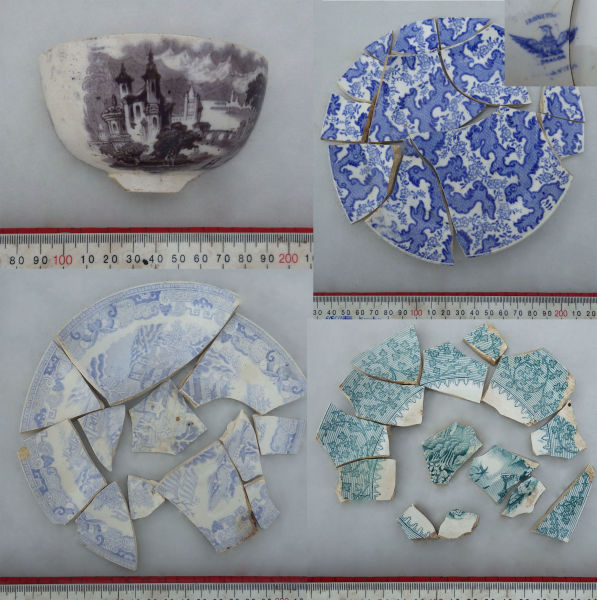
Ceramic artefacts from one of the rubbish pits on the section. Image: J. Garland.

Ceramic artefacts from one of the rubbish pits on the section. Image: J. Garland.

While it is difficult to associate the features found on the site with any one resident during the 19th century, it is almost certain that some of them were deposited by Hiorns and his family, including some of the 1037 artefacts found in the large depression to the rear of the building. That particular feature looks to have been used for the disposal of rubbish over an unknown period of time, based on the presence of small concentrations of objects within the feature as a whole, the size of the assemblage, and the wide range of manufacturing dates found among the artefacts. Many of the artefact dates, however, fit in well with the period in which Hiorns was resident on the section. On top of this, the assemblage contained a large number of alcohol bottles and several artefacts which are considered to be “higher status” items, or objects more often associated with people of reasonable wealth. It would make sense for the man who a) ran a hotel and wine bar and was in court more than once on alcohol related charges and b) later purchased the prestigious Linwood House, to have owned items like these.

Selected glass bottles from the site, including Rowland's Macassar Oil, a Piesse and Lubin perfume bottle and part of an infant feeding bottle. Image: J. Garland.

Selected glass bottles from the site, including Rowland’s Macassar Oil (mid-right), a Piesse and Lubin perfume bottle (top right) and part of an infant feeding bottle (top left). Image: J. Garland.

The assemblage also contained large quantities of ceramic tea and table wares, as well as household and hygienic items like chamber pots, wash basins and ointment pots, a quantity of shoes and fabric, food containers, pharmaceutical bottles and children’s artefacts. One of the most interesting finds, however, was a cluster of clay tobacco pipes that included pipes with political motifs as decoration. These pipes – bearing the name and bust of William Gladstone, liberal English politician, and the name of Garibaldi, famously nationalist and progressive Italian general – can easily be tied into Hiorns’ political engagement (which I sort of alluded to above, but haven’t had time to go into detail about) and the politically charged narrative of this entire Armagh Street site (which I definitely haven’t had time to go into). They’re an example of material culture that is actively entangled with the more intangible ideas and ideals of the people and society by which they are made and used (a topic for another day, I think).

Clay smoking pipes found in Feature 3 (the depression to the rear of the house). Image: J. Garland.

Clay smoking pipes found in Feature 3 (the depression to the rear of the house). The Gladstone pipe is the one in the top row, while the Garibaldi pipe is second from the right in the second row from the top. Image: J. Garland.

I may have started this post with a melodramatic paragraph that reads more as pulp fiction than historical narrative, but in truth, the story of Edward Hiorns (and all of the residents of this block of Armagh Street) is not all that sensational. What it is, however, is a tale we come across all the time in Christchurch. There are many interesting themes to be found in the archaeological and historical records of his life, but two of the most interesting from my perspective are the way he “improved” his situation in life, so to speak, and the way he involved himself so readily in the governance and development of the city in which he had settled. It’s a combination that we see again and again in the lives of Christchurch residents from the 19th century.

People talk a lot about the fluidity of class and social affluence in the 19th century, especially in colonial settlements like New Zealand, and the significance of the capitalist ‘entrepreneurial spirit’ in the prospering of Victorian society. These are both more than evident in the case of Mr Edward Hiorns (and Mr Jamieson, and Mr Ruddenklau and Reverend Fisher). What is just as evident, however, is the active engagement made by people like Hiorns with the present and future of the community in which they lived – be it at the local, national or global level. I could, with the aid of Mr Hiorns and others, very easily take you all down the rabbit hole with me here into the fascinating world of political and social change in 19th century Christchurch (the labour movement! radicalism! women’s suffrage!) and the lives of the people who fought to change the world around them, but that is too much for any one blog post, let alone this one. Nevertheless, it bears remembering that theirs were the hands that shaped a city and, though the city, helped to shape a nation.

Jessie Garland.

References

LINZ, c. 1850. Deeds Index – A – Christchurch town sections and town reserves. Archives New Zealand, Christchurch Office.

McAloon, J., 2000. The Christchurch elite. In Cookson, J. and Dunstall, G., eds). Southern Capital Christchurch: Towards a City Biography, 1850-2000., pp. 193-221. Canterbury University Press, Christchurch.

Wright, G. R. 1998. The Petty Bourgeoisie in Colonial Canterbury; A Study of the Canterbury Working Mans’ Political Protection and Mutual Improvement Association (1865-66) and the Canterbury Freehold Land Association. MA Thesis, University of Canterbury.

Papers Past. [online] Available at www.paperspast.natlib.govt.nz.

So, hair’s the thing…

As one 19th century advertisement begins, “in every civilised country throughout the world the human hair is always found to be a subject of peculiar attention.” For centuries, millenia even, we have tugged and twisted our hair into unnatural and often physically improbable shapes, sought luxury and lustre through the addition of all manner of substances and continually attempted to find a tried and true way of stopping the damn stuff from falling out.

The resulting works of art, be they hirsute, sleek or more reminiscent of a desert than a forest, have then been viewed through the discerning and often judgemental eyes of society. Your hair can mark your status, your wealth, your nationality, your personality traits, your identity, whether you want it to or not. It’s no wonder, really, that the care and maintenance of hair elicits such effort from us, is it?

With this in mind, the following images showcase some of the evidence we’ve found – archaeologically and historically – for hair care in the 19th century. Some of it is weird and wonderful, some of it was probably a bit uncomfortable, and some of it we still use today.

Just to set the scene. Note the flattering description of red-heads and the character assassination of brunettes. Image:

Just to set the scene. Note the flattering description of red-heads and the character assassination of brunettes. Image: Mataura Ensign 21/12/1899: 3.

Rowland's Macassar oil, culprit of oily hair and even oilier upholstery everywhere. Macassar oil was a hair restorative and beautifier, first introduced during the late 19th century by a barber named Alexander Rowland. It's the reason for the term 'antimacassar', which refers to the piece of fabric thrown over the top or back of arm chairs to deal with the oily residue hair-conscious people were leaving on furniture all over the place. The advertisement mentions scurf, which is another word for dandruff (I did not know this prior to this post), as well as the restoration of "whiskers, mustachios and eyebrows". How versatile! Image: J. Garland.

Rowland’s Macassar oil, perpetrator of oily hair and even oilier upholstery everywhere. Macassar oil was a hair restorative and beautifier, first introduced during the late 18th century by a barber named Alexander Rowland. It’s the reason for the term ‘antimacassar’, which refers to the piece of fabric thrown over the top or back of arm chairs to deal with the oily residue hair-conscious people were leaving on furniture all over the place. The advertisement mentions scurf, which is another word for dandruff (I did not know this prior to this post), as well as the restoration of “whiskers, mustachios and eyebrows”. How versatile! Image: New Zealand Gazette and Wellington Spectator 18/02/1843: 1, J. Garland.

May I direct your attention to the highlighted section, in which the application of electricity to the scalp is recommended as a cure for baldness.

May I direct your attention to the highlighted section, in which the application of electricity to the scalp is recommended as a cure for baldness. In all seriousness, though, some of these (maybe not the Venetian visor thing) are still used for the hair today, particularly the use of egg as a shampoo. Image: Tuapeka Times 6/04/1889: 2.

Bear's grease

Genuine Russian Bears Grease, made from (presumably) genuine Russian bears. Bears grease derived its popular reputation for hair care from the fact that since bears were hairy, rubbing their fat on your own head would also promote the growth of hair. Don’t be too quick to laugh, I’m sure similarly ridiculous misunderstandings of cause and effect are still around today. It was initially made from actual bears, although some later versions used anything from goose grease to lard as the base of the product. To promote the authenticity of their product, some hairdressers used to keep live bears, bear skins, or something that they could pass off as bear skins in the shop windows to convince customers that their bear’s grease was totally the genuine thing. Image: J. Garland.

The Toilet

Home remedies. While some of these might sound like risky combinations of chemicals (camphor!), many of them do actually have hair care properties. Sub-carbonate of potass is potassium carbonate, used to make soaps. Camphor, used to make mothballs and other pest deterrents, as well as embalming fluid, is also an active ingredient in anti-itch gels and various medicinal products applied externally. Still, maybe don’t try these at home. Image: Daily Southern Cross 5/12/1856: 3.

Dr Frampton's Pomatum, by Price & Co., Her Majesty's Perfumers. For those with unruly hair, unhealthy hair or hair that just won't stay on the head at all. Pomatum was a common hair product during the 19th century and well into the 20th century (also known as pomade). It was usually made of a scented grease or lard and used to smooth down the hair (or moustache, presumably). Articles towards the end of the century, when the use of pomatum had become slightly less widespread, speak disparagingly of resulting "locks saturated with strongly-scented grease" (Nelson Evening Mail 19/10/1882: 4). Image: J. Garland.

Dr Frampton’s Pomatum, by Price & Co., Her Majesty’s perfumers. For those with unruly hair, unhealthy hair or hair that just won’t stay on the head at all. Pomatum was a common hair product during the 19th century and well into the 20th century (also known as pomade). It was usually made of a scented grease or lard and used to smooth down the hair (or moustache, presumably). Articles towards the end of the century, when the use of pomatum had become slightly less widespread, speak disparagingly of resulting “locks saturated with strongly-scented grease” (Grey River Argus 31/10/1882: 4). Image: J. Garland.

Erm.

Erm. Maybe also don’t try this at home. Image: Southland Times 12/02/1885: 4.

Bay rum

A Bay Rum bottle, complete with label denoting it a “refreshing and invigorating tonic for the hair.” Bay Rum became increasingly popular towards the end of the 19th century, although it was in use from much earlier. Although primarily marketed as a hair product, it was also used for a variety of other personal grooming issues, from skin beautification to the relief of tired feet. Image: J. Garland.

potato dye

Some uses for claret and potatoes that you may not have heard of before…Image: Press 31/07/1896: 2.

DSC_0285ed1

A hair comb, made from vulcanite or vulcanised rubber. Regular brushing and combing of the hair was one of the most frequent recommendations in 19th century newspapers and magazines for the encouragement of healthy hair. Not so unusual to us, this one. Image: G. Jackson.

One thing that was notably different to general hair care now was the recommended frequency of washing.

One thing that was notably different to general hair care now was the recommended frequency of washing. Most articles suggested that it be washed, at the most, once a week and recommended intervals of several weeks to a month as optimal. Shampoo was also not as integral to hair washing as it is now, with a lot of articles recommending various oil and water concoctions or simply the use of warm water. The considerations given to the health concerns of wet hair also speak to the differences between our lives now and the lives – and environment – of those in the 19th century, who did not have the luxury of heat pumps and hair dryers. Image: Auckland Star 17/03/1899: 7.

Alexander Barry's Tricopherous is probably the most common hair related artefact that we find on 19th century archaeological sites. Composes largely of alcohol and oil, it promised all manner of miracles when it came to the beauty and restoration of the hair, including the cure of baldness. It was, however, also used in place of pomatum as a far less greasy tool with which to style the hair. Image: G. Jackson.

Alexander Barry’s Tricopherous is probably the most common hair related artefact that we find on 19th century archaeological sites. Composed largely of alcohol and oil, it promised all manner of miracles when it came to the beauty and restoration of the hair, including the cure of baldness. It was, however, also used in place of pomatum as a far less greasy tool with which to style the hair. Image: G. Jackson.

less coffee more hair

To finish off, while I’m sure that “obeying the laws of health” can’t help but aid the vitality of your hair, as someone with very long hair who consumes their fair share of wine, tea and coffee, I have to say that the second paragraph is very definitely not true. Image: Star 6/02/1897: 3.

Jessie Garland 

Feminine, masculine, grounds for divorce: the social effects of wearing perfume in the 19th century

When it comes to personal fragrance (continuing on from our post a couple of weeks ago), exactly which perfumes and deodorants we choose to wear can reveal a lot about us, as individuals and as a society. How we define ‘smelling nice’, for example, can vary depending on factors like the identity of the individuals present, their gender, the strength of the perfume or the context in which it is worn. A strong perfume in an enclosed space (on a plane, perhaps, with no chance of escape) can be the opposite of nice, for example, and it’s no secret that there are noticeable differences in the smells deemed attractive for men and women. In truth, many perfumes can be said to reinforce gender distinctions, through socially acceptable or traditional notions of ‘masculine’ and ‘feminine’ scents.

There’s a certain level of subjectivity – we do, after all, wear scents that we like personally – but perfumes are, unquestionably, involved in a wider social discourse in which the way we choose  to smell says something about who we are, whether we want it to or not.  Really, we only have to look at modern advertisements for perfumes and deodorants to see how much the way we smell is entangled with popular notions of, say, femininity or masculinity (and other aspects of social identity – wealth, status, elegance, refinement, desirability, etc). Whether those advertisements do this by choosing to challenge those stereotypes (Chanel, I’m looking at you) or reinforcing them (Old Spice, without a doubt), they’re still very much working from the basis that our personal fragrance is not just a fragrance.

Old Spice advertisement. The manliest of fragrances, apparently. Image:

Old Spice advertisement. The manliest of fragrances, apparently. Image: Riggs Partners.

People have been wearing perfume for a very long time, and it’s always been a marker of personal identity. In older societies, for example, perfume would have said something about the wealth of the wearer and their ability to afford frivolities like artificial scent. It still does, to a degree, just not for all perfumes: wearing an easily recognisable and expensive perfume today immediately implies that the wearer has a certain level of disposable income (or is willing to skimp on other things to afford it). Many perfumes today play to this, using images of wealth and luxury to see their fragrances (Dior, looking at you this time).

In the 19th century, perfume became inextricably entangled with gender. Some studies have suggested that the gender distinction in the perfume industry emerged out of early 19th century changes in society and social structure. With the growing prominence of the ‘bourgeoisie capitalists’ came a new set of social values, which included new perspectives on masculinity and femininity. In particular, one researcher suggests that “it was absolutely not done for men to spend their money on such ‘wasteful frivolities’. To put it bluntly, the modern (male) capitalist had better things to do, and with the exception of a small group of male artists and dandys [and there’s a stereotype all in itself], perfume became the exclusive domain of women” (Aspria 2005).

By the latter half of the 19th century, a brief scan of contemporary writing indicates that perfume was becoming more and more gendered, especially towards women. Although men did wear artificial fragrance (something that became increasingly acceptable in the early 20th century), perfume seems to have been a large part of the Victorian ideal of the proper, feminine woman (and, it follows, the absence of floral scents with an ideal of masculinity). It’s not so much that every perfume wearer was a proper lady, but rather that every proper lady wore perfume – of the correct strength and correct fragrance, of course. Lord help anyone who wore musk.

More than just a fragrance, the wrong perfume (musk, again, no surprises there) could even be blamed for the breakdown of a marriage, the transformation of “affection into aversion”, the “unwillllingness to marry which is one of those difficult questions which modern Governments at census times periodically have to consider .”

More than just a fragrance, the wrong perfume (musk, again, no surprises there) could even be blamed for the breakdown of a marriage, the transformation of “affection into aversion” and the “unwilllingness to marry which is one of those difficult questions which modern Governments at census times periodically have to consider.” Image: Hastings Standard 19/03/1904: 2.

There were numerous articles and advertisements in which various scents were discussed in correlation with certain feminine ideals, some even going so far as to describe the character traits found in women wearing particular scents. Significantly, all of these descriptions used terminology like ‘dainty’, ‘warm-hearted’, ‘unassuming’, ‘quiet temperament’ and ‘lovable if not very strong nature’ (ouch). One article described how “the suggestion of an ethereal atmosphere in which a slight and delicate fragrance has a part” immediately spoke of the wearer’s refinement, charm and a ‘gracious personality’.  Another writes that  “delicate odours, such as violet, heliotrope or orris root, are always permissible…a moderate use of a faint, suggestive odour, such as wood violet, for instance, is all in the way of a perfume that is allowable by a really refined woman.”

Article on the various character traits associated with the use of certain perfumes. Image:

Article on the various character traits associated with the use of certain perfumes. Image: Timaru Herald 31/03/1900: 6.

This positive ideal to which women were encouraged to aspire is reinforced again by descriptions of the negative image: the “superabundant use of the cheap stuff” is discussed in terms of “artificiality, vulgar and unredeemed [women]” (New Zealand Herald 19/09/1913:10). The claim that “a woman who saturates her belongings with strong perfumes…is likely to be mean-spirited, over-ambitious, strong-willed, but uncertain in temper” becomes an automatic judgement and dismissal of a person’s character, derived entirely from the way she smells. It simultaneously defines the identity of that person and reinforces the social ideal that is her contrast: the refined, demure, calm and content woman who only ever wears the appropriate level of perfume. It’s also, in a Victorian context, tied into the widely held belief in the importance of moderation and the physically, morally and socially debilitating effects of excess in any aspect of life.

Of course, it doesn’t necessarily follow that the reality of life accurately reflected these social ideals as they were discussed in the written record (or vice versa), even if they were seemingly widespread. No matter what we read in historical accounts, we don’t know that people actually believed that perfume could develop character, that someone meeting a new acquaintance would smell roses and think “she must be imaginative and warm-hearted”, or that the ‘ideal of femininity’ discussed so often in writing was as prevalent or as valued in day to day life.

The archaeological record is important here, as another data set against which we can compare written information. The contrast allows us to tease out the similarities and differences between the ways in which people present themselves (and others) in writing and the ways they do so in the physical world. Even more importantly, we can examine why those differences exist: the disconnect between written and physical history can be as important in understanding human behaviour in past societies as the actual records themselves.

For example, despite the increasing popularity of perfumes in the written record towards the end of the 19th century, especially for women (the number of perfume advertisements increases exponentially in the 1880s and 1890s), we don’t find that many perfume bottles on archaeological sites here in Christchurch. And we have to wonder why. Is it because of something specific to Christchurch? Were people here less into perfumes than elsewhere in the world? Is it the result of other social behaviours: i.e. rubbish disposal practices, reuse of perfume bottles or other ways of obtaining perfumes?

We do know that it was possible to make your own perfumes. There were several recipes and detailed instructions available for the self-sufficient Victorian woman (they’re always directed at women) who wished to make her own fragrance. Perhaps this was happening in Christchurch? I don’t know. As an aside, there’s another ‘ideal’ perpetuated through these do-it-your own perfume instructions for women: as well as constructing and reinforcing a concept of femininity, they also touch on the ‘industrious woman’, part of the ideal of domesticity that was so prevalent in the 19th century.

Instructions on how to make your own perfumes.

Instructions on how to make your own perfumes. Most perfumes, as this article suggests, were alcohol-based, leading to several accounts of people drinking them recreationally. Image: Clutha Leader 8/01/1892: 7.

In another example, one might be inclined, given the large quantity of literature relating perfumes to femininity, to see perfume bottles on archaeological sites as an indication of the presence of women. Yet, many of the perfume bottles we’ve come across (and I’m only talking about the small proportion that can be identified to brand, here) are brands or fragrances that were used by men as much, if not more than, women. Eau de Cologne, in particular, is increasingly associated with the ‘masculine toilette’ in the late 19th and early 20th centuries, although it’s certainly also used by women (Star 16/7/1904: 3West Coast Times 2/5/1907: 2) . Both Florida Water and the 4711 fragrance also appear to have been used by men as well as women.

Bottle of Mulhens 4711 cologne (left) and the Farina Eau de Cologne (right) found in Christchurch. Image: J. Garland.

Bottle of Mulhens 4711 cologne (left) and the Farina Eau de Cologne (right) found in Christchurch. Both of these appear to have been used as much by men as by women in the late 19th and early 20th centuries. Image: J. Garland.

What does this mean? Is it just a result of our sample? Maybe all the unlabelled, unbranded perfume bottles contained stereotypical feminine floral scents and we just don’t know. Or does it follow that notions of femininity and the ‘proper woman’ were different in Christchurch? That notions of masculinity were different? Are we seeing an example of a division between a social commentary largely derived from life and society in Britain and the distant reality of life in New Zealand? Am I speculating too much? Possibly. In truth (and we don’t have enough information to figure it out yet), the answer is probably more complex than any one of these possibilities. It usually is.

All the same, questions like these are an excellent reminder of how much the tangible things we use in our daily lives – like perfume – are connected to the intangible social constructs we navigate through every day, be they gender, personal identity or moral values. This material culture that we’re recovering from these sites, these pieces of broken glass, broken ceramic, broken rubbish – they’re more than just physical objects. They were part of a socio-cultural discourse – active agents in the construction, maintenance and transformation of human behaviour, of our social ideals and perceptions, especially regarding the perception of certain social stereotypes – in this case, the ‘ideal’ Victorian woman.

Basically, things aren’t ever really just things: they’re (in every sense of the word) artefacts of our lives, past and present, intrinsically entangled with who we are and, often, who we want to be.

Jessie Garland

References

Aspria, M., 2005. Sociologist Marcello Aspria: interview about perfume and gender. [online] Available at: www.boisdejasmin.com/2005/10/perfume_and_gen.html.

Aspria, M., 2005-2009. Scented pages. [online] Available at: www.scentedpages.com/default.html. 

Lindqvist, A., 2012. Preference and gender associations of perfumes applied on human skin. In Journal of Sensory Studies 27(6): 490-497.

New Zealand Herald. [online] Available at: www.paperspast.natlib.govt.nz.

Star. [online] Available at: www.paperspast.natlib.govt.nz.

West Coast Times. [online] Available at: www.paperspast.natlib.govt.nz.