Pieces of the Past

This week on the blog we’re sending you over to Pieces of the Past, an online exhibition we’ve curated as part of Beca Heritage Week here in Christchurch. The exhibition features the staff of Underground Overground Archaeology and their favourite artefacts. There’s a wealth of different objects and stories there (and a suspicious number of caffeine related biographies for our archaeologists), from a sheep hoof on a stick to pocket watches, spinning tops and poems about cowboys.

In fact, we may have been so excited about it that we modified (or butchered, depends on your point of view) a famous song in our excitement.

Glass eyes on skulls and sheep hooves on sticks,
Old broken watches and bright orange bricks,
Upright pianos, still with their strings,
These are a few of our favourite things.

Lost spinning tops and pointy bone hooks,
Cheese jars and Marmite and Rantin’s old books,
Cowboys and boats and small figurines,
These are a few of our favourite things.

When the trowel scrapes,
When the glass breaks,
When we’re feeling bored,
We simply remember our favourite things,
And then we don’t feel so bad.

Check it out here. 

In which a fortune is made, an Oddfellow is not a type of mint, and archaeology happens

Earlier this year, we excavated a site on Armagh Street that revealed not only a large quantity of artefacts, but also a historical and material narrative set in the swampy bowels of a fledgling city, a tale of politics, commerce, secret societies, nefarious happenings and BETRAYAL (cue ominous music). Well, maybe not those last two.  And maybe not quite as melodramatic as all that.

This story, told in turns by the objects and features we found on site and the records of those who owned them, included everyone from Oddfellows and Freemasons (even the United Ancient Order of Druids) to radicals (free radicals, even!) and liberals and some of the prominent voices of early Christchurch. Among the many figures whose history formed a part of the tale of this site, one who stood out was a Mr Edward Hiorns, tinsmith, hotelier, victualler, and protagonist of this particular post.

Excavating an archaeological feature filled with artefacts at a site on Armagh Street. Image: K. Bone.

Excavating an archaeological feature filled with artefacts at our site on Armagh Street. Image: K. Bone.

Mr Hiorns first arrived in Christchurch in 1862 on board the Victoria. A plumber, tinsmith and metal-worker, he operated a business from premises on Armagh Street East during 1860s and 1870s. By 1872, however, he had branched out into hotel-keeping, becoming the proprietor of the Central Hotel (later the Masonic), located on the corner of Colombo and Gloucester streets. He seems to have had something of a colourful time as a hotel proprietor, appearing in the courts several times as plaintiff and defendant in cases ranging from stolen watches to bail forfeit, forgery and the inappropriate sale of alcohol.

Edward Hiorns, the man himsef. Image: Wikimedia Commons.

Edward Hiorns, the man himsef. Image: Wikimedia Commons.

Like so many of Christchurch’s early residents Hiorns was a man of many hats, not just in terms of how he made a living, but also in regard to his involvement in the community. Among other things, he was a prominent member of the Licensed Victuallers Association (yes, this was a thing) from the 1870s onwards, as well as involving himself in local politics, both successfully and unsuccessfully. In 1875, he ran for the city council but only managed to finagle 21 votes, a meagre offering when compared to the winning candidate’s 634. Not one to be easily put off, though, he ran again successfully in the 80s and 90s. Hiorns was also a member of the Canterbury Freehold Land Association in the 1860s, a liberal organisation that aimed to assist working men with the purchase of land (an important part of socio-political independence and status at the time).

A description of the Canterbury Freehold Land Association from 1866, when they were first formed. Image:

A description of the Canterbury Freehold Land Association from 1866, when they were first formed. Image: Press 27/01/1866: 1.

On top of all this,  he was also active in the Oddfellows society, attaining the rank of Provincial Grand Master, an occurrence which seems to have been something of a prerequisite for the residents of Armagh Street in the 19th century (no, seriously, they’re ALL Oddfellows and I have the flowchart to prove it). If they weren’t Oddfellows, they were Freemasons, and if they weren’t Freemasons there’s every possibility that they were Druids. To modern ears, these societies (and their unbelievably amazing names, thank you “The Mistletoe Lodge of Druids”) sound incredibly anachronistic, but they were one of the major vehicles by which people (when I say people, I mean men, sadly) interacted with and supported each other. In the case of the Oddfellows, that support was largely aimed at the working classes. Ostensibly apolitical, they also likely fostered the growth of political ideas and movements enacted outside of the organisations, helped by the membership of men like W. S. Moorhouse, W. Rolleston, Rowland Davis, William Pember Reeves and many others.

The initial date of Hiorns’ arrival at our site on Armagh Street is a bit unclear, thanks to the existence of the similarly named Mr W. Hyorns, who leased the section in 1867 and may be the same person, a completely different person or a 19th century typo made flesh. Nevertheless, we know that he was active on Armagh Street in the 1870s and had leased the section on which our site was located by at least 1878 (for the period of 14 years, at the grand total of £20 a year; LINZ 1878: 337). Interestingly, one of the clauses of his lease was that he had to make £1000 pounds of improvements to the section at his own expense over the following two years, suggesting that he had a reasonable yearly income at the time (this is a LOT of money for the time). As it turns out, he later went on to buy and reside in Linwood House, the super fancy Georgian/Regency style house first built for Joseph Brittan. Pretty good for a tinsmith turned hotelier.

Linwood House in 2003, Image: Wikimedia Commons.

Linwood House in 2003, Image: Wikimedia Commons.

Archaeological site plan of the Armagh Street section on which Edward Hiorns resided in the 1870s. Image: K. Webb.

Plan of archaeological features on site. Image: K. Webb.

From historic photographs and maps, we know that between 1878 and 1884, significant modifications were made to the site. Two smaller buildings that are present on an 1877 map have, by 1884, been replaced with a large two storey brick townhouse (visible in the image below). It seems likely that this building tied into Hiorns’s £1000 pounds of modification to the section.  Unfortunately, we found no structural evidence of either this building or the earlier one during our excavations. What we did find, however, were several other archaeological features, including a large depression to the rear to the building that was completely and utterly filled with artefacts (unfortunately for us, this was the asbestos site was we’ve talked about previously on the blog, in the case of which more definitely wasn’t merrier). A smaller, rectangular pit feature was also found at the front of the section, containing a large quantity of tin and iron and a handful of artefacts, in addition to another small rubbish pit filled with domestic artefacts.
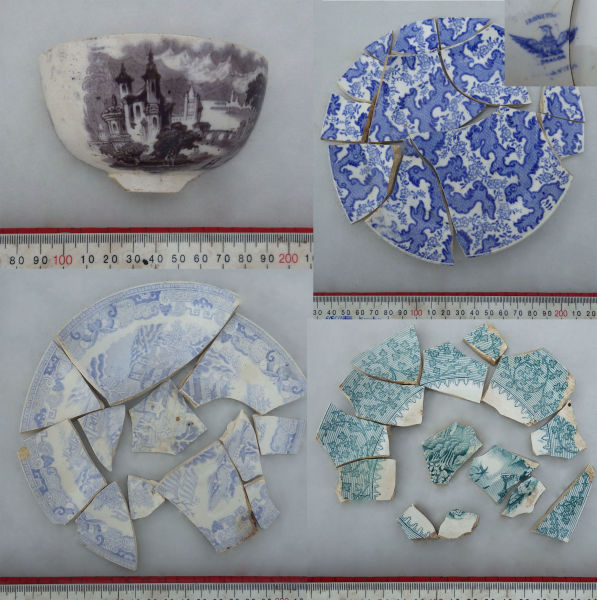
Ceramic artefacts from one of the rubbish pits on the section. Image: J. Garland.

Ceramic artefacts from one of the rubbish pits on the section. Image: J. Garland.

While it is difficult to associate the features found on the site with any one resident during the 19th century, it is almost certain that some of them were deposited by Hiorns and his family, including some of the 1037 artefacts found in the large depression to the rear of the building. That particular feature looks to have been used for the disposal of rubbish over an unknown period of time, based on the presence of small concentrations of objects within the feature as a whole, the size of the assemblage, and the wide range of manufacturing dates found among the artefacts. Many of the artefact dates, however, fit in well with the period in which Hiorns was resident on the section. On top of this, the assemblage contained a large number of alcohol bottles and several artefacts which are considered to be “higher status” items, or objects more often associated with people of reasonable wealth. It would make sense for the man who a) ran a hotel and wine bar and was in court more than once on alcohol related charges and b) later purchased the prestigious Linwood House, to have owned items like these.

Selected glass bottles from the site, including Rowland's Macassar Oil, a Piesse and Lubin perfume bottle and part of an infant feeding bottle. Image: J. Garland.

Selected glass bottles from the site, including Rowland’s Macassar Oil (mid-right), a Piesse and Lubin perfume bottle (top right) and part of an infant feeding bottle (top left). Image: J. Garland.

The assemblage also contained large quantities of ceramic tea and table wares, as well as household and hygienic items like chamber pots, wash basins and ointment pots, a quantity of shoes and fabric, food containers, pharmaceutical bottles and children’s artefacts. One of the most interesting finds, however, was a cluster of clay tobacco pipes that included pipes with political motifs as decoration. These pipes – bearing the name and bust of William Gladstone, liberal English politician, and the name of Garibaldi, famously nationalist and progressive Italian general – can easily be tied into Hiorns’ political engagement (which I sort of alluded to above, but haven’t had time to go into detail about) and the politically charged narrative of this entire Armagh Street site (which I definitely haven’t had time to go into). They’re an example of material culture that is actively entangled with the more intangible ideas and ideals of the people and society by which they are made and used (a topic for another day, I think).

Clay smoking pipes found in Feature 3 (the depression to the rear of the house). Image: J. Garland.

Clay smoking pipes found in Feature 3 (the depression to the rear of the house). The Gladstone pipe is the one in the top row, while the Garibaldi pipe is second from the right in the second row from the top. Image: J. Garland.

I may have started this post with a melodramatic paragraph that reads more as pulp fiction than historical narrative, but in truth, the story of Edward Hiorns (and all of the residents of this block of Armagh Street) is not all that sensational. What it is, however, is a tale we come across all the time in Christchurch. There are many interesting themes to be found in the archaeological and historical records of his life, but two of the most interesting from my perspective are the way he “improved” his situation in life, so to speak, and the way he involved himself so readily in the governance and development of the city in which he had settled. It’s a combination that we see again and again in the lives of Christchurch residents from the 19th century.

People talk a lot about the fluidity of class and social affluence in the 19th century, especially in colonial settlements like New Zealand, and the significance of the capitalist ‘entrepreneurial spirit’ in the prospering of Victorian society. These are both more than evident in the case of Mr Edward Hiorns (and Mr Jamieson, and Mr Ruddenklau and Reverend Fisher). What is just as evident, however, is the active engagement made by people like Hiorns with the present and future of the community in which they lived – be it at the local, national or global level. I could, with the aid of Mr Hiorns and others, very easily take you all down the rabbit hole with me here into the fascinating world of political and social change in 19th century Christchurch (the labour movement! radicalism! women’s suffrage!) and the lives of the people who fought to change the world around them, but that is too much for any one blog post, let alone this one. Nevertheless, it bears remembering that theirs were the hands that shaped a city and, though the city, helped to shape a nation.

Jessie Garland.

References

LINZ, c. 1850. Deeds Index – A – Christchurch town sections and town reserves. Archives New Zealand, Christchurch Office.

McAloon, J., 2000. The Christchurch elite. In Cookson, J. and Dunstall, G., eds). Southern Capital Christchurch: Towards a City Biography, 1850-2000., pp. 193-221. Canterbury University Press, Christchurch.

Wright, G. R. 1998. The Petty Bourgeoisie in Colonial Canterbury; A Study of the Canterbury Working Mans’ Political Protection and Mutual Improvement Association (1865-66) and the Canterbury Freehold Land Association. MA Thesis, University of Canterbury.

Papers Past. [online] Available at www.paperspast.natlib.govt.nz.

So, hair’s the thing…

As one 19th century advertisement begins, “in every civilised country throughout the world the human hair is always found to be a subject of peculiar attention.” For centuries, millenia even, we have tugged and twisted our hair into unnatural and often physically improbable shapes, sought luxury and lustre through the addition of all manner of substances and continually attempted to find a tried and true way of stopping the damn stuff from falling out.

The resulting works of art, be they hirsute, sleek or more reminiscent of a desert than a forest, have then been viewed through the discerning and often judgemental eyes of society. Your hair can mark your status, your wealth, your nationality, your personality traits, your identity, whether you want it to or not. It’s no wonder, really, that the care and maintenance of hair elicits such effort from us, is it?

With this in mind, the following images showcase some of the evidence we’ve found – archaeologically and historically – for hair care in the 19th century. Some of it is weird and wonderful, some of it was probably a bit uncomfortable, and some of it we still use today.

Just to set the scene. Note the flattering description of red-heads and the character assassination of brunettes. Image:

Just to set the scene. Note the flattering description of red-heads and the character assassination of brunettes. Image: Mataura Ensign 21/12/1899: 3.

Rowland's Macassar oil, culprit of oily hair and even oilier upholstery everywhere. Macassar oil was a hair restorative and beautifier, first introduced during the late 19th century by a barber named Alexander Rowland. It's the reason for the term 'antimacassar', which refers to the piece of fabric thrown over the top or back of arm chairs to deal with the oily residue hair-conscious people were leaving on furniture all over the place. The advertisement mentions scurf, which is another word for dandruff (I did not know this prior to this post), as well as the restoration of "whiskers, mustachios and eyebrows". How versatile! Image: J. Garland.

Rowland’s Macassar oil, perpetrator of oily hair and even oilier upholstery everywhere. Macassar oil was a hair restorative and beautifier, first introduced during the late 18th century by a barber named Alexander Rowland. It’s the reason for the term ‘antimacassar’, which refers to the piece of fabric thrown over the top or back of arm chairs to deal with the oily residue hair-conscious people were leaving on furniture all over the place. The advertisement mentions scurf, which is another word for dandruff (I did not know this prior to this post), as well as the restoration of “whiskers, mustachios and eyebrows”. How versatile! Image: New Zealand Gazette and Wellington Spectator 18/02/1843: 1, J. Garland.

May I direct your attention to the highlighted section, in which the application of electricity to the scalp is recommended as a cure for baldness.

May I direct your attention to the highlighted section, in which the application of electricity to the scalp is recommended as a cure for baldness. In all seriousness, though, some of these (maybe not the Venetian visor thing) are still used for the hair today, particularly the use of egg as a shampoo. Image: Tuapeka Times 6/04/1889: 2.

Bear's grease

Genuine Russian Bears Grease, made from (presumably) genuine Russian bears. Bears grease derived its popular reputation for hair care from the fact that since bears were hairy, rubbing their fat on your own head would also promote the growth of hair. Don’t be too quick to laugh, I’m sure similarly ridiculous misunderstandings of cause and effect are still around today. It was initially made from actual bears, although some later versions used anything from goose grease to lard as the base of the product. To promote the authenticity of their product, some hairdressers used to keep live bears, bear skins, or something that they could pass off as bear skins in the shop windows to convince customers that their bear’s grease was totally the genuine thing. Image: J. Garland.

The Toilet

Home remedies. While some of these might sound like risky combinations of chemicals (camphor!), many of them do actually have hair care properties. Sub-carbonate of potass is potassium carbonate, used to make soaps. Camphor, used to make mothballs and other pest deterrents, as well as embalming fluid, is also an active ingredient in anti-itch gels and various medicinal products applied externally. Still, maybe don’t try these at home. Image: Daily Southern Cross 5/12/1856: 3.

Dr Frampton's Pomatum, by Price & Co., Her Majesty's Perfumers. For those with unruly hair, unhealthy hair or hair that just won't stay on the head at all. Pomatum was a common hair product during the 19th century and well into the 20th century (also known as pomade). It was usually made of a scented grease or lard and used to smooth down the hair (or moustache, presumably). Articles towards the end of the century, when the use of pomatum had become slightly less widespread, speak disparagingly of resulting "locks saturated with strongly-scented grease" (Nelson Evening Mail 19/10/1882: 4). Image: J. Garland.

Dr Frampton’s Pomatum, by Price & Co., Her Majesty’s perfumers. For those with unruly hair, unhealthy hair or hair that just won’t stay on the head at all. Pomatum was a common hair product during the 19th century and well into the 20th century (also known as pomade). It was usually made of a scented grease or lard and used to smooth down the hair (or moustache, presumably). Articles towards the end of the century, when the use of pomatum had become slightly less widespread, speak disparagingly of resulting “locks saturated with strongly-scented grease” (Grey River Argus 31/10/1882: 4). Image: J. Garland.

Erm.

Erm. Maybe also don’t try this at home. Image: Southland Times 12/02/1885: 4.

Bay rum

A Bay Rum bottle, complete with label denoting it a “refreshing and invigorating tonic for the hair.” Bay Rum became increasingly popular towards the end of the 19th century, although it was in use from much earlier. Although primarily marketed as a hair product, it was also used for a variety of other personal grooming issues, from skin beautification to the relief of tired feet. Image: J. Garland.

potato dye

Some uses for claret and potatoes that you may not have heard of before…Image: Press 31/07/1896: 2.

DSC_0285ed1

A hair comb, made from vulcanite or vulcanised rubber. Regular brushing and combing of the hair was one of the most frequent recommendations in 19th century newspapers and magazines for the encouragement of healthy hair. Not so unusual to us, this one. Image: G. Jackson.

One thing that was notably different to general hair care now was the recommended frequency of washing.

One thing that was notably different to general hair care now was the recommended frequency of washing. Most articles suggested that it be washed, at the most, once a week and recommended intervals of several weeks to a month as optimal. Shampoo was also not as integral to hair washing as it is now, with a lot of articles recommending various oil and water concoctions or simply the use of warm water. The considerations given to the health concerns of wet hair also speak to the differences between our lives now and the lives – and environment – of those in the 19th century, who did not have the luxury of heat pumps and hair dryers. Image: Auckland Star 17/03/1899: 7.

Alexander Barry's Tricopherous is probably the most common hair related artefact that we find on 19th century archaeological sites. Composes largely of alcohol and oil, it promised all manner of miracles when it came to the beauty and restoration of the hair, including the cure of baldness. It was, however, also used in place of pomatum as a far less greasy tool with which to style the hair. Image: G. Jackson.

Alexander Barry’s Tricopherous is probably the most common hair related artefact that we find on 19th century archaeological sites. Composed largely of alcohol and oil, it promised all manner of miracles when it came to the beauty and restoration of the hair, including the cure of baldness. It was, however, also used in place of pomatum as a far less greasy tool with which to style the hair. Image: G. Jackson.

less coffee more hair

To finish off, while I’m sure that “obeying the laws of health” can’t help but aid the vitality of your hair, as someone with very long hair who consumes their fair share of wine, tea and coffee, I have to say that the second paragraph is very definitely not true. Image: Star 6/02/1897: 3.

Jessie Garland 

A local Lyttelton landmark lives on

This week on the blog, we look at what we found beneath a local landmark in the community of Lyttelton: the newly refurbished Albion Square.

Refurbished Albion Square, Lyttelton. Image: Christchurch City Council.

Refurbished Albion Square, Lyttelton. Image: Christchurch City Council.

The Albion Square, on the corner of London and Canterbury streets, is home of the Lyttelton War Memorial Cenotaph. It also acts as a community focal point, and is a testament to the recovery of the port town. However, the longer-standing residents of Lyttelton may recall that this was also once the site of the square’s namesake: the historic Albion Hotel.

We can trace the establishment of the first hotel at this site to 1858, when local merchant John Collier was granted a liquor licence, transforming his grocery store into the Albion Hotel. A year later he added a saddle horses for hire business to the rear of the hotel. An 1862 advertisement in the Lyttelton Times, for the lease of the hotel provides the first known description of Collier’s hotel:

The premises consist of a commodious bar, bar parlour, dining and sitting rooms, with 15 bedrooms, making up 24 beds; also skittle ground and outhouses. This establishment has for the last three years, been favoured with the support of the settlers of the Peninsula particularly.

Lyttelton Times 1/11/1862: 6.

A map of Lyttelton drawn in the 1860s shows the Albion Hotel fronting London Street. Two smaller buildings are shown to the rear of the hotel. These probably represent the outhouses and stables mentioned in newspaper sources (Lyttelton Times 8/1/1859: 5, 1/11/1862: 2).

Detail of an 1860s map of Lyttelton showing structures extant along London Street at the time. Albion  Hotel section outlined in red. Image: Rice 2004: 28.

Detail of an 1860s map of Lyttelton showing structures extant along London Street at the time. Albion Hotel section outlined in red. Image: Rice 2004: 28.

Collier was fortunate that his hotel survived the Lyttelton fire of 1870, which destroyed much of the Lyttelton central business district. In 1881, the original building was sold and removed from the site (Press 14/1/1881: 4). The sale advertisement described the old building as:

Covered with slates, and contains a large quantity of timber and bricks while the intended replacement was a stylish brick edifice to be substituted in its place, whenever the ancient hostelry is removed.

Press 21/1/1881: 2.

Later in 1881 the stables behind the hotel caught fire (Press 22/8/1881: 2). Little damage was done, but the resulting newspaper item indicates the stables were constructed from galvanised iron. The new Albion Hotel continued operating into the 20th century and can be seen in a photograph taken in 1911.  In 1943 a new façade was added to the building (Burgess 2009).

A 1911 photograph showing the Albion Hotel on the corner of London Street and Canterbury Street. Image: Burgess 2009.

A 1911 photograph showing the Albion Hotel on the corner of London Street and Canterbury Street. Image: Burgess 2009.

Over the course of the 19th century, the Albion Hotel and horse for hire business had at least 17 proprietors between them, and more still after the turn of the century. This high turnover complicated the task of attributing the artefacts recovered from the site to a specific individual. The dateable artefacts that were recovered from the site all post-date 1857, confirming that the assemblage was associated with the Albion Hotel. However, serval discreet archaeological features may have been deposited at different times.  The deposition dates of these features range from 1861 to the late 19th century. It is possible that the piece of salvaged roofing slate may have been part of the original Albion Hotel which was removed from the site in 1881 (Press 21/1/1881: 2).

An aerated water bottle manufactured by T. Raine between 1861 and 1871. Image: C. Dickson.

An aerated water bottle manufactured by T. Raine between 1861 and 1871. Image: C. Dickson.

The archaeological material that was recovered was found in a series of rubbish pits, located mainly toward the rear of the hotel site. From this evidence it is apparent that the back of the section was seen as a convenient location to dispose of the breakages and detritus associated with the day-to-day operation of the Albion Hotel. It is possible that the proprietors of the hotel may have deposited waste into these rubbish pits to avoid rubbish collection costs.

The rubbish pits contained combinations of artefacts that are signatures of 19th century hotel sites, such as alcohol bottles, matching serving ware sets and food remains. The alcohol bottles consisted mainly of black beers, though wine bottles, case gin bottles, spirit-shaped bottles and matching glass tumblers were also present. The contents of these bottles cannot be confirmed, as specific alcohol bottle shapes were commonly re-used for alternative purposes. However, it is probable that beer, wine, gin and other spirits were being served at the Albion Hotel. These vessels are also likely to only represent a fraction of the alcohol that was served. The presence of disposable clay pipes with use-wear indicates that the hotel patrons were also smoking at this site.

Rubbish pit feature consisting largely of broken 19th century alcohol bottles. Scale is in 200 mm increments. Image: M. Carter.

Rubbish pit feature consisting largely of broken 19th century alcohol bottles. Scale is in 200 mm increments. Image: M. Carter.

Stem of a clay smoking pipe manufactured by Charles Crop, London between 1856 to c.1891. Image: C. Dickson.

Stem of a clay smoking pipe manufactured by Charles Crop, London between 1856 to c.1891. Image: C. Dickson.

The matching decorative patterns that were found on ceramic tableware and servingware sets are representative of a standardised material culture, and this fashion can be associated with the Victorian idea of social respectability (Samford 1997). It is possible that this servingware is an indication that food was served at the hotel. However, there was a notable absence of condiment bottles from this site. This is unusual, as condiment bottles are typically abundant in 19th century hotel sites.

Fragments of platter and dinner plate set decorated with under-graze transfer print technique. Image C. Dickson.

Fragments of platter and dinner plate set decorated with under-graze transfer print technique. Image C. Dickson.

A number of animal bones with butchery marks were also recovered, the most common of which were cuts of lamb and mutton leg. It is probable that these cuts were being served to the patrons of the Albion Hotel. Shellfish, including oyster, rock oyster, cockle and cat’s eye were also recovered. These are all species that were locally available. There is a notable absence of fish and bird remains from the faunal assemblage. This is unusual, as 19th century hotels have been found to be more likely to serve fish and bird than private houses (Watson 2000).

A newspaper advertisement indicates that the Albion Hotel had rooms at the back that were for the owner’s family (Press 9/5/1882: 3). While both commercial and domestic items were recovered from this site, there appears to be a lack of domestic items that are typically associated with family homes. With the exception of chamber pots, this may be because hotel guests would bring these personal items with them during their visits, and would be unlikely to leave them at the hotel to be discarded.

The Albion Hotel artefact assemblage is comparable to other 19th hotel assemblages in Christchurch, such as the Oxford-on-Avon Hotel and the Zetland Arms/Parkers Hotel. All three sites yielded large quantities of alcohol bottles, with black beer bottles being the most prominent. Glass servingware and matching decorative ceramic servingware sets were also present at all sites: the Asiatic Pheasants pattern was dominant at the Oxford-on-Avon, and Willow pattern was well represented at the Zetland Arms/Parkers Hotel, while the Albion Hotel appears to have had sets of Willow and unidentified sponged and leaf tableware sets. Unlike Zetland Arms/Parkers Hotel, no evidence that could be associated with the neighbouring stables (such as horseshoes) was recovered from this site, despite the fact that the saddled horse for hire business appears to have been long-running at this address.

Matching sponged teacup and saucer set. Image: C. Dickson.

Matching sponged teacup and saucer set. Image: C. Dickson.

By combining the historical and archaeological information from the Albion Hotel site, the activities of those who lived there was revealed to show the use and modification of the section over time. This assemblage has shed light on the operation of a 19th century hotel in Lyttelton, and the provision of food and drink in this context. This site is also comparable to other 19th century hotels within Christchurch, and has the potential to add to our general understanding of similar establishments in the area. This analysis has salvaged a snapshot of one of Lyttelton’s historic watering holes, adding to the charisma of the vibrant entertainment hub of modern Lyttelton.

 Chelsea Dickson

References

Burgess, R., 2009. Registration Report for Historic a Area: Lyttelton Township Historic Area (Vol. 2). Unpublished report for New Zealand Historic Places trust Pouhere Toanga.

Lyttelton Times. [online] Available at: www.paperspast.natlib.govt.nz [Accessed July 2014].

Press. [online] Available at: www.paperspast.natlib.govt.nz [Accessed July 2014].

Rice, G., 2004. Lyttelton: Port and town. An illustrated history. Canterbury University Press, Christchurch.

Samford, Patricia M., 1997. Response to a market: Dating English underglaze transfer‐printed wares. Historical Archaeology 31 (2): 1‐30.

Watson, K., 2000. A land of plenty? Unpublished Masters thesis, Department of Anthropology, University of Otago.

From bottle to basement: uncovering a repository of information

Late in 2014 we were contacted by contractors working on a rebuild project in Christchurch’s city centre. It was reported that a number of bottles had been uncovered during routine earthworks and the area cordoned off until our arrival. The bottles themselves were in pristine condition but what was of particular interest was the area in which they were found. Behind us was a mound of dark dirt, strewn with displaced wooden planks and broken bottles. I’ll be the first to admit, it wasn’t one of the prettiest features I’ve ever seen and, oh yeah, it was 2 metres below the surface of the city. So, today I’m going to take you on a little ride, a pictorial one as such, down through that ugly mound of dirt, the archaeology involved and the story it told.

And so our tale begins…

It began with a phone call one Friday afternoon (when I was already thinking about a cold brew at the closest drinking hole), but it was answered and soon I was joined by fellow archaeologists, decked out in hi-vis vests and mud-caked boots, with WHS trowels in the back pocket ready to work.

PB110003

The feature on the arrival of the archaeologist. Image: K Bone.


Due to the unknown extent of the feature we established a simple quadrant system to allow us to record any material collected as we removed the debris from the area. This involved removing all the planks of wood that were no longer in situ, along with any large amounts of soil.

IMGP0450

Initial excavations following the removal of debris. Image: K Bone.


2014-11-21 Beam Placement & Cellar Dig 011

Excavation begins… Image: K Bone.

Once the area was cleared of all debris, we set out to define the full extent of the feature, which was beginning to look a lot like a floor. Three trenches were dug, along the western, southern and eastern sides of the feature (the northern side had already been dug out during the earthworks). Following the completion of these three trenches, we established a grid system for the collection of artefacts.

IMGP0493

The feature once fully exposed, and the three trenches excavated . Image: K Webb.

IMGP0522

Artefacts from below the floorboards, many complete bottles were recorded but were mostly damaged or broken. Image: K Webb.

Once the top layer of dirt and debris was removed and all structural wood was exposed the feature was mapped using a Trimble M3 total station.

SC161 Site plan 2

Site plan. Image: K. Webb.

At the same time, the stratigraphy of the northern baulk was drawn (this was the only stratigraphic profile that could be recorded, due to the sheet piling around the section).

This….IMGP0474

                       Was recorded as this…

161 strat (2)

                which became this….CS161 strat Kim amended

Then the wooden floorboards were removed and excavation of the subfloor space began, revealling a treasure trove of artefacts and structural information.

IMGP0454

The remains of some upright boards nailed to the bottom plate at the south end of the feature. Image: K. Webb.

IMGP0526

The stone piles supported the wooden floorboards. Three rows of piles were found, one down each of the east and west sides and one down the centre of the building. The piles were unevenly spaced. Image: K Bone.

IMGP0570

During the excavation samples of each of the different timber elements were taken so we could identify the species at a later date. Image: K. Webb.

Once the field work was completed preparation of the report began, with the historical research. Maps and newspapers revealed that this section of land was the site of Barnard’s repository and later Tattersall’s horse bazaar.

Next up: the artefact analysis, which was conducted by one of our in-house artefact specialists. The artefacts are analysed according to their material classes and recorded by a number of attributes, with research including place of manufacture, product type, company name and date of production. This research contributes to our final interpretation of the site.

Pipes 3

Clay smoking pipes were found below the floorboards: a John Reynolds pipe (top) and a J. M. Heywood pipe (see next week’s post for more on this interesting fellow from Lyttelton). Image: K. Bone.

PLYMOUTH

Plymouth gin tin capsule, still attached to the cork. Image: K. Bone.

capsules

Two bottle capsules still attached to the cork, and the bottle. This suggests that these bottles had not been opened at the time of their deposition. The manufacturer of the capsule at right was the Victoria Stores distributor; that at left could not be identified. Image: K. Bone.

COINS

One of two coins found on the site. This particular one has a profile of the young Queen Victoria, with the date 1853. The other coin was a George IV coin, with the date 1826. Image: K. Bone.

Following the artefact analysis a series of spatial distribution maps were produced to determine whether or not there were any patterns in the distribution of the artefacts.

20150521_114912 (1)

Example of one of the spatial distribution maps. This looked at the relationship between the different forms of glass recovered from the feature. Image: K. Bone.

So what does it all mean? The location of the floor 2 metres below the ground surface indicated that it was a cellar floor. The artefacts found indicated that the cellar was primarily used to store alcohol bottles and leather goods. Conveniently, the historical research indicated that there had been both a hotel and a saddlery on site.

IMGP0570

And that’s how the discovery of a few bottles led to us uncovering a unqiue piece of Christchurch’s history. From the field work to the research, the artefact analysis to the final write up, the process is important in allowing us to tell the story of Christchurch.

Kim Bone