In which goats frolic, pipes masquerade as baskets and camels do whatever it is that camels do.

Taking a break from our recent musings on society, smells and legacies, this week’s post features another selection of artefacts from the archives. All of these were found on the same site in Christchurch’s central business district over the last few weeks. Enjoy!

Glass lamp

How lovely is this? It’s the (nearly complete) base from a finger lamp. It would have originally had a glass chimney on the top, attached with a copper/brass fitting or burner, looking a bit like this. Image: J. Garland.

Plate with ... pattern

Saucer decorated with scenic pattern, Geneva, similar to the Lucerne patterned plate we featured a few weeks ago. Image: J. Garland.

Marble

A large glass marble, with swirl of coloured glass inside. Image: J. Garland.

DSC_4705ed1

The fragments of another children’s plate, similar to others that we’ve found. Image: J. Garland.

Goats!

Goats! Frolicking! This pattern is, aptly enough, titled “Goat” and seems to be associated with Scottish pottery manufacturer James Jamieson & Co and the Bo’ness (Barrowstouness) Pottery in the Central Lowlands (1829-1855). Image: J. Garland.

And camels!

And camels! Image: J. Garland.

Some patterned pipe bowls, including two with a 'basket weave' motif.

Some patterned pipe bowls, including two with a ‘basket weave’ motif. Image: J. Garland.

A ceramic egg. Eggs like this were used to encourage hens to lay in the nest, rather than elsewhere. Image: J. Garland.

A ceramic egg. Eggs like this were used to encourage hens to lay in the nest, rather than elsewhere. Image: J. Garland.

A small porcelain figurine, tragically missing it's head. Image: J. Garland.

A small porcelain figurine, tragically missing its head. Image: J. Garland.


Oh, the irony: a tale of unexpected survival (or how the little things can last the longest)

Over the last few weeks, as archaeologists do, I’ve found myself thinking about the physical legacies people leave behind them. In particular, I’ve been thinking about the contrast between the monumental (buildings, in this case) and the artefactual and how, oddly enough, it is not always the large or the supposedly permanent legacies that survive. We’ve come across this contrast before in Christchurch’s archaeology, in cases like that of J. G. Ruddenklau and the City Hotel or the china from Sydenham House, where the structural legacies are long gone, but the story – the memory – can still be found in the a single fragment or a single object. In small things forgotten, as the saying goes.

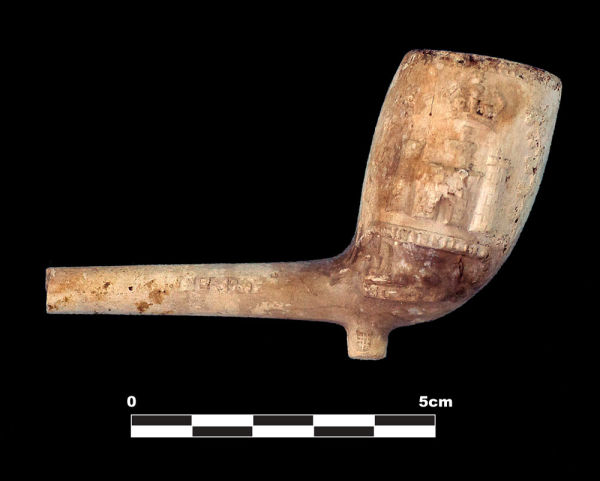
This came to mind again recently, thanks to a clay smoking pipe we found in the CBD, incised with the mark of Messrs Twentyman & Cousin, “whole sale and retail ironmongers”. It’s a simple cutty-shaped pipe, with a slightly angled bowl and no heel or spur evident at the base. Were it not for the circular stamp of “TWENTYMAN / COUSIN N.Z” at the back of the bowl, it would be unremarkable. The stamp renders it unusual, by virtue of the fact that it is rare to find clay pipes in New Zealand with the marks of local retailers or manufacturers.

We found another New Zealand branded pipe at this site, this time stamped with the mark of Twentyman & Cousin. Messrs Twentyman & Cousin (wonderful names!) were Christchurch retailers

The Twentyman & Cousin clay smoking pipe found in Christchurch. Interestestingly, the mark is only on one side of the bowl – the one facing the smoker. Image: J. Garland.

We don’t really know why the clay pipe bears the mark of Twentyman & Cousin. The only other examples of similarly branded pipes that I’ve come across were associated with tobacconists and hotels, both of which are more easily related to the practice of tobacco smoking than an ironmonger and agricultural merchant would have been. Was it advertising, perhaps? Maybe the business branched out into a few examples of personalised merchandise? Maybe it was commemorative in some way? Whatever their reason for marking the clay pipe, I suspect it had little to do with preserving a legacy. Yet, in a way, that is what it does now.

Twentyman & Cousin was first established in the late 1860s in Cathedral Square (Lyttelton Times 10/8/1867: 1), by John Holm/e Twentyman and his cousin, Alfred Charles Twentyman (hence the name). Although it is unclear when the latter arrived in the city, we know that Mr J. H. Twentyman arrived in Christchurch in late 1865, along with his family (Star 6/3/1900: 1). By all accounts he was a particularly well-read man (one advertisement details a lecture he gave to the Young Men’s Christian Association on Egypt in the ancient and modern eras) and heavily involved in Christchurch’s church community (Star 17/06/1879:3, 13/08/1879: 3, 16/04/1890:3). Less information is available about Alfred, unfortunately, although we do know that the partnership between the two men was dissolved in 1888 (Press 10/08/1888: 1).

Early advertisements for the business indicate that Twentyman & Cousin imported and sold a range of materials, from woolpacks  to corn sacks and sheep shears (Lyttelton Times 23/12/1868: 1, 10/8/1867:1). In later years, they were known for their ironmongery, particularly their selection of agricultural, pastoral and gardening tools and machinery. One advertisement from 1881 mentions products such as “garden syringes” and the “Ward & Paynes bow pattern solid crucible cast steel sheep shears”, a phrase that I challenge you all to try and say fast five times (Star 9/11/1881: 4). In that following year, numerous advertisements tell of their sale of reapers and binders and their participation in a “trial of reaping and binding” (which, to me, suggests some kind of demonic exorcism as much as it does agricultural work; Wanganui Herald 25/01/1882: 2 ). They didn’t limit themselves to agricultural and pastoral tools, though: other advertisements for the business promote the sale of “an assortment of guns, which for finish and cheapness surpass anything ever brought into the market” (Star 31/05/1883: 1).

An 1881 advertisement for Twentyman & Cousin. Image: Star 25/11/1881: 4

An 1881 advertisement for Twentyman & Cousin, listing all manner of machinery and tools (shovels, rakes and implements of destruction, even). Image: Star 25/11/1881: 4.

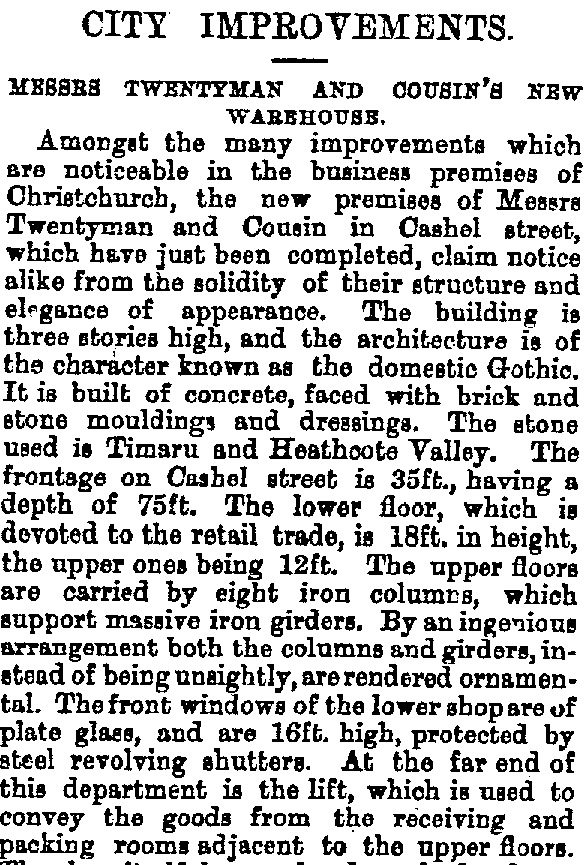
By 1880, the company had moved from Cathedral Square to a new building on Cashel Street west, one designed by renowned Gothic revival architect Benjamin Mountfort. Mountfort is most famous for his involvement in the design of the Canterbury Provincial buildings, which still stand today. The new Twentyman & Cousin building on Cashel street was constructed from concrete, brick and stone, and cost somewhere in the region of four thousand pounds to construct, a hefty sum in those days. Contemporary accounts described it as being in the domestic Gothic style, having “solidity of structure and elegance of appearance” and ornamented “sufficiently so as to relieve it from the sombre and barn like appearance of too many of our other buildings” (Press 10/4/1880: 1, Star 8/04/1880: 4). It was, it seems, the talk of the town.

Extract from an 1880 newspaper article on the new Twentyman & Cousin building in Cashel Street. You can see images of the building here. Image:

Extract from an 1880 newspaper article on the new Twentyman & Cousin building in Cashel Street. You can see images of the building here. Image: Press 10/4/1880: 1.

Although this building is of note for a number of reasons (the architectural design not least among them), I find it particularly interesting to think about it as an example of branding, of legacy, in comparison with the clay pipe. The building was elaborate (ostentatious, even), durable (remember that “solidity of structure”) and, presumably, deliberately built to carry the Twentyman & Cousin name into the future, be it 10 years or 100 years distant. There is an intention of permanence in its construction, in everything from the materials used to the style of the building. The clay pipe, on the other hand, emits no such sense of intentional durability. It’s a disposable item, meant to be used until it no longer works and can be discarded. Yet, it survives (albeit slightly the worse for wear), and the building does not.

The contrast (and irony) in this particular story is not just in the difference between the intended purpose of the pipe and the building, but in the manner of their survival. It’s fair to say, I think, that the clay pipe has survived where the building has not because it was discarded, kept safely in the ground over the decades. This often seems to be the way in archaeology, especially in circumstances like those found in Christchurch: the big things are lost and it is the small, disposable, things – the forgotten things – that slip through and keep the past alive. A legacy is a legacy, after all, even if it is not quite as originally intended.

Jessie Garland

References

Lyttelton Times. [online] Available at www.paperspast.natlib.govt.nz

Press. [online] Available at www.paperspast.natlib.govt.nz

Star. [online] Available at www.paperspast.natlib.govt.nz

Wanganui Herald. [online] Available at www.paperspast.natlib.govt.nz

A few of our favourite things…

Over the last few weeks, we’ve been excavating a site in the CBD that’s yielded some of the most interesting artefacts we’ve see for a while. So, today on the blog, we’ve selected a few of these fascinating things for your viewing pleasure. Clay pipes, candlesticks, pepper shakers and bowler hats: scroll down for a veritable feast of pictorial splendour! Or something along those lines.

A bowler hat! This hat is made of felt and may have been worn by either a man or a woman (women used to wear hats like these with riding outfits in the lat 19th century). If you look very closely at the rim of the hat, you can see the remnants of the ribbon trim that once decorated it. Image: J. Garland.

First up, a bowler hat! This hat is made of felt and may have been worn by either a man or a woman (women used to wear hats like these with riding outfits in the late 19th century). If you look very closely at the rim of the hat, you can see the remnants of the ribbon trim that once decorated it. Image: J. Garland.

A lovely brass candlestick (used by Colonel mustard in the library, perhaps...). We think that the pieces of fabric stuck to the metal are just the remnants of the wrapping it was thrown out in, rather than a functional or decorative part of the candlestick itself. There's even a candle stub still visible inside the holder, near the base. Image: J. Garland

A lovely brass candlestick (used by Colonel Mustard in the library, perhaps…).The pieces of fabric stuck to the metal are  probably just the remnants of the wrapping it was thrown out in, rather than a functional or decorative part of the candlestick itself. There’s even a candle stub still visible inside the holder, near the base. Image: J. Garland

This lovely little saucer is decorated with a Chinese motif, known as 'Chang'. It appears to show one man cooking, while another stands around smoking a pipe. Not such an unfamiliar scene, is it? Image: J. Garland.

This lovely little saucer is decorated with a Chinese motif, known as ‘Chang’. It appears to show one man cooking, while another stands around smoking a pipe. Not such an unfamiliar scene, is it? Image: J. Garland.

This is really, really cool. This clay tobacco pipe appears to have been made locally, here in Christchurch, by or for the Trent Brothers. The Trent brothers were coffee, flax and chicory merchants based in Christchurch in the second half of the 19th century. The lovely people over at the Lost Christchurch blog have an excellent series of posts on the brothers and their business.  As far as we're aware, no other pipes like this one have been found before in New Zealand.  Image: J. Garland.

This is really, really cool. This clay tobacco pipe has a local connection, being made by or for the Trent Brothers, Christchurch. The Trent brothers (Frederick and James) were coffee, flax and chicory merchants based in Christchurch in the second half of the 19th century. The lovely people over at the Lost Christchurch blog have an excellent series of posts on the brothers and their business. As far as we’re aware, no other pipes like this one have been found before in New Zealand. Image: J. Garland.

We found another New Zealand branded pipe at this site, this time stamped with the mark of Twentyman & Cousins. Messrs Twentyman & Cousins (wonderful names!) were Christchurch retailers

Surprisngly, we found another New Zealand branded pipe at this site, this time stamped with the mark of Twentyman & Cousin. Messrs Twentyman & Cousin (wonderful names!) were Christchurch retailers originally based in Cathedral Square. In the 1880s they moved to new premises at what is now 93 Cashel Street, into a building designed by renowned architect B. W. Mountfort (Press 17/06/1882:1). Image: J. Garland.

This Willow patterned salt/pepper shaker is a surprisingly unusual find: they're not often found in Christchurch's archaeological sites. It's one of my personal favourites from this assemblage. Image: J. Garland

This transfer printed salt/pepper shaker is a surprisingly unusual find: they’re not often found in Christchurch’s archaeological sites. It’s one of my personal favourites from this assemblage. Image: J. Garland

A pig snout gin bottle with a prunt or blob seal on the shoulder.

A pig snout gin bottle with an anchor decorated prunt or blob seal on the shoulder. Seals like these were most common in the first half of the 1800s, although they were still being added to bottles at the end of the century (usually to gin bottles like this one). This particular prunt is embossed with ‘Van Dulken Weiland & Co/ Rotterdam’, well-known 19th century Dutch gin manufacturers. Image: J. Garland.

A child's plate! We've featured plates like this before on the blog, although none quite like this one. It reads "...in passing along they beheld on the ground/ ... man stretch'd along in a sleep most profound". Image:  J. Garland

A child’s plate! We’ve featured plates like this before on the blog, although none quite like this one. It reads “…in passing along they beheld on the ground / … man stretch’d along in a sleep most profound”. Image: J. Garland

And to finish….

These gorgeous shoes are in excellent condition. The adult size one (top)

Shoes! We’ve found a surprisingly large number of shoes (adult and child size) and fabric artefacts from this site, all in fairly good condition. Both the child sized shoe (bottom) and adult lace up shoe shown here (top) are among the only examples we’ve found with the complete upper portion of the shoe intact. Usually, we’re only recovering heels and soles. Aren’t they gorgeous!  Images: J. Garland.

Jessie Garland

A small thing forgotten: tall tales from tiny things

In the 1970s, an American archaeologist by the name of James Deetz coined the phrase ‘in small things forgotten’ when he wrote a book that discussed how the smallest or most ordinary of objects could illustrate the histories of people and places in ways we might not expect. To this day, as discussed in our opening post a couple of weeks ago, this idea remains an important part of what we, as archaeologists, do when we record and investigate the small details of the site as well as the big ones.

Here in Christchurch, the artefacts we recover from archaeological sites often have connections to the international world as well as to local people and events. The tiniest object can be part of a much bigger story, which can take us out of our own city, across the world and into the lives of people with diverse backgrounds and places in history.

No doubt this will be a theme evident in many of the entries found on this blog, but this week it is especially obvious in the story of a clay tobacco pipe that we found during earthworks on the site of a former theatre in Christchurch. The pipe, although broken, is decorated on the bowl with the insignia of the Royal Iniskilling Fusiliers, an Irish infantry regiment with a history going back over 300 years.

Inniskilling-pipe

The clay smoking pipe found on a site in Christchurch. Although broken at the stem, the pipe is complete enough to see the raised relief of a castle and crown above the image of a sphinx on both sides of the bowl. The name of the regiment is stamped across this design, while ‘EGYPT’ is stamped below the sphinx and ‘DERRY’ is stamped into the stem of the pipe.

Known colloquially as ‘Tiffins’ after an early colonel, Zachariah Tiffins, the Royal Inniskilling Fusiliers formed in 1689 to stand against James II following the ‘Glorious Revolution’ in England the previous year. During the following centuries they were stationed all over the world, from the West Indies to Spain, and fought in numerous battles, including the Siege of Namur (1695), the Battle of Culloden (1745) and the Battle of Falkirk (1746), the Seven Years War (1756-1763), the Battle of Alexandria (1801) and the Battle of Waterloo (1815).

By all accounts, they had a fierce reputation and were awarded numerous battle honours during their long history of service – the sphinx image and reference to Egypt impressed on the bowl of our tobacco pipe represent honours awarded to the regiment for the battle against the French at Alexandria in 1801.

10th Royal Inniskilling Fusiliers on the march to Londonderry, May 1915

10th Royal Inniskilling Fusiliers on the march to Londonderry, May 1915. Photo: Gardiner S. Mitchell. 

The regiment went on to fight in both world wars, with their participation in WWI leading to the creation of nine ‘New Army’ battalions (in addition to the two existing battalions) recruited between 1914 and 1918 and later disbanded. Our pipe is associated with the 10th Battalion, who were formed from the Derry Volunteers in Omagh in September 1914  and consequently became known as ‘The Derrys’. They fought in the Middle East and the Battle of the Somme and were part of the Battle of Gallipoli in 1915, before being eventually disbanded on 21 January 1918, in France.

complete pipe

A complete example of a smoking pipe decorated with the symbols of the Royal Inniskilling Fusiliers 10th Battalion. The design would have been carved or raised on the inside of the mould used to make the pipe – this kind of moulded decoration was common on clay pipes from the late 16th century onwards and often had designs relating to organisations, places or prominent people as well as to their original manufacturers.
Photo: Gardiner S. Mitchell.

We know, then, that our pipe must have been made after 1914 and buried before 1929, when the building under which it was found was built. This gives us a clear date for its origins and arrival in Christchurch, but still doesn’t explain how or why it ended up in Christchurch. The Royal Inniskilling Fusiliers were never stationed in New Zealand and we found no trace of a connection between them and our site.

Still, there are many possible explanations for its presence. Perhaps a veteran soldier from the regiment moved to New Zealand in the early 20th century and brought it with him; maybe the child or family of a soldier did the same; a New Zealand solider serving in WWI may have met someone from the 10th Battalion during their time overseas (at Gallipoli perhaps) and exchanged or been given the pipe; it could have changed hands multiple times throughout the world, until, eventually, it was dropped or lost or thrown out here in Christchurch. However it came to be here, the pipe reminds us that Christchurch was just as connected to the wider world in the past as it is today.

Jessie Garland

Bibliography

For more information on the Royal Inniskilling Fusiliers, see:

–  The Irish Brigade: the story of the 38th (Irish) Brigade in the 2nd World War

The Long Long Trail: The British Army in the Great War of 1914-1918

The Inniskillings Museum

Three Cheers for the Derrys!, a book by Gardiner S. Mitchell on the history of the 10th Battalion can be found here. Our thanks go to Gardiner for his assistance with research on the history of the pipe and the Battalion.