There’s Gold in Them There Hills!

Today on the blog the lure of gold is taking us over the Southern Alps to the wild West Coast. Anyone who is a fan of The Luminaires is aware of the thrill, drama, and hardship that was a day in the life of the West Coast gold fields. The boom in industry saw hundreds of prospectors try their luck at making their fortunes, and populous settlements soon followed with thousands of people flooding into the region during the 1860s. But it wasn’t long before the rush began to decline, claims went dry, and the booms went bust.

What is now left behind is an archaeological landscape of industry. Ghost towns, sluice faces, water races, along with hut sites, shafts, tailings, and more that mark the once bustling countryside. Many of these features have been left for the native bush to slowly reclaim, but we know it’s all there – just ask a local. But despite this loud and rusty landscape being an archaeologist’s paradise (or at least mine) much of the remnants of the West Coast gold fields have not been archaeologically investigated.

A recent survey near Nelson Creek for a new gold claim in an area previously mined (around 150 years ago) found several archaeological gold mining features. These humble and hidden remains provide a glimpse into the lives of those hardy gold miners and highlight the types of mining features hidden deep within the West Coast bush.

The West Coast Gold Rushes

Firstly, a bit of background. By 1860 the West Coast was still very much considered an inhospitable wasteland, known for its dangerous beaches, swollen rivers, impenetrable forests, miserable weather, and sandflies the size of small dogs. Even early explorer Thomas Brunner (the discoverer of West Coast coal) once described the place as a dismal wilderness. Nonetheless the discovery of gold in Otago (Gabriels Gully – 1861) and the following gold rushes caused mounting pressure for the Canterbury province to find its own goldfield. The pressure was so great that from 1861 a reward from the Provincial Government was offered to any man who discovered gold within Canterbury (Figure 1). This included the West Coast, which was part of the Canterbury Province until 1868.

Figure 1. Advertisement for the Discovery of Gold (Lyttelton Times, 4 September 1861: 7)

Prospecting attempts quickly began on the eastern side of the divide, but soon proved futile and instead some prospectors dared to venture to the West Coast. Gold was quick to show in the pan and several discoveries were made over the following three years. In mid-1864 gold was discovered at Greenstone Creek, a tributary of the Taramakau River, by local Māori Ihaia Tainui and Haimona Taukau. The gold of Greenstone Creek proved to be of commercial quantity and with that the West Coast gold rush kicked off!

After the discovery of gold at Greenstone Creek the frenzied rushes of 1864-1867 ensued. The initial rush centred on the mining of the easily collected alluvial gold that lay in the riverbeds and on the black sand beaches. Settlements and claims soon sprung up along the many West Coast Rivers and alluvial gold towns appeared everywhere from as far north as Charleston, to the remote south at Bruce Bay. During this period the population of the West Coast exploded from less than 500 people to over 30,000 in the space of only a few years. Very quickly the quiet bush was cleared and replaced with extensive water races, fluming, sluicing, and tent towns that soon became the new scenery of the riverine valleys (Figure 2). Gold workings were left, right and centre, and during the initial gold rush period, a whopping 1.3 million ounces of gold was recovered (Smith 2001: 81). That’s over 2.3 billion dollars worth of gold based on today’s gold prices – getting gold fever yet?

Figure 2. Example of fluming at Dillmanstown (West Coast Recollect).

By 1866-1867 things were starting to slow down with much of the easy gold having been fast collected. Many of the settlements that rapidly emerged from within the bush quickly disappeared again once the gold began to run out. Despite the end of the rushes and all that initial excitement, alluvial gold mining continued (and still does – looking at you, Ross). Additionally, attention was turned to hard rock mining as the discovery of gold bearing quartz in 1870 in Reefton (aka Quartzopolis) sparked a new round of gold fever. However, this industrial landscape was far different from its alluvial counterpart as hard rock gold was more difficult to procure. That’s not to say it was not worthwhile though as Reefton, was so profitable and successful that in 1888 it became the first place in New Zealand AND the southern hemisphere to have a public supply of electricity – with miners being among the first to use it! (Just a humble brag there).

Gold mining continued through well into the mid-20th century, with large settlements like Waiuta powering through until the 1950s. Even today goldminers still operate around the traps and certainly to great success. But the extensive, intrusive, and loud industry that once occupied so much of the coast is now silent, moss covered, and waiting to be found.

Nelson Creek

Nelson Creek is located roughly 30km north of Greymouth, up the Grey Valley. Locally the settlement is well known for its famous swimming hole, campground, and friendly wee pub. While you’ll miss it if you blink, Nelson Creek was once a bustling mining township, originally known as Hatters Terrace (Figure 3). It, along with everywhere west of the Southern Alps and south of the Grey/Māwheranui River, was officially declared as a goldfield in 1865, and by 1866 the Nelson Creek rush was in full swing. Kilometres of claims were made along the creek and its tributaries, and at its height over 1000 men lived and worked in the area – hard to imagine now though!

Figure 3. Nelson Creek ca. 1880 (West Coast Recollect).

Like most places initial workings were shallow and saw gold recovered by pan, cradle, or sluice box. But workings soon intensified and the need for water became paramount. This led to the Government funded Nelson Creek Water Race – a first for the region. Advertisements for 200 “Good Pick and Shovel Men” for the construction of the race went out in 1874 and work soon commenced (West Coast Times, 1 October 1874: Page 3; Figure 4). By January 1878 the race was open. Stretching from Lake Hochstetter to Dry Gully the race spanned “18 miles in length, comprising nine miles and a half of open cutting, seven miles of tunneling, and one and a half miles of bridging” (West Coast Times, 26 January 1878: 2; Figure 5).

Figure 4: Advertisement for workers for the Nelson Creek Water Race, 1874 (West Coast Times, 1 October 1874: Page 3).

Figure 5. Map of the Nelson Creek Gold fields, showing the water race in blue and survey area in red (Sketch Plan of the Grey District and Surrounding Country., n.d.).

The completion of the water race was somewhat of an engineering marvel, especially when considering the terrain. Some of the bridge arches spanned 150 feet, with one in particular rising 180 feet in height (Figure 6). The race, and the various offshoots, serviced many claims within the valley and supported mining activity through most of the late nineteenth century. By the turn of the 20th century works were winding down, but the move to dredging saw a brief revival to mining in the area. Gold mining continued sporadically through the 20th century and continues today.

Figure 6. Photograph, circa 1880, showing part of the Nelson Creek Water Race (Perkins, n.d.).

The Survey

Earlier this month I ventured to Nelson Creek with bug spray in my pocket, swanndri on my back, and my faithful ranging pole – that also functions as a great walking stick. I was met by a professional gold miner (10/10 guy – even brought me a packed lunch) and we made our way through the regenerative forest, mostly uphill, in search of mining features (Figure 7). The dense bush, leaf litter, and fern cover made it a little difficult to navigate and fully inspect the area, but it wasn’t long before we found a hut site.

Figure 7. Typical scenery in the West Coast bush. Image: A. Kelly.

The first hut site we found was easily spotted as the base of the fireplace was still in pretty good condition (Figure 8). The square edges of the hearth were well defined, and I imagine many good meals were made on that fire. The second hut site was not in as good condition, with the hearth reduced to a pile of stones overtaken with intrusive ferns (Figure 9). It did however have several ring seal bottles that had been moved to on top of the hearth. So at least the fellows who lived here had access to a tipple or two at the end of a hard day’s work. The last hut site we encountered had been clearly cut into the natural hillslope (Figure 10). It also had a small stone oven constructed in the back wall, pretty state of the art if you ask me!

Figure 8. Hut site with fire place. Image: A. Kelly.

Figure 9. Hut site with a few ring seal bottles. Image: A. Kelly.

A hut site with a small oven feature. Image: A. Kelly.

Historic photographs from the time show us what these sites would have originally looked like (Figure 11). As the huts were made of canvas and wood it is often only the hearths that survive, along with some scattered artefacts.

Figure 11. Some good-looking miners hanging out at their huts, Nelson Creek, ca. 1870 (West Coast Recollect).

In addition to hut sites, we encountered adits – horizontal drive tunnels used to find paydirt (Figure 12). While it is tempting, you can’t always guarantee they are safe to enter, so we typically view them from the portal only. But with the handy help of a torch, we could see that some were deep, and others were only a few metres in length. The short ones suggest that the person prospecting was not hitting any good pay dirt so quickly moved on (Figure 13).

Figure 12. A mining adit. Image: A. Kelly.

Figure 13. Short prospecting adit. Image: A. Kelly.

Finally, we also encountered the remains of Cole’s Water Race, one of the many other water races built in the area. I am not sure who Cole was, but his water race is still looking pretty sharp today. Along the length of the race were small stone stacked sections indicating former side channels (Figure 15). These offshoots would have serviced the downhill claims and they provide one small example of the interconnected and widescale schemes that facilitated mining in the area.

Figure 14. Cole’s Water Race. Image: A. Kelly.

Figure 15. Blocked side channel in Cole’s Race. Image: A. Kelly.

Keen on Adventure?

For those keen on adventure there are plenty of walking tracks and mining relics publicly accessible at Nelson Creek. Nelson Creek also has areas for recreational gold fossicking, or you could head south to Goldsborough and try your hand at gold panning there too.

If you fancy visiting a Ghost town, check out Waiuta, home to New Zealand’s third largest gold mine, or maybe stop in at Ross. DOC also have a range of walking tracks throughout the region, like Woods Creek Track, where there are mining tunnels are safe to enter.

So don’t be afraid to explore, just make sure you stick to the tracks!

Figure 16. An archaeologist in their natural habitat. Disclaimer: this was on a public track. DO NOT enter any unmarked tunnels!

Check out the links below:

https://www.doc.govt.nz/parks-and-recreation/places-to-go/west-coast/places/greymouth-area/things-to-do/tracks/nelson-creek-walks/

https://tohuwhenua.nz/te-tai-poutini-west-coast/waiuta

https://www.doc.govt.nz/parks-and-recreation/places-to-go/west-coast/places/goldsborough-waimea-kumara-area/?tab-id=50578

https://www.doc.govt.nz/parks-and-recreation/places-to-go/west-coast/places/greymouth-area/things-to-do/tracks/woods-creek-track/

Alana Kelly


References

Lyttelton Times. 1851-1920. [online]. Available at: https://paperspast.natlib.govt.nz/newspapers/all

Perkins, W. H. (n.d.). Nelson Creek water race, Westland [photograph]. Alexander Turnball Library. https://natlib.govt.nz/records/23039624.

Sketch Plan of the Grey District and Surrounding Country. (n.d.). Archives New Zealand. https://ndhadeliver.natlib.govt.nz/delivery/DeliveryManagerServlet?dps_pid=IE33027512

Smith, N. 2001. Heritage of Industry: Discovering New Zealand’s Industrial History. New Zealand: Reed.

West Coast Recollect. [online]. Available at: https://westcoast.recollect.co.nz/

West Coast Times. 1865-1916 [online]. Available at: https://paperspast.natlib.govt.nz/newspapers/all

Steam laundries and why they got a bad press

Today on the blog we are going to be looking into steam laundries, both their use in the 19th century as well as how they relate to us today. Now, I know what you’re thinking, what is a steam laundry and why should I care? Well, in answer to that I would pitch that looking into the steam laundry industry from the late 1800s can allow us to draw some parallels on issues relevant to us in 2021.

The invention of the steam engine catapulted a lot of technologies into existence during the industrial revolution – including steam trains, various locomotives and the commercial steam laundry. Generally, the steam engine replaced other forms of energy, to become the primary source of power throughout the 19th century and into the early 20th century. A communal approach to washing clothes was not a new concept to the 1800s. In fact, this was common practice throughout history. Washhouses were scattered across Europe, harnessing water from natural rivers and springs to feed into the gazebo-like buildings – which only had a roof and no walls.

An Italian washhouse during the turn of the 20th century. – “Sanremo – Women of the populace at the wash house”. Image: Wikimedia Commons.  

Those privileged enough to afford maids would hand their dirty laundry off to them. According to “Mrs Beeton’s Guide to Household Management” of 1861, private laundry practice consisted of a wide variety of processes. In some cases, whole washhouses were attached to the kitchen for easy access. The women would use two basins of water – one cold to wring out initial stains and one hot to scald the clothing before it went through the laborious process of being dried and ironed. In other cases, whole rooms were dedicated to ironing, drying, and mangling. Mrs. Beeton stressed that more delicate fabrics were washed and treated at home regardless of access to a communal laundromat. Clearly, this was a tedious process in comparison to the modern method of chucking laundry into the washing machine and pressing a few buttons

However, the development of the steam engine in the 1800s revolutionized laundry permanently, as it proved far more time efficient and cost effective. Steam engines were used to drive washing machines, while boilers were used to heat water as well as run large steam presses. Each task was divided and divvied up so that each employee would have an individual task. This ensured that a larger volume of washing was completed each day than one could do in a personal washhouse. Specialized machines were developed to aid the specific processes of washing, drying, bleaching and mangling – among others – making the laundromats even more time and cost efficient. This was due to the high levels of pollution in cities during the industrial revolution – leaving one’s clothes and sheets often smelling of smoke. It was for efficiency, ease and accessibility that steam laundries rose in popularity.

19th Century steam laundry. 1883 engraving of a steam laundry in Berlin, Germany. Image: Sciencephotolibrary.

Interestingly, steam laundries became central to women’s rights issues within certain contexts. This was due to the high number of female employees within these laundromats, which were very commonly owned by men who were unsympathetic to the needs of female workers. As washhouses began to generate a bit of money, male owners of these establishments began to make themselves known as ‘laundrymen’. This was a gendered term to differentiate themselves from the female workers, as well as add a bit of prestige to their occupation. They generally made the argument that laundry was not an exclusively female concern, as this new machinery introduced into the washhouses needed a “male brain” to keep it organised and running. Of course, the women who had been burdened with the task of laundry for generations upon generations accused these laundrymen of not knowing nearly as much as the women employees, yet were reaping more benefits (Wang 2002). Furthermore, a wide variety of important questions surrounding gender issues were raised as a result of these commercial laundries, some resounding even as far as present day.

Today, doing the washing is largely a task which is expected of women as opposed to men. When watching a commercial about anything to do with laundry – whether it’s detergent, stain remover, or washing machines – the people represented are almost always women. It is still a societal expectation that women, especially mothers, have to take up the maternal role of caring for the household fabrics.

Similar to modern advertisements, laundry powder manufacturers in the 19th century also targeted their advertisements towards women. Image, top: Nelson Examiner and New Zealand Chronicle, 28.05.1862: 1; bottom: Lyttelton Times 02.02.1865: 2.

The steam powered laundromat continued to rise in popularity until the invention of electric washing machines proved more accessible and efficient as they could be installed in private homes. Ironically, these machines that undermined the steam laundry industry were modeled off the very machines promoted by laundrymen. The drive belts were replaced by more efficient electric motors mounted directly onto the machines, small enough to fit in a private dwelling.

What now seems like outdated technology was once cutting edge! Image: Otago Daily Times 20.05.1949: 2. 

The earliest steam laundry that we have been able to find reference to in New Zealand, was the ‘Otago Steam Laundry’, which opened around 1876 in the North-East Valley, sporting nine rooms and washing machines all the way from San Francisco. Interestingly, a breach of women’s rights was evident in New Zealand’s steams laundries as it was in Europe. A newspaper clipping reads that ‘George Millar, of the Otago Steam Laundry, was proceeded against this morning for a breach of the Employment of Female Act, by causing his woman to work in his laundry on Saturday afternoons.


May 1881 saw the opening of a steam laundry in Lyttelton by Mr. W. Holmes. The laundry sported a steam drying room, folding room, as well as an engine, boilers, tubes and mangles (a device used to remove excess water/ironing fabrics).

An 1885 survey plan of Lyttelton. The property of Holmes is highlighted in red. Image: LINZ, 1885.

This is a survey plan of Holmes’ land from 20th of July 1901, 18 years after the image prior. Evidently some buildings have been added to the land since 1885. The little black squares off to the side most likely represent the small cottages on the plot, while the longer square probably represents the steam laundry. Image: LINZ, 1901.

Mr Holmes owned the laundry. His wife, Mrs Homes, and two girls were employed to work within the Steam Laundry. Here we see evidence of a continuation of issues seen earlier in Europe and North America between male owners and female employees. The services of the laundry included  ‘starching, ironing and mangling’. Starching clothing was used to add crispness and structure to linen, as well as a higher resistance to creasing or stains. Mrs. Holmes expresses her enthusiasm for Bergers Starch in particular, as she states in a newspaper clipping that it has a ‘better finish and gloss than any starch I have ever used.

This advertisement from The Lyttleton Times shows a job advertisement for three women to work in the Lyttleton Steam Laundry. Image: Lyttelton Times 07/01/1890: 1. 

Advertisement for Bergers Starch. Image: Press 17/01/1890: 8. 

Unfortunately, Mr. Homes passed a short time after the opening of his laundromat – in 1897. The business was left to his wife, Catherine Holmes, who seemed keen to sell the land as soon as she could. However, it seemed like a struggle to sell the business along with the land accompanying it, as we see various advertisements for the selling of the business beginning early 1898. In 1906, part of the property was sold to a Lyttelton railway signalman, Charles Philip Ore Kempthorne. It is not clear if the steam laundry continued to operate after Mr. Homes’ death, although there are no advertisements for its services in newspapers of the time.

Mrs. Holmes numerous attempts to sell the property!. From top to bottom: Lyttelton Times 18/04/1898: 8; 14/01/1899: 1; 17/01/1900: 1; 19/04/1901: 8; 19/03/1904: 11. 

As you might expect, we became interested in Holmes’ Steam Laundry because we did some work at the site. Most of the material that we found was not directly linked to the steam laundry business but just general domestic objects. This material was probably deposited by Holmes and his family, or by any tenants of the other cottages located on the site, and was very typical of the types of objects that every household in 19th century Christchurch and Lyttelton would have owned (with one exception- eagle eyed readers of this blog may recognise a familiar artefact that inspired its own blog post in the image below)

A selection of artefacts found at the site. These were probably used by the Holmes’ and provide an insight into their lives. Image: C. Watson.

However, one object stuck out as an obvious find from the long-gone laundromat. This was the remains of a boiler, probably a vertical boiler. A vertical boiler is used to produce a low, steady stream of steam, as water is boiled inside its large vertical cylindrical shell.

The boiler! Though I am not an expert on the workings of a vertical boiler, after comparing with a diagram these holes seem to either be a fire hole, man hole or hand hole. Image: M. Hickey.

For those of you who, like me, weren’t exactly familiar with Vertical Boilers, here’s a diagram. Simple Vertical Boiler, Construction, Working And List of Parts. Image:  MechanicalJungle. 

Unfortunately the quality of this photography isn’t the greatest, but a similar boiler can be seen in the background of the photogram. Image: New Zealand Herald 26/02/1931: 5.

The boiler as it was uncovered in our trench! Image: M. Hickey.

The vertical boiler sitting in the ground before it was dug up. Image: M. Hickey.

It is fascinating how looking into the Holmes’ Steam Laundry can allow us to reflect on the parallels between the 19th century and today. Though many may think that a Lyttleton laundromat which shut down business in 1897 is a topic that is irrelevant to society today, when looking deeper I believe that it can tell us a lot about the foundations in which New Zealand was built. Feminist issues migrated to New Zealand with the British, often coming to a head with a laundromat as a backdrop. Looking into the steam laundry also reminds us that people in the early stages of New Zealand’s development were not so different from us today often facing similar issues.

Rosie Smith

References

LINZ., 1885. DP 3829, Canterbury. Landonline.

LINZ., 1901. DP 1677, Canterbury. Landonline.

Wang, Joan. “Gender, Race and Civilization: The Competition between American Power Laundries and Chinese Steam Laundries, 1870s – 1920s.” American Studies International 40, no. 1 (2002): 52-73. Accessed September 4, 2021. http://www.jstor.org/stable/41280954.

Beauty and the Beast Characters as Nineteenth Century Artefacts

As a bit of preface for this blog, for anyone not reading it on or around the 20th of August, 2021, New Zealand is back into a full lockdown and the whole country has gone a bit silly. So, in keeping with that spirit, today on the blog we are doing a Buzzfeed style article on Beauty and the Beast characters as 19th century artefacts found in Christchurch. This blog was inspired by our first artefact (and most definitely was not thought up as an excuse to justify a Disney+ subscription for “research purposes”). Enjoy!

Cogsworth

The artefact that inspired this post. Does the expression on the clock’s face just not remind you so much of Cogsworth?! On the left is the fragment that we found in one of our Lyttelton sites. If you thought that was amazing, the central image is the complete vase, which is even more amazing. I feel like the concerned expression on the face really captures Cogsworth’s worried personality.

Refined red earthenware vase with clock transfer print, N. Cross. The complete vase, Transferware Collectors Club.  Cogsworth, Disney Fandom.

Lumiere

Cogsworth’s best pal, the suave Lumiere would have to be this Miller lamp. While this is an oil lamp, and Lumiere is a candlestick, I feel that the silver plating and the decoration really demonstrate Lumiere’s sophistication in a way that some of the other candlesticks we’ve found before can’t.

Miller 1892 patent lamp, C. Watson. Lumiere, Disney Fandom.

Mrs Potts is a true gem. Not only does she take care of Belle and the rest of the household, but she sings Tale as Old as Time, an absolute banger. In the movie Mrs Potts is a porcelain teapot, but we don’t often find porcelain teapots here in Christchurch. So, instead I’ve gone with this silver lustre glazed teapot. It’s a little bit common, like Mrs Potts, but also literally shines, just like she does.

Lustre glazed refined red earthenware teapot, C. Watson. Mrs Potts, Disney Fandom.

Chip

The cute son of Mrs Potts, Chip has to be a gilt banded teacup. Like the teapot, it’s a bit common, but also is a timeless classic.

Gilt banded bone china cup, C. Watson. Chip, Disney Fandom.

Plumette/Fifi

Plumette, as she’s known in the 2017 live action remake, or Fifi, as she’s known in the original animation film, is the feather duster. She’s Lumiere’s girlfriend, and like him portrays an air of sophistication. This porcelain vase, with its ruffled handles, is reminiscent of Plumette’s feathers and like her, is sophisticated and classy.

Porcelain vase with painted floral decoration, C. Watson. Plumette, Disney Fandom.

Gaston

Gaston is an arrogant bully. He’s rich and handsome, but that doesn’t make up for being a horrible person. Look at the man on this bowl. He’s rich. But he’s also not a nice guy. Look at the horse, the horse knows his rider isn’t the good guy. The horse’s expression says it all.

whiteware bowl, decorated with the Field Sports pattern, C. Watson. Gaston, Disney Fandom.

Le Fou

Le Fou is Gaston’s sidekick. He’s not the sharpest tool in the shed, but he’s loyal to Gaston, even if he doesn’t always agree with him. I feel that the expression on this doll’s face really conveys a lot of what goes through Le Fou’s brain. Why is Gaston pursuing a woman who has very explicitly told him that she doesn’t like him? Why does Gaston steal my ideas? Why is he always hitting me? The face says it all.

Doll’s face, C. Watson. Le Fou, Disney Fandom.

Maurice

Belle’s father, Maurice is an inventor. And what better artefact to represent him than this Seasons patterned cup. While the cup is showing a man sharpening a scythe, rather than inventing something, I still feel like it’s very Maurice like.

Whiteware cup decorated with the Seasons pattern, C. Watson. Maurice, Disney Fandom.

The Bimbettes

Remember the girls who fawn over Gaston and are mean to Belle, apparently, they’re called the Bimbettes- Claudette, Laurette, and Paulette. They might be very minor characters, but if I’m dedicating a whole blog post to Beauty and the Beast we might as well include everyone. The girls painted on this cup really portray the snobbery of the Bimbettes. You can just imagine the girl on the left looking down her nose at Belle.

Porcelain cup with painted decoration, C. Watson. The Bimbettes, Disney Fandom.

The Wolves

If you thought the Bimbettes were a minor character, then we’re getting even more minor. The Wolves patrol the woods around the Beast’s castle, and attack both Maurice and Belle during the film. I feel like this jug really portrays the terror of those attacks, albeit it’s showing a dragonfly attacking ducklings. Why this exists as a pattern, I have absolutely no idea. But it’s amazing.

Whiteware jug decorated with the Frightened Ducklings pattern, C. Watson. The Wolves, Disney Fandom.

The Enchanted Rose

And while we’re doing minor characters, who could forget the enchanted rose that kickstarted the whole story.

Whiteware saucer, decorated with the Rose and Lily pattern, C. Watson. Enchanted Rose, Disney Fandom.

The Beast

Out of all the characters from the movie, I found the Beast the hardest to match with an artefact. While the Victorian’s decorated their transfer ware with patterns showing dragonflies attacking ducklings, they didn’t do man beasts, or at least not that I’ve found. So, I’ve decided on this clay pipe. The decorative antlers on the bowl and stem represent the Beast’s appearance, but the artefact overall is quite elegant and poised, just like the Prince that the Beast truly is.

Clay pipe with antler decoration, C. Watson. The Beast, Disney Fandom.

Belle

Our heroine, the Disney Princess for every little book loving girl out there. Also, arguably the most badass of all the original Disney Princesses (Moana definitely takes that title now). Remember that scene at the start of the movie where Belle is walking through the village, this cup is that scene. And then later on in the movie when she wears the yellow ballgown, that’s the doll below it.

Whiteware cup decorated with a blue transfer print featuring a woman waving, C. Watson. Belle, Disney Fandom.

Porcelain doll, C. Watson. Belle, Wikipedia.

Bonus Images

Some of the characters I found that there were multiple artefacts that could fit their personality. Here’s a compilation of artefacts that didn’t make the list, but that still work. See if you can guess which artefact represents which character.

Images: C. Watson

Clara Watson


Enterprise in a New Street

**TRIGGER WARNING: This blog talks of infant death and sex work**


Time forgives and forgets, dulling the harsh effects of first-hand accounts of shocking life events to a point where one can laugh at unfortunate events, or even become engrossed in the salacious accounts of someone’s long gone, some would say best forgotten, life. This ‘best forgotten’ approach to unfortunate historical events means history tends to present the winners in life, the successes, and the ideals of what a ‘good life’ is, skewing many a family history and leaving many questions and surprises for those who decide to delve.

In many of the histories we research we do get the opportunity to write about Canterbury’s success stories, but we also research the residential lives of the average colonial settler brought out to a new world. Despite the Canterbury Associations’ self-assured hubris, campaigning for the ideal Anglican settlement, life did get in the way. The need for immigrants to help play out the grand scheme of things brought working class innovations: the good and, in the Victorian’s eyes, the morally questionable.

Enter the world of a smallish new street, a right of way in the beginning, in the residential northeast of the city. It was a patchwork of small worker’s cottages with dodgy drainage. Most of these cottages were leased, and some were sold to those who ventured to better themselves by owning a property. Little was happening on this street during the early 1860s, but by 1868 the section we are going to focus on in this blog was sold, and a small cottage was built. The property went through a few owners with little fanfare. In July of 1878 the property sold to Mr John Hannan, who already lived in the new street. Hannan, hoping to extend his property portfolio, took a mortgage out with a Mr Michael Murphy. Hannan’s property empire wasn’t to be and, as mortgagee, Mr Michael Murphy, took over the property in 1879. It was from this time that life started to get interesting in the new street – yes you can cue the ominous music now (LINZ, 1860).

While this is not our street it does give an idea of early cottages in Christchurch in the 1860s – albeit in a nicer area! Image: Barker, Alfred Charles (Dr), 1819-1873. Canterbury Museum, 2016.13.7.

Michael Murphy, according to George Ranald Macdonald in his Macdonald Biography of Canterbury Project, along with his brother John ‘were two of the greatest rouges in the history of Christchurch’ (MacDonald, 1952-1964: M753a). It’s quite an accusation but Macdonald did go on to say, so vast and numerous were their appearances before the courts it was too much to record in the biography project. So, with this opinion of Mr Murphy and his brother in mind, the following events could be deemed unsurprising.

The year of 1879 for Murphy was relatively quiet year regarding court appearances. In July 1879 Murphy was fined 10 shillings and costs for allowing a cow to graze on Cambridge Terrace (Lyttelton Times, 15/7/1879: 3). Later in the same month Murphy was sued by a C. Hensley for the recovery of £15 for a dishonoured cheque. A Mr McConnell represented the plaintiff (Hensley), and Mr Izard represented the defendant (Mr Murphy). Murphy obtained £15 from his brother John in exchange for a cheque of the same amount. When John went to use cheque, it was returned endorsed with ‘payment stopped’. John then paid away the cheque to Mr Howe in liquidation of an account, and then Mr Howe paid away the cheque to the plaintiff, Mr Hensley in settlement of wages (still with me here?). Hensley made his way to the bank to deposit his wages, not noticing the endorsement, and duly had the cheque returned to him unpaid. Murphy disclaimed liability stating the cheque was given for a gambling debt. This resulted in some ‘very hard swearing’ and Murphy, in a peremptory manner, stated he could provide independent witnesses to state the contrary. It is at this point, dear reader, we find out that Murphy, true to form, had called in at his so-called witnesses’ office that morning to cross question him about the cheque and said if he leaned towards Murphy that it would be ‘worth his while’. Once the witness had stated the account to the court Murphy’s defence lawyer, Mr Izard, picked up his hat and quit the court room leaving Murphy to defend himself. Murphy then wondered if the Magistrate could adjourn the case stating, ‘I am left to myself’, with the Magistrate replying, ‘I don’t wonder indeed’. This left Murphy asking irrelevant questions of the incorruptible witness before asking for a verdict deeming, he had proved his case that the cheque had been produced under the influence of alcohol to pay a gambling debt. The Magistrate failed to see the case with Murphy having to pay all costs (Lyttelton Times, 18/7/1879: 6). This was a case among many of the Murphy Bros, sealing their reputation in Macdonald’s dictionary.

A day in the Magistrates Court… you can only imagine! Image: Addle-headed Justice on the Auckland Bench. Hangum J.P. (to smashed-up plaintiff): it serves yet tight far goin’ inter theae sort et ‘oases; so, let this be a warning to yer. The prisoner is discharged without a stain on ‘is character. ‘ (Observer, 27 May 1899). Alexander Turnbull Library, Wellington, New Zealand. /records/5813200

So back from that brief interlude to characterise Murphy, to our property in the new street. Murphy, as the ‘mortgagee’, decided to sell. Three freehold sections were advertised for sale in the new street; all had been in the ownership of Hannan and all had three-roomed cottages (Lyttelton Times, 7/3/1879: 8). The properties did not sell, and it was the property’s next appearance in the newspapers that sealed its fate. In April of 1881 in the magisterial column of a Saturday paper it noted ‘Larrikin Prostitutes’, Josephine Ellen, Nellie Ross, Alice Hulbert, and Jane Wilmot, all but one being of a young age, were brought up under the ‘Vagrancy Act’ and charged with having no lawful visible means of support. It was deposed that they lived at a house, in the new street, owned by Mrs Michael Murphy (it has to be said that Murphy himself was in Lyttelton gaol awaiting a perjury trial). The arresting sergeants disposed that the girls’ occupation of the property caused great disturbance to the neighbourhood. The accused were described as prostitutes, with one neighbour, Mr J. McDonald, who lived near the house, disposing that orgies had taken place at the property. The Bench responded in a severe manner about the degradation of the neighbourhood by the defendants, who were then sentenced to prison for three months with hard labour (Globe, 9/4/1881: 2; Lyttelton Times, 11/4/1881: 3). Another newspaper article said the prisoners had flippantly informed the Bench that indeed they did have support, so much so that they had considered purchasing the house they rented from Mrs Murphy (Star, 9/4/1881: 3). Josephine Ellen, the elder of the women and deemed the keeper of the brothel, exclaimed ‘Vel, vot am I do mit my little dorgs!’ (New Zealand Herald, 21/4/1881: 3). It was not known what happened to the dogs and no further records could be found regarding Josephine Ellen, her name likely to be an alias. Mrs Murphy continued to let cottages in the new street and in October of 1881 one of the cottages burnt down (Star, 31/10/1881: 3).

In 1882 Murphy sold one of the properties to an Eva M Boyd (LINZ, 1860: 600). You could surmise it may have been the now empty section, as Boyd already lived in the street and had purchased a property with a shared boundary in 1881 and another later on in 1897. Boyd styled herself as ‘Mrs Boyd’, ‘Ada Boyd’, and ‘Mabel Ada Boyd’. Nothing was found with current research regarding a Mabel Ada Boyd prior to this time or an Eva Mabel Boyd.

‘Mrs Boyd’, as she was referred to, is noted in newspapers linked with the street from March 1881 where she was associated with a court case of a Frederick Walter Berry on a charge of vagrancy. It was deposed during the court case that Berry had been cooking for Mrs Boyd (Star, 20/5/1881: 3). Mrs Boyd started to make regular appearances in Magisterial proceedings where her home was described as a ‘house of ill-fame’ and a ‘brothel’ (Globe, 14/6/1882: 3; Star, 14/6/1882: 3). It seems Mrs Boyd picked up where Josephine Ellen left off. The following is a little unsettling, so reader beware.

Things came to a head in the street in 1883 when three people, Alice Hulbert, Ada Willett, and Alice Willet, were arrested on a charge of disposal of a body of a child. A woman, Boyd, also had a charge of concealment but had yet to be arrested. The body of the child was found ‘secreted’ in the garden adjoining the house occupied by Mrs Boyd. Some boys playing in the garden found the body concealed in brown paper. The body had been buried. It was not known at the time if the child was still born (Star, 3/5/1883: 3). As the court case progressed, Mrs Boyd was eventually found in Dunedin and arrested. Boyd was later noted in court attacking a Constable Neale, the principal witnesses in the case. The constable was said to have ‘parried’ off the attack very skilfully, suffering no injury from his ‘formidable assailant’ (Star, 15/5/1883: 2). As the details of the case transpired, it was a girl named Amy Dyson, a lodger with Boyd, who had died and had been pregnant. On hearing that the boys had found the body, the Willets, and Hulbert removed the body and reburied it elsewhere. None of the witnesses testified to have seen or buried the child (Evening Star, 5/5/1883: 2).

It was in these reports of the case that Mrs Boyd was referred to as Mabel Ada Boyd (Star, 15/5/1883: 3). Later, in the police gazette, it is recorded that the four women were charged of the offence of concealment of birth, but in consequence of a legal difficulty, the Crown Prosecutor presented an indictment (New Zealand Police Gazette, 8/8/1883: 140).

From 1884 Mrs Boyd appeared to have a consistent account of keeping a disorderly house and being described as a ‘nuisance’ in the new street. In a Magisterial hearing, Mabel Ada Boyd was accused of acting as the mistress of a house of ill fame. Her lawyer, Mr Joyce, even suggested she lease the property and close her business. One neighbour across the road from her property described the goings on as a ‘regular terror to the neighbours’ and it was a ‘very bad house’. Another neighbour also offered his property for sale to Mrs Boyd, in order to escape the bad character of the neighbourhood. Mrs Boyd stated that she did not live in the house. Mrs Boyd was noted as living on the corner of the street in a rental property belonging to a Mr John Goston, which incidentally had recently burnt down (Press, 9/4/1884: 2; Lyttelton Times, 24/4/1884: 3). In 1885 another fire in the street burnt down a four-roomed cottage owned by Mrs Mabel Ada Boyd. The dwelling was considered old and had not been inhabited for 12 months. It was also stated that Mrs Boyd had gone to Wellington, and the property was to be leased to Mrs John Hannan. In a strange twist, this was the wife of the same Hannan that owned the properties originally (Lyttelton Times, 7/2/1885: 5; Star, 7/2/1885: 3).

The perceptions of prostitutes in 19th century New Zealand. Image: Blomfield, William, 1866-1938. Blomfield, William, 1866-1938: The Seven Ages of a Lost Sister. New Zealand Observer and Free Lance, 12 October 1889. Ref: H-713-095. Alexander Turnbull Library, Wellington, New Zealand. /records/22306446

After this eventful phase in the street, things seem to have settled down. Mrs Boyd was gone, having moved to Wellington and styling herself as Ada Boyd.  Again, Mrs Boyd is accused of bringing down the tone of a neighbourhood, this time in Boulcott Street Wellington.  The newspapers titled Boyd as a ‘notorious woman of ill-fame’ in an article titled ‘A Den of Iniquity’ (New Zealand Times, 10/9/1885: 3). Boyd was charged with keeping a disorderly house, frequented by idle and disorderly persons, and having no lawful visible means of support. Apparently, the nuisance had been tolerated by residents of Boulcott Street for some time, and it was hoped that it would be abated. The house was located in a very respectable area of town and close to two schools. The house was owned by a leading citizen of Wellington, no other than Mr John Plimmer. Plimmer stated that the lease was held by another woman called Farris. A Detective Chrystal gave evidence that Boyd kept a brothel with three girls called Carrie Williams, Sarah Williams (with an alias of Brighting), and Clara Mitchell.  A woman called Woodroofe, from Christchurch also resided at the property. It was stated that Boyd had been convicted of similar charges in Christchurch (New Zealand Times, 10/9/1885: 3). Boyd was later charged on remand and by 22 September had left the house in Boulcott Street (Evening Post, 22/9/1885: 3).

As for the new street? By 1891 it was renamed and the mysterious Eva Mabel Boyd, now listed as an Auckland spinster, seems to have purchased another section of land in the street in 1897. By 1899 the property was acquired by a building firm, who quickly subdivided, and developed the property into respectable residential sections – deemed no doubt by the Victorians as a more palatable enterprise for a new street.

-The Historian, Underground Overground Archaeology

References

Akaroa Mail and Banks Peninsula Advertiser, 1877-1839. [online] Available at: https://paperspast.natlib.govt.nz/newspapers

LINZ, 1860. Canterbury Land District Deeds Index – A/S – Subdivisions of Christchurch town sections. Archives New Zealand, Christchurch office.

Lyttelton Times, 1851-1920. [online] Available at: https://paperspast.natlib.govt.nz/newspapers

Evening Star, 1865-1947. [online] Available at: https://paperspast.natlib.govt.nz/newspapers

Globe, 1874-1882. [online] Available at: https://paperspast.natlib.govt.nz/newspapers

MacDonald, G.R., 1952-1964. Macdonald Dictionary of Canterbury Biography project. [online] Canterbury Museum. Available at: <https://collection.canterburymuseum.com/objects?query=maker_name%3A%22George+Ranald+Macdonald%22>.

New Zealand Police Gazettes, 1877-1945 [online] Available at: https://paperspast.natlib.govt.nz/newspapers

New Zealand Herald, 1863-1945. [online] Available at: https://paperspast.natlib.govt.nz/newspapers

Star, 1868-1920. [online] Available at: https://paperspast.natlib.govt.nz/newspapers


Hall’s Oriental Turkish Bath

It’s very easy to think of 19th century New Zealand as being a place isolated from the rest of the world. Yet as we research and investigate colonial Christchurch, we are constantly being reminded of the connections that existed between New Zealand and the rest of the British Empire. Most often we see those connections archaeologically through artefacts, but every so often we see them in a different way. Today’s blog is on a Turkish Bathhouse we excavated at the end of last year. When I think of 19th century Christchurch, a Turkish Bathhouse is definitely not the first thing that comes to mind. Yet Turkish Bathhouses became fashionable in Britain in the 1860s and from there spread to the rest of the empire, with Turkish Bathhouses opened in New Zealand in the 1870s (Press 31/12/1874: 2).

The Turkish Bath, or Hammam, is a public bathhouse that is associated with Muslim culture and found across the Islamic world. Hammam have been in existence for over a thousand years and evolved from similar public bathhouses used by the Ancient Romans. The Hammam was both a place to get clean, and a place to socialise and conduct business. The introduction of the Hammam to the British Empire was down to one man: David Urquhart. David Urquhart was a Scottish diplomat and politician who worked in Constantinople (Istanbul) in the 1830s and travelled throughout Europe and the east over his lifetime. In 1850, Urquhart wrote a book, The Pillars of Hercules, based on his travels through Spain and Morocco in 1848. Urquhart dedicates two chapters of his book to bathhouses, describing both the history of the bathhouse and the bathhouse process.

“The operation consists of various parts: first, the seasoning of the body; second, the manipulation of the muscles; third, the peeling of the epidermis; fourth; the soaping, and the patient is then conducted to the bed of repose. These are the five acts of drama. There are three essential apartments in the building: a great hall, or mustaby, open to the outer air; a middle chamber, where the heat is moderate; the inner hall, which is properly the thermae. The first scene is acted in the middle chamber; the next three in the inner chamber, and the last in the outer hall. The time occupied is from two to four hours, and the operation is repeated once a week.”       

-Urquhart 1850: 31

To call Urquhart passionate about bathhouses would be an understatement. His chapter on the bathhouse process begins with a very Victorian description of the morality of cleanliness, followed by an extensive description of the bathhouse process. Urquhart bases his description of bathhouses on the Hammam he had visited in Turkey and is quite critical of the Moorish bath he visited on his travels, providing a comparison between the Moorish bathhouse, the Turkish bathhouse, and Roman bathhouses. Urquhart ends his chapter with a very lengthy description of the benefits of introducing bathhouses to Britain. Richard Barter, an Irish physician who established St Ann’s Hydropathic Establishment, read Urquhart’s book and collaborated with him to open Britain’s first Turkish Bath in Ireland in 1856. In 1857 a Turkish Bathhouse opened in Manchester and in 1860 another opened in London. Over the next 150 years, over 600 Turkish Baths were opened in Britain.

I visited a Turkish Bath when I was in Turkey. I didn’t take any photos, but thanks to the magic of the internet I was able to find a picture of the one I went to. It was a few years ago now, but I remember both enjoying the experience and finding it a wee bit strange being washed by a stranger. My experience started with a sauna. Following that we went to this room where we were scrubbed and washed. We then had a massage and ended with face masks. All in all, it was relatively similar to what Urquhart describes – particularly the “peeling of the epidermis” and the “soaping”. Image: Tripadvisor

In August 1884, John Charles Fisher and Duncan Beamont Wallis leased a section of land on Cashel Street and constructed a Turkish Bathhouse. Construction was completed in October 1884 and the baths were open for business by the 21st of October. While Fisher and Wallis constructed the baths, they did not operate it for long and management was taken over by W. Dation in January of 1885. Dation himself did not operate the baths for long, and by June of 1885 was advertising the sale of a large amount of the bath’s furniture and fittings (suggesting he may have had financial difficulties).

Robert Hall announced he was taking over the proprietorship of the Oriental Turkish Baths on the 1st July 1885. He described the premises at this time as being “Now in First Class Order”, having been “Fitted and Furnished in the very Best Style”, which suggests that Hall replaced much of the furniture and fittings that had been sold by Dation (Star 29/6/1885: 2). He undertook various alterations and repairs to the premises during his proprietorship, adding a third hot room that could reach 200 degrees Fahrenheit. Hall was the proprietor of the bathhouse until 1905, when the business was taken over by Messrs. Young and Co., who operated the bathhouse until the property was sold in the 1920s (Trendafilov et al. 2021).

Photograph printed in 1902, showing the street frontage of Hall’s Oriental Turkish Baths in Cashel Street. Image: Davie, 1902: 304.

An advertisement from 1886, advertising the baths. Image: Star, 27/12/1886: 2.

The construction of the bathhouse was clearly of interest to the residents of Christchurch, and a thorough description of the building was relayed in the newspapers of the time:

The building will be of brick, and will cover a ground area of 60ft by 33ft. In the front are the hair-dressing rooms. A passage runs right through the building from front to back; to the right of this from the entrance are six chambers for hot, cold, and shower baths. On the left are the rooms for the special feature of the establishment – the Turkish baths. The person wishing to enjoy the Oriental luxury will first enter one of the dressing-rooms, of which there are eight, very neatly fitted up; he then passes to the first hot room, at which the temperature is maintained at about 125 deg Fah., and having become accustomed to this, he is prepared to pass to the hotter chamber, of 150 deg on an average. Both these hot rooms are of the same size — 12ft by 9ft 6in, floored with red and white tiles, and plastered; they are heated by hot-air flues passing round them, and connected with a furnace at the back. Special attention will be paid to ventilation, not only in these rooms, but in all connected with the baths. Disc ventilators in the walls and ceiling, that can be opened or closed at will, are the description made use of for the purpose. After he has had enough of the hot-air process, the visitor will pass to the shampooing room, in which is the “needle bath.” The operation of this is to throw from a number of small jets sprays of water gradually decreasing from warm to cold, thus preventing the danger to the bather of suffering a chill after he has finished his Turkish bath. Sulphur and vapour baths are also provided in the shampooing room, on leaving which the visitor pushes aside a crimson curtain and finds himself in the “cooling room,” a large, handsomely furnished apartment, in which files of the illustrated and other papers are kept, and where one can enjoy the dolce far niente till he feels disposed to return to the dressing-room. All the rooms, except those in front, are lighted by skylights (Lyttelton Times 15/8/1884: 6).

Sadly, the original bathhouse was long gone when we excavated the site last year. However, we found a couple of features that we were able to associate with the bathhouse, which was most exciting. One was a large brick structure, found at a depth of 750 mm. The feature was a trapezoid shaped lined brick pit, 3.4 m long and 1.4 m, which was located within the footprint of the bathhouse and was interpreted as being one of the baths.

The bath feature, first exposed by the digger. The feature didn’t look like much when it was first uncovered, but careful excavation revealed something interesting. Image: A. Trendafilov.

The bath emerges. Image: A. Trendafilov.

Angel does some phenomenology and puts himself in the place of a visitor to the baths. Image: site contractor.

We suspect that the bath was constructed as part of the purpose built building and was probably sunk into the ground which has led to it surviving. Interestingly, as Angel was excavating the feature he found several bits of radiator, along with a lead pipe with evenly distributed holes along the side. The 1884 description of the new bath house mentions that there were two hot chambers available, with temperatures of 125° Fahrenheit (51° Celsius) and 150° Fahrenheit (65° Celsius), connected to a furnace at the back of the building. It is probable that the radiators were used to transfer the heat to these chambers, either through the use of steam or hot water. The small lead pipe found in the feature may have been part of the ‘needle bath’ described in the same account: “the operation of this is to throw from a number of small jets sprays of water gradually decreasing from hot to cold” (Lyttelton Times 15/8/1884: 6). It is highly likely that the evenly distributed holes, which measured six mm in diameter and were spaced at intervals of approximately 50 mm, in the pipe are those small jet sprays described in the article.

The radiators were clustered down on end of the bath. Image: A. Trendafilov.

The radiator pipes. Image: A. Trendafilov.

The lead pipe with evenly spaced holes. Image: J. Garland.

We also found several coffee and chicory bottles in the feature, and overall coffee and chicory bottles made up 13% of the total glass assemblage (normally they might make up around 1% of a total glass assemblage). The ‘Oriental Turkish Bath House’ served tea and coffee to customers, with an article from September 1884 stating that “the room in which, what is, perhaps, the most pleasant part of the process takes place is a large, handsomely furnished apartment, with Brussels carpet on the floor and luxurious couches and chairs around the walls…and small tables disposed in various parts of the room can be used either as card tables or to bear the cup of tea or coffee presented to the visitor” (Star 21/10/1884: 3). It is however surprising that they may have been serving coffee and chicory or coffee extract, both of which can be considered substitutes for ground coffee or the equivalent of ‘instant’ coffee. Their use in the 19th century is often associated with economic hardship and coffee shortages, particularly in Napoleonic France and Civil War era North America (Smith 1996; Smith 2014). It may be that the Turkish Bath House was using coffee substitutes as a matter of taste preference, but it may also have been that they were economical in what they were serving to visitors.

One of the coffee and chicory bottles found in the feature. The bottle was embossed with the mark of Thomas Symington and Co., an Edinburgh based beverage manufacturer. Symington’s Coffee and Chicory, a blended coffee beverage, is relatively common on archaeological sites in New Zealand dating from the 1880s onwards. Image J. Garland.

We also found this Cyprus patterned ewer, which was likely used in the bathhouse. The ewer was made by Thomas G. Booth, a Staffordshire potter who operated the Church Bank Pottery in Tunstall between 1876 and 1883 (Godden 1991: 86). The date of manufacture for this vessel pre-dates the construction of the Turkish Baths, but ceramic vessels during the 19th century often had uselives of up to 15-20 years (Adams 2003), which would overlap with the construction and use of the Turkish Baths. It may be that the name of the pattern decorating this vessel, the Cyprus Pattern, was a deliberate choice on the part of the owners of the baths, as a nod to the geographical location of Cyprus, south of Turkey in the Mediterranean Sea, but it may also have been a coincidence in which the visual appearance of the pattern determined the choice of its use in the Turkish Baths. Image: J. Garland.

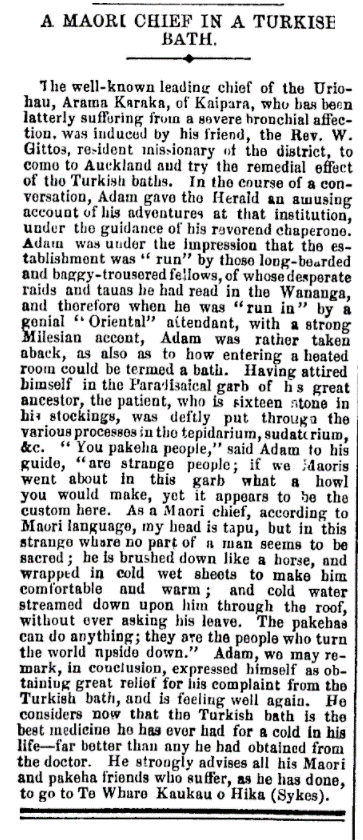
Hall’s Oriental Turkish Bath provides a fascinating insight into the cultural melting pot of the British Empire. It’s interesting to see the introduction of Turkish Baths into Britain in the 1850s, and from there, as they became fashionable, spreading through the Empire to reach New Zealand in the 1870s. A Turkish Bath was opened in Dunedin in 1874 (Press 31/12/1874: 2), one in Auckland by 1877 (New Zealand Herald 14/07/1877: 4) while an earlier bath opened on High Street in Christchurch in 1878 (Press 22/02/1878: 1). The collision of different cultures that resulted in the spread of ideas and practices across the empire is perhaps best illustrated in the below article.

A collision of culture. Image: Evening Post 12/07/1879: 3. 

Clara Watson, Jessie Garland, Lydia Mearns

References

Davie, Mort., 1902. Tourists’ Guide to Canterbury. P. A. Herman. Christchurch Press Company Limited.

Godden, G., 1991. Encyclopaedia of British Pottery and Porcelain Marks. Crown Publishers, New York.

Lyttelton Times, 1851-1914. [online] Available at: https://paperspast.natlib.govt.nz/.

New Zealand Herald, 1863-1945. [online] Available at: https://paperspast.natlib.govt.nz/

Press, 1861-1945. [online] Available at: https://paperspast.natlib.govt.nz/

Smith, S. D., 1996. “Accounting for Taste: British Coffee Consumption in Historical Perspective”, The Journal of Interdisciplinary History, Vol. 27: 2, pp. 183-214.

Smith, A. K., 2014. “The History of the Coffee Chicory Mix That New Orleans Made It’s Own”, Smithsonian Magazine. [online] Available at https://www.smithsonianmag.com/arts-culture/chicory-coffee-mix-new-orleans-made-own-comes-180949950/ [Accessed March 2021].

Star, 1868-1920. [online] Available at: https://paperspast.natlib.govt.nz/.

Trendafilov, A., Mearns, L., Garland, J. 212 Cashel Street, Christchurch (Superlot 6c): Final report for archaeological investigations under HNZPT authority 2020/811eq. Unpublished report for Fletcher Residential Living.

Urquhart, D. 1850. The Pillars of Hercules. Harper and Brothers, New York.