Frequently asked questions #1

Training and working as an archaeologist can be an interesting experience, not just because of the work we do, but thanks to the preconceptions and opinions of the people around us. Like so many other professions, archaeology is an extremely broad field of work and study, encompassing all manner of skills, time periods and subject matters. It’s also one that is misrepresented enough in the media that people often have a skewed notion of what it is that we actually do.

So, this week on the blog, we thought we’d have a go at answering some of the more frequently asked questions that have been posed to those of us working here in New Zealand. It will be the first of a couple of posts, since, as it turns out, there are quite a few questions we face on a regular basis.

We’ll start with the big ones:

1)      You’re an archaeologist? Like Indiana Jones*¹?

Actually, no. Not really like him at all. There have been many, many discussions of this in popular culture over the years (including this memorable letter). It’s generally agreed that Indiana Jones is a terrible archaeologist and most archaeologists would make a terrible, and very probably dead, Indiana Jones. The main differences are in comparative methods and objectives: archaeology is ultimately about understanding people in the past, collectively and individually, through ALL the physical traces they leave behind, while Indiana Jones is about the finding and collection of precious objects with little regard for their surrounding context.

Actual archaeology: less whips, pistols and mystical artefacts and more just a whole lot of digging. Image: H. Williams.

Actual archaeology: less whips, pistols and mystical artefacts and more just a whole lot of digging and recording. Image: H. Williams.

2)      That’s so cool! What’s your favourite dinosaur?*²

Similar questions to this include, “Were there many dinosaurs in New Zealand?”, “Oh, cool, like Ross from friends?” and “Found any dinosaur bones lately?”

As many of you will know, palaeontology and archaeology, while they do share some methods and a predilection for physical remnants of the past, are not the same thing. Put very simply, archaeologists focus on the human past, while palaeontologists work with fossils, including dinosaurs, from the more distant past.

Although, it should be noted that the difference between our professions doesn’t mean that archaeologists dislike dinosaurs. My favourite is Archaeopteryx, for the record, followed by actually-not-a-dinosaur Quetzalcoatlus.  A quick survey of the rest of the office tells me that archaeologists are fans of Triceratops, Velociraptor, Saurolophus, Stegosaurus, Tyrannosaurus rex, Deinonychus and also-not-a-dinosaur Megalodon.

T-Rex: not the purview of archaeologists, but still awesome. Image:

T-Rex: not the purview of archaeologists, but still awesome. Image: David Monniaux

3)      Archaeology? That’s like rocks and pyramids and stuff, right?

Er, sort of. There’s a bit more to it, really. As those of you who read this blog regularly will know, archaeology is far more varied and complex than just pyramids and rocks. Egyptology is just one small part of our profession and rocks (usually stone tools) are just one of the materials we deal with.

It’s one of my favourite things about archaeology, actually: that it covers all of human history, and thus anything and everything that people have done in the past, be it constructing massive monuments to gods and kings, making important advances in industrial technology, or figuring out how to make better toothbrushes. The infinite variety to be found in people, past and present, will never ever cease to amaze me.

Some of the artefacts found in Christchurch this year. Less pyramids and rocks and more remnants of everyday life. Image: J. Garland.

Some of the artefacts found in Christchurch this year. Less pyramids and rocks and more remnants of everyday life. Image: J. Garland.

4)      What’s the coolest thing you’ve ever found?

Variations on this include, “have you ever found treasure?”, “found any gold?” and “what’s the oldest thing you’ve ever found?”

I’d say that this is probably the question we hear the most. The problem with answering it is that in the course of their careers, most archaeologists will have found a LOT of things, many of which are cool and interesting. Picking just one can be a bit like asking someone to choose their favourite dinosaur (see what I did there?). It’s made even more difficult to answer by the fact that what is amazing to us is not always amazing to other people. The explanation of why an otherwise unremarkable object (like a brick, or a sherd of pottery) is so interesting is usually far longer and much, much, drier than the questioner wanted.

It may not help that, in my experience, this question is usually asked in bars or in the small-talk associated with first meeting someone. Very few people want to hear about the socio-cultural implications of changes in brickmaking in the 19th century in that situation. Or that most of the artefacts we deal with in Christchurch are less than 160 years old and we pretty much never find gold.

As a result, some of us may or may not have taken to answering this question with “a unicorn skull.” Another quick survey of the office suggests that other answers may include “a harmonium”, “a crystal skull”, “lots of stuff”,  “this [insert object] that someone else actually found but I am pretending that I found for the sake of this conversation” and the phrase “well, it depends…”

Moving on to more serious matters…

5)      There’s not that much archaeology in New Zealand though, is there?*

This is one of the more frequent questions asked here in New Zealand and it can be a little dispiriting to be reminded of how many people don’t realise what a rich, interesting and unique archaeological record we have in this country.

From the very first Polynesian settlers, arriving here c. 1300 AD (Jacomb et al. 2014), through to the most recent periods of immigration and settlement, New Zealand has a fascinating and globally significant archaeological record. It may be short, compared to other places in the world (such as our neighbour, Australia), but that lack of time depth is part of what makes it interesting. Archaeologists have used our relatively condensed archaeological record to look at the impact of human settlement on the environment, to better understand patterns of settlement, migration and  trade, motivations for warfare, the processes of social and cultural change, and how people adapt to new social and physical environments (among many, many other things).

Excavations at a 14th century archaeological site in the Catlins. Image: K. Webb.

Excavations at a 14th-16th century archaeological site in the Catlins. Image: K. Webb.

Archaeology in New Zealand is protected by the Heritage New Zealand Pouhere Taonga Act 2014, which “defines an archaeological site as a place associated with pre-1900 human activity, where there may be evidence relating to the history of New Zealand” (Heritage New Zealand Pouhere Taonga 2014). The modification or destruction of any such site, which includes standing structures, requires the permission of Heritage New Zealand, and usually involves one or more archaeologists recording and salvaging any archaeological features or material found during that process.

As those of you who follow our work here in Christchurch will have realised, this means that there is in fact a lot of archaeology in New Zealand. Even more than that, the wide scope of the work that is being carried out throughout the country has huge potential to add to our understanding of people in the past and their influence on the world around them.

6)      Who pays for all that?

Simplified, there are two main types of archaeological work undertaken in New Zealand: research archaeology, or those investigations carried out by the universities and/or independent researchers, and cultural resource management, carried out by consulting or contracted archaeologists in response to the modification or destruction of sites, as governed by the 2014 act. As a result, there are different methods of paying for that work.

Research archaeology is usually funded through the universities themselves or through research grants such as those provided by the Marsden Fund. Cultural resource management archaeology functions as a ‘polluter pays’ system, in which the authority holder covers the cost of recording and salvaging the archaeological information being lost through the modification or destruction of an archaeological site.

Cultural heritage management archaeology in Christchurch. Image: M. Carter.

Cultural heritage management archaeology in Christchurch. Image: M. Carter.

7)      Huh. Why? What’s the point?

To put it simply? Because our heritage is important. Because understanding where and who and what we’ve come from, as individuals, as a society, as a culture and as a country, is invaluable in understanding where we are now and where we may be in the future.  Because future generations deserve the opportunity to explore that heritage for themselves without wondering why we didn’t do more to save it for them. Because the actions and creations and lives of the people who’ve gone before us deserve to be remembered. Because there are things we learn from the archaeological record that would otherwise be lost to us. Because archaeology allows us to expand our horizons, to catch a glimpse of people and places that are so different to our own, yet linked to us through time and across cultures thanks to the things that they left behind.

Because, ultimately, people are important, and at its heart, archaeology is all about people.

 Jessie Garland

*¹ Less frequently, Indiana Jones may be switched out for Lara Croft.
Apparently, palaeontologists often get the same question in reverse and have responded with t-shirts.


References

Jacomb, C., Holdaway, R.N., Allentoft, M.E., Bunce, M., Oskam, C.L., Walter,
R., Brooks, E., 2014. High-precision dating and ancient DNA profiling of moa (Aves: Dinornithiformes) eggshell documents a complex feature at Wairau Bar and refines the chronology of New Zealand settlement by Polynesians. In Journal of Archaeological Science (2014), doi: 10.1016/j.jas.2014.05.023. [online] Available at www.sciencedirect.com

In which goats frolic, pipes masquerade as baskets and camels do whatever it is that camels do.

Taking a break from our recent musings on society, smells and legacies, this week’s post features another selection of artefacts from the archives. All of these were found on the same site in Christchurch’s central business district over the last few weeks. Enjoy!

Glass lamp

How lovely is this? It’s the (nearly complete) base from a finger lamp. It would have originally had a glass chimney on the top, attached with a copper/brass fitting or burner, looking a bit like this. Image: J. Garland.

Plate with ... pattern

Saucer decorated with scenic pattern, Geneva, similar to the Lucerne patterned plate we featured a few weeks ago. Image: J. Garland.

Marble

A large glass marble, with swirl of coloured glass inside. Image: J. Garland.

DSC_4705ed1

The fragments of another children’s plate, similar to others that we’ve found. Image: J. Garland.

Goats!

Goats! Frolicking! This pattern is, aptly enough, titled “Goat” and seems to be associated with Scottish pottery manufacturer James Jamieson & Co and the Bo’ness (Barrowstouness) Pottery in the Central Lowlands (1829-1855). Image: J. Garland.

And camels!

And camels! Image: J. Garland.

Some patterned pipe bowls, including two with a 'basket weave' motif.

Some patterned pipe bowls, including two with a ‘basket weave’ motif. Image: J. Garland.

A ceramic egg. Eggs like this were used to encourage hens to lay in the nest, rather than elsewhere. Image: J. Garland.

A ceramic egg. Eggs like this were used to encourage hens to lay in the nest, rather than elsewhere. Image: J. Garland.

A small porcelain figurine, tragically missing it's head. Image: J. Garland.

A small porcelain figurine, tragically missing its head. Image: J. Garland.


“Today, tomorrow, Timaru”: souvenirs of early tourism in New Zealand

The idea of a ‘souvenir’, as a physical keepsake of a place or event, is not a new concept. It’s been around for as long as people have been bringing home exotic treasures from far-off lands, or trying to preserve the memory of past events in physical objects. From the explorers of the distant past, to the ‘grand tourists’ of more recent times, people have taken the material culture of the world and turned it into tangible tokens of personal experiences. It’s a quintessentially human trait and one that, I think, ties into the overall tendency of people to hold onto what has gone before.

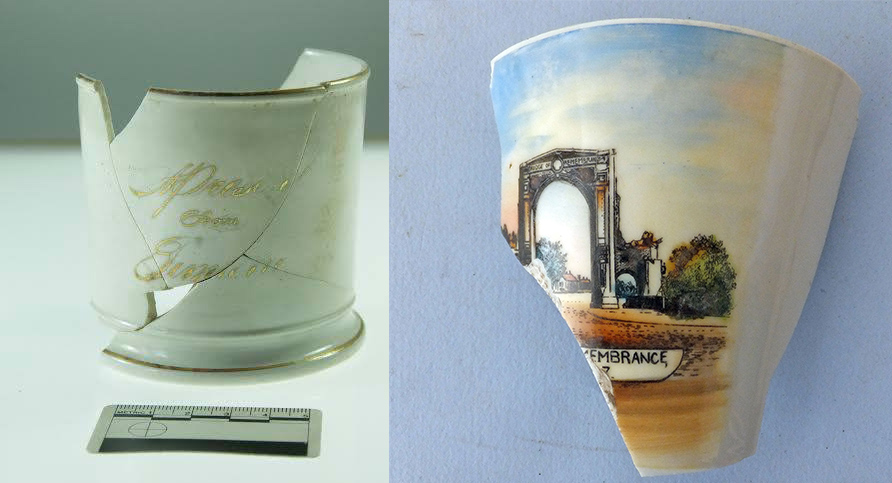
Over the last few years in Christchurch, we’ve found a multitude of artefacts from other places, many of which may have been souvenirs of past experiences, people or events to their owners. There are two, however, that stand out, not because they may have been treated as keepsakes, but because they seem to have been intended as such.

Souvenir cups found in Christchurch. Images: G. Jackson & Underground Overground Archaeology Ltd.

Souvenir cups found in Christchurch. Images: G. Jackson & Underground Overground Archaeology Ltd.

Both are cups and both are decorated with reference to places: one with the words ‘A Present from Timaru’ and one with an image of the Bridge of Remembrance in Christchurch. The latter has to have been made after the construction of that bridge in 1923, and objects matching the description of our Timaru cup were being advertised in the Timaru Herald in the early 1900s (Timaru Herald 13/7/1901: 1). The fact that both cups reference a place suggest that they were intended as travel souvenirs, keepsakes of visits to Timaru and Christchurch and, in the current age of global tourism and mass produced mementos, it’s easy to make that connection. Today, souvenirs are inextricably linked with travel, especially travel for leisure.

Advertisements for souvenirs from Timaru and Oamaru. Images: North Otago Times 6/1/1893: 2, Timaru Herald 13/7/1901: 1.

Advertisements for souvenirs from Timaru and Oamaru. Images: North Otago Times 6/1/1893: 2, Timaru Herald 13/7/1901: 1.

However, it wasn’t always so. For much of the 19th century, souvenirs were linked with events – with commemoration – rather than with anything approaching tourism. Newspapers of the 19th and early 20th century are filled with accounts of souvenir hunters, waiting eagerly at bridge openings to snag some of the ribbon, or casing the venue of a royal or dignitary’s visit to find a keepsake (New Zealand Herald 29/4/1910: 4; Te Puke Times 11/06/1920: 2). There are occasional descriptions of people returning from elsewhere with souvenirs, but they are almost always gifts, not purchases or acquisitions (Bruce Herald 3/6/1868: 4). A memorable exception to this is the party of townsmen who returned to Oamaru with a couple of boulders from Moeraki (or the ‘Devil’s Foundry’, as they referred to it; North Otago Times 17/8/1865:2).

Consequently, the fact that our cups, especially the ‘Present from Timaru’, appear to have been made to be souvenirs of travel is one that raises some interesting questions about the emergence of a souvenir culture and the greater framework of tourism, or travel for leisure, in New Zealand. Especially as it is such a key part of our national identity in the present day.

As we have mentioned many, many times here on the blog, the 19th century was a period of increasing global exploration and travel. The European settlement of New Zealand is itself evidence of that, but that long distance colonisation was accompanied and followed by increasingly regular travel between and within the northern and southern hemispheres. Much of this travel was commercial in nature, centred around international trade, politics, personal health and, to a degree, professional advances. Yet, tourism – travel for leisure – in the sense that we think of it today remained very much the province of the elite, who could afford both the time and the expense (McClure 2004: 79-80).

It wasn’t really under the late 19th (1880s onwards) and early 20th century that traveling for the sake of travel, the notion of going to see a place rather than visit a person, took off. In New Zealand, much of that very early ‘tourism’ seems to have been associated with the natural appeals of the country (much as it is today). The 1880s saw increasing numbers of mountaineers and tourists in and around Mt Cook, for example, leading to the construction of the Hermitage in 1884. Similarly, the Pink and White Terraces saw numerous tourist visits prior to their destruction in 1886, one of our first (and, perhaps, greatest) examples of a natural tourist attraction (McClure 2004: 79-80).

The stunning vista of Mt Cook, a prime spot for adventure tourism even in the 19th century. Image: C. M. Lynch.

The stunning vista of Mt Cook, a prime spot for adventure tourism even in the 19th century. Image: C. M. Lynch.

It can be difficult to determine from the available evidence, but travel between cities – urban tourism, if you will – is not referenced nearly as much. Don’t get me wrong, people were travelling between towns and villages from the earliest years of European settlement, but for different reasons and with different levels of comfort. Before the construction of the railway between Timaru and Christchurch, for example, travel between the two towns took the form of a sea voyage from Lyttelton or an overland carriage journey of 16 hours or more, often in bad weather and uncomfortable conditions. One description of the overland trip, written in the 1860s, calls it an “alarming undertaking”, greatly fatiguing “even for gentlemen” (Garner and Foster 2011: 90). It seems to have been a journey undertaken only when necessity called for it, rather than because a person simply wanted to. Even after the construction of the railway between the two settlements in the 1860s, the kind of travel that we now consider tourism – the kind that establishes a demand for souvenirs – still doesn’t appear to have been commonplace. Not until much later in the century, at least.

Early 20th century image of Stafford Street, Timaru. Image: Progress 1/7/1907: 338

Early 20th century image of Stafford Street, Timaru. Image: Progress 1/7/1907: 338

There are a number of interesting questions to be asked here, not least among them how and why our society shifted from viewing travel as a means to an end and starting viewing it as an end in and of itself. It’s a shift in perspective that seems to be tied up with a number of other changes in society as a whole. Among them is the the gradual transition from a society in which leisure is a luxury of the elite to the one we have now, where it can be considered a necessary part (a basic right, even) of ordinary life for everyone.

Souvenirs themselves are quite the contrast in meaning, as mass-manufactured objects that are simultaneously uniquely personal mementos. They’re also part of another shift in social perspective, I think, from a largely practical material culture, to the more frivolous form of consumerism found in the present day. They may take the form of practical objects, like our cups, but souvenirs are usually bought to be tokens of memory, not because they’re useful. There’s an element of display inherent in their purchase as well, which raises all kinds of interesting ideas regarding how souvenirs of travel are used in the modern world to project a certain image (this sparked a conversation in the office this morning about the hierarchies of travellers, from backpackers to luxury holiday-makers and how we judge people based on the kinds of things they bring back from trips).

Souvenirs from around the world. What do yours say about you? Image: Wikimedia Commons.

Souvenirs from around the world. What do yours say about you? Image: Wikimedia Commons.

Sadly, the discussion that these questions deserve is way beyond the scope of this particular blog post, but it’s certainly something to think about the next time you buy a souvenir or travel just to see something new in the comfort of modern transportation.

“I well remember one of my companions laughingly alluding to the time when our great-grandchildren, a hundred years thence, would be steaming over the plains, lolling back in a comfortable railway carriage, and wondering what sort of men their great-grandfathers could have been to have lived and laboured contentedly in a land without such a convenient means of getting about the country.”  – Alfred Cox, 1884.

Jessie Garland

References

Bruce Herald. [online] Available at http://paperspast.natlib.govt.nz

Cox, A., 1884. Recollections: Australia, England, Ireland, Scotland, New Zealand. Whitcombe and Tombs, Christchurch.

Garner, J. and Foster, K. (eds), 2011. Letters to Grace: writing home from colonial New Zealand. Canterbury University Press, Canterbury.

McClure, M., 2004. The Wonder Country: Making New Zealand tourism. Auckland University Press, Auckland.

New Zealand Herald. [online] Available at http://paperspast.natlib.govt.nz

North Otago Times. [online] Available at http://paperspast.natlib.govt.nz

Te Puke Times. [online] Available at http://paperspast.natlib.govt.nz

Timaru Herald. [online] Available at http://paperspast.natlib.govt.nz

Oh, the irony: a tale of unexpected survival (or how the little things can last the longest)

Over the last few weeks, as archaeologists do, I’ve found myself thinking about the physical legacies people leave behind them. In particular, I’ve been thinking about the contrast between the monumental (buildings, in this case) and the artefactual and how, oddly enough, it is not always the large or the supposedly permanent legacies that survive. We’ve come across this contrast before in Christchurch’s archaeology, in cases like that of J. G. Ruddenklau and the City Hotel or the china from Sydenham House, where the structural legacies are long gone, but the story – the memory – can still be found in the a single fragment or a single object. In small things forgotten, as the saying goes.

This came to mind again recently, thanks to a clay smoking pipe we found in the CBD, incised with the mark of Messrs Twentyman & Cousin, “whole sale and retail ironmongers”. It’s a simple cutty-shaped pipe, with a slightly angled bowl and no heel or spur evident at the base. Were it not for the circular stamp of “TWENTYMAN / COUSIN N.Z” at the back of the bowl, it would be unremarkable. The stamp renders it unusual, by virtue of the fact that it is rare to find clay pipes in New Zealand with the marks of local retailers or manufacturers.

We found another New Zealand branded pipe at this site, this time stamped with the mark of Twentyman & Cousin. Messrs Twentyman & Cousin (wonderful names!) were Christchurch retailers

The Twentyman & Cousin clay smoking pipe found in Christchurch. Interestestingly, the mark is only on one side of the bowl – the one facing the smoker. Image: J. Garland.

We don’t really know why the clay pipe bears the mark of Twentyman & Cousin. The only other examples of similarly branded pipes that I’ve come across were associated with tobacconists and hotels, both of which are more easily related to the practice of tobacco smoking than an ironmonger and agricultural merchant would have been. Was it advertising, perhaps? Maybe the business branched out into a few examples of personalised merchandise? Maybe it was commemorative in some way? Whatever their reason for marking the clay pipe, I suspect it had little to do with preserving a legacy. Yet, in a way, that is what it does now.

Twentyman & Cousin was first established in the late 1860s in Cathedral Square (Lyttelton Times 10/8/1867: 1), by John Holm/e Twentyman and his cousin, Alfred Charles Twentyman (hence the name). Although it is unclear when the latter arrived in the city, we know that Mr J. H. Twentyman arrived in Christchurch in late 1865, along with his family (Star 6/3/1900: 1). By all accounts he was a particularly well-read man (one advertisement details a lecture he gave to the Young Men’s Christian Association on Egypt in the ancient and modern eras) and heavily involved in Christchurch’s church community (Star 17/06/1879:3, 13/08/1879: 3, 16/04/1890:3). Less information is available about Alfred, unfortunately, although we do know that the partnership between the two men was dissolved in 1888 (Press 10/08/1888: 1).

Early advertisements for the business indicate that Twentyman & Cousin imported and sold a range of materials, from woolpacks  to corn sacks and sheep shears (Lyttelton Times 23/12/1868: 1, 10/8/1867:1). In later years, they were known for their ironmongery, particularly their selection of agricultural, pastoral and gardening tools and machinery. One advertisement from 1881 mentions products such as “garden syringes” and the “Ward & Paynes bow pattern solid crucible cast steel sheep shears”, a phrase that I challenge you all to try and say fast five times (Star 9/11/1881: 4). In that following year, numerous advertisements tell of their sale of reapers and binders and their participation in a “trial of reaping and binding” (which, to me, suggests some kind of demonic exorcism as much as it does agricultural work; Wanganui Herald 25/01/1882: 2 ). They didn’t limit themselves to agricultural and pastoral tools, though: other advertisements for the business promote the sale of “an assortment of guns, which for finish and cheapness surpass anything ever brought into the market” (Star 31/05/1883: 1).

An 1881 advertisement for Twentyman & Cousin. Image: Star 25/11/1881: 4

An 1881 advertisement for Twentyman & Cousin, listing all manner of machinery and tools (shovels, rakes and implements of destruction, even). Image: Star 25/11/1881: 4.

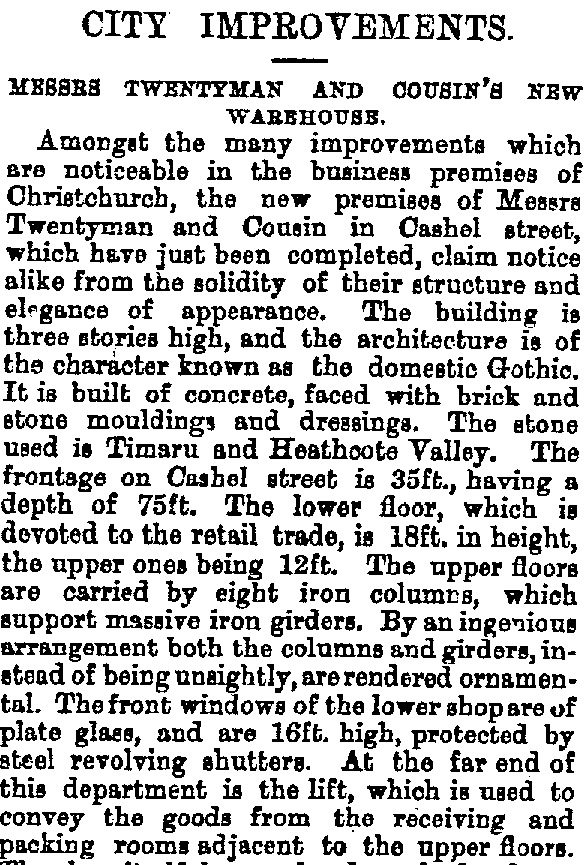
By 1880, the company had moved from Cathedral Square to a new building on Cashel Street west, one designed by renowned Gothic revival architect Benjamin Mountfort. Mountfort is most famous for his involvement in the design of the Canterbury Provincial buildings, which still stand today. The new Twentyman & Cousin building on Cashel street was constructed from concrete, brick and stone, and cost somewhere in the region of four thousand pounds to construct, a hefty sum in those days. Contemporary accounts described it as being in the domestic Gothic style, having “solidity of structure and elegance of appearance” and ornamented “sufficiently so as to relieve it from the sombre and barn like appearance of too many of our other buildings” (Press 10/4/1880: 1, Star 8/04/1880: 4). It was, it seems, the talk of the town.

Extract from an 1880 newspaper article on the new Twentyman & Cousin building in Cashel Street. You can see images of the building here. Image:

Extract from an 1880 newspaper article on the new Twentyman & Cousin building in Cashel Street. You can see images of the building here. Image: Press 10/4/1880: 1.

Although this building is of note for a number of reasons (the architectural design not least among them), I find it particularly interesting to think about it as an example of branding, of legacy, in comparison with the clay pipe. The building was elaborate (ostentatious, even), durable (remember that “solidity of structure”) and, presumably, deliberately built to carry the Twentyman & Cousin name into the future, be it 10 years or 100 years distant. There is an intention of permanence in its construction, in everything from the materials used to the style of the building. The clay pipe, on the other hand, emits no such sense of intentional durability. It’s a disposable item, meant to be used until it no longer works and can be discarded. Yet, it survives (albeit slightly the worse for wear), and the building does not.

The contrast (and irony) in this particular story is not just in the difference between the intended purpose of the pipe and the building, but in the manner of their survival. It’s fair to say, I think, that the clay pipe has survived where the building has not because it was discarded, kept safely in the ground over the decades. This often seems to be the way in archaeology, especially in circumstances like those found in Christchurch: the big things are lost and it is the small, disposable, things – the forgotten things – that slip through and keep the past alive. A legacy is a legacy, after all, even if it is not quite as originally intended.

Jessie Garland

References

Lyttelton Times. [online] Available at www.paperspast.natlib.govt.nz

Press. [online] Available at www.paperspast.natlib.govt.nz

Star. [online] Available at www.paperspast.natlib.govt.nz

Wanganui Herald. [online] Available at www.paperspast.natlib.govt.nz

Archaeology: where losing your marbles is sometimes a good thing

Imagine, if you will, that you were born in 1870. Your parents are colonists who journeyed to Christchurch to build a new life for themselves and their family. They’re not rich, but you live comfortably enough in this new country. As an infant, you survive the many dangers of your time and, eventually, you grow old enough to play with other children of your age.

You participate in a variety of children’s games, from ‘kiss-in-the-ring’ to rounders or ‘jolly miller’, but the ones you love best, your absolute favourites, are those played with marbles. You have your own collection, mostly made up of ‘commies’ (cheap clay marbles), but with a few treasured German glass marbles. You even end up with a couple of glass ones stolen from some Codd soda bottles that you found outside, but you lose them when you play for keeps against the children from the next street over. And, maybe, over the years, you misplace a few marbles from your collection, accidentally rolling them under a building or dropping them between the floorboards. And there they’ll stay, long after you’ve grown to be an adult and left childhood games behind you, until a curious archaeologist finds them in the dirt a century and a half later.

An 1897 cartoon of grown men playing at rounders and kiss-in-the-ring. Image:

An 1897 cartoon of grown men playing at rounders and kiss-in-the-ring. Image: Observer 27/3/1897: 12.

Marbles are actually quite rare finds here in Christchurch, surprisingly for something so easily lost. We’ve talked before about how the lives of children, especially their lives at play, can be so difficult to see in the archaeological record, making those few marbles we do find as precious to us now as they were to their original owners. We’re beginning to recover quite a variety of different types here in the city as excavations continue, from small clay (earthenware) ‘commies’, to coloured glass marbles and larger earthenware and porcelain examples.

A selection of marbles found on an archaeological site in Christchurch. Image: L. Davies .

A selection of marbles found on an archaeological site in Christchurch. Image: L. Davies .

Commies were one of the cheapest and most readily available types of marble around during the 19th century and were made from unglazed earthenware. From the mid-18th century until 1859, when a mechanised shaping process was introduced, they would have been hand crafted, probably in Europe or America (Gartley & Carskadden 1998: 49-50).Other marbles were made from glazed clay, porcelain or agate (known sometimes as ‘aggies’). During the latter half of the 19th century, handmade glass marbles became increasingly common, as manufacture became easier, although they weren’t mass produced until the turn of the century (Schrock 2004: 124).

Many of these marbles, especially the glass and stone ones, were made in Germany during the late 19th and early 20th centuries. One 1901 account in the New Zealand Herald describes in detail the process by which workers in Germany used the marble and agate debris from quarries to create stone marbles (New Zealand Herald 28/2/1901: 20). The East German region of Lauscha was also renowned for its production of glass marbles, thanks in part to glassmaker Elias Greiner’s creation of ‘marble scissors’ in 1846. First used to create glass eyes for dolls, these scissors meant the glassmaker could cut and shape the ends of a glass rod into marbles relatively easily (Baumann 2004).

A 1901 description of marble manufacture in Germany. Image:

A 1901 description of marble manufacture in Germany. Image: New Zealand Tablet 28/2/1901: 29

A sketch of boys playing a game of marbles. Image:

A sketch of boys playing a game of marbles. Image: New Zealand Herald  27/10/1945: 4.

These marbles would all have been used to play a variety of different games, most of which involved trying to hit an opponent’s marbles or knock them out of play (i.e. ringers or ‘ring taw’) or attempting to shoot marbles through obstacles or into holes. Most of these would have been played outside in the Victorian era, on the street or in the yard of a house or school (Taranaki Herald 15/3/1886: 2). While many advertisements and anecdotes found in newspapers of the time suggest that most games were played by boys (New Zealand Tablet 28/2/1901: 29, Star 21/4/1876: 3), it seems that girls also participated. One newspaper from 1878 speaks specifically of an indoor marbles board designed for girls to use, which involved attempting to shoot marbles into certain circles or triangles by striking them with a mallet (Otago Witness 21/1/1878: 2).

An 1878 advertisement for an indoor marbles board, targeted at girls. Image:

An 1878 advertisement for an indoor marbles board, targeted at girls. Image: Otago Witness 28/1/1878: 2.

Of course, games were not the only use found for marbles. They were also used as ammunition, as schoolyard currency and, apparently, in Wales, some people thought them good for eating…Now, they are as much collector’s items as they are toys, although people still play many of the games as a sport. The British and World Marbles Championship is still held in Tinsley Green, in West Sussex, England, every year, as it has been for centuries (New Zealand Herald 16/4/1938: 33).

To an archaeologist, though, marbles are information. They’re a glimpse of those who are so often unseen in the archaeological record, evidence of a part of life – play – that is obscured behind the more utilitarian day-to-day artefacts we usually find. They’re little pieces of a childhood that were misplaced, but never quite completely lost.

Jessie Garland

References

Baumann, P., 2004. Collecting Antique Marbles: identification and price guide. Krause Publications, Wisconsin.

Gartley, R. & Carskadden, J., 1998. Colonial Period and Early 19th Century Children’s Toy Marbles. The Muskingham Valley Archaeological Survey, Ohio.

New Zealand Herald. [online] Available at www.paperspast.natlib.govt.nz

New Zealand Tablet [online] Available at www.paperspast.natlib.govt.nz

Observer [online] Available at www.paperspast.natlib.govt.nz

Otago Witness. [online] Available at www.paperspast.natlib.govt.nz

Schrock, J., 2004. The Gilded Age. Greenwood Publishing Group, Portsmouth.

Star [online] Available at www.paperspast.natlib.govt.nz

Taranaki Herald [online] Available at www.paperspast.natlib.govt.nz