A crumbling mystery…

North and west elevations of the house.

Regarded as Christchurch’s oldest home, this two storey farm cottage was built in 1851-2 for Mr. Parkerson, a surgeon. It was built with 600 mm thick scoria stone blocks quarried from Lyttelton and roofed with Welsh slate.

Exposed wall structure in upstairs bedroom.

600 mm thick south wall of original stone cottage.

OLYMPUS DIGITAL CAMERA

Stonemason’s minor blunder hidden in the cupboard under the stairs.

The layout of this cottage is unusual, and some have suggested it was a common design back in Norfolk, England. Downstairs, the two rooms are orientated around central back-to-back stone fireplaces, with a chimney that runs up through the centre of the house, and there’s no central hall.

Central fireplace in the east downstairs main room.

Central fireplace in the west downstairs main room.

Oddly enough, this small cottage has two mirroring staircases at either end of the house, each leading to two small upstairs bedrooms. But perhaps the most bizarre aspect about this building is the absence of a connecting doorway to allow the occupants to access both ends of the house.

Staircase at east end of house.

Staircase at west end of house.

Upstairs main bedrooms once separated by a brick wall (which collapsed in the earthquakes).

Original casement windows in upstairs bedroom.

Exposed early split lath used to constructed a wall in the west downstairs main room.

The layout of this mid-19th century stone cottage presents us with whole new set of questions about the mysterious ways our ancestors lived, and will help us understand the development of Christchurch’s domestic architecture.

Francesca Bradley

Pieces of the Past

This week on the blog we’re sending you over to Pieces of the Past, an online exhibition we’ve curated as part of Beca Heritage Week here in Christchurch. The exhibition features the staff of Underground Overground Archaeology and their favourite artefacts. There’s a wealth of different objects and stories there (and a suspicious number of caffeine related biographies for our archaeologists), from a sheep hoof on a stick to pocket watches, spinning tops and poems about cowboys.

In fact, we may have been so excited about it that we modified (or butchered, depends on your point of view) a famous song in our excitement.

Glass eyes on skulls and sheep hooves on sticks,
Old broken watches and bright orange bricks,
Upright pianos, still with their strings,
These are a few of our favourite things.

Lost spinning tops and pointy bone hooks,
Cheese jars and Marmite and Rantin’s old books,
Cowboys and boats and small figurines,
These are a few of our favourite things.

When the trowel scrapes,
When the glass breaks,
When we’re feeling bored,
We simply remember our favourite things,
And then we don’t feel so bad.

Check it out here. 

A poetic reflection on heritage buildings

As building archaeologists we record and analyse the form, structure and ornamentation of 19th century dwellings to learn about the lives led by past occupants.

The Victorian era was a time of invention and achievement. Society was dominated by middle-class morality as they relentlessly pursued comfort and material wealth. Their houses expressed the energy and exuberance of this time, as they presented their best face to the public.

These efforts can be directly observed through the choice of internal linings used in 19th century dwellings. Wealthy homes were commonly lined with timber laths and lime plaster, while poorer houses used roughly sawn butted sarking boards. When we recorded a modest workman’s cottage in the Avon Loop we uncovered some of these roughly sawn butted sarking boards in the parlour, a room purposely decorated for public display.

Roughly sawn butted sarking boards used in parlour of workman's cottage. Image: F. Bradley.

Roughly sawn butted sarking boards used in parlour of workman’s cottage. Image: F. Bradley.

Over time, however, seven layers of wallpaper had been applied to this room to disguise the poor lining material.

Original layer 1

The first layer of wallpaper applied was a mid-Victorian pattern design of purple and light brown diamond shapes dating to between the 1860s and 1870s. Image: F. Bradley.

Layer 2

Applied on top of the original layer was a brown wallpaper with a blue flowers and leaves pattern design, dating to the 1880s. Image: F. Bradley.

Layer 4

The fourth layer of wallpaper dated to the 1850s and had design elements of the Edwardian period, with green diamond shapes and pink roses. Image: F. Bradley.

top layer 7

The last layer was a pearlescent wallpaper with a design pattern of white, pink and yellow flowers, dating to between the 1920s and 1930s. Image: F. Bradley.

When we record these historic dwellings, we try decipher the social conventions at play during the Victorian era and how they influenced the way in which their dwellings were decorated. But when it came to recording this workman’s cottage in the Avon Loop, we were confronted with the juxtaposition of how 19th century society decorated their houses and a very unique way one 21st century occupant had decided to decorate her humble abode.

IMGP6129

Street-facing elevation of workman’s cottage in the Avon Loop. Image: F. Bradley.

In its irreparable state the creative owner of this house took to it with a fine paint brush and turned its rough-cast plastered walls into a mural of poetry.

The street-facing south elevation bore the words of Percy Shelley’s sonnet ‘Ozymandias’.

IMGP6135

Percy Shelley’s poem ‘Ozymandias’ painted on the street-facing south elevation. Image: F. Bradley.

Ozymandias – Percy Bysshe Shelley

I met a traveller from an antique land
Who said: “Two vast and trunkless legs of stone
Stand in the desert. Near them on the sand,
Half sunk, a shattered visage lies, whose frown
And wrinkled lip and sneer of cold command
Tell that its sculptor well those passions read
Which yet survive, stamped on these lifeless things,
The hand that mocked them and the heart that fed.
And on the pedestal these words appear:
`My name is Ozymandias, King of Kings:
Look on my works, ye mighty, and despair!’
Nothing beside remains. Round the decay
Of that colossal wreck, boundless and bare,
The lone and level sands stretch far away”.

(Source: Wikipedia, 2001).

‘Ozymandias’ was one of English romantic poet Percy Bysshe Shelley’s most famous works, first published in 1818. Shelley’s works often attracted controversy as they spoke out against oppression, convention and religion (Source: Wikipedia, 2001).

His poem ‘Ozymandias’ acts as a a metaphor for the ephemeral nature of political power. Its central theme explores the indiscriminate and destructive power of history, by contrasting all leaders’ pretentions to greatness and their inevitable decline. It is a powerful statement about the insignificance of human beings to the passage of time (Wikipedia, 2001).

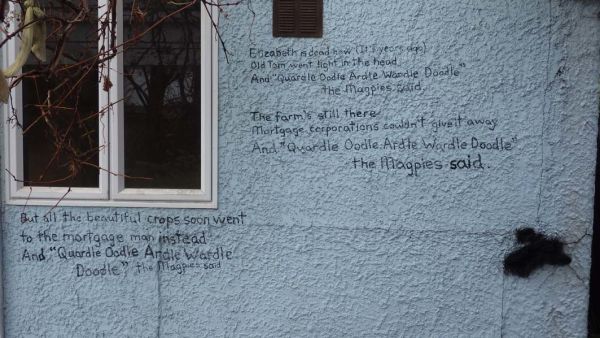
Along the north elevation of the cottage were the words of Denis Glover’s iconic New Zealand poem ‘The Magpies’.

IMGP6145

Denis Glover’s poem ‘The Magpies’ painted along the north elevation of the cottage. Image: F. Bradley.

IMGP6139

First section of ‘The Magpies’. Image: F. Bradley.

IMGP6142

Second section of ‘The Magpies’. Image: F. Bradley.

The Magpies – Denis Glover

When Tom and Elizabeth took the farm
The bracken made their bed,
And Quardle oodle ardle wardle doodle
The magpies said.

Tom’s hand was strong to the plough
Elizabeth’s lips were red,
And Quardle oodle ardle wardle doodle
The magpies said.

Year in year out they worked
While the pines grew overhead,
And Quardle oodle ardle wardle doodle
The magpies said.

But all the beautiful crops soon went
To the mortgage-man instead,
And Quardle oodle ardle wardle doodle
The magpies said.

Elizabeth is dead now (it’s years ago)
Old Tom went light in the head;
And Quardle oodle ardle wardle doodle
The magpies said.

The farm’s still there. Mortgage corporations
Couldn’t give it away.
And Quardle oodle ardle wardle doodle
The magpies say.

(Source: Xyphir, 2011).

‘The Magpies’ by Denis Glover is one of New Zealand’s most famous poems, first published in 1941. This poem relates to the passage of time as it laments the fate of farmers in hard economic times (Wikipedia, 2006). The hard-working farming couple become victims of an oppressive social system that exploits the working man. In this poem, the cruel and impartial nature of time is personified by the distinctive caw of the magpies, as they watched the farmers struggle away (Shieff, 2008).

As architectural styles and their decorative features can help us understand the conditions of bygone generations, the choice of poetry used here to decorate this workman’s cottage may be a reflection on the current post-quake social condition of Canterbury. Or perhaps the owner was merely commenting on the passage of time and its indiscriminate treatment of her home. Who knows, as archaeologists we can only speculate…

IMGP6137

Words of wisdom painted next to the dwelling’s front door. Image: F. Bradley.

Francesca Bradley.

References

Wikipedia, 2001. Ozymandias. [online] (22 September 2015) Available at: https://en.wikipedia.org/wiki/Ozymandias [Accessed 1 October 2015].

Xyphir, 2011. The Magpies – Denis Glover. A poem a day, [online] 26 April 2011. Available at: http://nzpoems.blogspot.co.nz/2011/04/magpies-denis-glover.html [Accessed 1 October 2015].

Wikipedia, 2006. The Magpies. [online] (2 May 2015) Available at: https://en.wikipedia.org/wiki/The_Magpies [Accessed 1 October 2015].

Shieff, Sarah, 2008. Denis Glover, 1912 – 1980. [online] Wellington: Victoria University. Available at: file:///Users/Shebitch/Downloads/716-622-1-PB%20(1).pdf [Accessed 1 October 2015].


The light fantastic

In last week’s blog post, we talked about the use of light in Christchurch’s city streets and public spaces, from oil lamps to gas lights to electricity in the early 20th century. This week, we step out of the street and through the door into the house, where 19th century residents harnessed everything from naked flame to caged lightning (their words, not mine) to illuminate their daily lives.

In the first years of European settlement, unsurprisingly, lighting options were limited. Setters in the 1850s and early 1860s would have relied exclusively on candles and kerosene for lighting in the home. These had the advantage of being cheap, easy and portable. They also had the disadvantage of being smoky, dim, sometimes odorous and prone to setting things on fire. In a settlement largely constructed from timber, the last of these was definitely a concern.

Candles and kerosene or oil lamps weren’t just used because of a lack of alternative options, however. Even after the introduction of gas lighting into homes later in the 19th century, candles and lamps continued to be a popular method of illuminating the room, so to speak, with contemporary newspapers advertising their use well into the 20th century (Ashburton Guardian 12/05/1900: 3, Star 12/09/1896: 4). In truth, candle light is probably the form of household lighting for which we have the most archaeological evidence, in the form of candle sticks, chamber sticks and candle snuffers. Most households are likely to have had several candle sticks and/or chamber sticks, the flat circular candle holders with a handle and inbuilt snuffer holder for ease of carrying (presumably into the bedchamber, hence the name).

Candle sticks and a candle snuffer. Candle snuffers would often rest on the cone of chamber sticks (see picture below) for ease of access. Image: J. Garland.

Candle sticks and a candle snuffer. Candle snuffers would often rest on the cone of chamber sticks (see picture below) for ease of access. Image: J. Garland.

We’ve talked about the types of candles available to consumers before on the blog, from cheap tallow candles to spermaceti (or, as they are hilariously referred to sometimes, sperm candles) and stearine candles, advertised for their superior quality and bright light. The amount of light provided from each of these varied, as one would expect, but even the best stearine candle was limited in the amount of illumination that it could provide. Stearine candles were, however, the ones used as a measurement of candle power against new light forms like burning magnesium. Lights could be anything from 15-20 candle power (basic lamps) to bright light house beacons with candle power measured in the hundreds of thousands.

Advertisement for prize medal spermacetti and stearine candles from the

Advertisement for prize medal spermacetti and stearine candles from the Lyttelton Times 6/05/1863: 5.

Candles, like the candle sticks and chamber sticks in which they were displayed, also came in a variety of forms, with some attention paid to appearance. For example, one advertisement offers “plain, fluted or coloured piano and bedroom candles”, suggesting that different candles may have been used in different – perhaps public and private – parts of the house. Similarly, the candlesticks we’ve found have been both decorated and undecorated, in everything from brass to porcelain to plain old refined earthenware. In this way, as with almost every other object we use in our lives, the provision of artificial light becomes another avenue for the expression of style and status and taste within the home (as is still the case today, from modern industrial chic fittings to terrible awful 1970 glass lamp shades).

Ceramic chamber sticks or chamber candle sticks. Note the cone for the snuffer and, although they're all roughly the same shape, the differing decoration. Image: J. Garland.

Ceramic chamber sticks or chamber candle sticks. Note the cone for the snuffer and, although they’re all roughly the same shape, the differing decoration. Image: J. Garland.

The same thing is apparent with oil and kerosene lamps.  While we tend to only find the plainer lamps in the archaeological record, if we find them at all (lamp glass is thin and fragile and usually in tiny pieces by the time it gets to us), a variety of elaborate casings were available to discerning consumers. Kerosene and oil lamps, as I’m sure many of you are aware, operated by burning fuel, usually stored in a burner at the base of the lamp, through the means of a wick, either an upright or flat wick or a circular rolled wick (also known as the Argand lamp), aided by a draught from the glass chimney casing.

Both kerosene lamps and candles were used in hanging lamps, chandeliers and light fittings as well as the portable lamps and holders that we commonly find in the archaeological record.  In fact, archaeological evidence for the more elaborate lights and light fittings is scarce. I think this is probably because they were part of the furnishings of a house and a) less likely to have been broken or damaged than portable lights and b) more likely to have been refitted for gas and/or electricity later on (although we also don’t find many original light fittings in extant 19th century buildings today).

A 'finger' lamp found on a site in central Christchurch and an advertisement showing the selection of lamps available to the consumer. This is the base of a kerosene lamp that would have looked a bit like this when complete.

A ‘finger’ lamp base found on a site in central Christchurch and an advertisement showing the selection of lamps available to the consumer. The lamp would have originally had a glass chimney on the top, attached with a metal burner, looking a bit like this. Image: J. Garland, Ashburton Guardian 12/05/1900: 3.

As I mentioned in last week’s post, gas began to be used for lighting in Christchurch in the 1860s. The Christchurch Gas Company was formed in 1862, by which point “the city of Christchurch [had] attained such dimensions and density that it appears capable of supporting a Gas Factory.” The company was formed with the purpose of lighting the city, and the advantages of gas as “the cheapest and safest means of illumination yet offered to the public” were emphasised, particularly in comparison to the cost of oil and candles (Press 22/11/1862: 6). Works were carried out throughout 1863 and 1864 and by November 1864, they were giving notice that gas would be supplied to consumers by early December, aided by the work of Mr Edward Reece, who would “furnish the internal fittings.” The first use of gas lighting in a building appears to have been in late December 1864, when Coker’s Hotel, J. G. Ruddenklau’s City Hotel and a few other buildings braved “the new acquisition” (New Zealand Spectator and Cook’s Strait Guardian 28/12/1864: 3).

Notice of the first use of gas lighting in buildings in Christchurch, given in December 1864. Image:

Notice of the first use of gas lighting in buildings in Christchurch, given in December 1864. Image:

By the 1870s and 1880s, many people were lighting their rooms with gas, piped through a meter from the mains laid down under the roads (the connection initially paid for by the Christchurch Gas Company). Public buildings were also outfitted with gas pipes and lamps, although kerosene also seems to have maintained a tenacious hold in some places: the Canterbury Provincial Chambers, although fitted with gas pipes, were still being lit with kerosene in November 1865, much to the outrage of one letter-writing citizen in the local newspaper. Interestingly, gas lighting in domestic residences is another thing that’s under-represented in the archaeological record, likely for the same reasons as the fixed oil and candle light fittings are missing. In fact, sometimes we only find indirect evidence of it, through the presence of associated architectural features like gas vents in ceilings.
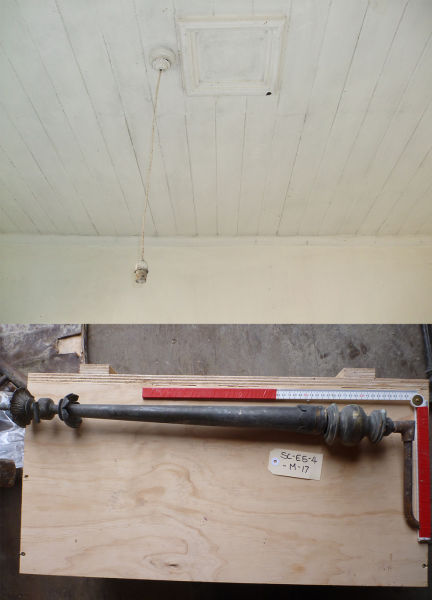
Archaeological evidence for gas lighting in buildings. Top: a ceiling vent in a 19th century house. Below: one of the gas light fittings from the Canterbury Provincial Chambers. Image: F. Bradley, L. Tremlett.

Archaeological evidence for gas lighting in buildings. Top: a ceiling vent in a 19th century house. Below: one of the gas light fittings from the Canterbury Provincial Chambers. Image: F. Bradley, L. Tremlett.

Eventually gas lamps were surpassed by the “superior” electric light towards the turn of the century. By the 1910s, houses were being advertised with electric lights as a selling point, although, many homes in Christchurch (and New Zealand) continued to be lit with gas lighting until well into the 20th century. This seems to have the result of a few issues. For one, electricity was expensive, especially at the beginning, and gas was the easier and cheaper option. For another, people in the 19th century had become used to portable, easy, lights in the home and – early on, in the 1880s – electricity was neither of those things. At least one enterprising swindler took advantage of this, advertising “portable electric lamps” for the home in the mid-1880s that sounded an awful lot like oil lamps, described modestly as a “most important invention that will bring about a complete revolution in all branches of lighting” (Thames Star 26/11/1885: 1). The scheme was soon unmasked as “an unmitigated fraud and swindle” (Thames Advertiser 10/02/1886: 3).

Advertisement for the Norman Electric Company Portable light (left) and a company offering installation of electric lights in the early 20th century. Image:

Advertisement for the Norman Electric Company Portable light (left) and a company offering installation of electric lights in the early 20th century. Image: Thames Star 26/11/1885: 1Sun 13/08/1914: 2.

It brings up an interesting point though, this emphasis on the portability of light. If there’s anything that stands out to me from the progress of lighting in Christchurch, especially in the home, it’s that shift from artificial light as something personal – that people lit themselves, candle by candle or lamp by lamp, and carried with them – to something that is a fixture of the surroundings, no longer carried with a person, but always there to be switched on (as it is today).

Looking back at last week’s post, there’s also a contrast to be explored between the lighting of the public spaces of the city and the use and perception of light in the private spaces of the home, some of it to do with that same issue of portability. For the city as a community, lighting in public spaces was a question of safety and convenience, a response to the dangers of the dark, as well as a matter of civic pride and a certain standard of civilised living. The fixed street lamps, city wide gas provision, the requirement for lighting outside hotels and early attempts to adopt electricity all bear witness to this. Those same themes of pride and status are evident in the use of light in private homes, from just the ability to provide light after dark to the quality and style of lights used. The lighting of our homes and personal spaces, though, seems to me more of a convenient luxury than a mitigation of danger (although there’s an element of that as well), even in the 19th century. It is what allowed people then – and now – to live their lives outside of the constraints of sunrise and sunset, to essentially manufacture more time from the day.

Jessie Garland

References

Ashburton Guardian. [online] Available at www.paperspast.natlib.govt.nz.

New Zealand Spectator and Cook’s Strait Guardian. [online] Available at www.paperspast.natlib.govt.nz.

Press. [online] Available at www.paperspast.natlib.govt.nz.

Star. [online] Available at www.paperspast.natlib.govt.nz.

Thames Advertiser. [online] Available at www.paperspast.natlib.govt.nz.

Thames Star. [online] Available at www.paperspast.natlib.govt.nz.

The dilapidatedly grand villa

This week we are treating you to a photographic tale of the life of a Cantabrian abode. Come with us now on a journey through time and space, to the wonderful world of dilapidated Victorian villas…

FOH

Between 1904 and 1905 Mr. Andrew McNeil Paterson, a salesman, built this rather grand residence. In its former glory the house had a total of eight rooms, including a scullery, pantry and bathroom. Image: Kirsa Webb.

dining

Mr. Paterson’s dining room with faceted bay windows. Image: Kirsa Webb.

cornice

Detail of decorative cornice in the dining room. Image: Kirsa Webb.

P1060130

The perforated ceiling rose in the dining room. Perforated ceiling roses helped ventilate rooms with fireplaces. This one was the most decorative ceiling rose that remained in the villa. Image: Peter Mitchell.

turret

The turret bay window of the drawing room. The door on the left led to the modern addition of a bathroom, where the original verandah would have run. Image: Kirsa Webb.

P1060132

Detail of unperforated ceiling rose in drawing room. Image: Peter Mitchell.

Untitled-1

Original perforated ceiling rose in the hallway. Image: Peter Mitchell.

P5050081

Ornate cornice detail of the original hallway. Image: Kirsa Webb.

P1060242

Detail of a perforated ceiling rose in a bedroom, which was significantly smaller than the other remaining ceiling roses in the house. Image: Peter Mitchell.

Despite its grandiose design, Mr. Paterson soon grew tired of the villa and sold the house just four years later. Over the next couple of decades the dwelling was home to a collection of different occupants. However, as was common practice in Christchurch during the Depression, this ornate villa was eventually divided up into a jigsaw puzzle of single bedroom flats.

plan

2011 plan of Mr. Paterson’s former residence divided into four flats. Image: Francesca Bradley.

And it was this jigsaw of four derelict flats Underground Overground Archaeology had to piece together to bring you the story of Mr. Andrew McNeil Paterson and his once grandiose residence.

Francesca Bradley