A club for Christchurch gentlemen

At the start of an archaeological investigation we often consult historical documents to learn as much as we can about a site’s past. Such research can identify the buildings that were once present, the people associated with the site through land purchase and occupation, and the kinds of activities undertaken at the site. This helps us determine what kind of archaeological remains we can expect during excavation. Often the archaeology meets these expectations, although sometimes a site can completely surprise you.

The excavation of the Canterbury Club is a good example of an archaeological investigation in which the archaeological evidence did not quite match up with information gained from the documentary sources. This evidence was not contradictory. Instead it supplemented the documentary information and ended up providing us with a more multi-faceted interpretation of the site.

 The Canterbury Club on the Corner of Worcester Boulevard and Cambridge Terrace c. 1882. Photo: Christchurch City Libraries, PhotoCD13, IMG0060.


The Canterbury Club on the corner of Worcester Boulevard and Cambridge Terrace c. 1882. Photo: Christchurch City Libraries, PhotoCD13, IMG0060.

The Canterbury Club, on the corner of Cambridge Terrace and Worcester Boulevard, was established for the professional gentlemen of Christchurch in the 1870s. Many noteworthy gentlemen of Victorian Christchurch were members and the building itself was considered to possess plenty of aesthetic and architectural merit (e.g. Press 20/12/1873: 2). The club, and the men associated with it, was therefore well documented in the formal histories of Christchurch and the gentlemen’s clubs of New Zealand. The club itself produced its own published history in the 1970s (Lamb 1972).

Here’s what the formal histories told us about the site. The Canterbury Club was a Victorian gentlemen’s club in the style of its English predecessors – institutions where men of wealth and status met socially and conducted business. By the mid 19th century these clubs had become an integral part of the upper and middle class British male lifestyle, reflecting the Victorian obsession with class (Manning 1991: 1). As a written history of another such club put it:

Having securely anchored his wife at home with a large family and at the same time established himself as ‘the master’ who could do no wrong, the Victorian husband would spend his leisure no longer in drinking to excess and gambling but in surroundings of luxury never excelled, where the house, the food, the wine and the service bore comparison with those found in any royal palace.

          Macdonald 1956

Brooks Club, London, one of the oldest gentlemen's clubs in England. Image: Hatton 1890:

Brooks Club, London, one of the oldest gentlemen’s clubs in England. Image: Hatton 1890: 13.

In 1856 the Christchurch Club was established on Latimer Square, providing a ‘house in town’ for Canterbury’s rural landowners. In contrast, the Canterbury Club was established by urban, professional gentlemen wanting a club that represented their own social sphere (Opus 2006). The 151 founding members purchased Town Section 403 and part Town Section 407 for their establishment, and the buildings were designed in ornate Italianate style by William Armson and Frederick Strouts. The main club buildings were completed in 1874 (a detailed description of the buildings appeared in the Press during construction and can be found here). The club’s service wing was located discretely behind the club and connected to it via a passageway, which was frequented by the club’s serving staff (Press 29/5/1873: 2). These included a cook/housekeeper, kitchen-, scullery- and house-maids, a steward, waiters, a barman and a billiard marker (Lamb 1972: 30). Once the buildings were finished they were furnished by local suppliers J. Ballantyne & Co and Morrow, Basset & Co  (Lamb 1972: 23). The club’s crockery – white with a maroon band and a ‘Canterbury Club’ monogram – was ordered from London. The club was opened officially on 24 October 1874 with an inaugural dinner.

Advertisement calling for founding members for the Canterbury Club. Image: Press 10/7/1872: 1.

Advertisement calling for founding members for the Canterbury Club. Image: Press 10/7/1872: 1.

When excavation began at the Canterbury Club site it was expected that the archaeology would substantiate the information from the written sources. However, only one rubbish pit, containing a minimum number of 165 artefacts, appeared to be related to the club. Moreover, the artefacts recovered from this pit did not quite match up with the written descriptions.

The ceramic artefacts consisted of a mix of ware types. Two large whiteware basins fitted for indoor plumbing and manufactured by J. Tylor & Sons of London were the largest and most complete ceramic vessels recovered from the rubbish pit. Whiteware cups, saucers and plates were the most common vessel forms, but a stoneware bottle, a bone china cup and dyed-body tiles were also found. While cups, saucers and plates were identified in the assemblage, no other forms associated with food presentation and consumption, such as serving vessels, were found. However, variety was evident in the decorative transfer print patterns on these vessels. The ubiquitous Asiatic Pheasant print was identified on one of the vessels, but the basins were the two only vessels bearing the same pattern. No vessel recovered from the rubbish pit could be positively identified as part of the monogrammed set ordered from London for use in the club.

A whiteware basin recovered from the Canterbury Club rubbish pit. Photo: R. Geary Nichol.

A whiteware basin recovered from the Canterbury Club rubbish pit. Photo: R. Geary Nichol.

A collection of ceramic artefacts recovered from the Canterbury Club rubbish pit. Photo: R. Geary Nichol.

A collection of ceramic artefacts recovered from the Canterbury Club rubbish pit. Photo: R. Geary Nichol.

The faunal remains recovered from the pit also contrasted with written information about the type of fare served to club members. Lamb (1972: 26-27) states that goose, turkey, duck, rabbit, pheasant, hare and several types of fish were ordered from the local fishmonger and butcher and served up at the club. A maximum of four species were recovered from the pit – oyster, cow, sheep, and possibly pig. The meat cuts that could be identified – beef chuck, mutton leg and forequarter – were cuts typically used for boiling, mincing and roasting. There was no sign of the more exotic fare known to have been eaten at the club.

A pair of shoes, belonging to an adult male, was also recovered from the pit. These shoes were interesting because they were made with a combination of leather and canvas. It is possible that these were lighter summer shoes, or perhaps a poorer quality shoe than the full leather pieces often recovered from archaeological contexts in Christchurch. Another possibility, given the use of canvas, was that they were used as sports shoes.

Few glass artefacts were recovered from the pit, and this too was inconsistent with known consumption of alcohol by Club members.

The artefacts from the Canterbury Club rubbish pit did not simply reiterate the information in the written sources and so forced consideration of alternative interpretations. It’s possible that these artefacts represented the less formal side of club life and are the debris of run-of-the-mill activities. For example, the basins in the club bathrooms may have been deemed old-fashioned and discarded. Informal lunches, beverages and snacks may have been served on common dishes rather than the monogrammed crockery, which may have been reserved for formal occasions. Similarly, these meals may have consisted of plainer fare than that served on special occasions. A pair of worn sport shoes, forgotten by a Club member after a cricket match, may have been discarded after they went unclaimed. These are the kind of mundane details that do not make it into the formal histories.

A pair of leather and canvas shoes recovered from the Canterbury Club rubbish pit. Photo: R. Geary Nichol.

A pair of leather and canvas shoes recovered from the Canterbury Club rubbish pit. Photo: R. Geary Nichol.

It is also possible that the artefacts relate to the staff of the Canterbury Club rather than its members. The difference in status between members and staff could account for the common dishes and plain fare represented in the rubbish pit, assuming the staff ate separately. The staff would have been present at the club each day, as opposed to the more transient club members, and their everyday meal is unlikely to have consisted of exotic delicacies served on fancy crockery.

The archaeology of the Canterbury Club site highlights the way in which historical documents and archaeological excavation can supplement each other and result in a more multi-faceted understanding than could be reached by either research method alone. Whether the artefacts represented consumption by club members or staff (or both) they are evidence of the more mundane details of club life that were excluded from the formal histories. Details of daily life are often taken for granted and ignored in favour of more glamorous narratives. However, the artefacts of everyday activities are instantly recognisable even today, and forge a common bond between the past and the present. It is often through these artefacts, rather than the glamorous histories, that a strong connection with the site’s history is made.

Rosie Geary Nichol

References

Lamb, Robert C., (1972), The Canterbury Club 1872-1972: Centennial Notes. Christchurch: Whitcombe and Tombs Ltd.

Hatton, J., 1890. Club-Land: London and Provincial. [online]. Available at: http://archive.org/details/cu31924077731317.

MacDonald, G. R., 1956. The Christchurch Club: A History. Christchurch: Whitcombe and Tombs Ltd.

Opus International Consultants, 2006. Conservation Plan for the Canterbury Club, 129 Cambridge Terrace Christchurch. Unpublished report for the Canterbury Club.

Press. [online] Available at: <http://paperspast.natlib.govt.nz>.


A lot of old rubbish!

…this yard being kept in a disreputable state, there are no cinder pits in proper places to throw the refuse of cooking and things in general, as at home, so old bones, vegetable remains, scrapings of plates, cinders, tea leaves, every conceivable thing is flung anywhere over these yards…

From Taken In by “Hopeful”, 1887.

Imagine that you live in 1860s Christchurch. Although it’s officially a city, there’s not much here that’s like the cities of Europe. The roads aren’t paved – in fact, most of them have hardly been formed. Your house is wooden, rather than being stone or brick. There’s no running water, and nothing to speak of in the way of drains between your house and the street. There are rubbish collection services, but only within the four avenues and you have to pay for them yourself. Fortunately, though, there’s a lot more space than back home. So, instead of paying the night-soil man or the town scavenger(s), you can just bury your rubbish in your backyard, throw it under your house (or even out the back door, if you don’t care too much about the smells and ‘nuisances’) or toss it into the Avon River.

This post is a bit different from others we’ve written to date. It’s the first in an occasional series that looks at the process of archaeology, and the factors that we consider before we interpret a site, or a particular artefact. In this case, it’s rubbish, because that’s largely what we find. When we find rubbish, we have to think about what was deposited, where and how was it deposited and why. When it was deposited is pretty important too, but we’ll look at that in another post. This post only provides the briefest of overviews over rubbish disposal practices, but it’ll give you an idea of how we think about these things.

 The motion passed by the Christchurch City Council, outlining how the council would charge for rubbish collection (Press 25/11/1863: ).


The motion passed by the Christchurch City Council, outlining how the council would charge for rubbish collection (Press 25/11/1863: ).

From 1863, the disposal of waste within the area bounded by Bealey Avenue, Fitzgerald Avenue, Hagley Park and Moorhouse Avenue  was regulated by the Christchurch City Council (the council was formed in 1862). The council set aside a rubbish dump very early on in the piece (Press 5/4/1862: 3), but it was not until January 1864 that the council contracted the Hadfield brothers to collect “refuse, slops, etc”, and instructed the Inspector of Nuisances “to cause the dry rubbish and ashes in every house or yard to be placed in bins provided for that purpose, the same to be conveniently accessible to the contractor at stated periods for removal, and to see that this authority be exercised within the cess-pan district…” (Lyttelton Times 28/1/1864: 5). It had been decided late the previous year that the council would recover the cost of this service directly from ratepayers, although subsequent council reports suggest that this was sometimes difficult (Press 25/11/1863: 3).

 An official report on rubbish collection (Press 12/1/1865: 4).


An official report on rubbish collection (Press 12/1/1865: 4).

While an official report in early 1865 suggested that this system was working well (Press 12/1/1865: 4), there were also reports of rubbish not being collected or people failing to pay for the service and people sweeping rubbish into gutters (Press 22/3/1865: 2, Lyttelton Times 28/3/1865: 3). A year later it was noted that “The Committee thought it desirable to make inquiries as to the removal of ashes and other dry rubbish, but they do not find that any systematic plan has been adopted in the manner or time of removal, nor as to the description of removal.” (Press 21/3/1866: 2). Whether or not any changes followed this report is not known but it is clear that there was a system of removal of rubbish in place in 1867 (Press 24/12/1867: 2). After 1870, there’s not much information about rubbish collection in the council reports in the newspapers, although in 1871 it became illegal to throw rubbish into “any public sewer or drain”, suggesting that this was a problem (Press 1/4/1871: 4).

 Problems with rubbish collection (Press 22/3/1865: 2).


Problems with rubbish collection (Press 22/3/1865: 2).

 Rubbish collection, 1867 (Press 24/12/1867: 2).


Rubbish collection, 1867 (Press 24/12/1867: 2).

Charging for rubbish collection continued until at least the late 1870s (Press 11/4/1878: 2). By 1886 the fee for this service seems to have been taken from rates (it wasn’t possible to work out exactly when this change took place; Star 9/3/1886: 4).

Even though rubbish in Christchurch could be collected from your property by at least 1864 (and it appears to have been a legal requirement that rubbish was removed from your property), archaeology tells us that families and businesses continued to dispose of their rubbish themselves throughout the 19th century (as a number of the posts on this blog illustrate).

A purpose-dug rubbish pit. Photo: L. Tremlett.


A purpose-dug rubbish pit. Photo: L. Tremlett.

So how did people do this? Mostly, they buried their rubbish it in purpose-dug pits, which were sometimes lined with tins – this may have been to prevent noxious material leaching into the city’s water. Because there are no soil or sand layers in these pits, we know that people weren’t throwing dirt or sand into the pit (which would have helped stop those noxious odours). The pits may have been covered is some way, which would also have reduced the odours – and the rodents – and  stopped loose sand or soil blowing into the pit. No physical evidence of such a cover has been found to date. Elsewhere in New Zealand, people threw their rubbish into abandoned privies or wells, but we’ve not found any examples of this in Christchurch so far.

 An under-floor accumulation. Photo: K. Webb.


An under-floor accumulation. Photo: K. Webb.

Some people were evidently too lazy to dig a pit and simply threw  the rubbish under their house (archaeologists call this an ‘under-floor accumulation’ (Butcher and Smith 2010)), while others took advantage of neighbouring sections that weren’t occupied and buried their rubbish there – nasty! The rubbish we’ve found at the Theatre Royal may be the result of this sort of activity. And apparently sometimes people just threw their rubbish out their back door or in a pile in the backyard (a surface accumulation or surface layer). That’s what the quote at the start of this post is referring – it’s from a book written by a young woman who was rather disillusioned by 1880s Christchurch (Hopeful 1974).

1890-11-20_8 Press


The Papanui Bone Mill produced ‘bonedust’ (a fertiliser) from bones (Press 20/11/1890: 8).

Like us today, the residents of Victorian Christchurch threw out items that were beyond repair or had fallen out of fashion. But fashions changed a lot less quickly then than they do today and there was a whole lot less packaging than there is now. And people rarely threw out objects of monetary value, such as jewellery or watches. There was also reuse, particularly of bottles, and bones leftover from meals were often collected and turned into ‘bonedust’ (a form of fertiliser). People tended not to throw out complete or unbroken objects – it’s rare that we find something that’s not broken, and in many cases we only find one fragment from a given plate or bottle. When we do find complete or nearly complete artefacts, we start to think a bit harder about why someone might have thrown something like that out, and that’s when the out-of-fashion argument can come into play.

 A nearly complete plate that someone threw out. Photo: J. Garland.


A nearly complete plate that someone threw out, possibly because it was no longer in fashion. Photo: J. Garland.

These are just some of the things we have to take into account before we interpret an artefact or assemblage, and before we can get to the heart of what archaeology’s about: people.

Katharine Watson

References

Butcher, M. and Smith, I., 2010. Talking trash: classifying rubbish-bearing deposits from colonial New Zealand sites. Journal of Pacific Archaeology 1(1): 53-61.

Hopeful (pseudonym), 1974 [1887]. Taken In: Being a sketch of New Zealand life. Capper Press, Christchurch.

Lyttelton Times. [online] Available at: <http://paperspast.natlib.govt.nz>.

Press. [online] Available at: <http://paperspast.natlib.govt.nz>.

Star. [online] Available at: <http://paperspast.natlib.govt.nz>.

“the marvellous antiquity…of our beloved ritual” – Past Master G. W. Speth, 1893.

Context is an important concept in archaeology. Everyday artefacts, often mundane and fragmented, can take on a powerful meaning due to an unusual placement or an association with other material of a different type or function. These circumstances will often nudge the archaeologists towards stories about the past that are easily overlooked in favour of the stronger, overarching narrative of a site’s archaeology. The excavation of Grubb cottage in Lyttelton in 2010 provided an opportunity to contemplate the broader meaning of two common artefacts recovered from unusual contexts. This incongruity, combined with a consideration of the broader context of the cottage’s history, informs an interpretation of the cottage’s occupants that extends beyond the daily domestic activities so often reflected in the archaeology of historical residences in New Zealand.

Grubb cottage is one of the oldest standing residential buildings in Christchurch. John Grubb, a ship’s carpenter from Scotland, was stranded in Wellington in 1847 when the ship on which he was employed was condemned due to leaks on a voyage between London and Melbourne (Cyclopedia 1903a). He made his way down to the newly established port of Lyttelton in search of work, and he liked it so much he decided to settle there and bring out his family from Scotland. His wife, Mary, and their three daughters arrived in 1850 on the Charlotte Jane, one of the “first four ships”.

John and Mary Grubb. Image: Cyclopedia 1903a.

John and Mary Grubb. Image: Cyclopedia 1903a.

With them they brought the building tools with which John established a thriving shipwright’s business at the port (Amodeo and Chapman 2003: 88). In 1851 John was the first to purchase a town section in Lyttelton after the balloted sections were allotted. On this section in London Street he built a simple timber cottage. The Grubb family grew as John’s business prospered and John himself became a figure of importance in the local community. He served on the borough council, as did his son James who became the Mayor of Lyttelton in 1902. When John died in 1898 (LINZ c.1860: 5W237), James inherited the cottage, which had been enlarged by a significant addition to the south elevation (Cyclopedia 1903b). The cottage remained in the Grubb family for over a century until it was sold in 1961 (HMS 2008: 8).

James Grubb. Image: Cyclopedia 1903b.

James Grubb. Image: Cyclopedia 1903b.

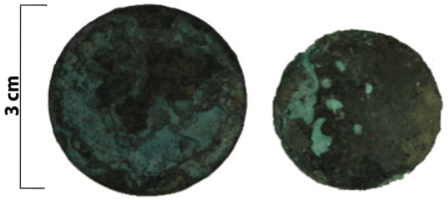
The archaeological excavation of Grubb cottage highlighted two themes: the deposition of the material debris of a century’s worth of occupation by the Grubb family, and changes made to the cottage and surrounding landscape as the Grubb family grew in number and community prominence. However, within these overarching narratives two small artefacts stood out due to their unusual context. During the excavation of new pile holes two timbers were uncovered, one under the other, running north-south along the line of the east elevation of the original cottage. Two coins were found lying on these timbers, later identified as a British bronze halfpence and a bronze penny (Clayton 2013). Unfortunately much of the detail on these coins was corroded but the material, dimensions and remaining detail were enough to date their issue to 1860-1890 and 1874 respectively.

The bronze penny (left) and half-penny (right) recovered from Grubb cottage.

The bronze penny (left) and half-penny (right) recovered from Grubb cottage.

Archaeologists often find coins during excavations and these can be useful for dating the context in which they were found. However, these coins were under the original cottage, which was built in the early 1850s and therefore predated the coins’ issue.  It is here that the physical context in which the coins were found provided a possible explanation for the dating discrepancy. The coins appeared to have been deliberately placed – what if their placement had a ritual purpose, rather than being the result of careless discard? It is likely that the east elevation of the original cottage was the location of the formal entrance until the addition, which included a new front door, was made to the south elevation at an unknown date. The date of the coins precludes any association with the opening of the original cottage entrance, but was it possible that they were used to ceremonially close that entrance before the opening of another? In which case, the coins would date the construction of the southern addition to sometime after 1874.

This possibility is evocative of common ceremonies such as the laying of time capsules, a custom that has been identified at several Christchurch buildings including an early 20th century Masonic lodge. Freemasons held elaborate ceremonies to lay the foundation stones of Masonic buildings, and these almost always included the laying of a time capsule containing a newspaper and coins (Speth 1893). Mention of Freemasonry often conjures notions of conspiracy theories and Dan Brown books, but ‘the brotherhood’ was a real and powerful influence in New Zealand’s male-dominated colonial society. The first lodge in New Zealand opened in Wellington in 1842 and by 1890 New Zealand boasted 151 lodges (Phillips 2012).Members included important society and political leaders, such as Richard Seddon, New Zealand premier and the Most Worshipful Grand Master of the Masonic Lodge of New Zealand.

Now this is where the broader context of the archaeology of Grubb cottage affects the meaning of those two little coins found in the ground – both John Grubb and his son James were Freemasons. Not only were they Freemasons, but they were leaders of the Masonic community in Lyttelton for almost 40 years. Together with several others they succeeded in founding the Canterbury Kilwinning lodge in 1875 (Press 3/12/1875; 21/2/1898). This was the second Masonic lodge in Lyttelton, the first being the Lodge of Unanimity, which was established in 1851 (Cyclopedia 1903c). Three years later John Grubb was elected lodge treasurer while James was elected a senior warden (Press 6/12/1878). The Kilwinning Lodge commissioned the construction of a hall on Canterbury Street, for which James Grubb as Worshipful Master laid the foundation stone in a ceremony in 1881 (Press 30/5/1881). John Grubb remained treasurer of the Kilwinning lodge for 18 years, resigning shortly before his death in 1898 (Press 3/12/1896).

So, if the placement of the coins was related to change in the cottage structure, it is possible that the Grubb cottage coins had a ritual significance that echoed the traditions of Freemasonry. But why were coins and newspapers used in such ceremonies? The reason seems obvious – to provide temporal information concerning the construction of the building for posterity in case of the building’s destruction. However, one would expect that the future destruction of the building was not a desirable result. Could there be an underlying explanation for these ritual actions?

George Speth, a prominent English Mason, related components of Masonic tradition to the folklore of construction. After all, a mason is a builder, and the Freemasons traced their origins to the cathedral builders of medieval Europe, and building tools were treasured symbols of the society (Newton 1921: 97-124). Speth associated common builders’ rites with the ancient belief that in order to ensure the permanence and stability of a structure it must be imbued with a soul (Speth 1893: 3). He suggested that originally this was undertaken by human sacrifice. Legends from around the world connect death to construction and Speth cited instances where human bones have been uncovered in the foundations of ancient buildings (Speth 1893: 4-22). He maintained that over time such sacrifice became symbolic in nature, with the use of animals and animal products, images and effigies. It is this symbolic form of sacrifice that Speth related to the custom of including coins in foundation ceremonies – ”…coins bearing the effigy, impressed upon the noblest of metals, the pure red gold of the one person to whom we are all most loyal, and whom we all most love, our Gracious Queen…” (Speth 1893: 22) – even if the conscious intention of imbuing the structure with a protective spirit had been shed over time.

A stained glass window depicting Saint Columba in Iona Abbey, Scotland.

A stained glass window depicting Saint Columba in Iona Abbey, Scotland. Legend has it that Columba buried alive his companion, Odran, to ensure the lasting stability of his chapel there. Image: Wikipedia 2008.

John Grubb was a builder by trade and a Freemason of high standing in Lyttelton. It is entirely likely that he was aware of the traditions and rites associated with construction. It is even possible that, on the closing of the old entrance to his cottage, he buried two coins to ceremonially mark the occasion. He didn’t necessarily do this while fully conscious of all the connotations of this little ritual. Perhaps it was done out of deference to Masonic practice, or perhaps it was done out of habit – an old superstition he picked up during his time in the building trade in Scotland. Whatever his motivation, this interpretation of past events was only made possible through consideration of two mundane objects within their immediate and broader context.

Rosie Geary Nichol

References

Amodeo, C. and Chapman, R., 2003. The Forgotten Forty-Niners: being an account of the men and women who paved the way in 1849 for the Canterbury pilgrims in 1850. Christchurch: Caxton Press.

Clayton, T., 2013. Coins of England and Great Britain. [online] Available at: http://www.coins-of-the-uk.co.uk/coins.html.

Cyclopedia of New Zealand, 1903a. Professional, Commercial and Industrial: Mr. John Grubb. [online] Available at: http://nzetc.victoria.ac.nz//tm/scholarly/tei-Cyc03Cycl-t1-body1-d3-d60-d2.html.

Cyclopedia of New Zealand, 1903b. Lyttelton: His Worship the Mayor, Mr. James Grubb, J.P. [online] Available at: http://nzetc.victoria.ac.nz//tm/scholarly/tei-Cyc03Cycl-t1-body1-d3-d60-d1.html.

Cyclopedia of New Zealand, 1903c. Orders and Friendly Societies: Masonic: New Zealand Constitution: Unanimity Lodge. [online] Available at: http://nzetc.victoria.ac.nz//tm/scholarly/tei-Cyc03Cycl-t1-body1-d3-d22-d3.html.

Heritage Management Services (HMS), 2008. Grubb Cottage Conservation Report. Unpublished report.

Land Information New Zealand (LINZ), c.1860. Probate Index – 5W237. Archives New Zealand, Christchurch Office.

Newton, J. F., 1921. A Story and Study of Masonry. [online] Available at: http://www.gutenberg.org/files/19049/19049-h/19049-h.htm#CHAPTER_IB.

Philips, J., 2012. ‘Men’s clubs – Masons’. [online] Available at: http://www.TeAra.govt.nz/en/mens-clubs/page-4.

Press. [online] Available at: http://paperspast.natlib.govt.nz.

Speth, G. W., 1893. ‘Builders’ Rites and Ceremonies: Two Lectures on the Folk-Lore of Masonry. Delivered by G. W. Speth to the Members of the Church Institute, Margate, On the 30th October and 13th November, 1893. [online]. Available at: http://www.slv.vic.gov.au/.

Black deeds in Draper Street

Today, through the wonders of archaeology and Papers Past, we bring you the story of Charles Henry Cox, a man whose crime has been buried – literally – for over 100 years. But let’s not get too carried away. As crimes go, it wasn’t such a serious one. And probably largely victimless, as it doesn’t seem to have been terribly successful.

Before we found Cox’s little rubbish pit, we didn’t have a sense of who he was or what he was like. He wasn’t like some of the other men we’ve featured here, who were frequently written about in the paper and were probably quite well known about town. But he was someone who – like so many of us – wanted to get ahead, financially and/or socially. This was in the mid-1880s, so he may have lost his job in the depression that was affecting so much of the country at the time, and it may have been this that forced him to turn to crime. Or maybe he just thought he’d hit upon a cunning get-rich-quick scheme.

Cox wasn’t that badly off in the first place, though. He had sufficient money to buy himself and his family a block of land (where we found the incriminating evidence) in Richmond in 1885 and he took out a mortgage against it that same year, possibly to build a house on the land (LINZ 1885).

Now, here’s where it gets a bit confusing, so pay close attention.

The section Charles bought in 1885 was on a street known by a variety of names until the 1940s, when it became Harvey Terrace. It was known as Salisbury Street and Windsor Terrace and possibly – just possibly – as Draper Street (CCL 2013: 39; LINZ 1885). The possibility that it was known as Draper Street is important, because newspaper advertisements tell us that Cox lived on Draper Street (e.g. Star 29/1/1886: 2, Star 23/1/1896: 3). Even if Cox didn’t live on the section he bought in 1885, Draper Street was literally just around the corner and the archaeology tells us that he was definitely using the section on what is now Harvey Terrace. He owned this section until at least 1911 and newspapers place him and his wife – who was constantly advertising for servants (e.g. Star 29/1/1886: 2Star 23/1/1896: 3) – on Draper Street from 1885 until at least 1900.

Mrs Cox advertising for a servant, 1900 (Star 5/3/1900: 3).


Mrs Cox advertising for a servant, 1900 (Star 5/3/1900: 3).

So what did we find? Well, at first glance it was an odd but seemingly innocuous rubbish pit that contained a large number of shoe polish bottles. A minimum number of 110 artefacts were found in the pit, over half of which were shoe polish bottles. There were two types of these bottles: the standard stoneware blacking bottles and glass bottles embossed with “HAUTHAWAY’S PEERLESS GLOSS”. This was a shoe polish made by Charles Hauthaway in Bridgewater, Massachusetts, from 1852 (Hauthaway Corporation n.d.). It was advertised for sale in New Zealand from at least 1879 until at least 1894 and claimed to be “a necessity in every family” (New Zealand Herald 19/6/1879: 4, Ellesmere Guardian 22/8/1896: 1).

Two stoneware blacking bottles. Image: K. Bone.


Two stoneware blacking bottles. Image: K. Bone.

 Two Hauthaway's Peerless Gloss bottles. Image: K. Bone.


Two Hauthaway’s Peerless Gloss bottles. Image: K. Bone.

At first we thought that maybe there’d been a shoe shop on the site – but there were no shoes in the rubbish pit. So then we thought, maybe it was just a general store of some sort? But the other artefacts from the feature didn’t suggest that. Then we found an advertisement for “Cox’s Pioneer Gloss”, which was being sold wholesale by the manufacturer from Draper Street from October 1886 to January 1887 (Press 30/10/1886: 1, Star 10/1/1887: 1). We didn’t find any evidence that Cox was selling anything else from Draper Street, such as other brands of shoe polish.

 Advertisement for Cox's Pioneer Gloss (Press 30/10/1886: 1).


Advertisement for Cox’s Pioneer Gloss (Press 30/10/1886: 1).

 The advertisement that Cox placed in the Star (Star 10/12/1886: 4).


The advertisement that Cox placed in the Star (Star 10/12/1886: 4).

The stash of blacking and shoe polish bottles found at the site suggests that Cox’s Pioneer Gloss was not a product that Cox had developed, but that Cox was on-selling Hauthaway’s product in a different container (such as the stoneware blacking bottles, which were not associated with any particular brand). It is also possible that Cox was blending the no-brand blacking and Hauthaway’s shoe polish to make something slightly different. Maybe Cox’s product contained other ingredients as well, but no evidence was found to suggest this. Searches to find the recipe for Cox’s patent were unsuccessful – it is quite likely that Cox never patented his product, but that this was simply an advertising ploy.

Cox’s illicit venture was not a long-lived one, which suggests that he lost money on the scheme, and certainly didn’t make the profits he’d no doubt hoped for. There’s no evidence in the historical record to suggest that he was found out. No doubt the bottles – and other artefacts – were buried early in 1887, in the hope that no would ever know. He didn’t count on archaeology though.

Katharine Watson

References

Christchurch City Libraries, 2013. Christchurch street names: H. [online] Available at: < http://christchurchcitylibraries.com/Heritage/PlaceNames/ChristchurchStreetNames-H.pdf>.

Ellesmere Guardian. [online]. Available at: www.paperspast.natlib.govt.nz [Accessed April 2013].

Hauthaway Corporation, n.d. History. [online] Available at: < http://www.hauthaway.com/history.php> [Accessed 21/8/2013].

LINZ, 1885. CB79/259, Canterbury. Landonline.

New Zealand Herald. [online]. Available at: www.paperspast.natlib.govt.nz.

Otago Witness. [online]. Available at: www.paperspast.natlib.govt.nz.

Press. [online]. Available at: www.paperspast.natlib.govt.nz.

Star. [online]. Available at: www.paperspast.natlib.govt.nz.

Baker, hotel-keeper, confectioner, merchant…..mayor.

Once upon a time, there was a baker (a pie-maker, even) who left his home in Germany and travelled the length of the world to a small country in the South Pacific. There, in a young city built on a marsh, he made his name offering food, drink and lodging to weary travellers and local settlers alike. From near and far, they came to his hotel, his pie shop and his vault of wine until, eventually, he became so greatly esteemed that the citizens of the city on the marsh put forth his name and elected him to be their mayor. After he had retired, he still could not rest and continued to work tirelessly for the city, never once asking for recognition…

Photograph of John George Ruddenklau, taken c. 1892. Image: Christchurch City Libraries, file reference CCL PhotoCD 15, IMG0097.

John George Ruddenklau, taken c. 1892. Image: Christchurch City Libraries, file reference CCL PhotoCD 15, IMG0097.

It may seem a little silly, but the life of John George Ruddenklau, one time Mayor of Christchurch and a man involved in so much of Christchurch’s early history, reads a bit like a fairy tale. Or, at least, like the archetypal tale of the man who sets forth to find adventure and make his fortune in the big wide world.

He was born in the town of Hesse Cassel in Germany in 1829, and “brought up in the bakery business” (Cyclopedia of New Zealand 1903: 107) before leaving for London in the early 1850s. There, he continued to work as a baker until he took a berth aboard a ship to New Zealand in 1857, landing in Lyttelton later that same year (Press 16/12/1891: 5).

In Christchurch, he opened a bakery (also referred to as a pie shop and confectioner’s) and a beer shop at either end of a row of four buildings on the corner of High and Colombo streets, in the heart of the business district (Andersen 1949: 270-71; Lyttelton Times 3/4/1861: 1). Initially, he shared the location with two other businesses (a grocery and an eating house), before gradually taking over the whole corner. As well as operating as a “fancy bread and biscuit maker” (Andersen 1949: 270-71; Press 14/09/1861: 7), he had established the City Wine Vaults there by 1861, offering rooms for refreshment as well as supplying alcohol (Lyttelton Times 17/8/1861: 5).

An advertisement for the City Wine Vaults (left) and a drawing of what became the City Hotel block, with Ruddenklau's pie shop and beer store visible at either end (right). Image: Lyttelton Times 17/8/1861: 5; Andersen, 1949: 270.

Left: An advertisement for the City Wine Vaults (Lyttelton Times 17/8/1861: 5). Right: The corner of Colombo & High streets before the establishment of the City Hotel, with Ruddenklau’s pie shop and beer store visible at either end (Andersen 1949: 270).

An 1864 advertisement for the opening of J. G. Ruddenklau's City Hotel. Image: Lyttelton Times 12/4/1864: 5

An 1864 advertisement for the opening of J. G. Ruddenklau’s City Hotel. Image: Lyttelton Times 12/4/1864: 5

Eventually this part of town came to be known as the City Hotel block, after the hotel that Ruddenklau opened there in 1864. In opening this hotel, Ruddenklau combined his various skills to provide “every comfort and convenience appertaining to a first-class hotel” (Lyttelton Times 12/4/1864: 5). By all accounts the City Hotel was a large, well-furnished establishment, claiming such luxuries as the “best billiard room in New Zealand” (Star 15/6/1868: 1). Its central location must have been great for business, especially after a cab stand, which later grew to include Hansom cabs, set up right outside his front door.

Unfortunately, when we excavated the site of the City Hotel (which later became the Triangle Centre) we found almost nothing in the way of archaeological material, a result of the long history of construction in that location (Hennessey 2012). The wooden City Hotel building that Ruddenklau built in the early 1860s was demolished before 1910 to make way for a stone and brick building known as Mitchell’s City Hotel (Rice 1999: 46).

A photograph of the City Hotel building on the corner of High Street and Colombo Street. This was taken in 1880s, after Ruddenklau's retirement, by E. Wheeler & Son. Image:  Rice 1999: 46

The City Hotel building on the corner of High Street and Colombo Street. This was taken in 1880s, after Ruddenklau’s retirement, by E. Wheeler & Son. Image: Rice 1999: 46

What we did find, however, through archaeological excavations at other sites in Christchurch’s central business district, were fragments of ceramics printed with a pattern specific to the City Hotel and to Ruddenklau himself. The pattern is a rather garish pink and brown design, but the use of both the City Hotel name and Ruddenklau’s initials provides an interesting example of Victorian personal and commercial branding. It also suggests that Mr Ruddenklau was prosperous enough to warrant his own custom china set (which would have been made elsewhere in the world (probably Staffordshire) and imported into New Zealand).

Fragments of a saucer, teacup and mask jug, decorated with the City Hotel pattern and the initials J. G. R.

Fragments of a saucer, teacup and mask jug, decorated with the City Hotel pattern and the initials J. G. R. Image: J. Garland.


The spout from a mask jug decorated with the City Hotel pattern and found in a site at the corner of Cathedral Square. Image: J. Garland

A closeup of the spout of the City Hotel mask jug found in a site at the corner of Cathedral Square. Image: J. Garland

One of the fragments, found at a site on the corner of Cathedral Square, formed the spout of a ‘mask jug’, a jug decorated with the moulded relief of a face on the spout. Jugs like this are relatively rare archaeologically (although there are a couple of complete ones in the Canterbury Museum), and can feature a variety of different ‘faces’,including the male bearded face depicted here.

The other City Hotel china fragments include pieces of a tea cup and a saucer, also found at the Cathedral Square site, as well as another sherd from a (different) hotel site on Lichfield Street. It’s interesting to consider how, exactly, such distinctively branded tea-wares (which were presumably, part of a much larger set) ended up in the ground at sites with no known connection to either the City Hotel or to J. G. Ruddenklau.

The most likely explanation probably revolves around the fact that Ruddenklau retired from the hotel business in 1869 and was succeeded by J. Oram, who ran the ‘J. Oram Sheppard City Hotel’ until the late 19th century (Hennessey 2012: 3-4). Ruddenklau’s personalised china would have had no place in the new establishment and may have been sold off, probably cheaply, to those who didn’t mind drinking their tea out of cups and saucers decorated with someone else’s name. The appearance of such china, however, is particularly surprising at another – presumably competing – hotel.

Ruddenklau appears to have retired to his home in Addington after he left the City Hotel in 1869, at the relatively young age of 40 (Press 16/12/1891: 5). However, he apparently found retirement “irksome” (Press 16/12/1891: 5), and set himself up into business as a grain merchant, as well as getting involved in local politics.

Details of a testimonial presented to J. G. Ruddenklau for his efforts as Mayor during the International Exhibition hosted in Christchurch in 1882. Image: The Evening Post 22/11/1882: 3

Details of a testimonial presented to J. G. Ruddenklau for his efforts as Mayor during the International Exhibition hosted in Christchurch in 1882. Image: Evening Post 22/11/1882: 3

He was first elected to the Christchurch City Council in 1863, then again in 1873 and 1877 (Press 16/12/1891: 5). He followed this up by running for and being elected as Mayor of Christchurch in 1881 (Press 16/12/1891: 5) and again (unopposed) in 1882 (Star 22/11/1892: 3). During his time in office Christchurch hosted the International Exhibition, a showcase of exhibits from all over the world held in Hagley Park from April to July of 1882 (Christchurch City Libraries 2013). Numerous accounts of his mayoral career mention the success of this event (Evening Post 22/11/1882: 3; Press 16/12/1891: 5). Later, in 1884, he was exhorted to stand as one of the Canterbury members of parliament by the electors of Stanmore, which he then did as part of Sir Julius Vogel’s party (Press 15/07/1884: 4; Star 17/07/1884: 3).

A photograph of the temporary buildings constructed to house the New Zealand International Exhibition,  hosted in Hagley Park in 1882.

The temporary buildings constructed to house the New Zealand International Exhibition, hosted in Hagley Park in 1882, during Ruddenklau’s tenure as mayor. Image: Christchurch City Libraries, file reference CCL PhotoCD 2, IMG0008.

As well as his involvement in local politics, it seems that John Ruddenklau was also a particularly active member of the local Christchurch community, like so many of the early Christchurch figures we’ve featured here on the blog. He served as the treasurer of the Albion Cricket Club (Lyttelton Times 3/10/1868: 1), Chairman of Christchurch Young Men’s Club Committee (Press 20/12/1883: 2), on the Board of Directors for the Canterbury Brewing Malt and Distillery Company (Press 2/07/1867: 3), and as President of the Christchurch German Association (Press 26/5/1863: 3), along with various other roles.

It was in that last role, as President of the German Association, that he was instrumental in procuring the ‘German Bells’  for Christchurch in 1873. These were church bells made for the German Church (Deutsche Kirche) from gun metal taken from the French by Germany during the Franco-Prussian war and gifted to the Association by Kaiser Wilhelm I (Press 26/5/1873: 3). The site of the German Church, on Montreal Street, was excavated as part of the construction of the Christchurch Art Gallery, which now stands in the same location. Interestingly, the church bells were taken down and melted following the end of World War I, seemingly as a result of anti-German and pro-French sentiments (Dominion 9/06/1919: 4).

John George Ruddenklau died in 1891 at the age of 72, following a long illness (Press 16/12/1891: 5). His name is not one that has endured in the public eye since his death, nor is he one of Christchurch’s more well-remembered figures. Yet his contribution to the early prosperity of this city is undeniable, and his tireless work, as a businessman, as a politician, and as an involved member of the 19th century Christchurch community, makes him a man worth remembering. Thankfully, and it’s one of the greatest things about this job, the archaeological work we’re doing here at the moment gives us the chance to do just that.

Jessie Garland

Bibliography

Andersen, J. C., 1949. Old Christchurch in Picture and Story. Simpson & Williams Ltd, Christchurch.

Christchurch City Libraries, Digital Collections. [online] Available at: <http://christchurchcitylibraries.com/heritage/photos/disc6/IMG0061.asp>.

Cyclopedia of New Zealand [Canterbury Provincial District]. 1903. [online] Available at <http://nzetc.victoria.ac.nz/>.

Dominion. [online] Available at <http://paperspast.natlib.govt.nz>.

Evening Post. [online] Available at <http://paperspast.natlib.govt.nz>.

Hennessey, M., 2012. High, Colombo and Cashel streets triangle, Christchurch: A report on archaeological monitoring. Unpublished report for Mackey Leighs Demolition.

Rice, G. W., 1999. Christchurch Changing An Illustrated History. Canterbury University Press, Christchurch.

Press. [online] Available at <http://paperspast.natlib.govt.nz>.

Star. [online] Available at <http://paperspast.natlib.govt.nz>.