Archaeological challenges in the Hundred Acre Wood

Hello everyone! Belated happy new year and welcome back.

We’ve decided to begin the year by talking about problems (just to start on a positive note). Well, sort of. We’re participating in an international round-up of blog posts this month on the subject of grand challenges in archaeology (you can see the whole thing here). Obviously, we’re approaching this from the perspective of Christchurch (and, to a degree, New Zealand) and the challenges we face here – both in the sense of difficulties encountered and challenges to be met.

To this end, three of us – with different areas of interest and experience in archaeology – got together and had a bit of a discussion about the challenges that stand out to us the most, the salient points of which are presented here. However, partly because it amuses me and partly because I want to see if any of you can guess who said what, I have replaced our real names with the names of Winnie-the-Pooh characters for the purposes of this post.

Imagine, if you will then, that Christopher Robin, Tigger and Owl, playing at being archaeologists for a day, are sitting around a fire in a clearing of the Hundred Acre Wood. Their conversation turns, as it always does when archaeologists congregate, to their (current) profession, and some of the challenges they’ve encountered while uncovering the mysteries of the past. For the purposes of this tortured metaphor, The Hundred Acre Wood is not always a place in England but sometimes a city in New Zealand (just go with it, okay?).

(In reality, we sat at our computers and carried out an online conversation over a couple of days when we should have been doing other work. The truth is always so much less fun than fiction.)

It was a situation not dissimilar to this. Image:

See, doesn’t this look much better than people hunched over computer screens?

This conversation ranges from the specific and often practical difficulties they have faced in their daily work to some of the broader questions facing archaeology as a profession and field of research. Two major themes start to emerge: one revolves around the engagement of archaeology with the world today, the other encompasses the research potential of archaeological work, especially when it comes to answering big, broad questions.

The challenges of research – from the practical difficulties of realising it, to the scale at which it can be approached and the questions to be asked and answered – is perhaps the most obvious to the three participants, given the scale of work and amount of archaeological data being gathered in the city after the earthquakes. The last five years have resulted in over 2000 new recorded archaeological sites in Christchurch, approximately 1000 (or more) boxes of artefacts and the systematic excavation of the first 50 years of a whole city (not to mention several earlier Maori archaeological sites as well). It can be a little overwhelming.

“Indeed,” says Owl, hootingly. “Just from a practical perspective, there are the challenges presented by the time and money required to undertake research, by issues like databases and data management and accessibility and so on. A lot of which is made more challenging by the fact that all of the archaeological work in the city is done by archaeological consultants, who have neither the time nor funds to actually do the research.”

“Yeah,” says Tigger, bouncing up and down (please feel free to imagine this said in a Tigger voice, it’s kind of hilarious). “It’s the perennial problem of realising the research potential of archaeological consultancy, where most of the work happens but not much of the research. Unlike universities and research institutes, where most of the research happens, but less of the work. I mean, less of the initial data collection and excavation. I would never suggest that academics do less work.”  

In which Tigger bounces and

In which Tigger bounces and muses on the challenges of research in archaeological consultancy at the same time.

“Maybe,” says Christopher Robin (who has been uncharacteristically silent until now), “we’re excavating too many sites. There does seem to be too much data and not enough people to work with it. But it’s also important that we don’t lose the information offered by those sites.”

Owl nods. Wisely. Because owls are wise. “It’s not just the amount of information we have from sites being excavated and investigated right now. It’s also all of the accumulated information we have from old sites, which is constantly being re-analysed and integrated into new databases and new methods and new research questions.”

Christopher Robin gently suggests that Owl try not to be such an Eeyore, and think instead about the potential of this information. “The fact that so much data has been accumulated makes possible some really interesting challenges as far as research questions go. We can look at bigger, broader questions of life in the past that we couldn’t before. Ideas like the birth of the modern city, the development of regional architectural styles, the development of identity at different scales and at different groups.”

“Capitalism! Consumerism! Colonialism!” hoots Owl, in a momentary loss of dignity.

Tigger, in the typically positive manner of tiggers everywhere, reminds the other two that this potential is one of the most exciting things about working in Christchurch. The other two agree, nodding solemnly in the firelight. Christchurch has immense potential when it comes to broad research questions in archaeology, uniquely placed as it is to explore the past through the lives of individuals and communities and the global processes that changed the world. We’re excavating on a site by site basis, but accumulating a city wide dataset that fits within a much wider context. The scale of the archaeology (in every sense of the word) has so much to offer.

Owl, the ruffled feathers and dignity from the previous outburst settling back into place, adds “There are some challenges inherent in that as well, though. There’s a need for comparative data from other places and time periods in the world, especially if we want to address these questions on a global scale over time. Accessibility and data compatibility – and comparability – is a real challenge, as other archaeologists have already talked about elsewhere.”

“It doesn’t mean that incompatible or incomparable datasets can’t contribute to a bigger global conversation, though,” says Christopher Robin, reasonably.

“True” Owl continues, on a roll. “It’s not just the practicalities of it, though. It’s not always easy to reconcile different scales of research potential. When you’re looking at big picture questions, it can be hard to hold on to the nuances and details of individuals and things and easy to over generalise or simplify complicated situations and concepts. But, at the same time, these are the questions we need to be asking, the ideas and changes that are most relevant to the world we live in today – and some of the most exciting to pursue.”

Owl holds court on

Owl holds court on research potential in Christchurch.

It is at this point that a second big theme begins to emerge from the conversation: the challenge of engaging archaeology with the world today. Again, it is one that is particularly obvious to those of us working in Christchurch, where the value and relevance of heritage in the present day is a complex and often controversial topic. So much of the city’s visible heritage has been lost and the significance and future of those elements that have survived (the cathedral is a case in point) is very publicly and contentiously negotiated. The challenge goes beyond this, however, beyond the very obvious examples of symbolic heritage buildings to the ways in which archaeology (and heritage in general) is engaging with the world and lives of people today.

“Exactly,” says Owl, slightly long winded-ly. “There’s so much potential, especially with the situation here, to make use of all this information we have about the history of the city in the context of the world around us now. Like the parallels and contrasts you can see between the social, political, and urban processes that are occurring in Christchurch now, after the earthquakes, and those that occurred during the first decades of European settlement in the 19th century. Our past is relevant to our present (and our future) and we need to be better at communicating this.”

akjfh;auejfna.rv

They may not look like much, but sites and features like these can answer all kinds of questions on all kinds of scales. A small midden (left), when combined with other information, might shed light on how humans have impacted the environment in the past (through progressively smaller shellfish sizes over time, for example) or where and how people were getting their food. Historic rubbish pits and artefacts (right) might, when placed in a larger dataset or context, tell us about individual and collective consumption choices (and what those choices tell us about people and societies) or manufacturing and trade processes in the Victorian world. The potential of individual objects, sites and assemblages to contribute to a wider understanding of the past is something we’ve covered often here on the blog (because it’s something that’s important and needs to be talked about). Images: T. Wadsworth (left), J. Garland (right).

Christopher Robin adds, thoughtfully (everything Christopher Robin does is thoughtful), “There’s definitely a lot to be said for the value that relevance adds to archaeology, as well, especially from the perspective of non-archaeologists. That’s one of the biggest challenges for me, you know – the public perception of archaeology and the apparent lack of value that people place on heritage in Christchurch (and New Zealand), outside of a few select examples.”

“That’s something that archaeology faces all over the world, I think,” says Tigger.

“Yes,” says Christopher Robin. “It’s that issue of archaeology, and heritage in general, being seen as something that halts or holds up development and is therefore a nuisance, rather than something useful to society.”

Owl hoots in agreement. Or something.

ChristopherRobin

In which Christopher Robin ponders the challenge of archaeology and public opinion.

“For New Zealand in general, though” Christopher Robin continues, “it does seem like we place a lot of value on our natural heritage, which is such a huge part of our national identity, but not as much on our cultural heritage. Maybe, as a profession, one of the challenges to be met here is how we present what we do to the general public. Maybe we should be focusing more on what the public wants out of archaeology, rather than what we think they should know about.”

“Maybe,” says Owl. “It’s true that I am often surprised by the kinds of stories and discoveries that people – archaeologists and non-archaeologists, alike – think are interesting and cool. It turns out that the things that owls find interesting are not always interesting to other people.”

“Who knew,” says Christopher Robin, only a little sarcastically.

“It’s not just what we’re communicating,” says Tigger, still bouncing. “It’s how we’re communicating it. We need to be better at making archaeology accessible to non-archaeologists. Tiggers watch a lot of YouTube videos, you know, and a lot of the archaeology channels are dry. They should be active, experimental or – if we’re talking about that natural heritage focus – taking place in relation to the landscape. Time Team was a good example of that.”

“I miss Time Team,” says Owl, mournfully.

“And if we’re talking about individual artefacts or sites or even archaeologists,” adds Tigger, “they need to be personalised in some way.That’s it! We need to personalise the past, make it engaging and accessible.”

“What, like writing an entire blog post as fictional characters from our childhoods?” asks Christopher Robin.

“Sure,” says Owl. “That sounds like a good idea. Could be fun.”

Fun,” agrees Tigger. “Fun, fun, fun, fun fun.”

It is here that we shall leave our three intrepid archaeologists, although their conversation continues long into the night, as the flames of their campfire flicker through the trees of the Hundred Acre Wood. There are other challenges to be solved, other adventures to be had and discoveries to be made, but these are tales for another day.

(Or, the online conversation occurring in reality deteriorates into a series of typos and comments on coffee and shoes and the subject is tabled for another day.)

Owl, Christopher Robin and Tigger.

Acknowledgements:

The fantastic, fabulous work of A. A. Milne, of course.

Pieces of the Past

This week on the blog we’re sending you over to Pieces of the Past, an online exhibition we’ve curated as part of Beca Heritage Week here in Christchurch. The exhibition features the staff of Underground Overground Archaeology and their favourite artefacts. There’s a wealth of different objects and stories there (and a suspicious number of caffeine related biographies for our archaeologists), from a sheep hoof on a stick to pocket watches, spinning tops and poems about cowboys.

In fact, we may have been so excited about it that we modified (or butchered, depends on your point of view) a famous song in our excitement.

Glass eyes on skulls and sheep hooves on sticks,
Old broken watches and bright orange bricks,
Upright pianos, still with their strings,
These are a few of our favourite things.

Lost spinning tops and pointy bone hooks,
Cheese jars and Marmite and Rantin’s old books,
Cowboys and boats and small figurines,
These are a few of our favourite things.

When the trowel scrapes,
When the glass breaks,
When we’re feeling bored,
We simply remember our favourite things,
And then we don’t feel so bad.

Check it out here. 

In which a fortune is made, an Oddfellow is not a type of mint, and archaeology happens

Earlier this year, we excavated a site on Armagh Street that revealed not only a large quantity of artefacts, but also a historical and material narrative set in the swampy bowels of a fledgling city, a tale of politics, commerce, secret societies, nefarious happenings and BETRAYAL (cue ominous music). Well, maybe not those last two.  And maybe not quite as melodramatic as all that.

This story, told in turns by the objects and features we found on site and the records of those who owned them, included everyone from Oddfellows and Freemasons (even the United Ancient Order of Druids) to radicals (free radicals, even!) and liberals and some of the prominent voices of early Christchurch. Among the many figures whose history formed a part of the tale of this site, one who stood out was a Mr Edward Hiorns, tinsmith, hotelier, victualler, and protagonist of this particular post.

Excavating an archaeological feature filled with artefacts at a site on Armagh Street. Image: K. Bone.

Excavating an archaeological feature filled with artefacts at our site on Armagh Street. Image: K. Bone.

Mr Hiorns first arrived in Christchurch in 1862 on board the Victoria. A plumber, tinsmith and metal-worker, he operated a business from premises on Armagh Street East during 1860s and 1870s. By 1872, however, he had branched out into hotel-keeping, becoming the proprietor of the Central Hotel (later the Masonic), located on the corner of Colombo and Gloucester streets. He seems to have had something of a colourful time as a hotel proprietor, appearing in the courts several times as plaintiff and defendant in cases ranging from stolen watches to bail forfeit, forgery and the inappropriate sale of alcohol.

Edward Hiorns, the man himsef. Image: Wikimedia Commons.

Edward Hiorns, the man himsef. Image: Wikimedia Commons.

Like so many of Christchurch’s early residents Hiorns was a man of many hats, not just in terms of how he made a living, but also in regard to his involvement in the community. Among other things, he was a prominent member of the Licensed Victuallers Association (yes, this was a thing) from the 1870s onwards, as well as involving himself in local politics, both successfully and unsuccessfully. In 1875, he ran for the city council but only managed to finagle 21 votes, a meagre offering when compared to the winning candidate’s 634. Not one to be easily put off, though, he ran again successfully in the 80s and 90s. Hiorns was also a member of the Canterbury Freehold Land Association in the 1860s, a liberal organisation that aimed to assist working men with the purchase of land (an important part of socio-political independence and status at the time).

A description of the Canterbury Freehold Land Association from 1866, when they were first formed. Image:

A description of the Canterbury Freehold Land Association from 1866, when they were first formed. Image: Press 27/01/1866: 1.

On top of all this,  he was also active in the Oddfellows society, attaining the rank of Provincial Grand Master, an occurrence which seems to have been something of a prerequisite for the residents of Armagh Street in the 19th century (no, seriously, they’re ALL Oddfellows and I have the flowchart to prove it). If they weren’t Oddfellows, they were Freemasons, and if they weren’t Freemasons there’s every possibility that they were Druids. To modern ears, these societies (and their unbelievably amazing names, thank you “The Mistletoe Lodge of Druids”) sound incredibly anachronistic, but they were one of the major vehicles by which people (when I say people, I mean men, sadly) interacted with and supported each other. In the case of the Oddfellows, that support was largely aimed at the working classes. Ostensibly apolitical, they also likely fostered the growth of political ideas and movements enacted outside of the organisations, helped by the membership of men like W. S. Moorhouse, W. Rolleston, Rowland Davis, William Pember Reeves and many others.

The initial date of Hiorns’ arrival at our site on Armagh Street is a bit unclear, thanks to the existence of the similarly named Mr W. Hyorns, who leased the section in 1867 and may be the same person, a completely different person or a 19th century typo made flesh. Nevertheless, we know that he was active on Armagh Street in the 1870s and had leased the section on which our site was located by at least 1878 (for the period of 14 years, at the grand total of £20 a year; LINZ 1878: 337). Interestingly, one of the clauses of his lease was that he had to make £1000 pounds of improvements to the section at his own expense over the following two years, suggesting that he had a reasonable yearly income at the time (this is a LOT of money for the time). As it turns out, he later went on to buy and reside in Linwood House, the super fancy Georgian/Regency style house first built for Joseph Brittan. Pretty good for a tinsmith turned hotelier.

Linwood House in 2003, Image: Wikimedia Commons.

Linwood House in 2003, Image: Wikimedia Commons.

Archaeological site plan of the Armagh Street section on which Edward Hiorns resided in the 1870s. Image: K. Webb.

Plan of archaeological features on site. Image: K. Webb.

From historic photographs and maps, we know that between 1878 and 1884, significant modifications were made to the site. Two smaller buildings that are present on an 1877 map have, by 1884, been replaced with a large two storey brick townhouse (visible in the image below). It seems likely that this building tied into Hiorns’s £1000 pounds of modification to the section.  Unfortunately, we found no structural evidence of either this building or the earlier one during our excavations. What we did find, however, were several other archaeological features, including a large depression to the rear to the building that was completely and utterly filled with artefacts (unfortunately for us, this was the asbestos site was we’ve talked about previously on the blog, in the case of which more definitely wasn’t merrier). A smaller, rectangular pit feature was also found at the front of the section, containing a large quantity of tin and iron and a handful of artefacts, in addition to another small rubbish pit filled with domestic artefacts.

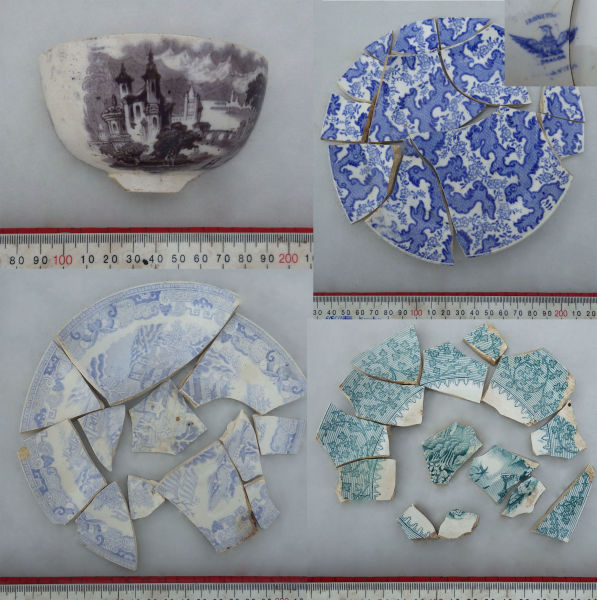
Ceramic artefacts from one of the rubbish pits on the section. Image: J. Garland.

Ceramic artefacts from one of the rubbish pits on the section. Image: J. Garland.

While it is difficult to associate the features found on the site with any one resident during the 19th century, it is almost certain that some of them were deposited by Hiorns and his family, including some of the 1037 artefacts found in the large depression to the rear of the building. That particular feature looks to have been used for the disposal of rubbish over an unknown period of time, based on the presence of small concentrations of objects within the feature as a whole, the size of the assemblage, and the wide range of manufacturing dates found among the artefacts. Many of the artefact dates, however, fit in well with the period in which Hiorns was resident on the section. On top of this, the assemblage contained a large number of alcohol bottles and several artefacts which are considered to be “higher status” items, or objects more often associated with people of reasonable wealth. It would make sense for the man who a) ran a hotel and wine bar and was in court more than once on alcohol related charges and b) later purchased the prestigious Linwood House, to have owned items like these.

Selected glass bottles from the site, including Rowland's Macassar Oil, a Piesse and Lubin perfume bottle and part of an infant feeding bottle. Image: J. Garland.

Selected glass bottles from the site, including Rowland’s Macassar Oil (mid-right), a Piesse and Lubin perfume bottle (top right) and part of an infant feeding bottle (top left). Image: J. Garland.

The assemblage also contained large quantities of ceramic tea and table wares, as well as household and hygienic items like chamber pots, wash basins and ointment pots, a quantity of shoes and fabric, food containers, pharmaceutical bottles and children’s artefacts. One of the most interesting finds, however, was a cluster of clay tobacco pipes that included pipes with political motifs as decoration. These pipes – bearing the name and bust of William Gladstone, liberal English politician, and the name of Garibaldi, famously nationalist and progressive Italian general – can easily be tied into Hiorns’ political engagement (which I sort of alluded to above, but haven’t had time to go into detail about) and the politically charged narrative of this entire Armagh Street site (which I definitely haven’t had time to go into). They’re an example of material culture that is actively entangled with the more intangible ideas and ideals of the people and society by which they are made and used (a topic for another day, I think).

Clay smoking pipes found in Feature 3 (the depression to the rear of the house). Image: J. Garland.

Clay smoking pipes found in Feature 3 (the depression to the rear of the house). The Gladstone pipe is the one in the top row, while the Garibaldi pipe is second from the right in the second row from the top. Image: J. Garland.

I may have started this post with a melodramatic paragraph that reads more as pulp fiction than historical narrative, but in truth, the story of Edward Hiorns (and all of the residents of this block of Armagh Street) is not all that sensational. What it is, however, is a tale we come across all the time in Christchurch. There are many interesting themes to be found in the archaeological and historical records of his life, but two of the most interesting from my perspective are the way he “improved” his situation in life, so to speak, and the way he involved himself so readily in the governance and development of the city in which he had settled. It’s a combination that we see again and again in the lives of Christchurch residents from the 19th century.

People talk a lot about the fluidity of class and social affluence in the 19th century, especially in colonial settlements like New Zealand, and the significance of the capitalist ‘entrepreneurial spirit’ in the prospering of Victorian society. These are both more than evident in the case of Mr Edward Hiorns (and Mr Jamieson, and Mr Ruddenklau and Reverend Fisher). What is just as evident, however, is the active engagement made by people like Hiorns with the present and future of the community in which they lived – be it at the local, national or global level. I could, with the aid of Mr Hiorns and others, very easily take you all down the rabbit hole with me here into the fascinating world of political and social change in 19th century Christchurch (the labour movement! radicalism! women’s suffrage!) and the lives of the people who fought to change the world around them, but that is too much for any one blog post, let alone this one. Nevertheless, it bears remembering that theirs were the hands that shaped a city and, though the city, helped to shape a nation.

Jessie Garland.

References

LINZ, c. 1850. Deeds Index – A – Christchurch town sections and town reserves. Archives New Zealand, Christchurch Office.

McAloon, J., 2000. The Christchurch elite. In Cookson, J. and Dunstall, G., eds). Southern Capital Christchurch: Towards a City Biography, 1850-2000., pp. 193-221. Canterbury University Press, Christchurch.

Wright, G. R. 1998. The Petty Bourgeoisie in Colonial Canterbury; A Study of the Canterbury Working Mans’ Political Protection and Mutual Improvement Association (1865-66) and the Canterbury Freehold Land Association. MA Thesis, University of Canterbury.

Papers Past. [online] Available at www.paperspast.natlib.govt.nz.

Blowing smoke: clay pipes, advertising and other things in the 19th century

As the study of human history, it comes as no surprise that archaeology can be an exercise in contradictions. Humans are, after all, complex and paradoxical creatures. From a material culture perspective, one of the most obvious and frustrating incongruities lies in the dissonance between a profession with classification at the heart of its investigative method and a subject – a world – that defies easy classification. People, and the things we create, the objects we use, are not easy to put into tidy little boxes, however much we might like to do so.

This is particularly obvious when it comes to understanding the role of objects in the past, specifically, the different ways in which we have used them. Many of the artefacts we find in the archaeological record are likely to have had more than one function during their ‘uselife’. Sometimes this is a result of re-use: a teacup repurposed as a measuring cup, a beer bottle base used as a preserving jar, a coin turned into jewellery. Sometimes an artefact can have several different purposes, depending on how you look at them and why they are being used: ointments with both medical and cosmetic qualities, for example, or coffee cans that are as much souvenirs as they are objects for drinking out of. Children’s ceramics that were simultaneously intended to be vessels for children to eat off and objects which reinforced educational and social ideals.

Polyfunctional-artefacts-for-web

Artefacts with more than one use. Left: souvenir cups, functioning as both drinking vessels and mementos. Right: alcohol bottles with the tops cut off to turn them into preserving jars. Image: J. Garland & G. Jackson, K. Bone.

Another good example of this is the humble clay pipe, an object which, on the surface, has a fairly definitive and obvious purpose – smoking tobacco (or flammable substance of your choice, I suppose). Yet there are numerous recorded instances in the past of clay pipes being used for activities that have nothing to do with smoking. Archaeological investigations in the United States have discovered clay pipe stems converted into penny whistles through the addition of drilled holes, while other accounts describe the use of stems as hair curlers (when warmed, of course), gardening aids (for killing bugs in carnations, specifically) and even murder weapons (Walker 1976). One record recounted the use of clay pipes as a prop in dancing, “where about a dozen pipes were laid close together on the floor and the dancer placed the toe of his boot between them while keeping time to the music” (Walker 1976: 125). Our own New Zealand newspapers advertise their use as bubble-blowing instruments for children and the occasional adult (Observer 17/05/1902: 7). There’s even an excellent and somewhat disturbing illustration of their use in the application of horse enemas for the treatment of ‘lilac passion’ in the 17th century (I kid you not).

A selection of alternative uses for clay smoking pipes. The expression on the horse's face is priceless. Images:

A selection of alternative uses for clay smoking pipes (the expression on the horse’s face is priceless). Images: Auckland Star  19/11/1936: 26,Observer 17/05/1902: 7, Society for Clay Pipe Research 1984.

With the exception of the bubble blowing, which used new pipes, all of these alternative uses were, presumably, carried out after the pipe in question had been smoked (although in the case of the horse enemas, all bets are off). They’re cases of re-use, the 19th century (or earlier) recycling of an object that was no longer wanted or needed for its original purpose. We see this with quite a few artefact types, but most often with glass bottles and jars (we’ve talked about it a little on the blog before). There’s another use for clay pipes, however, that relates directly to their nature as a highly visible and easily available object on which any motif, slogan or name can be displayed. This function was exploited by people in the 19th century for all kinds of political, social and commercial objectives including, as is evident in Christchurch’s archaeological record, advertising.

We recently found a large assemblage of clay pipes on one of our sites in central Christchurch, including fourteen pipes bearing an oval mark with HEYWOOD / LYTTELTON / NZ impressed on the bowls. The mark refers to the business of Mr Joseph Martin Heywood, general commission agent, insurance agent, customs agent, goods transporter and all around 19th century entrepreneur. Heywood first set himself up in business as a general commission agent in Lyttelton in 1851 in partnership with Messrs. Tippetts and Silk, which I think sounds like the name for a detective agency and my co-worker argues sounds like a tailor’s shop (crime fighting tailors?; CCL 2013). The partnership dissolved, and Heywood went on to expand his business into Christchurch: in addition to his premises on Norwich Quay in Lyttelton he also had a building on the corner of Colombo Street and Cathedral Square in the city (Star 22/10/1897: 2, Press 19/12/1908: 8). His business interests expanded as well, going from ‘general commission agent’ to operating a customs house and a ‘cartage’ company, involved with the storage and transportation of goods between Lyttelton and Christchurch. He was exceedingly successful, securing the railway contract for the delivery of goods between the two towns in 1879 and holding it until 1896 (Cyclopedia of New Zealand 1903).

Selection of Heywood pipes found on one site in Christchurch. Image: J. Garland.

Selection of Heywood pipes found on one site in Christchurch. Image: J. Garland.

We’ve found pipes with his mark on them on a couple of sites in the city, dating from the 1860s to the 1880s. All of them refer to the Lyttelton store, suggesting to me that this was the premises most closely associated with Heywood or the one from which the pipes were sold (although they could easily have been sold from the Christchurch store). At least one advertisement for the Norwich Quay store lists “pipes, meerschaum washed (Heywood’s)” available for purchase, telling us that, although the ones we’ve found aren’t meerschaum, Heywood definitely sold pipes bearing his name in his store (Lyttelton Times 31/07/1861).

A close up of the Heywood / Lyttelton mark found on the pipes. Image: J. Garland.

A close up of the Heywood / Lyttelton mark found on the pipes. Image: J. Garland.

All the pipes that we’ve found with the Heywood mark were also made by Charles Crop, a prolific London pipe maker, making it likely that Heywood commissioned pipes exclusively from the one manufacturer. It’s not likely to have cost him very much: one price catalogue from 1875 for D. MacDougall and Co. gives a price of 2 pence for a gross extra (12 dozen or 144) of “pipes stamped with name on bowl or stem” (Sudbury 1978: 106). He also wasn’t the only one to do it. We’ve featured pipes bearing the mark of Twentyman and Cousin and Trent Brothers here on the blog before. This suggests to me that not only was this a common thing for pipe-makers to offer, but it was a relatively common thing for Christchurch businesses to commission and use clay smoking pipes as a means of advertising for their own companies. Not just Christchurch businesses, either: we’ve found at least one pipe with the name of an Australian tobacconist business on it as well.

Two clay pipes marked with the names of local Christchurch retailers. Image: J. Garland.

Pipes marked with the names of Trent Brothers and Twentyman & Cousin, local Christchurch businesses. Image: J. Garland.

It’s not that surprising, when you think about it. As a cheap and disposable item (one of the 19th century’s first truly disposable objects), clay pipes provided an excellent medium for advertising a range of products and businesses throughout the European world. They were everywhere: pipe smoking was exceedingly popular during the 19th century, and was one of the few activities that crossed almost all social and status boundaries in society. Anyone could smoke a pipe. They were highly visible: marks or decoration on the front of a pipe bowl would be seen by anyone in conversation with or even just sight of the smoker, while marks on the back of the bowl were in the eyeline of the smokers themselves. Even their fleeting existence was an advantage: being disposable items allowed advertisers to not only continue to sell or distribute them, again and again, but also to change or update their marks, emblems or decoration as they wished.

They were most often used to advertise the associated paraphernalia of smoking, as one would expect, from tobacco and tobacconists’ shops to the pipe makers themselves (Walker 1976). Increasingly, though, as the 19th century unfolded, they were used to advertise the general businesses of merchants and agents, locally and internationally, and it’s interesting that this is the only type that we’ve found in Christchurch. All three of our locally commissioned pipe examples relate to businesses that have nothing to do with the smoking industry itself. Heywood had many fingers in many pies, but none of them were specifically related to tobacco, while Trent Brothers operated a chicory farm and Twentyman and Cousin were wholesale and retail ironmongers. I suspect that this simply reflects the fact that by the time these businesses were operating, the value of pipes as merchandise had begun to equal their value as smoking paraphernalia, resulting in their commissioning by a wider variety of business types.

There are all kinds of directions we could go in with these pipes and what they tell us. The use of mass-produced disposable items as an advertising medium is both something that relates to the modern day (basically the 19th century equivalent of the tote-bag?), as well as to the rise of modern consumerist culture and the huge role advertising played in the development and maintenance of that culture. As commissioned objects they tie into the increasingly globalised nature of international trade and goods production, representing in physical forms the relationship that existed between colonial businesses and British manufacturers. Their simultaneous function as an implement of smoking and a form of advertising also has implications for how we look at and understand the role of objects in our lives, both in the past and in the modern day. They fulfil certain purposes in our own lives, but they’re also part of wider social and cultural phenomena that we may not even think about which shape, and have shaped, the world around us.

Jessie Garland

References

CCL (Christchurch City Libraries), 2015. [online] Available at www.christchurchcitylibraries.com. 

Cyclopedia Company Ltd., 1903. Cyclopedia of New Zealand: Canterbury Provincial Distict. Cyclopedia Company Ltd., Christchurch. [online] Available at www.nzetc.victoria.ac.nz.

Lyttelton Times. [online] Available at www.paperspast.natlib.govt.nz. 

Observer. [online] Available at www.paperspast.natlib.govt.nz. 

Press. [online] Available at www.paperspast.natlib.govt.nz. 

Star. [online] Available at www.paperspast.natlib.govt.nz. 

Sudbury, B., 1978. Additional Notes on Alternative Uses for Clay Tobacco Pipes and Tobacco Pipe Fragments. Historical Archaeology, Vol. 12: 105-107.

Walker, I., 1976. Alternative Uses for Clay Tobacco Pipes and Tobacco Pipe Fragments. Historical Archaeology, Vol. 10: 124-127.

Feminine, masculine, grounds for divorce: the social effects of wearing perfume in the 19th century

When it comes to personal fragrance (continuing on from our post a couple of weeks ago), exactly which perfumes and deodorants we choose to wear can reveal a lot about us, as individuals and as a society. How we define ‘smelling nice’, for example, can vary depending on factors like the identity of the individuals present, their gender, the strength of the perfume or the context in which it is worn. A strong perfume in an enclosed space (on a plane, perhaps, with no chance of escape) can be the opposite of nice, for example, and it’s no secret that there are noticeable differences in the smells deemed attractive for men and women. In truth, many perfumes can be said to reinforce gender distinctions, through socially acceptable or traditional notions of ‘masculine’ and ‘feminine’ scents.

There’s a certain level of subjectivity – we do, after all, wear scents that we like personally – but perfumes are, unquestionably, involved in a wider social discourse in which the way we choose  to smell says something about who we are, whether we want it to or not.  Really, we only have to look at modern advertisements for perfumes and deodorants to see how much the way we smell is entangled with popular notions of, say, femininity or masculinity (and other aspects of social identity – wealth, status, elegance, refinement, desirability, etc). Whether those advertisements do this by choosing to challenge those stereotypes (Chanel, I’m looking at you) or reinforcing them (Old Spice, without a doubt), they’re still very much working from the basis that our personal fragrance is not just a fragrance.

Old Spice advertisement. The manliest of fragrances, apparently. Image:

Old Spice advertisement. The manliest of fragrances, apparently. Image: Riggs Partners.

People have been wearing perfume for a very long time, and it’s always been a marker of personal identity. In older societies, for example, perfume would have said something about the wealth of the wearer and their ability to afford frivolities like artificial scent. It still does, to a degree, just not for all perfumes: wearing an easily recognisable and expensive perfume today immediately implies that the wearer has a certain level of disposable income (or is willing to skimp on other things to afford it). Many perfumes today play to this, using images of wealth and luxury to see their fragrances (Dior, looking at you this time).

In the 19th century, perfume became inextricably entangled with gender. Some studies have suggested that the gender distinction in the perfume industry emerged out of early 19th century changes in society and social structure. With the growing prominence of the ‘bourgeoisie capitalists’ came a new set of social values, which included new perspectives on masculinity and femininity. In particular, one researcher suggests that “it was absolutely not done for men to spend their money on such ‘wasteful frivolities’. To put it bluntly, the modern (male) capitalist had better things to do, and with the exception of a small group of male artists and dandys [and there’s a stereotype all in itself], perfume became the exclusive domain of women” (Aspria 2005).

By the latter half of the 19th century, a brief scan of contemporary writing indicates that perfume was becoming more and more gendered, especially towards women. Although men did wear artificial fragrance (something that became increasingly acceptable in the early 20th century), perfume seems to have been a large part of the Victorian ideal of the proper, feminine woman (and, it follows, the absence of floral scents with an ideal of masculinity). It’s not so much that every perfume wearer was a proper lady, but rather that every proper lady wore perfume – of the correct strength and correct fragrance, of course. Lord help anyone who wore musk.

More than just a fragrance, the wrong perfume (musk, again, no surprises there) could even be blamed for the breakdown of a marriage, the transformation of “affection into aversion”, the “unwillllingness to marry which is one of those difficult questions which modern Governments at census times periodically have to consider .”

More than just a fragrance, the wrong perfume (musk, again, no surprises there) could even be blamed for the breakdown of a marriage, the transformation of “affection into aversion” and the “unwilllingness to marry which is one of those difficult questions which modern Governments at census times periodically have to consider.” Image: Hastings Standard 19/03/1904: 2.

There were numerous articles and advertisements in which various scents were discussed in correlation with certain feminine ideals, some even going so far as to describe the character traits found in women wearing particular scents. Significantly, all of these descriptions used terminology like ‘dainty’, ‘warm-hearted’, ‘unassuming’, ‘quiet temperament’ and ‘lovable if not very strong nature’ (ouch). One article described how “the suggestion of an ethereal atmosphere in which a slight and delicate fragrance has a part” immediately spoke of the wearer’s refinement, charm and a ‘gracious personality’.  Another writes that  “delicate odours, such as violet, heliotrope or orris root, are always permissible…a moderate use of a faint, suggestive odour, such as wood violet, for instance, is all in the way of a perfume that is allowable by a really refined woman.”

Article on the various character traits associated with the use of certain perfumes. Image:

Article on the various character traits associated with the use of certain perfumes. Image: Timaru Herald 31/03/1900: 6.

This positive ideal to which women were encouraged to aspire is reinforced again by descriptions of the negative image: the “superabundant use of the cheap stuff” is discussed in terms of “artificiality, vulgar and unredeemed [women]” (New Zealand Herald 19/09/1913:10). The claim that “a woman who saturates her belongings with strong perfumes…is likely to be mean-spirited, over-ambitious, strong-willed, but uncertain in temper” becomes an automatic judgement and dismissal of a person’s character, derived entirely from the way she smells. It simultaneously defines the identity of that person and reinforces the social ideal that is her contrast: the refined, demure, calm and content woman who only ever wears the appropriate level of perfume. It’s also, in a Victorian context, tied into the widely held belief in the importance of moderation and the physically, morally and socially debilitating effects of excess in any aspect of life.

Of course, it doesn’t necessarily follow that the reality of life accurately reflected these social ideals as they were discussed in the written record (or vice versa), even if they were seemingly widespread. No matter what we read in historical accounts, we don’t know that people actually believed that perfume could develop character, that someone meeting a new acquaintance would smell roses and think “she must be imaginative and warm-hearted”, or that the ‘ideal of femininity’ discussed so often in writing was as prevalent or as valued in day to day life.

The archaeological record is important here, as another data set against which we can compare written information. The contrast allows us to tease out the similarities and differences between the ways in which people present themselves (and others) in writing and the ways they do so in the physical world. Even more importantly, we can examine why those differences exist: the disconnect between written and physical history can be as important in understanding human behaviour in past societies as the actual records themselves.

For example, despite the increasing popularity of perfumes in the written record towards the end of the 19th century, especially for women (the number of perfume advertisements increases exponentially in the 1880s and 1890s), we don’t find that many perfume bottles on archaeological sites here in Christchurch. And we have to wonder why. Is it because of something specific to Christchurch? Were people here less into perfumes than elsewhere in the world? Is it the result of other social behaviours: i.e. rubbish disposal practices, reuse of perfume bottles or other ways of obtaining perfumes?

We do know that it was possible to make your own perfumes. There were several recipes and detailed instructions available for the self-sufficient Victorian woman (they’re always directed at women) who wished to make her own fragrance. Perhaps this was happening in Christchurch? I don’t know. As an aside, there’s another ‘ideal’ perpetuated through these do-it-your own perfume instructions for women: as well as constructing and reinforcing a concept of femininity, they also touch on the ‘industrious woman’, part of the ideal of domesticity that was so prevalent in the 19th century.

Instructions on how to make your own perfumes.

Instructions on how to make your own perfumes. Most perfumes, as this article suggests, were alcohol-based, leading to several accounts of people drinking them recreationally. Image: Clutha Leader 8/01/1892: 7.

In another example, one might be inclined, given the large quantity of literature relating perfumes to femininity, to see perfume bottles on archaeological sites as an indication of the presence of women. Yet, many of the perfume bottles we’ve come across (and I’m only talking about the small proportion that can be identified to brand, here) are brands or fragrances that were used by men as much, if not more than, women. Eau de Cologne, in particular, is increasingly associated with the ‘masculine toilette’ in the late 19th and early 20th centuries, although it’s certainly also used by women (Star 16/7/1904: 3West Coast Times 2/5/1907: 2) . Both Florida Water and the 4711 fragrance also appear to have been used by men as well as women.

Bottle of Mulhens 4711 cologne (left) and the Farina Eau de Cologne (right) found in Christchurch. Image: J. Garland.

Bottle of Mulhens 4711 cologne (left) and the Farina Eau de Cologne (right) found in Christchurch. Both of these appear to have been used as much by men as by women in the late 19th and early 20th centuries. Image: J. Garland.

What does this mean? Is it just a result of our sample? Maybe all the unlabelled, unbranded perfume bottles contained stereotypical feminine floral scents and we just don’t know. Or does it follow that notions of femininity and the ‘proper woman’ were different in Christchurch? That notions of masculinity were different? Are we seeing an example of a division between a social commentary largely derived from life and society in Britain and the distant reality of life in New Zealand? Am I speculating too much? Possibly. In truth (and we don’t have enough information to figure it out yet), the answer is probably more complex than any one of these possibilities. It usually is.

All the same, questions like these are an excellent reminder of how much the tangible things we use in our daily lives – like perfume – are connected to the intangible social constructs we navigate through every day, be they gender, personal identity or moral values. This material culture that we’re recovering from these sites, these pieces of broken glass, broken ceramic, broken rubbish – they’re more than just physical objects. They were part of a socio-cultural discourse – active agents in the construction, maintenance and transformation of human behaviour, of our social ideals and perceptions, especially regarding the perception of certain social stereotypes – in this case, the ‘ideal’ Victorian woman.

Basically, things aren’t ever really just things: they’re (in every sense of the word) artefacts of our lives, past and present, intrinsically entangled with who we are and, often, who we want to be.

Jessie Garland

References

Aspria, M., 2005. Sociologist Marcello Aspria: interview about perfume and gender. [online] Available at: www.boisdejasmin.com/2005/10/perfume_and_gen.html.

Aspria, M., 2005-2009. Scented pages. [online] Available at: www.scentedpages.com/default.html. 

Lindqvist, A., 2012. Preference and gender associations of perfumes applied on human skin. In Journal of Sensory Studies 27(6): 490-497.

New Zealand Herald. [online] Available at: www.paperspast.natlib.govt.nz.

Star. [online] Available at: www.paperspast.natlib.govt.nz.

West Coast Times. [online] Available at: www.paperspast.natlib.govt.nz.