The difficulties of dating #1: age is not equal to experience

One of the most commonly assumed facts about archaeologists (aside from our ability to have adventures, look good in a fedora and be surprisingly skilful with a whip), is that we can look at an object and know how old it is. While this (much like the fedora and whip thing) is not true of all archaeologists, the ability to date artefacts is an integral part of the archaeological process. It is by no means the only part, but it is an important feature of our work and one that can, on occasion, be a little bit frustrating.

Today’s post is the first of three looking at how we date artefacts and assemblages; what this means for the broader archaeological interpretation of sites and people in the past; and some of the difficulties we encounter along the way. This week focuses on some of the issues involved in using evidence of manufacturing methods to date artefacts – specifically, glass bottles – and how those dates relate to the use and eventual discard of an object.

Illustration of the glassmaking methods used in England in 1858.

The glassmaking methods used in England in 1858. Early glass vessels were ‘freeblown’ or blown by skilled glassmakers without the aid of a mould and are easy to identify, since they’re often asymmetrical with various degrees of imperfections in the glass. Alternatively, bottles blown using a mould can be identified by the seams left on the glass where the mould closed/opened (see below) and by the obviously hand finished tops. There’s an excellent video of the mould blowing process here, under the mould blown manufacturing section. Image: William Barclay Parsons Collection, New York Public Library Archives. Accessed through Wikimedia Commons.

When we find artefacts at a site and get them back to the lab, one of the first things we look at is when they might have been made (even though we’re most interested in when they were used, which is not the same thing). Bottles (and other artefacts as well) are covered in physical clues that can help date when they were made, thanks to modifications in manufacturing techniques and changes in style or fashion over the decades. Such clues are visible in the seams of a bottle, its shape, the type of closure (top of the bottle) and a hundred other scars and traces left behind by the manufacturing process.

Various glass bottle moulds, into which the hot glass would have been placed and then blown into shape by skilled glassblowers during the 19th century.  From left to right: a dip mould, tapered inwards towards the bottom to aid in the removal of the cooled glass. Dip moulded bottles usually date to the first three quarters of the 19th century (not always, though!) and are identified by a ridge  and/or seam running around the shoulder of a bottle, where the mould ended and the bottle was finished by hand.

Various glass bottle moulds, into which the hot glass would have been placed and then blown into shape by skilled glassblowers during the 19th century. These would have resulted in seams running up the sides of the bottles they made (in the case of the two piece moulds) or around the shoulder (where the dip mould stops), which allow us to identify exactly which method was used. Dip moulds tend to suggest earlier dates of manufacture than two piece moulds (although not always!). Images: Lindsey 2010

Image of the Owen's Automatic Bottling Machine, #6. Michael Owen's invention, patented in 1904, was the first fully automated   bottle making machine and paved the way for the 20th century machine made bottle industry. Image: Walbridge 1920, taken from Lindsey 2010.

Image of the Owen’s Automatic Bottling Machine, #6. Michael Owen’s invention, patented in 1904, was the first fully automated bottle making machine and paved the way for the 20th century machine made bottle industry. Image: Walbridge 1920, from Lindsey 2010.

The information these scars provide can be anything from extremely broad date ranges to quite narrow periods of manufacture. There’s an obvious and highly visible distinction, for example, between 20th century machine made bottles and (usually) pre-1900 mould or free blown bottles, but dating an artefact to one century or the other is, unfortunately, a little inexact for our purposes. On the other hand, characteristics like crown top closures (invented in 1892) or the Codd style soda bottle (patented in 1870 (UK) and 1873 (USA) and used until the early 20th century) can help to narrow down the date to a specific decade (Lindsey 2010).


From right to left: A 19th century dip moulded black beer bottle, probably made before the late 1880s (note the slightly wonky shape); a crown top Robinson & Sons bottle manufactured after 1892; a 20th century machine made pharmaceutical bottle, dated by the seams you can see running up the side of the bottle to the top of the lip; a Codd style Smith & Holland soda water bottle, made after the style was patented in 1873 (in this case we know the bottle was made between 1920 and 1924, when Smith & Holland were operating). Images: J. Garland.

From left to right: A 19th century dip moulded black beer bottle, probably made before the 1880s (note the slightly wonky shape); a crown top Robinson & Sons bottle manufactured after 1892; a 20th century machine made pharmaceutical bottle, dated by the seams you can see running up the side of the bottle from the base to the top of the lip; a Codd-style Smith & Holland soda water bottle, made after the style was patented in 1873 (in this case we know the bottle was made between 1920 and 1924, when Smith & Holland were operating). Images: J. Garland.

A page from the 1906 catalogue of the Illinois Glass Company, one of the many glassmaking companies operating in the 19th and early 20th century. Image taken from Lindsey 2010.

A page from the 1906 catalogue of the Illinois Glass Company, one of the many glassmaking companies operating at the time. Image: Lindsey 2010.

Unfortunately, however, some bottles have very few traces of the manufacturing process evident on the glass and can only be dated very roughly. Even when the details of manufacture are visible, we have to be aware that the transition from one manufacturing technique to another (and thus their associated dates) was never clear cut. Since these bottles were being made by individual glassmaking companies and, within that, by individual glassmakers, a lot of the variation in early bottles is as dependent on the people behind the process as it is on the technology available. It’s simultaneously one of the coolest things about 19th century artefacts – the personal touch behind each object – and the most frustrating, from a dating perspective at least.

Glass blowers

A 1908 photograph of a gaffer (glassblower) and his team manufacturing glass bottles at West Virginia factory. Image: Lewis Hine photo, Library of Congress, from Lindsey 2010.

Fortunately, we have alternative ways of figuring out the manufacturing dates of glass vessels. As we’ve mentioned before, sometimes bottles will have a maker’s mark stamped on the base and, depending on how often a manufacturer changed their stamp (and how well documented those changes are), we can use these to establish when an artefact was made. Other times, we’ll be able to determine the contents of the bottle from embossing on the glass and figure out when that product was being made or sold – like many of the pharmaceutical and soda bottles we’ve already featured on the blog.

Left: A bottle base made by glassmakers Cooper & Wood, Portobello (Scotland). We know that the company began in 1859, but the partnership dissolved in 1868, giving us a 9 year range for the manufacture of this bottle. RIght: An R & J Milsom Lyttelton aerated water bottle. Again, we know that Richard Milsom and his son James went into partnership in 1879, but James became sole owner in 1885, dating the manufacture of this bottle to the 6 year period they were in business together.

Left: A bottle base made by glassmakers Cooper & Wood, Portobello (Scotland). We know that the company began in 1859, but the partnership dissolved in 1868, giving us a 9 year range for the manufacture of this bottle (Toulouse 1971: 141). Right: An R & J Milsom, Lyttelton, aerated water bottle. Again, we know that Richard Milsom and his son James went into partnership in 1879, but James became sole owner in 1885, dating the manufacture of this bottle to the 6 year period they were in business together (Donaldson et al. 1990). Images: J. Garland.

This is great if the product is a short-lived one that’s well documented, but more often than not we’ll come across a product like Lea & Perrins, which has been made continuously since the 1830s or one like W & W’s Double Refined Table Salt, about which very little information was available (Tasker 1989: 88). Similarly, a bottle manufacturer might have used the same maker’s mark on a bottle for a long period of time: glassmaking company Parke, Davis & Co used the same initials on its bottles from 1875 through until the 20th century (Toulouse 1971: 417). Even if the marks do change over time, if there’s no record of those changes and when they occurred, we still can’t narrow down the date.

Left: A Lea and Perrins bottle, with a date of manufacture somewhere between 1852 (first imported into New Zealand) and the early 1900s. Right: the base of a jar of W & W's Double Refined Table Salt, of unknown age.

Left: A Lea and Perrins bottle, with a date of manufacture somewhere between 1852 (when it was first imported into New Zealand) and the early 1900s. Right: the base of a jar of W & W’s Double Refined Table Salt, of unknown age. Images: J. Garland.

Sometimes a maker’s mark will only be visible as initials or a monogram that we can’t always trace back to the manufacturer. These can be some of the most frustrating artefacts to come across when you’re trying to date a site, because we know that the information is there, on the bottle, but we can’t find or access the resources to make that information useful.

And, while these bits and pieces of information might be able to tell us when a bottle was made, they don’t necessarily tell us when it was used (or how long for) and more importantly, if we’re looking at a whole site, when it might have been discarded. Most of the artefacts we find on 19th century archaeological sites in New Zealand were made overseas and we have to consider the time it would have taken for them to reach New Zealand when we’re figuring out our dates. We also have to consider the length of time for which an object might have been used – its ‘uselife’ – before being discarded or lost, and ending up in the ground.

With bottles, this is a particular problem thanks to an issue known as bottle re-use. A lot of (if not most) 19th century bottles would be reused many times by the contents manufacturer (or another manufacturer entirely) before being thrown out (Busch 1987).In New Zealand, this occurred in response to the absence of a local glassmaking industry until the early 20th century and the effort involved in importing bottles from overseas. Newspapers from the time are filled with advertisements from hotels, soda water manufacturers and pharmacists offering discounts or cash for the return of bottles. There are cases of court action being brought against people or companies who failed to return bottles and were consequently convicted and fined for the offence.

Notices and advertisements in New Zealand newspapers on the issue of bottle return and reuse. Images: Evening Post 10/09/1908; Colonist 13/09/1919; Auckland Star 19/11/1926.

Notices and advertisements in New Zealand newspapers on the issue of bottle return and reuse. Images: Evening Post 10/9/1908; Colonist 13/9/1919; Auckland Star 19/11/1926.

Of course, from a dating perspective, issues like bottle reuse mean that the date of manufacture is almost never an accurate reflection of when a bottle was being used or eventually discarded. It’s just a starting point in the life of an artefact, one piece of information about an object that usually has a bunch of other stories to tell. It’s only when we take that starting point and look at it in light of all the information an object (and the other objects around it) can give us that it becomes a useful window into the past.

And, despite the difficulties involved in artefact dating, it is hugely important that we ask the question in the first place, because it gives us the chance to link assemblages and objects to people in the past. If we can date the use and discard of an object to a specific period, we might be able to figure out who used it and why they threw it away. It’s part of what makes context so integral to what we do, and why we get frustrated with fossickers and people who dig up sites illegally to find collectables – because in doing so, they destroy the additional information that we could have used to link an object with the people who used it.

It’s one of the most important principles of archaeology – that (unlike Indiana Jones) we’re not just interested in the things (although the things are pretty cool and very useful), we’re interested in people and what those things can tell us about them.

Jessie Garland

References

Auckland Star. [online] Available at http://paperspast.natlib.govt.nz.

Busch, J., 1987. Second Time Around: A Look at Bottle Reuse. Historical Archaeology, 21(1):67-80.

Colonist. [online] Available at http://paperspast.natlib.govt.nz.

Donaldson, B., Hume, G. & Costello, S., 1990. Antique Bottles and Containers of Christchurch and District. Christchurch Antique Bottle and Collectors Club, Christchurch.

Evening Post. [online] Available at http://paperspast.natlib.govt.nz.

Lindsey, B., 2010. Historic Glass Bottle Identification & Information Website. Society for Historical Archaeology and Bureau of Land Management. [online] Available: http://www.sha.org/bottle/index.htm.

Tasker, J., 1989. Old New Zealand Bottles and Bygones. Heinemann Reed, Auckland.

Toulouse, J. H., 1971. Bottle Makers and Their Marks. Blackburn Press, New Jersey.

The Standard Hotel: beer, burlesque and a “sketchy kind of farce”

This week we’re delving into the seedier side of the life in early Christchurch with the story of the Standard Hotel, an establishment that found itself on the fringes of Victorian respectability during its short existence in the 1860s. At the heart of this tale are two brothers, James and William Willis, who appear to have trod very different paths to success (or not, as the case may be) after their arrival in the city.

Portrait of Joseph Brittan, founder of the Canterbury Standard. Image: Wikimedia Commons & Rolleston 1971.

Portrait of Joseph Brittan. Image: Wikimedia Commons & Rolleston 1971.

The story begins with James Willis, a printer by trade, who arrived in Christchurch in the early 1850s (Lyttelton Times 7/5/1853: 6). By 1855, he was the official printer to the Canterbury Provincial Council (Lyttelton Times 20/01/1855: 4). It’s here that he probably made contact with Joseph Brittan, one of Christchurch’s prominent early citizens and the founder of the Canterbury Standard, the third newspaper to be established in the city (Lyttelton Times 13/8/1853: 12). James went on to work with Brittan on the paper, becoming the printer, part owner and eventual proprietor of the publication in the late 1850s and early 1860s (Burke Manuscript n.d.: 114).

An article in the Lyttelton Times in 1853, announcing the establishment of the Canterbury Standard, to be

An announcement of the Canterbury Standard‘s founding in the Lyttelton Times in 1853 claimed that “the public good will be it’s guiding principle [and] the advancement of the interests of the Province its constant aim.” Image: Lyttelton Times 13/8/1853: 12.

The Canterbury Standard was produced and printed in a building located on the corner of Hereford Street and Oxford Terrace in central Christchurch, just across the road from Brittan’s home on the other side of Hereford Street. Early images of the building show a two storey façade at the front, facing onto Oxford Terrace, with the printing sheds (to house the printing press) extending along Hereford Street.

Burke's Manuscript cropped

Sketch of the Canterbury Standard building and proprietor, James Willis. Image: Burke Manuscript: 114, accessed through the Christchurch City Libraries.

James continued to operate a printing press in this location until his death in 1866, under the eventual auspices of the Telegraph Printing Press (Press 8/12/1866: 2). During the last few years of his life, however, he shared the premises with his brother, William Willis, who took the old Standard offices at the front of the building and transformed them into a hotel.

The old Canterbury Standard building, transformed into the Standard Hotel in 1864. Image: Dr. A. C. Barker Collection, Canterbury Museum. Permission of the Canterbury Museum must be obtained before any re-use of this image.

The old Canterbury Standard building, transformed into the Standard Hotel in 1864. Image: Dr. A. C. Barker Collection, Canterbury Museum. Permission of the Canterbury Museum must be obtained before any re-use of this image.

Well, I say hotel…

Advertisement for the opening of the Standard Hotel in July 1864, emphasising the selection of alcohol available. Image: Lyttelton Times

Advertisement for the opening of the Standard Hotel in July 1864, emphasising the selection of alcohol available. Image: Lyttelton Times 9/7/1864: 5.

The Standard Hotel, which opened in July 1864 (Lyttelton Times 9/7/1864: 5), appears to have had very little to do with offering accommodation and a great deal more to do with drinking beer and providing ribald entertainment. Only one reference to accommodation at the hotel was found in the newspapers of the period and this from an unemployed man staying at the hotel, suggesting that the accommodation available was fairly cheap (LytteltonTimes 6/8/1866: 1). In contrast, advertisements for the opening of the hotel in 1864 place particular emphasis on the selection of ales and wines available for consumption (Lyttelton Times 9/7/1864: 5). We excavated the section next to the hotel earlier this year, where we found a lot of beer bottles. While many of these are associated with the warehouse on that section in the 1870s, some of them may also have been debris from drinking sessions at the Standard in the 1860s.

Some of the black beer bottles excavated from the Standard Hotel site in May 2013. Image: J. Garland.

Some of the black beer bottles that may have been related to the Standard Hotel, excavated from the adjacent site in May 2013. Image: J. Garland.

Advertisement for a performance of Poses Plastique at Willis's Assembly Rooms in 1866.

Advertisement for a performance of Poses Plastique at Willis’s Assembly Rooms in 1866. Image: Press 10/4/1866: 1.

The tone of this particular establishment becomes clear when we look at historical records for William Willis’s Assembly Rooms, opened in 1865 and located next to the Standard Hotel on Oxford Terrace (Press 8/11/1865: 1; 15/02/1866: 1). Although these rooms hosted public auctions and were used by the Canterbury Jockey Club for meetings (Lyttelton Times 1/01/1866: 3; Press 8/11/1865: 1), they were also the setting for a variety of musical entertainments, from vaudeville-style theatre and burlesque to the more risqué Poses Plastique (Lyttelton Times 10/3/1866: 2; 12/3/1866: 2; Press 10/4/1866: 1).

Entertainment at Willis's Assembly Rooms

Advertisements for entertainments held at Willis’s Assembly Rooms in 1866, including burlesque, a “sketchy kind of farce” and “nigger eccentricities”. Images: Lyttelton Times 12/3/1866: 2; 10/03/1866: 2.

While vaudeville theatre may be a form of entertainment familiar to many, the term ‘burlesque’ didn’t mean quite the same thing in a 19th century context as it does now. Rather than involving Dita von Teese-like figures and the sultry dance routines it’s now known for, burlesque in the mid-1800s was simply a form of musical entertainment, often involving elaborate or farcical costumes, parodies and caricatures of well-known historical and literary figures (Oxford English Dictionary).

Clockwise: Advertising poster from 1899 for a vaudeville and ‘hurly-burly’ extravaganza; 1870 advertisement for performance of an Aladdin burlesque at the Theatre Royal in Christchurch; 1897 excerpt from a burlesque titled ‘Doing a Moose.’ Images: Library of Congress Prints and Photographs Collection, accessed through Wikimedia commons; Star 16/5/1870: 3; Observer 15/5/1897: 10.

Poses Plastique, on the other hand, was definitely a form of entertainment that only flirted with the notion of respectability. It was a form of Tableau Vivant, or ‘living scene’, a 19th century performance in which the performers, both women and men, acted as living statues on stage. These performances often involved various states of undress, justified and made ‘classy’ by references to Classical mythology and the imitation of Greek and Roman statues (Anae 2008). Sometimes the performers would wear nude body stockings, so as to give the appearance of undress yet not be completely indecent.

Woodcut of a performance of poses plastique at the Coal Hole in the Strand, c. 1854. Image: Wikimedia commons.

Woodcut of a performance of poses plastique at the Coal Hole in the Strand, c. 1854. Image: Wikimedia commons.

tableau vivant

Advertisement for performances of tableau vivant based on well-known fairy tales. Image: Poverty Bay Herald 25/5/1881: 3.

I should mention that while Poses Plastique was a form of Tableau Vivant, not all examples of the 19th century living statue involved the same degree of undress or risqué material. Tableau Vivant was often used to present famous literary, artistic or historical scenes, such as battles, famous paintings or moments from well-known works like Cinderella (Poverty Bay Herald 25/5/1881: 3).

The performance at Willis’s Rooms in 1866 is one of only two examples of Poses Plastique advertised in New Zealand newspapers before 1900 (Nelson Evening Mail 25/2/1884: 2), although there are numerous references to burlesque and vaudeville shows being held throughout the country (see Papers Past). Clearly, the semi-nude living statue never really took off here, despite enjoying great popularity in London and Australia during the same period.

In Christchurch, at least, one reason for this may have been the disapproval with which such entertainment was viewed by the general authorities and community. While it was not illegal (that we’ve been able to find), we did note that William Willis had his liquor license refused in 1866 due to reports of “objectionable entertainment, low women and noisy people” in the vicinity of his Assembly Rooms late at night (Lyttelton Times 2/5/1866: 2). Interestingly, this notice came soon after the advertised performances of Poses Plastique. Coincidence? I think not.

License refusal

Details of the refusal to renew William Willis’s general license in 1866, citing objectionable entertainment, low women and noisy people. Image: Lyttelton Times 6/5/1866: 2.

The Standard Hotel, along with Willis’s Assembly Rooms, closed its doors in 1867 after only three years of operation (Lyttelton Times 4/7/1867: 1). Later that same year, a fire in the offices of the Telegraph Printing Press next door so badly damaged the building that it was abandoned and moved to Bealey Avenue in early 1869 (Lyttelton Times  4/1/1869: 3). For reasons unknown to us, the section on the corner of Hereford Street and Oxford Terrace remained empty and unused during the following decades, until a suite of offices was constructed there in the early 20th century (Press 16/9/1905: 9).

During its life the Standard Hotel building was home to two very different sides of the social and commercial spectrum, personified in the figures of James and William Willis. From its origins in Joseph Brittan’s, and later James Willis’s, Canterbury Standard, with its guiding principles of “public good [and] the advancement of the province”, to its eventual demise in William’s den of alcohol and “low women”, it showcases a diversity of character and commerce in Christchurch’s early history that we don’t always get to see. Hopefully, as we work our way through the rest of the archaeological material from this site, even more of that variety will be revealed.

Jessie Garland

References

Anae, N. 2008., Poses, plastiques: the art and style of ‘statuary’ in Victorian visual theatre. Australasian Drama Studies. Available at http://eprints.usq.edu.au/7003/.

Andersen, J. 1949. Old Christchurch in Picture and Story. Simpson & Williams Ltd: Christchurch.

Burke Manuscript, 1860s. [online] Available through the Christchurch City Libraries Digital Collection at http://christchurchcitylibraries.com/Heritage/Digitised/Burke/

Canterbury Museum Digital Collections

Lyttelton Times. [online] Available at http://paperspast.natlib.govt.nz.

Nelson Evening Mail. [online] Available at http://paperspast.natlib.govt.nz.

Observer. [online] Available at http://paperspast.natlib.govt.nz.

Oxford English Dictionary. Available online via the Christchurch City Libraries subscription service.

Poverty Bay Herald. [online] Available at http://paperspast.natlib.govt.nz.

Press. [online] Available at http://paperspast.natlib.govt.nz.

Star. [online] Available at http://paperspast.natlib.govt.nz.

Wikimedia Commons. [online] Available at http://commons.wikimedia.org.

A club for Christchurch gentlemen

At the start of an archaeological investigation we often consult historical documents to learn as much as we can about a site’s past. Such research can identify the buildings that were once present, the people associated with the site through land purchase and occupation, and the kinds of activities undertaken at the site. This helps us determine what kind of archaeological remains we can expect during excavation. Often the archaeology meets these expectations, although sometimes a site can completely surprise you.

The excavation of the Canterbury Club is a good example of an archaeological investigation in which the archaeological evidence did not quite match up with information gained from the documentary sources. This evidence was not contradictory. Instead it supplemented the documentary information and ended up providing us with a more multi-faceted interpretation of the site.

 The Canterbury Club on the Corner of Worcester Boulevard and Cambridge Terrace c. 1882. Photo: Christchurch City Libraries, PhotoCD13, IMG0060.


The Canterbury Club on the corner of Worcester Boulevard and Cambridge Terrace c. 1882. Photo: Christchurch City Libraries, PhotoCD13, IMG0060.

The Canterbury Club, on the corner of Cambridge Terrace and Worcester Boulevard, was established for the professional gentlemen of Christchurch in the 1870s. Many noteworthy gentlemen of Victorian Christchurch were members and the building itself was considered to possess plenty of aesthetic and architectural merit (e.g. Press 20/12/1873: 2). The club, and the men associated with it, was therefore well documented in the formal histories of Christchurch and the gentlemen’s clubs of New Zealand. The club itself produced its own published history in the 1970s (Lamb 1972).

Here’s what the formal histories told us about the site. The Canterbury Club was a Victorian gentlemen’s club in the style of its English predecessors – institutions where men of wealth and status met socially and conducted business. By the mid 19th century these clubs had become an integral part of the upper and middle class British male lifestyle, reflecting the Victorian obsession with class (Manning 1991: 1). As a written history of another such club put it:

Having securely anchored his wife at home with a large family and at the same time established himself as ‘the master’ who could do no wrong, the Victorian husband would spend his leisure no longer in drinking to excess and gambling but in surroundings of luxury never excelled, where the house, the food, the wine and the service bore comparison with those found in any royal palace.

          Macdonald 1956

Brooks Club, London, one of the oldest gentlemen's clubs in England. Image: Hatton 1890:

Brooks Club, London, one of the oldest gentlemen’s clubs in England. Image: Hatton 1890: 13.

In 1856 the Christchurch Club was established on Latimer Square, providing a ‘house in town’ for Canterbury’s rural landowners. In contrast, the Canterbury Club was established by urban, professional gentlemen wanting a club that represented their own social sphere (Opus 2006). The 151 founding members purchased Town Section 403 and part Town Section 407 for their establishment, and the buildings were designed in ornate Italianate style by William Armson and Frederick Strouts. The main club buildings were completed in 1874 (a detailed description of the buildings appeared in the Press during construction and can be found here). The club’s service wing was located discretely behind the club and connected to it via a passageway, which was frequented by the club’s serving staff (Press 29/5/1873: 2). These included a cook/housekeeper, kitchen-, scullery- and house-maids, a steward, waiters, a barman and a billiard marker (Lamb 1972: 30). Once the buildings were finished they were furnished by local suppliers J. Ballantyne & Co and Morrow, Basset & Co  (Lamb 1972: 23). The club’s crockery – white with a maroon band and a ‘Canterbury Club’ monogram – was ordered from London. The club was opened officially on 24 October 1874 with an inaugural dinner.

Advertisement calling for founding members for the Canterbury Club. Image: Press 10/7/1872: 1.

Advertisement calling for founding members for the Canterbury Club. Image: Press 10/7/1872: 1.

When excavation began at the Canterbury Club site it was expected that the archaeology would substantiate the information from the written sources. However, only one rubbish pit, containing a minimum number of 165 artefacts, appeared to be related to the club. Moreover, the artefacts recovered from this pit did not quite match up with the written descriptions.

The ceramic artefacts consisted of a mix of ware types. Two large whiteware basins fitted for indoor plumbing and manufactured by J. Tylor & Sons of London were the largest and most complete ceramic vessels recovered from the rubbish pit. Whiteware cups, saucers and plates were the most common vessel forms, but a stoneware bottle, a bone china cup and dyed-body tiles were also found. While cups, saucers and plates were identified in the assemblage, no other forms associated with food presentation and consumption, such as serving vessels, were found. However, variety was evident in the decorative transfer print patterns on these vessels. The ubiquitous Asiatic Pheasant print was identified on one of the vessels, but the basins were the two only vessels bearing the same pattern. No vessel recovered from the rubbish pit could be positively identified as part of the monogrammed set ordered from London for use in the club.

A whiteware basin recovered from the Canterbury Club rubbish pit. Photo: R. Geary Nichol.

A whiteware basin recovered from the Canterbury Club rubbish pit. Photo: R. Geary Nichol.

A collection of ceramic artefacts recovered from the Canterbury Club rubbish pit. Photo: R. Geary Nichol.

A collection of ceramic artefacts recovered from the Canterbury Club rubbish pit. Photo: R. Geary Nichol.

The faunal remains recovered from the pit also contrasted with written information about the type of fare served to club members. Lamb (1972: 26-27) states that goose, turkey, duck, rabbit, pheasant, hare and several types of fish were ordered from the local fishmonger and butcher and served up at the club. A maximum of four species were recovered from the pit – oyster, cow, sheep, and possibly pig. The meat cuts that could be identified – beef chuck, mutton leg and forequarter – were cuts typically used for boiling, mincing and roasting. There was no sign of the more exotic fare known to have been eaten at the club.

A pair of shoes, belonging to an adult male, was also recovered from the pit. These shoes were interesting because they were made with a combination of leather and canvas. It is possible that these were lighter summer shoes, or perhaps a poorer quality shoe than the full leather pieces often recovered from archaeological contexts in Christchurch. Another possibility, given the use of canvas, was that they were used as sports shoes.

Few glass artefacts were recovered from the pit, and this too was inconsistent with known consumption of alcohol by Club members.

The artefacts from the Canterbury Club rubbish pit did not simply reiterate the information in the written sources and so forced consideration of alternative interpretations. It’s possible that these artefacts represented the less formal side of club life and are the debris of run-of-the-mill activities. For example, the basins in the club bathrooms may have been deemed old-fashioned and discarded. Informal lunches, beverages and snacks may have been served on common dishes rather than the monogrammed crockery, which may have been reserved for formal occasions. Similarly, these meals may have consisted of plainer fare than that served on special occasions. A pair of worn sport shoes, forgotten by a Club member after a cricket match, may have been discarded after they went unclaimed. These are the kind of mundane details that do not make it into the formal histories.

A pair of leather and canvas shoes recovered from the Canterbury Club rubbish pit. Photo: R. Geary Nichol.

A pair of leather and canvas shoes recovered from the Canterbury Club rubbish pit. Photo: R. Geary Nichol.

It is also possible that the artefacts relate to the staff of the Canterbury Club rather than its members. The difference in status between members and staff could account for the common dishes and plain fare represented in the rubbish pit, assuming the staff ate separately. The staff would have been present at the club each day, as opposed to the more transient club members, and their everyday meal is unlikely to have consisted of exotic delicacies served on fancy crockery.

The archaeology of the Canterbury Club site highlights the way in which historical documents and archaeological excavation can supplement each other and result in a more multi-faceted understanding than could be reached by either research method alone. Whether the artefacts represented consumption by club members or staff (or both) they are evidence of the more mundane details of club life that were excluded from the formal histories. Details of daily life are often taken for granted and ignored in favour of more glamorous narratives. However, the artefacts of everyday activities are instantly recognisable even today, and forge a common bond between the past and the present. It is often through these artefacts, rather than the glamorous histories, that a strong connection with the site’s history is made.

Rosie Geary Nichol

References

Lamb, Robert C., (1972), The Canterbury Club 1872-1972: Centennial Notes. Christchurch: Whitcombe and Tombs Ltd.

Hatton, J., 1890. Club-Land: London and Provincial. [online]. Available at: http://archive.org/details/cu31924077731317.

MacDonald, G. R., 1956. The Christchurch Club: A History. Christchurch: Whitcombe and Tombs Ltd.

Opus International Consultants, 2006. Conservation Plan for the Canterbury Club, 129 Cambridge Terrace Christchurch. Unpublished report for the Canterbury Club.

Press. [online] Available at: <http://paperspast.natlib.govt.nz>.


“the marvellous antiquity…of our beloved ritual” – Past Master G. W. Speth, 1893.

Context is an important concept in archaeology. Everyday artefacts, often mundane and fragmented, can take on a powerful meaning due to an unusual placement or an association with other material of a different type or function. These circumstances will often nudge the archaeologists towards stories about the past that are easily overlooked in favour of the stronger, overarching narrative of a site’s archaeology. The excavation of Grubb cottage in Lyttelton in 2010 provided an opportunity to contemplate the broader meaning of two common artefacts recovered from unusual contexts. This incongruity, combined with a consideration of the broader context of the cottage’s history, informs an interpretation of the cottage’s occupants that extends beyond the daily domestic activities so often reflected in the archaeology of historical residences in New Zealand.

Grubb cottage is one of the oldest standing residential buildings in Christchurch. John Grubb, a ship’s carpenter from Scotland, was stranded in Wellington in 1847 when the ship on which he was employed was condemned due to leaks on a voyage between London and Melbourne (Cyclopedia 1903a). He made his way down to the newly established port of Lyttelton in search of work, and he liked it so much he decided to settle there and bring out his family from Scotland. His wife, Mary, and their three daughters arrived in 1850 on the Charlotte Jane, one of the “first four ships”.

John and Mary Grubb. Image: Cyclopedia 1903a.

John and Mary Grubb. Image: Cyclopedia 1903a.

With them they brought the building tools with which John established a thriving shipwright’s business at the port (Amodeo and Chapman 2003: 88). In 1851 John was the first to purchase a town section in Lyttelton after the balloted sections were allotted. On this section in London Street he built a simple timber cottage. The Grubb family grew as John’s business prospered and John himself became a figure of importance in the local community. He served on the borough council, as did his son James who became the Mayor of Lyttelton in 1902. When John died in 1898 (LINZ c.1860: 5W237), James inherited the cottage, which had been enlarged by a significant addition to the south elevation (Cyclopedia 1903b). The cottage remained in the Grubb family for over a century until it was sold in 1961 (HMS 2008: 8).

James Grubb. Image: Cyclopedia 1903b.

James Grubb. Image: Cyclopedia 1903b.

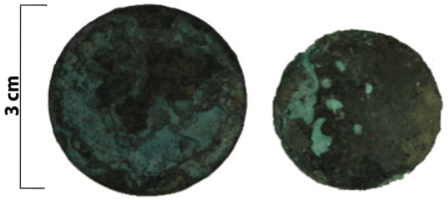
The archaeological excavation of Grubb cottage highlighted two themes: the deposition of the material debris of a century’s worth of occupation by the Grubb family, and changes made to the cottage and surrounding landscape as the Grubb family grew in number and community prominence. However, within these overarching narratives two small artefacts stood out due to their unusual context. During the excavation of new pile holes two timbers were uncovered, one under the other, running north-south along the line of the east elevation of the original cottage. Two coins were found lying on these timbers, later identified as a British bronze halfpence and a bronze penny (Clayton 2013). Unfortunately much of the detail on these coins was corroded but the material, dimensions and remaining detail were enough to date their issue to 1860-1890 and 1874 respectively.

The bronze penny (left) and half-penny (right) recovered from Grubb cottage.

The bronze penny (left) and half-penny (right) recovered from Grubb cottage.

Archaeologists often find coins during excavations and these can be useful for dating the context in which they were found. However, these coins were under the original cottage, which was built in the early 1850s and therefore predated the coins’ issue.  It is here that the physical context in which the coins were found provided a possible explanation for the dating discrepancy. The coins appeared to have been deliberately placed – what if their placement had a ritual purpose, rather than being the result of careless discard? It is likely that the east elevation of the original cottage was the location of the formal entrance until the addition, which included a new front door, was made to the south elevation at an unknown date. The date of the coins precludes any association with the opening of the original cottage entrance, but was it possible that they were used to ceremonially close that entrance before the opening of another? In which case, the coins would date the construction of the southern addition to sometime after 1874.

This possibility is evocative of common ceremonies such as the laying of time capsules, a custom that has been identified at several Christchurch buildings including an early 20th century Masonic lodge. Freemasons held elaborate ceremonies to lay the foundation stones of Masonic buildings, and these almost always included the laying of a time capsule containing a newspaper and coins (Speth 1893). Mention of Freemasonry often conjures notions of conspiracy theories and Dan Brown books, but ‘the brotherhood’ was a real and powerful influence in New Zealand’s male-dominated colonial society. The first lodge in New Zealand opened in Wellington in 1842 and by 1890 New Zealand boasted 151 lodges (Phillips 2012).Members included important society and political leaders, such as Richard Seddon, New Zealand premier and the Most Worshipful Grand Master of the Masonic Lodge of New Zealand.

Now this is where the broader context of the archaeology of Grubb cottage affects the meaning of those two little coins found in the ground – both John Grubb and his son James were Freemasons. Not only were they Freemasons, but they were leaders of the Masonic community in Lyttelton for almost 40 years. Together with several others they succeeded in founding the Canterbury Kilwinning lodge in 1875 (Press 3/12/1875; 21/2/1898). This was the second Masonic lodge in Lyttelton, the first being the Lodge of Unanimity, which was established in 1851 (Cyclopedia 1903c). Three years later John Grubb was elected lodge treasurer while James was elected a senior warden (Press 6/12/1878). The Kilwinning Lodge commissioned the construction of a hall on Canterbury Street, for which James Grubb as Worshipful Master laid the foundation stone in a ceremony in 1881 (Press 30/5/1881). John Grubb remained treasurer of the Kilwinning lodge for 18 years, resigning shortly before his death in 1898 (Press 3/12/1896).

So, if the placement of the coins was related to change in the cottage structure, it is possible that the Grubb cottage coins had a ritual significance that echoed the traditions of Freemasonry. But why were coins and newspapers used in such ceremonies? The reason seems obvious – to provide temporal information concerning the construction of the building for posterity in case of the building’s destruction. However, one would expect that the future destruction of the building was not a desirable result. Could there be an underlying explanation for these ritual actions?

George Speth, a prominent English Mason, related components of Masonic tradition to the folklore of construction. After all, a mason is a builder, and the Freemasons traced their origins to the cathedral builders of medieval Europe, and building tools were treasured symbols of the society (Newton 1921: 97-124). Speth associated common builders’ rites with the ancient belief that in order to ensure the permanence and stability of a structure it must be imbued with a soul (Speth 1893: 3). He suggested that originally this was undertaken by human sacrifice. Legends from around the world connect death to construction and Speth cited instances where human bones have been uncovered in the foundations of ancient buildings (Speth 1893: 4-22). He maintained that over time such sacrifice became symbolic in nature, with the use of animals and animal products, images and effigies. It is this symbolic form of sacrifice that Speth related to the custom of including coins in foundation ceremonies – ”…coins bearing the effigy, impressed upon the noblest of metals, the pure red gold of the one person to whom we are all most loyal, and whom we all most love, our Gracious Queen…” (Speth 1893: 22) – even if the conscious intention of imbuing the structure with a protective spirit had been shed over time.

A stained glass window depicting Saint Columba in Iona Abbey, Scotland.

A stained glass window depicting Saint Columba in Iona Abbey, Scotland. Legend has it that Columba buried alive his companion, Odran, to ensure the lasting stability of his chapel there. Image: Wikipedia 2008.

John Grubb was a builder by trade and a Freemason of high standing in Lyttelton. It is entirely likely that he was aware of the traditions and rites associated with construction. It is even possible that, on the closing of the old entrance to his cottage, he buried two coins to ceremonially mark the occasion. He didn’t necessarily do this while fully conscious of all the connotations of this little ritual. Perhaps it was done out of deference to Masonic practice, or perhaps it was done out of habit – an old superstition he picked up during his time in the building trade in Scotland. Whatever his motivation, this interpretation of past events was only made possible through consideration of two mundane objects within their immediate and broader context.

Rosie Geary Nichol

References

Amodeo, C. and Chapman, R., 2003. The Forgotten Forty-Niners: being an account of the men and women who paved the way in 1849 for the Canterbury pilgrims in 1850. Christchurch: Caxton Press.

Clayton, T., 2013. Coins of England and Great Britain. [online] Available at: http://www.coins-of-the-uk.co.uk/coins.html.

Cyclopedia of New Zealand, 1903a. Professional, Commercial and Industrial: Mr. John Grubb. [online] Available at: http://nzetc.victoria.ac.nz//tm/scholarly/tei-Cyc03Cycl-t1-body1-d3-d60-d2.html.

Cyclopedia of New Zealand, 1903b. Lyttelton: His Worship the Mayor, Mr. James Grubb, J.P. [online] Available at: http://nzetc.victoria.ac.nz//tm/scholarly/tei-Cyc03Cycl-t1-body1-d3-d60-d1.html.

Cyclopedia of New Zealand, 1903c. Orders and Friendly Societies: Masonic: New Zealand Constitution: Unanimity Lodge. [online] Available at: http://nzetc.victoria.ac.nz//tm/scholarly/tei-Cyc03Cycl-t1-body1-d3-d22-d3.html.

Heritage Management Services (HMS), 2008. Grubb Cottage Conservation Report. Unpublished report.

Land Information New Zealand (LINZ), c.1860. Probate Index – 5W237. Archives New Zealand, Christchurch Office.

Newton, J. F., 1921. A Story and Study of Masonry. [online] Available at: http://www.gutenberg.org/files/19049/19049-h/19049-h.htm#CHAPTER_IB.

Philips, J., 2012. ‘Men’s clubs – Masons’. [online] Available at: http://www.TeAra.govt.nz/en/mens-clubs/page-4.

Press. [online] Available at: http://paperspast.natlib.govt.nz.

Speth, G. W., 1893. ‘Builders’ Rites and Ceremonies: Two Lectures on the Folk-Lore of Masonry. Delivered by G. W. Speth to the Members of the Church Institute, Margate, On the 30th October and 13th November, 1893. [online]. Available at: http://www.slv.vic.gov.au/.

Fizz, bang, pop!: Christchurch’s early soda water industry.

Coke. Fanta. Lemonade. Lemon and Paeroa. Mountain Dew. Ginger beer. Dr Pepper. Seven Up. Ice-cream soda. Coke and raspberry. Lift.

Cartoon of soft drink rivals Coke and Pepsi battling it out. Image from Neatorama

Cartoon of soft drink rivals Coke and Pepsi battling it out. Image: Neatorama.

Fizzy drinks, or sodas, are everywhere in our society. In all the flavours and colours of the rainbow, they grace our televisions, billboards, magazines, movies, and our fridges. They are (to the chagrin of so many nutritionists) a staple of the modern diet. They are also, in a slightly different way, a staple of 19th century archaeology. Locally and internationally, soda-water (or aerated water) bottles are common finds on archaeological sites and can be some of the most informative artefacts we recover.

Advertisement for Schweppe’s aerated water from the Lyttleton Times, 5/02/1862.

Advertisement for Schweppe’s aerated water (Lyttleton Times, 5/2/1862).

The soda water industry has its origins in the latter half of the 18th century. It began as a medicinal product, created and sold by apothecaries for ailments like “putrid fevers, scurvy, dysentery, bilious vomiting etc” (Emmins 1991: 9). The first person to artificially carbonate water is believed to have been Dr Joseph Priestly, who wrote a book called Directions for Impregnating water with Fixed Air in the 1760s. Later, in 1792, Jacob Schweppe (yes, that Schweppe), established his first commercial scale soda water factory in London and the fizzy drink industry as we know it was born (Emmins 1991: 10).

Even after Schweppe started the ball rolling on the non-medicinal consumption of soda waters, the industry was still somewhat restricted by the available methods of bottling and storing their product. Glass and stoneware (ceramic) bottles were both used, but difficulties were encountered because of the internal pressure generated by the ‘fizz’ of the drink. Manufacturers had to use bottles with thick glass and find ways to seal the soda bottle and keep the cork or seal from being pushed out by the carbonation.

Two 1887 paintings by William Henry Hamilton Trood, showing the somewhat explosive uncorking of a torpedo shaped soda water bottle. Image: Munsey 2010: 3-4.

Two 1887 paintings by William Henry Hamilton Trood, showing the somewhat explosive uncorking of a torpedo-shaped soda water bottle. Image: Munsey 2010: 3-4.

In the early 1800s, one solution was the ‘torpedo’ bottle, which was constructed with a rounded or pointed base. This meant it had to be laid on its side, with the liquid inside the bottle keeping the cork moist so that it was less likely to shrink, fly out and unseal the bottle (Emmins 1991; Lindsey 2013; Munsey 2010: 4-9).

A torpedo shaped soda water bottle found in Christchurch and embossed with the details of Thomas Raine, Soda Water Manufacturer, Christchurch. Image: K. Bone.

A torpedo-shaped soda water bottle found in Christchurch and embossed with the details of Thomas Raine, soda water manufacturer, Christchurch. Image: K. Bone.

Lamont style soda bottle found in Christchurch, embossed with Lees & Evans, Reliance, Christchurch (1891-1913). Image: J. Garland.

Lamont style soda bottle, embossed with Lees & Evans, Reliance, Christchurch (1891-1913). Image: J. Garland.


Eventually, in the early 1870s, a man named Hiram Codd patented a new kind of soda water bottle, now known as the Codd bottle (or ‘marble bottle’). His invention used a marble to seal the bottle, in combination with the natural pressure of the carbonated liquid and a rubber seal, and quickly became a common and popular method of bottling soda water, particularly in the United Kingdom (Munsey 2010). Other inventions and adaptations were also applied to soda water bottles over the decades, including the Hogben patent, Hutchinson patent and, eventually, the crown finish (which we find on beer bottles today; Lindsey 2013). But none were quite so famous as the Codd patent.

Two different variations on the Codd patent, both found in Christchurch. Note the wide indent on both bottles, there to keep the marble at the top of the bottle after it was opened. The smaller indents above it stopped the marble from resealing the bottle when the drinker tilted it a certain way. The bottle on the left is embossed with T. C. Hill, Waltham, ChCh, Zebra Trade Mark Regd (1904-1914), while the one on the right reads Smith & Holland, Christchurch, Trade Mark (c. 1920-1924). Image: J. Garland.

Two different variations on the Codd patent, both found in Christchurch. Note the wide indent on both bottles, to keep the marble at the top of the bottle after it was opened. The smaller indents above it stopped the marble from resealing the bottle when the drinker tilted it a certain way. The bottle on the left is embossed with ‘T. C. Hill, Waltham, ChCh, Zebra Trade Mark Regd’ (1904-1914), while the one on the right reads ‘Smith & Holland, Christchurch, Trade Mark’ (c. 1920-1924). Image: J. Garland.

 Crown top soda bottle embossed with Ballin Brothers, Trade Mark Christchurch (1914 +). Image: J. Garland.

Crown top soda bottle embossed with ‘Ballin Brothers, Trade Mark Christchurch’ (1914 +). Image: J. Garland.

These bottles, in all their various forms, are the artefacts of the soda water industry that we find on archaeological sites throughout Christchurch. Here, soda water production began in the early 1860s (possibly slightly earlier) with manufacturers like Thomas Raine (later known as ‘Soda Pop Raine’), the Milsom family, and James Swann (among many others). Later, names like Henry Mace, the Sharpe brothers, Lees & Evans, the Ballin Brothers and George Ellingford came to dominate the industry (Donaldson et al. 1990). As the industry grew, it remained the province of small, almost boutique, manufacturers rather than large companies or conglomerates (Wilson 2005). Most of the factories employed only a couple of people to work on the bottling process (Press 20/7/1908: 8) and produced soda water for the local, rather than national or international, market.

An 1885 sketch of McPherson’s Aerated Water Manufactory on the corner of Worcester Street and Cambridge Terrace. Image: Christchurch City Libraries, File Reference CCL PhotoCD 12 IMG0064. Source: Lyttelton Times, 28 June 1851, p. 3.

An 1885 sketch of McPherson’s Aerated Water Manufactory on the corner of Worcester Street and Cambridge Terrace. Image: Christchurch City Libraries, File Reference CCL PhotoCD 12 IMG0064. Source: Lyttelton Times, 28 June 1851, p. 3.

Local soda water manufacturers branded their bottles with their names and company logos, and it’s these embossed designs that make these bottles so informative for archaeologists. As well as using the physical shapes of the bottles to understand the bottling technology being used in Christchurch, we can use the designs and names embossed on the glass to understand the who and the what and the when of the local soda water industry. Alterations to these designs can tell us when a bottle was made and, perhaps, when it might have been placed in the ground. We can see changes in the history of a company, like when it might have passed from father to son or when a new partner was brought on board.

Some of the bottle designs we come across are also tied to personal events or stories in the lives of the manufacturers, giving us a glimpse of the people behind the industry. Henry Mace, who operated a soda water factory on St Asaph Street from the 1880s until his death in 1902 (although the business continued until the 1920s), used a dog trademark on his bottles, supposedly in tribute to a dog that saved a member of the family from drowning (Donaldson et al. 1990: 244-245). Another manufacturer on St Asaph Street, John Robinson, used the image of a bicycle on his bottles in reference to his previous occupation as a cycle engineer (Donaldson et al. 1990: 254).

Left) A Henry Mace stoneware bottle, also found in Christchurch, showing the ‘Dog’ trademark; Right) A crown top J. Robinson bottle found in Christchurch, with the image of a bicycle embossed in the center. Images: J. Garland

Left: A Henry Mace stoneware bottle, showing the ‘Dog’ trademark; Right: A crown top J. Robinson bottle found in Christchurch, with the image of a bicycle embossed in the centre. Images: J. Garland

Yet, these bottles, despite their personal and commercial branding, were not made in New Zealand. The first New Zealand bottle production plant wasn’t started until the 1920s (Auckland Star 11/12/1925: 11), which means that every local manufacturer in Christchurch, and throughout the rest of the country, had to source their bottles from overseas. Fortunately, as well as the name of the contents manufacturer, many bottles were also embossed with the initials, logo or name of the bottle manufacturer. Manufacturers that we’ve come across include Australian, British and American glass-making factories, some of which made bottles for multiple Christchurch companies.

This George Ellingford & Sons bottle, although embossed with the details of the Christchurch based company, was made by Cannington, Shaw & Co, bottle makers based in St Helens, England. We know this, thanks to the C. S. & Co also embossed on the base of the bottle. Image: J. Garland.

This George Ellingford & Sons bottle, embossed with the details of the Christchurch-based company, was made by Cannington, Shaw & Co, bottle makers based in St Helens, England. We know this thanks to the ‘C. S. & Co’  embossed on the base of the bottle. Image: J. Garland.

It’s worth remembering that this also took place long before any kind of high speed communication was common in business endeavours. To get their personalised bottles, Christchurch manufacturers would have had to send off for them months in advance and wait for their purchases, not necessarily knowing whether or not their order had been received, processed or even produced correctly. It shows a kind of risk taking, a leap of faith, that those of us in the present day, with our instant communication and electronic transactions, can’t really comprehend.

There’s an interesting pattern to see here too, in the relationships between the local (grass-roots even) Christchurch soda water industry and the much larger industry of glass making in the late 19th and early 20th century. We’ve talked about global relationships on the blog before, in relation to importing overseas products like Wolfe’s Aromatic Schnapps, various pharmaceutical products and ceramics, and it’s something that leaps out again in this case. No matter how small the scale of production, how local the market, or how personal the branding, the Christchurch aerated water industry was part of a much wider, much more global industry. Frankly, it’s kind of cool that every time we pick up a soda water bottle at a site, we can see that connection right there in our hands, embossed onto the glass.

Jessie Garland

References

Auckland Star. [online] Available at: <http://paperspast.natlib.govt.nz>.

Donaldson, B., Hume, G. & Costello, S., 1990. Antique Bottle and Containers of Christchurch and District. Christchurch Bottle and Collectibles Club: Christchurch.

Emmins, C., 1991. Soft Drinks: Their Origins and History. Shire Publications: Buckinghamshire.

Lindsey, B., 2013. Historic Glass Bottle Identification and Information Website. [online] Available at: <http://www.sha.org/bottle/>.

Lyttelton Times. [online] Available at: <http://paperspast.natlib.govt.nz>.

Munsey, Cecil, 2010. Codd (Marble In the Neck) Soda Water Bottles: Then and Now. [online] Available at <http://www.sha.org/bottle/pdffiles/coddarticleMunsey.pdf>.

Press. [online] Available at: <http://paperspast.natlib.govt.nz>.

Wilson, J., 2005. Christchurch City Contextual History Overview. Theme IV: Industry and Commerce. [online] Available at: <http://resources.ccc.govt.nz>.