Pieces of the Past

This week on the blog we’re sending you over to Pieces of the Past, an online exhibition we’ve curated as part of Beca Heritage Week here in Christchurch. The exhibition features the staff of Underground Overground Archaeology and their favourite artefacts. There’s a wealth of different objects and stories there (and a suspicious number of caffeine related biographies for our archaeologists), from a sheep hoof on a stick to pocket watches, spinning tops and poems about cowboys.

In fact, we may have been so excited about it that we modified (or butchered, depends on your point of view) a famous song in our excitement.

Glass eyes on skulls and sheep hooves on sticks,
Old broken watches and bright orange bricks,
Upright pianos, still with their strings,
These are a few of our favourite things.

Lost spinning tops and pointy bone hooks,
Cheese jars and Marmite and Rantin’s old books,
Cowboys and boats and small figurines,
These are a few of our favourite things.

When the trowel scrapes,
When the glass breaks,
When we’re feeling bored,
We simply remember our favourite things,
And then we don’t feel so bad.

Check it out here. 

A poetic reflection on heritage buildings

As building archaeologists we record and analyse the form, structure and ornamentation of 19th century dwellings to learn about the lives led by past occupants.

The Victorian era was a time of invention and achievement. Society was dominated by middle-class morality as they relentlessly pursued comfort and material wealth. Their houses expressed the energy and exuberance of this time, as they presented their best face to the public.

These efforts can be directly observed through the choice of internal linings used in 19th century dwellings. Wealthy homes were commonly lined with timber laths and lime plaster, while poorer houses used roughly sawn butted sarking boards. When we recorded a modest workman’s cottage in the Avon Loop we uncovered some of these roughly sawn butted sarking boards in the parlour, a room purposely decorated for public display.

Roughly sawn butted sarking boards used in parlour of workman's cottage. Image: F. Bradley.

Roughly sawn butted sarking boards used in parlour of workman’s cottage. Image: F. Bradley.

Over time, however, seven layers of wallpaper had been applied to this room to disguise the poor lining material.

Original layer 1

The first layer of wallpaper applied was a mid-Victorian pattern design of purple and light brown diamond shapes dating to between the 1860s and 1870s. Image: F. Bradley.

Layer 2

Applied on top of the original layer was a brown wallpaper with a blue flowers and leaves pattern design, dating to the 1880s. Image: F. Bradley.

Layer 4

The fourth layer of wallpaper dated to the 1850s and had design elements of the Edwardian period, with green diamond shapes and pink roses. Image: F. Bradley.

top layer 7

The last layer was a pearlescent wallpaper with a design pattern of white, pink and yellow flowers, dating to between the 1920s and 1930s. Image: F. Bradley.

When we record these historic dwellings, we try decipher the social conventions at play during the Victorian era and how they influenced the way in which their dwellings were decorated. But when it came to recording this workman’s cottage in the Avon Loop, we were confronted with the juxtaposition of how 19th century society decorated their houses and a very unique way one 21st century occupant had decided to decorate her humble abode.

IMGP6129

Street-facing elevation of workman’s cottage in the Avon Loop. Image: F. Bradley.

In its irreparable state the creative owner of this house took to it with a fine paint brush and turned its rough-cast plastered walls into a mural of poetry.

The street-facing south elevation bore the words of Percy Shelley’s sonnet ‘Ozymandias’.

IMGP6135

Percy Shelley’s poem ‘Ozymandias’ painted on the street-facing south elevation. Image: F. Bradley.

Ozymandias – Percy Bysshe Shelley

I met a traveller from an antique land
Who said: “Two vast and trunkless legs of stone
Stand in the desert. Near them on the sand,
Half sunk, a shattered visage lies, whose frown
And wrinkled lip and sneer of cold command
Tell that its sculptor well those passions read
Which yet survive, stamped on these lifeless things,
The hand that mocked them and the heart that fed.
And on the pedestal these words appear:
`My name is Ozymandias, King of Kings:
Look on my works, ye mighty, and despair!’
Nothing beside remains. Round the decay
Of that colossal wreck, boundless and bare,
The lone and level sands stretch far away”.

(Source: Wikipedia, 2001).

‘Ozymandias’ was one of English romantic poet Percy Bysshe Shelley’s most famous works, first published in 1818. Shelley’s works often attracted controversy as they spoke out against oppression, convention and religion (Source: Wikipedia, 2001).

His poem ‘Ozymandias’ acts as a a metaphor for the ephemeral nature of political power. Its central theme explores the indiscriminate and destructive power of history, by contrasting all leaders’ pretentions to greatness and their inevitable decline. It is a powerful statement about the insignificance of human beings to the passage of time (Wikipedia, 2001).

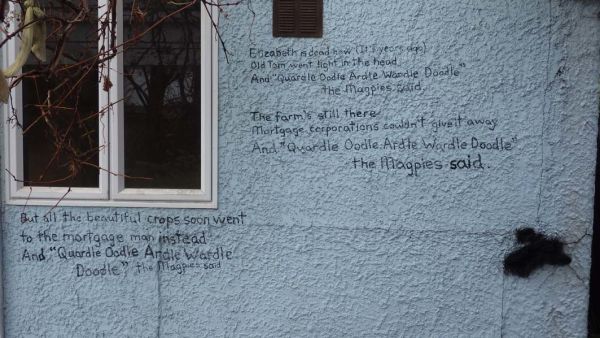
Along the north elevation of the cottage were the words of Denis Glover’s iconic New Zealand poem ‘The Magpies’.

IMGP6145

Denis Glover’s poem ‘The Magpies’ painted along the north elevation of the cottage. Image: F. Bradley.

IMGP6139

First section of ‘The Magpies’. Image: F. Bradley.

IMGP6142

Second section of ‘The Magpies’. Image: F. Bradley.

The Magpies – Denis Glover

When Tom and Elizabeth took the farm
The bracken made their bed,
And Quardle oodle ardle wardle doodle
The magpies said.

Tom’s hand was strong to the plough
Elizabeth’s lips were red,
And Quardle oodle ardle wardle doodle
The magpies said.

Year in year out they worked
While the pines grew overhead,
And Quardle oodle ardle wardle doodle
The magpies said.

But all the beautiful crops soon went
To the mortgage-man instead,
And Quardle oodle ardle wardle doodle
The magpies said.

Elizabeth is dead now (it’s years ago)
Old Tom went light in the head;
And Quardle oodle ardle wardle doodle
The magpies said.

The farm’s still there. Mortgage corporations
Couldn’t give it away.
And Quardle oodle ardle wardle doodle
The magpies say.

(Source: Xyphir, 2011).

‘The Magpies’ by Denis Glover is one of New Zealand’s most famous poems, first published in 1941. This poem relates to the passage of time as it laments the fate of farmers in hard economic times (Wikipedia, 2006). The hard-working farming couple become victims of an oppressive social system that exploits the working man. In this poem, the cruel and impartial nature of time is personified by the distinctive caw of the magpies, as they watched the farmers struggle away (Shieff, 2008).

As architectural styles and their decorative features can help us understand the conditions of bygone generations, the choice of poetry used here to decorate this workman’s cottage may be a reflection on the current post-quake social condition of Canterbury. Or perhaps the owner was merely commenting on the passage of time and its indiscriminate treatment of her home. Who knows, as archaeologists we can only speculate…

IMGP6137

Words of wisdom painted next to the dwelling’s front door. Image: F. Bradley.

Francesca Bradley.

References

Wikipedia, 2001. Ozymandias. [online] (22 September 2015) Available at: https://en.wikipedia.org/wiki/Ozymandias [Accessed 1 October 2015].

Xyphir, 2011. The Magpies – Denis Glover. A poem a day, [online] 26 April 2011. Available at: http://nzpoems.blogspot.co.nz/2011/04/magpies-denis-glover.html [Accessed 1 October 2015].

Wikipedia, 2006. The Magpies. [online] (2 May 2015) Available at: https://en.wikipedia.org/wiki/The_Magpies [Accessed 1 October 2015].

Shieff, Sarah, 2008. Denis Glover, 1912 – 1980. [online] Wellington: Victoria University. Available at: file:///Users/Shebitch/Downloads/716-622-1-PB%20(1).pdf [Accessed 1 October 2015].


In which a fortune is made, an Oddfellow is not a type of mint, and archaeology happens

Earlier this year, we excavated a site on Armagh Street that revealed not only a large quantity of artefacts, but also a historical and material narrative set in the swampy bowels of a fledgling city, a tale of politics, commerce, secret societies, nefarious happenings and BETRAYAL (cue ominous music). Well, maybe not those last two.  And maybe not quite as melodramatic as all that.

This story, told in turns by the objects and features we found on site and the records of those who owned them, included everyone from Oddfellows and Freemasons (even the United Ancient Order of Druids) to radicals (free radicals, even!) and liberals and some of the prominent voices of early Christchurch. Among the many figures whose history formed a part of the tale of this site, one who stood out was a Mr Edward Hiorns, tinsmith, hotelier, victualler, and protagonist of this particular post.

Excavating an archaeological feature filled with artefacts at a site on Armagh Street. Image: K. Bone.

Excavating an archaeological feature filled with artefacts at our site on Armagh Street. Image: K. Bone.

Mr Hiorns first arrived in Christchurch in 1862 on board the Victoria. A plumber, tinsmith and metal-worker, he operated a business from premises on Armagh Street East during 1860s and 1870s. By 1872, however, he had branched out into hotel-keeping, becoming the proprietor of the Central Hotel (later the Masonic), located on the corner of Colombo and Gloucester streets. He seems to have had something of a colourful time as a hotel proprietor, appearing in the courts several times as plaintiff and defendant in cases ranging from stolen watches to bail forfeit, forgery and the inappropriate sale of alcohol.

Edward Hiorns, the man himsef. Image: Wikimedia Commons.

Edward Hiorns, the man himsef. Image: Wikimedia Commons.

Like so many of Christchurch’s early residents Hiorns was a man of many hats, not just in terms of how he made a living, but also in regard to his involvement in the community. Among other things, he was a prominent member of the Licensed Victuallers Association (yes, this was a thing) from the 1870s onwards, as well as involving himself in local politics, both successfully and unsuccessfully. In 1875, he ran for the city council but only managed to finagle 21 votes, a meagre offering when compared to the winning candidate’s 634. Not one to be easily put off, though, he ran again successfully in the 80s and 90s. Hiorns was also a member of the Canterbury Freehold Land Association in the 1860s, a liberal organisation that aimed to assist working men with the purchase of land (an important part of socio-political independence and status at the time).

A description of the Canterbury Freehold Land Association from 1866, when they were first formed. Image:

A description of the Canterbury Freehold Land Association from 1866, when they were first formed. Image: Press 27/01/1866: 1.

On top of all this,  he was also active in the Oddfellows society, attaining the rank of Provincial Grand Master, an occurrence which seems to have been something of a prerequisite for the residents of Armagh Street in the 19th century (no, seriously, they’re ALL Oddfellows and I have the flowchart to prove it). If they weren’t Oddfellows, they were Freemasons, and if they weren’t Freemasons there’s every possibility that they were Druids. To modern ears, these societies (and their unbelievably amazing names, thank you “The Mistletoe Lodge of Druids”) sound incredibly anachronistic, but they were one of the major vehicles by which people (when I say people, I mean men, sadly) interacted with and supported each other. In the case of the Oddfellows, that support was largely aimed at the working classes. Ostensibly apolitical, they also likely fostered the growth of political ideas and movements enacted outside of the organisations, helped by the membership of men like W. S. Moorhouse, W. Rolleston, Rowland Davis, William Pember Reeves and many others.

The initial date of Hiorns’ arrival at our site on Armagh Street is a bit unclear, thanks to the existence of the similarly named Mr W. Hyorns, who leased the section in 1867 and may be the same person, a completely different person or a 19th century typo made flesh. Nevertheless, we know that he was active on Armagh Street in the 1870s and had leased the section on which our site was located by at least 1878 (for the period of 14 years, at the grand total of £20 a year; LINZ 1878: 337). Interestingly, one of the clauses of his lease was that he had to make £1000 pounds of improvements to the section at his own expense over the following two years, suggesting that he had a reasonable yearly income at the time (this is a LOT of money for the time). As it turns out, he later went on to buy and reside in Linwood House, the super fancy Georgian/Regency style house first built for Joseph Brittan. Pretty good for a tinsmith turned hotelier.

Linwood House in 2003, Image: Wikimedia Commons.

Linwood House in 2003, Image: Wikimedia Commons.

Archaeological site plan of the Armagh Street section on which Edward Hiorns resided in the 1870s. Image: K. Webb.

Plan of archaeological features on site. Image: K. Webb.

From historic photographs and maps, we know that between 1878 and 1884, significant modifications were made to the site. Two smaller buildings that are present on an 1877 map have, by 1884, been replaced with a large two storey brick townhouse (visible in the image below). It seems likely that this building tied into Hiorns’s £1000 pounds of modification to the section.  Unfortunately, we found no structural evidence of either this building or the earlier one during our excavations. What we did find, however, were several other archaeological features, including a large depression to the rear to the building that was completely and utterly filled with artefacts (unfortunately for us, this was the asbestos site was we’ve talked about previously on the blog, in the case of which more definitely wasn’t merrier). A smaller, rectangular pit feature was also found at the front of the section, containing a large quantity of tin and iron and a handful of artefacts, in addition to another small rubbish pit filled with domestic artefacts.
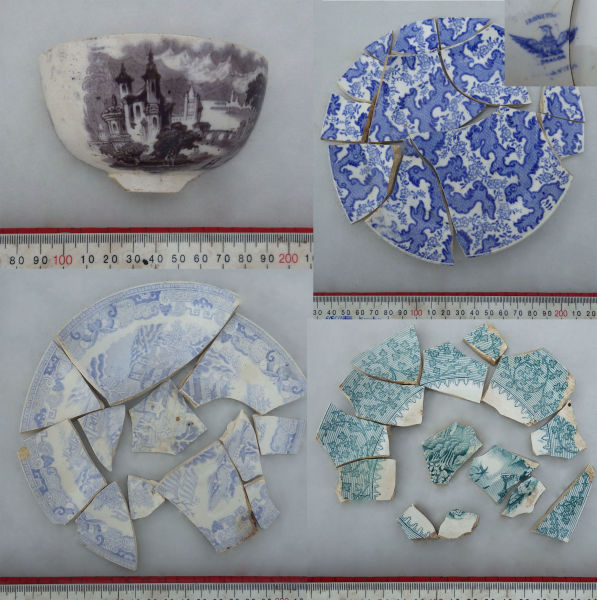
Ceramic artefacts from one of the rubbish pits on the section. Image: J. Garland.

Ceramic artefacts from one of the rubbish pits on the section. Image: J. Garland.

While it is difficult to associate the features found on the site with any one resident during the 19th century, it is almost certain that some of them were deposited by Hiorns and his family, including some of the 1037 artefacts found in the large depression to the rear of the building. That particular feature looks to have been used for the disposal of rubbish over an unknown period of time, based on the presence of small concentrations of objects within the feature as a whole, the size of the assemblage, and the wide range of manufacturing dates found among the artefacts. Many of the artefact dates, however, fit in well with the period in which Hiorns was resident on the section. On top of this, the assemblage contained a large number of alcohol bottles and several artefacts which are considered to be “higher status” items, or objects more often associated with people of reasonable wealth. It would make sense for the man who a) ran a hotel and wine bar and was in court more than once on alcohol related charges and b) later purchased the prestigious Linwood House, to have owned items like these.

Selected glass bottles from the site, including Rowland's Macassar Oil, a Piesse and Lubin perfume bottle and part of an infant feeding bottle. Image: J. Garland.

Selected glass bottles from the site, including Rowland’s Macassar Oil (mid-right), a Piesse and Lubin perfume bottle (top right) and part of an infant feeding bottle (top left). Image: J. Garland.

The assemblage also contained large quantities of ceramic tea and table wares, as well as household and hygienic items like chamber pots, wash basins and ointment pots, a quantity of shoes and fabric, food containers, pharmaceutical bottles and children’s artefacts. One of the most interesting finds, however, was a cluster of clay tobacco pipes that included pipes with political motifs as decoration. These pipes – bearing the name and bust of William Gladstone, liberal English politician, and the name of Garibaldi, famously nationalist and progressive Italian general – can easily be tied into Hiorns’ political engagement (which I sort of alluded to above, but haven’t had time to go into detail about) and the politically charged narrative of this entire Armagh Street site (which I definitely haven’t had time to go into). They’re an example of material culture that is actively entangled with the more intangible ideas and ideals of the people and society by which they are made and used (a topic for another day, I think).

Clay smoking pipes found in Feature 3 (the depression to the rear of the house). Image: J. Garland.

Clay smoking pipes found in Feature 3 (the depression to the rear of the house). The Gladstone pipe is the one in the top row, while the Garibaldi pipe is second from the right in the second row from the top. Image: J. Garland.

I may have started this post with a melodramatic paragraph that reads more as pulp fiction than historical narrative, but in truth, the story of Edward Hiorns (and all of the residents of this block of Armagh Street) is not all that sensational. What it is, however, is a tale we come across all the time in Christchurch. There are many interesting themes to be found in the archaeological and historical records of his life, but two of the most interesting from my perspective are the way he “improved” his situation in life, so to speak, and the way he involved himself so readily in the governance and development of the city in which he had settled. It’s a combination that we see again and again in the lives of Christchurch residents from the 19th century.

People talk a lot about the fluidity of class and social affluence in the 19th century, especially in colonial settlements like New Zealand, and the significance of the capitalist ‘entrepreneurial spirit’ in the prospering of Victorian society. These are both more than evident in the case of Mr Edward Hiorns (and Mr Jamieson, and Mr Ruddenklau and Reverend Fisher). What is just as evident, however, is the active engagement made by people like Hiorns with the present and future of the community in which they lived – be it at the local, national or global level. I could, with the aid of Mr Hiorns and others, very easily take you all down the rabbit hole with me here into the fascinating world of political and social change in 19th century Christchurch (the labour movement! radicalism! women’s suffrage!) and the lives of the people who fought to change the world around them, but that is too much for any one blog post, let alone this one. Nevertheless, it bears remembering that theirs were the hands that shaped a city and, though the city, helped to shape a nation.

Jessie Garland.

References

LINZ, c. 1850. Deeds Index – A – Christchurch town sections and town reserves. Archives New Zealand, Christchurch Office.

McAloon, J., 2000. The Christchurch elite. In Cookson, J. and Dunstall, G., eds). Southern Capital Christchurch: Towards a City Biography, 1850-2000., pp. 193-221. Canterbury University Press, Christchurch.

Wright, G. R. 1998. The Petty Bourgeoisie in Colonial Canterbury; A Study of the Canterbury Working Mans’ Political Protection and Mutual Improvement Association (1865-66) and the Canterbury Freehold Land Association. MA Thesis, University of Canterbury.

Papers Past. [online] Available at www.paperspast.natlib.govt.nz.

Fireplaces I have known

They’re one of the most ubiquitous aspects of 19th century houses, a feature that functions as both a source of warmth and light and a decorative element in the interior design of the house (as so many things do). We see a lot of fireplaces during our work in the city, as we record 19th century buildings damaged by the earthquakes. Some of them are elaborate, some of them are basic and some of them have been modified over the last century, evolving to reflect changing fashions and taste in interior design. All of them have a story to tell. The following images include some of the best and most interesting examples seen by our buildings archaeologists as they investigate the built heritage of the city.

Going for the elegant yet minimal look to start with. An example of a plain 19th century cast iron coal register in an early 20th century timber surround. Image: P. Mitchell.

Elegant, yet minimal. An example of a plain 19th century cast iron coal register in an early 20th century timber surround. Image: P. Mitchell.

Often, the fireplaces found in historic houses display evidence of modification over the century. This 19th century tiled fireplace, for example, has a 1920s timber surround. Image: P. Mitchell.

Often, the fireplaces found in historic houses display evidence of modification. This 19th century tiled fireplace, for example, has a 1920s timber surround. Image: P. Mitchell.

This lovely example was found in the master bedroom of a house constructed between 1883 and 1887. Although the cast iron plates date to somewhere between the 1880s and 1890s, the surrounds appear to be 1920s modifications. Image: F. Bradley.

This lovely example was found in the master bedroom of a house constructed between 1883 and 1887. Although the cast iron plates date to somewhere c. 1880- the 1890s, the surround is a later addition (probably from the 1920s, again). Image: F. Bradley.

The original wallpaper visible behind the 1920s surround in the previous photograph. Image: F. Bradley.

The original wallpaper visible behind the 1920s surround in the previous photograph. Image: F. Bradley.

Unfortunately, this beautifully ornate "timber as marble" surround had been removed before it could be photographed in situ. Still, it's pretty cool. Image: P. Mitchell.

Unfortunately, this beautifully ornate “timber as marble” surround had been removed before it could be photographed in situ.  It’s unusual, thanks to the decorative styling of the faux-marble: slightly more ostentatious than is common in Christchurch. Image: P. Mitchell.

This is my/Peter's personal favourite. The 19th century cast iron coal register was painted to look like brick before being boarded up, probably in the 1960s. Image: P. Mitchell.

Peter’s personal favourite. The 19th century cast iron coal register was painted to look like brick before being boarded up, probably in the 1960s. This fireplace was found in a house in Ashburton that once belonged to a doctor. Image: P. Mitchell.

Another modified 19th century fireplace, with 20th century bricks in a timber surround. Image: P. Mitchell.

Another modified 19th century fireplace, with 20th century bricks in a timber surround. It wouldn’t originally have been placed in the corner of the room as it is here: that placement tells us that the wall to the left was a later addition to the house. Image: P. Mitchell.

One of the more unusual fire surrounds we've come across, with neoclassical ionic columns featuring on either side. Image: p. Mitchell.

One of the more unusual fire surrounds we’ve come across, with neoclassical ionic columns on either side. Image: P. Mitchell.

A plain cast iron coal register with a moderately ornate timber surround. Image: P. Mitchell.

A plain cast iron coal register with a moderately ornate timber surround. Image: P. Mitchell.

This beautiful example from an 1860s heritage building in Kaiapoi has the most fantastic tiles.

This beautiful example from an 1860s heritage building in Kaiapoi has the most fantastic tiles. The couple who built this house worked for J. White & Co., Importers and General Storekeepers, during the 1860s and, in and unusual turn of events, had their wages credited to the store so that they could buy the building materials with which they built their home.  Image: K. Webb.

See? Gorgeous. Image: K. Webb.

See? Gorgeous. The classical ruins here tie into the neo-classical fashions that were prevalent during the mid-19th century, a style that was also visible in many of the patterns used to decorate household ceramics, especially table wares.  Image: K. Webb.

From the same house,a  slightly different form of fireplace. This coal range... Image: K. Webb.

From the same house, a slightly different form of fireplace. This coal range is an ‘Atlas’ model, with the maker’s mark “SCOTT BROS / CHRISTCHURCH” found on it. This brand of ranges were shown by the Scott Brothers at the Metropolitan Show in 1886, although the company had been operating as iron founders at the Railway Foundry from 1870 onward. Image: K. Webb.

More ornate decoration, this time on the cast iron coal register, which has had its tiles removed. It probably went with the timber surround shown above. Image: P. Mitchell.

This one has a cast iron coal register with an urn and foliage raised design, and would have had tiles on either side, which have since been removed. Image: P. Mitchell.

I think the columns on this one look a bit like chair legs. Image: K. Webb.

It’s interesting to note how many of the fireplaces we come across have been painted white at some point (often within the last few decades), another sign of how personal and social tastes are changing over time. If you look closely enough, you can see that this is the exact same model as the previous photograph, just painted white. It suggests that this was a popular design, probably available ready made through catalogues and shops.  Image: K. Webb.

Another example with cool tiles. Image: K. Webb.

Another example with cool tiles. For something that is such a prominent feature of a room, it’s really not surprising that so much effort would go into making and choosing fireplaces that were aesthetically, as well as functionally, pleasing.  Image: K. Webb.

See? Image: K. Webb.

See? Can you spot the one tile that was obviously laid the wrong way…? Image: K. Webb.

And yet another. Image: K. Webb.

Another ornate wooden fireplace, found in a turn of the century house built by a saw miller in Duvauchelle. The tiles on this one, rather than drawing on the neo-classical scenic images of the earlier fireplace, form a tessellated geometric and floral pattern, far more in line with the more restrained, abstract styles of this later period. It also has some interesting and unusual wood inlays in the surround. Image: K. Webb.

Peter Mitchell, Kirsa Webb, Francesca Bradley and Jessie Garland. 

All dolled up

To many people they’re simply a nostalgic throwback to childhood. To some, they’re treasures to be collected and curated. To others, they’re objects of horror, a sentiment encouraged by tv, films and a particular island in Mexico. To archaeologists, they’re the remnants of long lost childhoods, a personal and sometimes poignant reminder of the children that came before us. They make visible an aspect of life in the past that is so often hidden, in both the archaeological and historical records.

They’re also cute and creepy by turns. The following are some of our favourites from Christchurch. Enjoy!

This one seems disappointed.

The porcelain head of an infant in a bonnet, with painted cheeks and hair and a disappointed expression. Which is disconcerting on a baby. That face says to me “did you really just do that?” (left), “I can’t believe you just did that” (right). Image: J. Garland.

askjfvnaier

This one, on the other hand, is disapproving. A lot of Victorian dolls seem to me to be either disappointed or disapproving. Which either says something about the Victorians or something about me. Let’s not go there. The rouged cheeks on this particular head are a common feature (see some of the examples below), although these ones are more than usually pronounced. Image: Underground Overground Archaeology.

 uc nhb vjlgc m

A small boy, raising his face to the heavens and pleading… for his lost innocence? The whereabouts of his lower body? For someone to please, please take the bib off?  This one is probably one of the creepiest doll artefacts we’ve found (picture it emerging from the earth, seriously), but it’s an unusual example of a clearly male doll. Most of the dolls we find are either recognisably female or figurines of babies too young to differentiate between. Also, his upper lip makes him look a little bit like he has a moustache. Image: J. Garland.

hjkvbutgcmh

I get ‘unimpressed’ from this one. She was found on the site of a 19th century hotel (the Zetland Arms) on Lichfield Street, meaning that she may have originally belonged to a child visiting the hotel or the child of one of the hotel keepers. This particular doll is also likely to have been manufactured in Germany, as many dolls were during the latter half of the 19th century. Image: J. Garland.

This particularly shapely calf comes with a lovely little ankle boot.

This particularly shapely dismembered calf comes with a lovely little ankle boot, painted on over the glaze. Limbs like this one were often attached to a fabric body, tied using the groove you can see just below the top of the leg. Image: Underground Overground Archaeology.

I love this one. She looks like a soothsayer.

I love this one. She looks like a soothsayer. A smirking soothsayer. She definitely knows something that you don’t. And her hair is amazing. Image: Underground Overground Archaeology.

I find this one unsettling. One of my colleagues thinks it's adorable. You be the judge. If you look closely you can see that the baby is holding a rattle

I find this one unsettling. One of my colleagues thinks it’s adorable. You be the judge. If you look closely you can see that the baby is holding a rattle in one hand and there’s the edge of a quilt or blanket visible in the bottom right corner. The whole thing forms the lid to a small porcelain container of some sort, perhaps one that contained something associated with children or infants. Image: J. Garland.

jkkcyfc m

The always wonderful, yet completely awful Frozen Charlotte or ‘pudding doll’, named after the ballad about a girl who went out in the cold without a coat and froze to death… Image: J. Garland.

IMGP4589ed1

One thing that I find really interesting to note with dolls is the various different hairstyles they showcase. Much as we do today, the Victorians reflected changing fashions and social ideals in the toys and figurines they made for their children. Image: J. Garland.

More often than you might think, we just get a torso. Or an arm. A foot. A disconcerting remnant of somebody's once beloved toy. Sometimes, when struck by a combination of melancholy and melodrama, I find myself thinking 'archaeology: it's all just lost and broken things' and that sentiment never seems more apt than when you're looking at a bunch of broken dolls. Image: J. Garland.

More often than you might think, we just get a torso. Or an arm. A foot. A disconcerting remnant of somebody’s once beloved toy. Sometimes, when struck by a combination of melancholy and melodrama, I find myself thinking ‘archaeology: it’s all just lost and broken things’ and that sentiment never seems more apt than when you’re looking at a bunch of broken dolls. Image: J. Garland.

Then again, sometimes you get the head of a figurine wearing a fantastic

Then again, sometimes you come across the porcelain head of a a man in a very fine hat, and it’s a different story altogether. Image: J. Garland.

Jessie Garland