A tale of two suburbs: the story (and the man) behind the naming of Sydenham and Waltham

Should you have been so fortunate, while wandering the streets of 1860s Christchurch, to find yourself north of the square, you may have come across an establishment bearing the name of Sydenham House and containing within its walls all manner of treasures. Stepping inside, you would have been surrounded by an elegant assortment of glass and china, exotic oranges, lemons and pineapples and a few choice canaries, fowls and prize-winning birds of all kinds. You may even have caught a glimpse of the proprietor, Mr Charles Prince, a man of excellent taste and education and the eventual, unintentional, inspiration for the naming of two of Christchurch’s southern suburbs.

Colombo Street between Gloucester and Armagh in 1882. Sydenham house would have stood in the block on the left of the image, between the Golden Fleece hotel and Gloucester Street. Image:

Colombo Street between Gloucester and Armagh in 1882. Sydenham House would have stood in the block on the left of the image, between the Golden Fleece Hotel and Gloucester Street. Image: Burton Brothers, via Christchurch City Libraries, File Reference CCL PhotoCD 1, IMG0050.

We first came across the story of Charles Prince and Sydenham House earlier in the year, when we found an artefact – a double handled serving bowl – from Sydenham House on a site elsewhere in the central city. It was found blocks away from the actual location of the china shop (between Armagh and Gloucester on Colombo Street), and the bowl was marked with the name of the manufacturer (Copeland), a pattern registration diamond (with a registration date of 17th or 27th September 1861) and a banner bearing the words “Sydenham House, Christchurch, C. Prince”. As we researched the bowl and the maker’s mark, we found ourselves unravelling the tale of Charles Prince, a shopkeeper, bird importer and teacher who had a hand in naming the Christchurch suburbs of Waltham and Sydenham, through his residence and business respectively.

This piece is particularly interesting, marked as it is with 'Sydenham House, Christchurch' on the base, along with the name of the manufacturer (Copeland) and pattern registration diamond. Image: J. Garland.

The handled serving bowl bearing the mark of Sydenham House. The registration diamond indicates that this pattern was registered in 1861 (R in the top corner), on the 17th or 27th (number in the right corner) of September (D in the left corner). The pottery manufacturer, Copeland, was in business from 1847 until well into the 20th century (The Potteries 2014). Image: J. Garland.

Charles Prince arrived in Christchurch in 1858 on the Zelandia, having previously been the principal of the Classical School of Westbury East in St Kilda and the master of Grays Grammar School in England (Christchurch City Libraries 2014). On or soon after his arrival in New Zealand, he appears to have formed one half of the partnership of Prince and Dawes, with a man named Edmund Marriott Dawes, although this was broken in 1861 (Lyttelton Times 24/04/1861: 8). Sydenham House was in operation from at least 1860, and Prince continued as proprietor of the shop until 1867, when he went bankrupt and the business was sold (Christchurch City Libraries 2014; Lyttelton Times 2/04/1867: 2).

Prince also continued his calling as a schoolmaster, filling the role of master of the Christchurch Commercial School in the 1860s in addition to founding the private Christchurch Commercial Academy in 1860, with the intention of “embracing every branch of a sound English and Commercial education” (Lyttelton Times 8/09/1860: 1). Until his bankruptcy in 1867, he also lived in a large – twelve roomed! – house known as Waltham House, “pleasantly situated in Colombo Street south, within a mile of the Town Belt (Moorhouse Ave)” (Lyttelton Times 9/03/1867: 3). The size of the house alone suggests that he was a relatively successful and affluent man – at least until he went bankrupt.

Advertisem

Advertisement for birds and dogs sold at Sydenham House in 1864. Image: Lyttelton Times 10/09/1864:6.

He was known, not only as an educator and a retailer of assorted finery, but also as an importer and keeper of prize-winning birds (Press 10/09/1866: 2, Lyttelton Times 10/09/1866: 2). Many of the advertisements for Sydenham House and mentions of Charles Prince in contemporary newspapers make reference to his birds, some of which won prizes at local A & P shows (my favourites are the excellently named dorking fowls!). After he went bankrupt in 1867, Prince ended up on the West Coast, where he remained traceable in the newspapers of the time due to his occupation as a schoolmaster and, amusingly, to his reputation as a bird fancier, with one article stating that he has “become prominent by his expenditure and taste in the purchase of poultry” (Grey River Argus 15/03/1873: 2, 13/05/1873: 3). Another West Coast newspaper recounted an incident in which he ran afoul of some erstwhile avian burglars who allegedly absconded with a pair of ‘Bramah’ chickens (although the article does also suggest that the birds might just have run away…; Grey River Argus 4/11/1872: 2).

However, bird burglars aside, it’s Charles Prince’s time in Christchurch that is most of interest to us today, specifically his time as proprietor of Sydenham House and resident of Waltham House. Sydenham House is described in contemporary accounts as a building “containing eight rooms, a coach house, stables, a shop and store” and was sandwiched between G. Coate’s watchmaking and jewellery store and Miss Phillip’s drapery (Lyttelton Times 16/04/1867: 6). As well as birds (and dogs!) the store appears to have sold all manner of goods, from fancy glass wares (including cake shades, decanters and custard glasses) to all manner of china (“breakfast, tea, dinner, dessert and toilet services”) and household accoutrements (candlesticks, lamps and toilet boxes; Lyttelton Times 28/09/1861: 510/09/1862: 6). He also sold local and exotic delicacies, from “Canterbury grown walnuts” to pineapples, which can’t have been a common foodstuff in 19th century Christchurch (Lyttelton Times 22/03/1862: 5, 23/04/1862: 5).

Advertisement for Sydenham House from

Advertisement for Sydenham House from 1862, listing all kinds of treasures for sale. Image: Lyttelton Times 10/09/1862: 6.

The establishment also functioned as a boarding house,  with a variety of tenants, including a French teacher, a writing teacher and a professor of phrenology (Lyttelton Times 30/01/1866: 3, 15/09/1866: 1, 14/02/1867: 7). This last, Mr A. S. Hamilton, was available for consultation at Sydenham House, describing himself as “twenty eight years [a] Practical Phrenologist in England, Ireland, and Scotland, and the Australian Colonies… [who] may be consulted [for] delineations of characters and advice for direction, correction and profitable application of the mental powers” (Lyttelton Times 14/02/1867: 7). I’m not sure of the efficacy of Mr Hamilton’s advice, but I know that I could definitely use some help with the “profitable application of the mental powers” this morning…

Colombo Street between Armagh and Gloucester in the 1880s. Sydenham House would originally have stood on the right hand side of the image, about a third of the way along the block. Image:

Colombo Street between Armagh and Gloucester in the 1880s. Sydenham House would have stood on the right hand side of the image, about a third of the way along the block. Image: F. A. Coxhead, via Christchurch City Libraries, File Reference CCL PhotoCD 1, IMG0010.

Several advertisements for Sydenham House in the Press in 1863 and 1864 are of particular interest, as they mention Prince’s intention to take orders for dinner, tea and breakfast services etc. from England, all of which could be marked with the crest, initials or “other distinctive badge” of the purchaser, if they wished (Press 12/09/1863: 122/10/1864: 6). These advertisements not only provide a tangible connection between our artefact and the historical record, but also a possible one between Charles Prince and the story of John George Ruddenklau, mayor,  proprietor of the City Hotel and the subject of one of our blog posts last year. J. G. Ruddenklau’s role in Christchurch’s early decades was also brought to our attention through a few personalised ceramic artefacts we found that were, coincidentally, decorated with exactly the same pattern as the Sydenham House bowl, along with Ruddenklau’s initials and the mark of the City Hotel. The latter was founded in 1864 and run by Ruddenklau until 1869: it’s not implausible to think that J. G. Ruddenklau might have ordered personalised china through Charles Prince in 1864 for his newly established hotel.

Fragments of a saucer, teacup and mask jug, decorated with the City Hotel pattern and the initials J. G. R.

Fragments of a saucer, teacup and mask jug, decorated with the same pattern as the Sydenham House bowl, the initials J. G. R and the name ‘City Hotel’. Image: J. Garland.

This notion of connectedness seems to be something of a theme with this artefact, and this story. It’s been fascinating, actually, researching Charles Prince and finding all of these connections – direct and indirect – between his life and business in Christchurch and other people, places and things in the city – both then and now. Initially, when I deciphered the mark on the bowl I thought that the Sydenham House mentioned must have been named after the suburb and was probably located in that general vicinity. As it turns out, it was the other way around: it seems to have been due to the fond recollections of Charles Prince’s china shop by a man named Charles Ellison that ‘Sydenham’ was first used for the local borough council in 1876 and, eventually, the actual neighbourhood south of Moorhouse Avenue (Christchurch City Libraries 2014).

Christchurch south

A view of Christchurch South, including the suburb now known as Sydenham. Image: Geoff Wilson, via Wikimedia Commons.

A similar connection is evident for Prince’s residence, Waltham House, which played a comparably crucial yet indirect role in the naming of Waltham (of special note to those of us at Underground Overground, as our offices are in Waltham). In 1866 a group of people placed an advertisement in the Press stating that a meeting of residents at that house had unanimously decided that the neighbourhood “of Colombo Street south and the Gasworks road, leading to Wilson’s bridge” should be called Waltham (Press 26/10/1866: 1). A letter to the editor placed four days later decried it as a hoax, and offensive to the “modest and rather retiring disposition of that gentleman” (although there doesn’t seem to be any word on it from the man himself; Lyttelton Times 30/10/1866: 3). Still, the name seems to have stuck and Charles Prince, teacher and shop owner, through no fault or intention of his own, left an indelible mark on the city of Christchurch. A reminder, perhaps, that sometimes our legacies aren’t always ours to determine?

We talk about six degrees of separation (two at most in New Zealand, right?), but sometimes I think we forget that it doesn’t just apply to people in the here and now – that it doesn’t just apply to people, full stop. Increasingly, as we uncover more and more of Christchurch’s past, literally and metaphorically, we’re finding connections between the lives of the city’s inhabitants in the objects, places and moments in time where their stories cross over. These things, these tangible connections between people, are the physical embodiment of the ever increasing network of human interaction that’s built the world we live in today. It’s incredibly cool to see those connections in Christchurch’s archaeological record and the role they played in shaping the city we see around us today.

Jessie Garland

References

Christchurch City Libraries, 2014. [online] Available at www.christchurchcitylibraries.com

Grey River Argus. [online] Available at www.paperspast,natlib.govt.nz.

Lyttelton Times. [online] Available at www.paperspast,natlib.govt.nz.

Press. [online] Available at www.paperspast,natlib.govt.nz.

A penny for your thoughts…

Money, as Liza Minnelli has told us, makes the world go around. It is such an intricate and constant part of the societies we live in, a factor upon which so many of our actions – collectively and individually – are based. It is also, as so many television shows and books have taught me, an excellent source of information about people and their motivations.

We don’t often find money in archaeological sites, for the simple and entirely obvious reason that people tend not to throw their coins away (except in the figurative sense of the phrase, clearly). Those examples of currency that we do find, however, are curious reminders of past values and costs of living, as well as the physical differences of living with a currency that is so different from the way our financial exchanges work now.

A Victorian penny minted in 1863. The top image shows the penny found in Christchurch, while the bottom image shows a cleaner example of an identical coin. Image: J. Garland.

A Victorian penny minted in 1863. The top image shows the penny found in Christchurch, while the bottom image shows a cleaner example of an identical coin. Image: J. Garland.

Most of the currency used in New Zealand in the 19th century was British, naturally, by virtue of this country being a British colony. We’ve found several British pennies and at least one halfpenny in sites in Christchurch and Lyttelton. Pennies, such as the one shown to the right were embossed with the likeness of Her Majesty, Queen Victoria on the obverse and variations of the image of the figure Britannia, seated in her chariot, on the reverse. The particular likeness used on the penny in the image to the right is known as the ‘bun head’ likeness, in reference to her hairstyle. The bun head design was preceded by what is known as the ‘young head ’, used from 1838-1859/60, and followed by the ‘old head’ (also known as the ‘veiled head’, used from 1895 until Victoria’s death in 1901). Not the most flattering of names for Her Majesty’s head that I’ve heard…

During the 19th century (and for much of the 20th), it took 12 pence to equal a shilling, and 20 shillings to equal a pound, meaning that a single penny was 1/240th of a pound. To put that in perspective, in 1863 (when our bun head penny was made), a person could buy, at wholesale prices, a dozen quart bottles of pickles for one pound,  a pound tin of ground coffee for one and half shillings, or a pound of sultanas for eight pence (Lyttelton Times 13/6/1863: 3). It can be problematic to relate the value of money in the past to the value we give it now, thanks to inflation and the constantly shifting values of different currencies and market values, but it’s interesting to consider the relative cost of these items today. For example, a 400g bag of Sultanas costs c. $3 at Countdown now, while the equivalent amount of ground coffee is around the $10 mark.

An advertisement from 1863, showing wholesale prices for goods in Lyttelton. Image: Lyttelton Times

An advertisement from 1863, showing wholesale prices for goods in Lyttelton. Image: Lyttelton Times 13/6/1863: 3.

Pennies, and other 19th century coins such as these, provide an interesting link, not only to the monetary system and values of the 19th century, but to the physical production of royal currency.  In 1860, for example, the Royal Mint ceased  to manufacture pennies from copper (which they had done since the first minting of the cartwheel penny in 1797) and began to make them of bronze instead. The size of the coin also changed, from 34 mm in diameter to 31 mm. The process of minting coins, particularly the penny, is one that ties into other technological developments of the time (including the switch to a steam-powered mint in the late 18th century) and the achievements of famous figures (such as Matthew Boulton; Selgin 2003). It’s also a process that is integral to the economic growth of the British empire and her colonies, like New Zealand (Royal Mint Museum 2014).

The bronze penny (left) and half-penny (right) recovered from Grubb cottage.

A bronze penny (left) and half-penny (right) recovered from Grubb cottage. These coins were particularly interesting due to their association with Masonic ritual. Image: R. Geary-Nichol.

However, as well as British coins, we’ve also found alternative forms of currency in Christchurch’s archaeological sites.  A Belgian ’10 centimes’ coin was found in Lyttelton following the earthquakes, manufactured in 1863 (again!). Of course, the presence of coins in archaeological sites is not always related to their primary use as currency, as we’ve mentioned before on the blog in reference to Masonic rituals . A Belgian coin found in Christchurch doesn’t necessarily hold any meaning as money in this context, but may instead provide other avenues of information – such as a connection between Belgium and Christchurch, be it familial, commercial or otherwise.

The 1863 Belgian '10 centimes' coin found in Lyttelton. Image: L. Davies.

The 1863 Belgian ’10 centimes’ coin found in Lyttelton. Image: L. Davies.

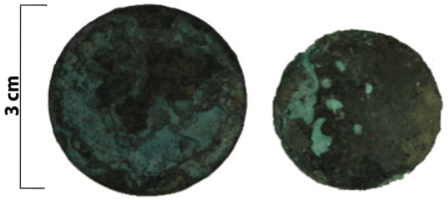
One alternative to British currency that does relate directly to the monetary system of Christchurch, though, is the humble Christchurch token. We’ve found a couple of these on sites in the city now: flat circular pieces of metal that bear every resemblance to coins, except for the insignia of local merchants embossed into the surface.

For much of the early decades of Christchurch’s settlement, it seems, small currency was difficult to come by. Local businesses and settlers combated this shortage of actual money by creating their own, known as ‘trade tokens’. Tokens became recognised as legal tender in Christchurch and were used as currency in the city from 1857 until 1897, when they were demonetised by the government. Interestingly, many (if not most) of these tokens only had value in Christchurch and were considered worthless in other cities in the country (Thomas & Dale 1950: 11).

An example of a Henry J. Hall halfpenny token, identical to the one found in Christchurch. Image: Victoria Museum.

An example of a Henry J. Hall halfpenny token, identical to the one found in Christchurch. Image: Museum Victoria.

Although they were struck in Australia, and then shipped to Christchurch, tokens were stamped with the names and insignia of local traders and businesses. One such example found on an archaeological site in the city bears the mark of Henry Joseph Hall, reading “HALF PENNY / HENRY J. HALL / CHRISTCHURCH COFFEE MILLS” on one side and “H.J.HALL / FAMILY GROCER / WINE & SPIRIT MERCHANT” on the other.

Henry Joseph Hall was an agriculturalist and pastoralist turned grocer who arrived in Christchurch in 1857. He opened a grocery business in Cashel Street west in 1864, subsequently converting the Wesleyan Chapel on High Street into a large store in 1865. During his time as a grocer, he issued a total of 19 varieties of penny tokens and three varieties of halfpenny tokens in Christchurch, struck by the Melbourne medallists W. J. Taylor and Thomas Stokes, as well as W. J. Taylor of London. These tokens were circulated throughout the city as money in relatively large numbers and could be used, not only with  the issuing firm, but with all other traders in the city (Thomas & Dale 1950 56-61; Museum Victoria).

We’ve talked about the entrepreneurial spirit of 19th century Christchurch a few times here on the blog, in reference to so many of the individuals and businesses that contributed to the economic and social growth of Christchurch as a city. It strikes me now, that in people like Henry Hall and other manufacturers of trade tokens – people who made their own money – that entrepreneurial spirit is even more pronounced.

Money is a curious thing, so vital to our everyday existence in this world and yet so completely a construction that we, as a society, have created to be necessary in our lives. It can be very easy, I think, especially in this age of electronic transactions, to forget where our money came from in the first place. Artefacts like these – be they royally issued coins or locally struck tokens – are a somewhat disconcerting reminder that we made it ourselves.

Jessie Garland

References

Lyttelton Times. [online] Available at www.paperspast.natlib.govt.nz

Museum Victoria. [online] Available at www.museumvictoria.com.au

Royal Mint Museum. [online] Available at www.royalmintmuseum.org.uk

Selgin, G., 2003. Steam, hot air, and small change: Matthew Boulton and the reform of Britain’s coinage. The Economic History Review, 56, 478-509.

Thomas, E. R. & Dale, L. J. (eds.), 1950. They made their own money: the story of early Canterbury traders & their tokens. Canterbury Branch of the Royal Numismatic Society of New Zealand.

Brewery to bonded store (or a tale involving beer, misfortune and the casualties of long distance trade)

From Staffordshire pottery to American made glass-ware, we’ve come across artefacts from all over the world on archaeological sites here in Christchurch. This prevalence of internationally made artefacts, and what it means for the city’s history, is something that’s come up frequently in previous posts on this blog. Today’s post continues to discuss that theme, albeit from a slightly different perspective – that of the importer.

Over the last little while, we’ve been looking at the artefact assemblage from a site in the central city that was associated with a bonded store from the 1860s onwards. Bonded stores (also known as bonded warehouses) were buildings in which goods could be stored and remain exempt from customs duties. They were usually used to store goods and bulk merchandise until they were distributed for retail, at which time those duties and taxes would have to be paid.

We found numerous archaeological features (mostly rubbish pits) on the site, almost all of which contained artefacts. Many of these rubbish pits contained a large number of alcohol bottles. This is not particularly unusual. What is unusual is that within each feature most of the alcohol bottles were identical and almost all of the bottle tops found were still sealed – with cork, wire seal and metal capsule.

One of the rubbish pits found at the site, containing a large number of J & R Tennent sealed bottles.

One of the rubbish pits found at the site, containing a large number of J & R Tennent sealed bottles. Image: J. Hughes.

One rubbish pit contained a total of 130 artefacts (in 454 fragments), 126 of which were black beer bottles. Although the bottles were broken, the tops and bases were almost equal in number. More significantly, all of those black beer bottles were still sealed, or found in association with their corks and capsule seals, and every single seal bore the distinctive trademarks of J & R Tennent’s Pale Ale, brewed at the Wellpark Brewery, Scotland. Most of the capsules were also stamped with the mark of Betts & Co, the company who patented and manufactured this type of metal capsule seal for bottles. Similarly trademarked bottle capsules have been found at other 1860s-1880s sites throughout New Zealand, although not in such large quantities (Petchey and Innanchai 2012).

A couple of the J & R Tennent sealed tops found in the rubbish pit. The side of the seal reads: "Bottled by J & R Tennent" and (not pictured) "Betts & Co/Patent/Patent/ Trade Mark/ London."

A couple of the J & R Tennent sealed tops found in the rubbish pit. The side of the seal reads: “Bottled by J & R Tennent” and (not pictured) “Betts & Co / Patent / Patent / Trade Mark / London.” Betts & Co were the original patentees and manufacturers of metal bottle capsules like these. They were founded in 1804, but weren’t established in London until 1840. The company continued to manufacture bottle capsules until the 1960s: these particular seals were probably made between 1860 and 1915 (Nayton 1991). Images:  J. Garland.

J & R Tennent capsule drawing

A drawing of one of the J & R Tennent bottle capsules found at this site. Note that the beer is a pale ale, and the reference to Wellpark Brewery in Glasgow. Image: J. Garland.

John and Robert Tennent were Glaswegian brewers and bottlers who began operating in the 1770s. Their business continued to be run by their descendants throughout the 19th and 20th centuries, right up until the present day (Petchey and Innanchai 2012). By the end of the 19th century they were increasingly known for the quality of their beer and were a relatively large presence in the export market for bottled beer throughout the English speaking world (Hughes 2006). In Christchurch, Tennent’s Pale Ale was sold in large quantities from the 1850s onwards by a number of Christchurch merchants such as Robert Symington, Charles Wesley Turner (my great great grandfather!), Longden & Le Cren, Robert Wilkin & Co, and Tonks, Norton & Co, among others (Lyttelton Times 6/11/1852: 312/8/1865: 1Star 22/10/1869: 4; Press 18/9/1879: 3,14/1/1891: 8).

A second rubbish pit at the site contained a similar assemblage: 125 artefacts, 88 of which were identical dark green beer bottles. Like the Tennent bottles, almost all of these were still sealed or found in association with metal capsules, wire seals and corks. Unfortunately, the seals from this feature weren’t in the best condition: only eight of them could be definitively identified to the bottler, T. B. Hall & Co, Liverpool. It seems likely, however, given the similarity of the bottles (a handful of which still had the remnants of T. B. & Hall labels on the glass), that all 88 were originally T. B. Hall & Co products.

Some of the T. B. Hall & Co bottle capsules found in the second rubbish pit. Image: J. Garland.

Some of the T. B. Hall & Co bottle capsules found in the second rubbish pit. Image: J. Garland.

This drawing of one of the T. B. Hall & Co metal capsules shows the distinctive boar trademark used by the company. Image: J. Garland.

This drawing of a T. B. Hall & Co bottle seal shows the distinctive boar trademark used by the company. Image: J. Garland.

T. B. Hall refers to Thomas Bird Hall, who operated an export bottling company in Liverpool in the latter half of the 19th century. The company became well known for their ‘Boar’s Head’ brand, which we see on the bottles found in Christchurch.  They started bottling beer under this brand in 1874, much of which was exported to British colonies, including Australia and New Zealand. They bottled a range of beers, spirits and liqueurs, including the well-known Bass and Guinness ales and stouts (Hughes 2006: 131). We have evidence for the brand being sold in Christchurch from at least 1878 until the late 1890s (Press 22/4/1878: 2; Press 23/10/1899: 4).

Interestingly, during the excavation of this rubbish pit, it was noted that most of the bottles were complete, but cracked, while they were still in the ground. Many of them fell apart as they were lifted out, suggesting that they had broken or cracked from the impact of being thrown – complete and still sealed – into the pit.

The partially excavated rubbish pit containing numerous T. B. Hall & Co sealed bottles. A couple of complete bottles are visible, sticking out of the top of the feature: one of these fell apart as it was lifted, due to the cracks already present in the glass. Image: J. Garland.

The partially excavated rubbish pit containing numerous T. B. Hall & Co sealed bottles. A couple of complete bottles are visible, sticking out of the top of the feature: one of these fell apart as it was lifted, due to the cracks already present in the glass. Image: J. Garland.

As archaeologists, we’re used to finding old or broken artefacts in archaeological assemblages  – objects that have clearly been used and discarded, due to damage, age, changes in fashion or simply because they’ve reached the end of their uselife. The fact that two rubbish pits at this site contain artefacts that have clearly not been used and, in one case, were complete when they were discarded, indicates that there must be another reason for their disposal.

Given the association of the site with a bonded store, it seems likely that these bottles were originally imported and stored at the warehouse with the intention of being distributed to local retailers and consumers. The question then remains: why were they thrown out? There are numerous potential answers to this, from damages incurred during transport to a bad quality batch of beer, a lack of demand or old, unsaleable stock. Bottled beer was a hell of a lot more unpredictable – both in quality and preservation – during the 19th century than it is now, and it wasn’t uncommon for batches to go bad, or simply be bad.

This extract from a legal case involving the supply and sale of bad beer lists just a few of the ways beer could go bad in the 19th century. Image: Colonist 26/07/1911

This extract from a legal case involving the supply and sale of bad beer lists just a few of the ways beer could go bad in the 19th century. Image: Colonist 26/7/1911: 4.

It’s easy to forget, in this age of air freight and controlled temperatures, that these goods had to come a very long way in relatively difficult conditions in order to reach our shores (and our stomachs) in the 19th century. British export beers travelled to colonies like Australia and New Zealand by ship, a journey that could take anything upwards of 100 days (by clipper, the fastest non-steam powered ship at the time). These voyages often encountered rough seas and extreme temperatures, both of which could damage cargoes of bottled beer (Hughes 2006). High temperatures (when sailing through the tropics, for example) could cause the beer itself to go off: sometimes, if it caused rapid fermentation, the bottles would explode (my personal favourite). On top of the sea voyage, of course, the bottles had to survive loading and unloading as well as transport over rough roads to their final destination. It’s hardly surprising that breakages occurred!

There were also issues with supply and demand: agents in New Zealand would have been ordering the stock well in advance (remember, 100 days or more to get here), based on predicted demand. If their predictions were wrong, products might not sell and be left, instead, to age to the point where they were both undrinkable and unsaleable, and had to be discarded. All of which leads to rubbish pits such as these, containing the physical casualties and failures of the 19th century import/export trade.

Analysis of this site is continuing but, as you can see from the small part of it that I’ve discussed here, it has the potential to provide us with a window into the realities of the goods trade in Christchurch – internationally and locally. It’s also an excellent example of the importance of archaeological context in the interpretation of artefacts and archaeological features.  Just one of these bottles, out of context, wouldn’t have nearly such an interesting story to tell.

Jessie Garland

References

Colonist. [online] Available at www.paperspast.natlib.govt.nz

Hughes, David. 2006. “A Bottle of Guiness Please”: the Colourful History of Guiness. Phimboy: Berkshire, England.

Lyttelton Times. [online] Available at www.paperspast.natlib.govt.nz

Nayton, G., 1992. Applying frontier theory to a Western Australian site: the problem of chronological control. Australasian Historical Archaeology 10: 75-91.

Petchey, P. and Innanchai, J., 2012. Bottle top capsules in New Zealand historic archaeological sites. Journal of Pacific Archaeology 3 (2): 1-16.

Press. [online] Available at www.paperspast.natlib.govt.nz

Star. [online] Available at www.paperspast.natlib.govt.nz