Conference uncovered

For a change of pace, a group from Underground Overground Archaeology spent last week out of the office, and out of Christchurch at the New Zealand Archaeological Association Conference on Stewart Island. The New Zealand Archaeological Association (known affectionately as the NZAA, and not to be confused with the automobile association) is the national organisation for archaeology, and is the primary group devoted to promoting the archaeology of Aotearoa. It’s membership includes both professional archaeologists like ourselves, but also interested amateurs, other heritage professionals and groups with a vested interest in archaeology. Every year, the NZAA has a conference, and members from all over the country (and further afield) gather to share and discuss their work. Among the many things archaeologists debate and fail to agree on is the collective term for a group of archaeologists, but I like to refer to it as an assemblage of archaeologists.

Archaeologists catching up over lunch. Photo credit: New Zealand Archaeological Association

Remains of a boiler and other sawmilling equipment at Maori Beach, Stewart Island. True to winter in the deep south, it was close to a miserable day when I visited. Photo credit: Tristan Wadsworth.

This year, conference was on Rakiura/Stewart Island, and Michael, Kirsa and myself braved the sickness-inducing southern waters to attend. The people of Oban and Stewart Island were great hosts, and in particular local iwi members shared a great deal of knowledge about Rakiura and its history. It was a pleasure to be there, and a few archaeologists who had done work on the island put together a series of public talks, to share our findings with the locals. Conference usually consists of a few days of papers/presentations across a range of topics and locations. This year the papers ranged from excavations on an early Māori site in the Bay of Islands, to tin mining on Stewart Island’s south coast, to occupation and landscape modification on the islands of Vanuatu. Subjects included stone fishing net weights, new techniques of radiocarbon dating pā palisades in the Waikato, DNA identification of previously unidentified animal foods in early Māori middens, the Ng (King) Bros Chinese market garden site in Ashburton, and the archaeology of servants quarters in Dunedin. Among the presentations were those by Underground Overground alumni Kat Watson and Jessie Garland who presented separately on their doctorate research on the buildings and artefacts of Christchurch, building on their work from their time here. I spoke about recent archaeological investigations I’ve been involved with here in Christchurch. The papers are a great way archaeologists to keep up with the wide range of work going on across the country, and to keep abreast of new developments in the field, particular in relation to ever-changing technological methods. I can’t tell you the number of times I’ve come across something in the field and gone “hrm, this reminds me of that thing such-and-such talked about at conference”.

The newly refurbished Rakiura museum kindly gave us special access to their collections. Photo credit: New Zealand Archaeological Association

The archaeological community is small (the NZAA only has between 300-400 members) and everyone knows each other, so conference is as much a social occasion as a professional one. Discussions bleed on from papers to the pub, as the community shares war stories and recent finds, argue about minutiae and various theories, and generally enjoy spending time with old and new friends.

Members of the association swarm the Norwegian Ross Sea Whaler’s Base. Photo credit: New Zealand Archaeological Association

Archaeological remains at the whaler’s base. I’ve always wanted to do a presentation with props. Photo credit: Tristan Wadsworth.

The association also typically organises a field trip to local archaeological and heritage sites, because archaeologists are big nerds, and even when ostensibly ‘on holiday’, they like to talk archaeology and see archaeology. This year we took a boat trip with local guides around to Paterson Inlet, to the site of a winter base for Norwegian whalers operating in the Ross Sea between 1923 and 1933, now protected as an archaeological site under the Heritage New Zealand Pouhere Taonga Act 2014. We also visited the Ulva Island ecosanctuary, saw dolphins, weka, a leopard seal, mollymauks, sea lions, tieke, and other smaller birds aplenty. Not technically archaeology, but a major part of the discipline is investigating human interaction with other species and the environment, and also, birds are cool.

A local keeps a wary eye on proceedings. Photo credit: Jessie Garland.

Steam-powered log hauler associated with the Maori Beach Timber Company. Photo credit: Tristan Wadsworth.

Conference is typically in a different location each year, and the field trips are always a fun opportunity. Archaeology and archaeological landscapes exist everywhere you go in New Zealand, and no matter where conference is held, there is a local element, because we all walk through a land steeped in heritage and archaeology. It was a great conference, in a great location, and thanks to the people of Oban and Stewart Island for having us!

Acker’s Cottage, among the oldest stone structure’s in the country, built by Lewis Acker between 1834-1836. The remains of an early pier can be seen on the beach just below the cottage.Photo credit: Tristan Wadsworth.

If you’re interested in joining the New Zealand Archaeological Association, check out the NZAA’s website, Facebook, or visit https://nzarchaeology.org/membership/join-nzaa to join.

The Shape of Things

On Wednesday I celebrated my six year anniversary working at Underground Overground Archaeology. I did plan on marking this milestone by staying up all Tuesday night to bake a special six-tiered chocolate cake to bring in to work and share with the team, but because of an out-of-town work assignment, this didn’t happen. Oh well, might get to bake a seven tiered cake next year.

I really wanted to celebrate my six year stint at UOA by writing this week’s blog about my absolute favourite, or at least the most memorable, Christchurch site that I have had the privilege to dig over my six year tour of duty, but I struggled to nail down just one site, because there have been so many, and each of these sites memorable in their own unique ways. So instead, I thought I’d share some of the most memorable archaeological shapes that I have met along the way. When put in context, each shape is like a puzzle piece that holds a little bit of the picture, (or at least the promise of a little bit of the picture), of what life was really like for the people of the past who made  that shape, who left behind their mark in the landscape. Please enjoy.

A small shape from one of the most memorable, and largest of our Lichfield Street sites. Small shapes, round or square, we usually interpret as postholes – those marks left in the ground where the posts of long demolished fences, buildings, or other such structures once stood. The magic of these small shapes often only materialises later on when we are out of the field, when with available historic plans at hand, (and usually a bit of creative guesswork) we can connect the posthole dots on our site plans, and work out where fences and buildings were located. Gotta love the humble posthole. Image: Hamish Williams.

Helen, I really do miss investigating archaeological shapes with you. Image: Hamish Williams.

Larger shapes, whether they be square, rectangular, circular, or like this one, irregular/amorphous, more often than not turn out to be rubbish pits. These are by far the most common type of feature that we find on historic period Christchurch sites – because digging a hole in the back yard and burying your trash was so much easier and cheaper than paying a man to come and take it away. I especially liked the shape of this one, after so many rubbish pit circles and rectangles this one was simply a breath of fresh air. Image: Hamish Williams.

This rubbish pit had a nice rectangular shape, and contained some interesting 19th century rubbish, but it was memorable for me mostly because at the time of finding this one I had a really gouty foot and I did a lot of limping around site from shape to shape. Two weeks of blue powerade and steak and cheese pie morning smokos is less than ideal, I now know, but boy, they were really good pies. Everything in moderation folks. Image: Hamish Williams.

A nice, little, sort-of square rubbish pit. Gouty foot at right of image. Image: Hamish Williams.

Thought at first that this big rectangle was a rubbish pit…..

But then we half sectioned it and found (most of) a timber triangle. The rimu timbers in this large posthole were well preserved and well braced – they clearly supported a big structure. There were in total three such rectangular shaped pits from this site that contained timber triangles – all of these found in a nice neat line. Both images: Hamish Williams.

The two square shapes in the foreground turned out to be long drop pits, and both were memorable because they were some of the first such long drop pits in the city that we got a chance to investigate – they went pretty deep. When they filled up one shape they dug another right next to it (or so we reckon) and then they filled that one up. Some shapes are dirty. Bonus points if you can tell us which of the earthquake damaged buildings in the background was demolished with explosives. Image: Hamish Williams.

These two shapes I liked because they were found so close together, but the shape on the right (a sewer pipeline trench) was made about 30 years after the other one. So close, but oh so far, they almost met, but didn’t – ships passing in the night. Image: Hamish Williams.

These two square shapes I found some time back on a small residential site in Phillipstown, within the footprint of where an 1890s villa once stood. Both shapes were memorable because of their nice clean, straight sides (pits that were dug with a spade not a shovel, me thinks) and that upon investigation both shapes ended up being related to the construction of this 1890s villa – used for mixing up the lime mortar used to build the villa’s brick chimney. I investigated both of shapes in terrible rainy conditions, on an evil wet autumn day. Well worth it though. Image: Hamish Williams.

This square-ish shape with bulged-in brick lined sides Angel found. He asked me to site for a second opinion on how to best go about excavating it (you can investigate archaeological shapes in any number of different ways depending on what kind of information you are after). Turned out to be a brick lined cesspit filled with all sorts of goodies – which we decided would be best going at it not from the top down, but instead we attacked it from the side (classic textbook outflanking manoeuvre). Learn more about the investigation of this curious shape here . Image: Hamish Williams.

Is psychedelic a shape? Better go ask Alice, when she’s 10 feet tall. Image: Hamish Williams.

Rectangular rubbish pit and brick lined well – possibly my two favourite shapes of 2017. Another one from Angel’s site: both shapes ended up teaching us a lot about water supply in 19th century Christchurch. Learn more about that curious subject here .

The shape of a shape is sometimes, but not always, made the way it is because of its intended function. This 1881 brick sewer located deep below Moorhouse Avenue that I got a chance to look at with SCIRT some years ago had an oviform – or egg-shaped cross-sectional shape. Oviform sewers go way back to Roman times: this shape means that irrespective of whether the sewer is carrying a small or large amount of sewage, that sewage will always be travelling at more of a ‘self-cleansing’ velocity. Absolutely the stinkiest archaeological shape I ever had the privilege to know, this was one of the most interesting. Find out more about the repair of this earthquake damaged section of 19th century sewer in one of my earliest blog posts here.

A cross-section through the Ferry Road brick barrel stormwater sewer – built in 1875. The biggest circle – and almost a perfect one. Image: Hamish Williams.


What shape is your favourite? We’d love to know.

Hamish Williams.


The Dirtiest Word in Archaeology: Fossicking

Disclaimer: This blog post will mainly focus on fossicking on historic sites, as that’s what we have the greatest experience with in Christchurch. We wouldn’t be able to do justice to discussing fossicking on Māori sites, but it has occurred (largely outside urban areas and the standard authority process) since Europeans first came to New Zealand. To make matters worse, fossicking of Māori sites often includes the disturbance of burials, and the collection and treatment of Māori human remains as yet another object. Tangata whenua have made great strides recently in the return of their tupuna, led by Te Papa museum, which you can read more about here.

Second disclaimer: We also need to acknowledge that much of the “archaeology” conducted in New Zealand in the late 18th and early 19th centuries was essentially treasure hunting. New Zealand archaeology evolved from the activities of historians, museum anthropologists, students of Maori lore, and private fossickers and collectors. Back in the early days of “archaeology” – “archaeologists” disturbed archaeological sites to collect artefacts for museum collections, with little regards to context and stratigraphy. These actions have been thoroughly condemned by modern archaeologists and the damage that was done is widely noted.


Typically, when we think of archaeological sites being fossicked, images of Egyptian tombs and Mayan temples flash before our eyes. We picture people stealing gold and precious gems (possibly Indiana Jones style) and selling the artefacts to collectors for thousands of dollars. But what if I told you this activity happens all over little old New Zealand?

An Egyptian tomb, a classic fossicking site.

It might look like just an ordinary construction site, but really it’s a crime scene. This is just one of our archaeological sites that have been fossicked in the past year. Image: J. Hearfield.

We hear about archaeological sites being fossicked every so often, usually when weather or erosion has exposed a site on public land, or Heritage New Zealand is reminding the public of the law. In 2015 Northland Age published an article based on the notice Heritage New Zealand put out about what to do when you come across artefacts (don’t take them, cover it up and report it). In 2017 the Otago Daily Times reported that a known archaeological site near Oamaru was fossicked after a storm had exposed artefacts, and that a person or persons had used a garden fork to remove the finds. There are many other articles written over the years about the issue.

Fossicking in the headlines. Clockwise from left: RNZ 2015, Northland Age 2015, ODT 2017, Stuff 2019.

A quick refresher for those that are unsure of what defines an archaeological site in New Zealand: “The Heritage New Zealand Pouhere Taonga Act 2014 defines an archaeological site as a place associated with pre-1900 human activity, where there may be evidence relating to the history of New Zealand.” – Heritage New Zealand This includes sites and features below ground as well as buildings, structures, and shipwrecks.

Fossicking is illegal in New Zealand, with archaeological sites and the artefacts they contain protected under several pieces of legislation. The Heritage New Zealand Pouhere Taonga Act 2014 protects all New Zealand archaeological sites, whether they are previously known or newly discovered. Under this legislation modifying or destroying an archaeological site is an offence, unless an archaeological authority has been granted by Heritage New Zealand. Certain land is protected further: the Conservation Act and Reserves Act protect areas of New Zealand and taking items from places protected under this legislation is illegal. Depending on where you are, fossicking could involve trespassing under the Trespass Act 1980, and, depending on what you find, the artefacts could also be subject to the Protected Objects Act 1975.

Heritage New Zealand Archaeologist for Canterbury/West Coast Gwen Jackson says:

If you do discover an archaeological site, the best thing to do is to leave it in place and contact your local Heritage New Zealand office. If the site or object is at risk of being damaged or taken while exposed, you can cover it up and mark the site to find later. It’s important to remember that this applies regardless of how the find is made: whether you are walking along a beach, digging on your own private property, or working on a construction site any archaeological find is protected.

Fossicking not only destroys archaeological sites, it also denies the public their right to learn about the history of their communities.

While blanket protection for archaeological sites is capped at the year 1900 under the law, we also have a way to protect significant sites that are more recent. Sites can be ‘declared’ by gazettal, giving them the same protection under the law and making it an offence to disturb or fossick the site without an authority.

In the past 12 months, there have been at least four sites under archaeological investigation by Underground Overground Archaeology that have been fossicked overnight. The main target of these activities has been historic rubbish pits. These actions take away part of the puzzle piece, not only for the history of that site, but also the history and archaeology of Christchurch as a whole. The removal of artefacts, without proper recording, means we lose the ability to connect objects to people from the past, in essence meaning their stories are lost.

A perfect example of a historic rubbish put that was fossicked. When we left site the rubbish pit was exposed in the baulk (side) of the excavation. The next morning it was gone. It is likely the fossickers just shovelled out the contents, leaving a very unstable baulk for the construction team to deal with. Image: J. Hearfield.

On this particular site, not only did we find rubbish pits that had been dug over, but we also found the bottles they were after. Alongside the bottles were a pair of waders. As you can see from the picture above this one, the excavated area had filled up with water due to heavy rainfall. The fact there were waders on site means the fossickers had scoped out the site beforehand and come prepared. We’re assuming that because the waders and bottles were left on site, the fossickers got spooked and bailed, leaving a few things behind… Whilst they left behind the artefacts, we had no idea which feature they had come from as the fossickers managed to destroy five features in total. Image: J. Hearfield.

Another site that was hit. The broken ceramic and bottles were thrown around the edges of the pit, as these were not what these fossickers were looking for. You might be able to spy a couple of bottles left behind. This suggests these fossickers were also spooked while digging. Image: A. Trendafilov.

A third site that was hit. The rubbish pits were completely dug out, meaning no information could be recorded about them. Image: J. Hearfield.

So why is fossicking bad?

When people fossick archaeological sites, they are typically looking for items to keep as part of their personal collection. Whilst the artefact is preserved in these personal collections, the contextual information surrounding where the artefact was found is lost. An artefact by itself might hold information about its own history (such as where and how it was made) but will not tell us much about the people who used it in isolation. The ability for archaeologist to recover all artefacts, broken and whole, from a context we can identify and record (such as a rubbish pit or infilling of hollow ground) means we can connect the use of the artefact and the activity which created the context with the history of the site to reveal the story of the people from our past. Whether that story is one of a quick hole dug in the backyard to get rid of the week’s rubbish or the infilling of a large gully in the centre of Christchurch to reclaim more land for local businesses, archaeologists are able to analyse these artefacts, and share those stories with the public (which is what we do with this blog). When people fossick archaeological sites, they are, in essence, stealing New Zealand’s history from the public and preserving it only for themselves. Ultimately, it is destroying our history.

What type of fossicking happens in New Zealand?

All types! Fossicking ranges from

  • picking up artefacts from beaches and reserves that have been exposed by erosion and weather
  • metal detecting
  • digging up historic deposits on public and private land

What are the differences between archaeologists and fossickers?

Besides the training and working under the legislation, the main difference between the two practices is controlled excavation techniques. These techniques allow us to gain as much information as possible about the activity which created the archaeological deposit before it is destroyed or in some cases is left partly in situ for future generations.

Controlled excavation techniques include:

  • The recording of the exact location of the material that is then produced into a site plan
  • Careful excavation of the material
    • Including observing the type of deposit or feature it was found within (for example, a rubbish pit or infilled well)
    • Staying within the boundary of the feature to record shape and extent
  • Excavating to expose a cross section of the feature can be used to understand the layers of artefacts and other materials
    • A great example of this is a historic rubbish pit. When cross sectioned, it becomes clear if the pit was dug and used for a single deposit or if it was used to discard rubbish over a period of time, creating different layers of material. The artefacts can be used to date these different layers so we can work out how long the pit as used for.
  • Photographic record of the material in situ before being removed for further analysis
  • Analysis of the artefacts
    • used to date when the deposit was likely created as well as understand what activities people were using the land for.
      • Includes dating of maker’s marks, stylistic patterns and samples taken for radiocarbon dating
    • Identifying species from bones and shellfish to learn what people were eating in the past
    • The types of artefacts found can tell us so much about the activity and people who deposited the artefacts such as:
      • what activity was happening on site – whether commercial, residential, industrial
      • What kind of goods people liked/were able to purchase
      • Whether children were part of the family and what kind of toys were played with

Once the controlled excavation is completed, the archaeologist writes a report on all of the findings and submits it to Heritage New Zealand. The report serves as a complete picture of the information recorded on site and how it all fits together to add to our understanding of the past. Once the report is accepted by Heritage New Zealand Pouhere Taonga, it can be accessed by the public through Heritage New Zealand’s Digital Library, meaning that New Zealand’s history is accessible to all.

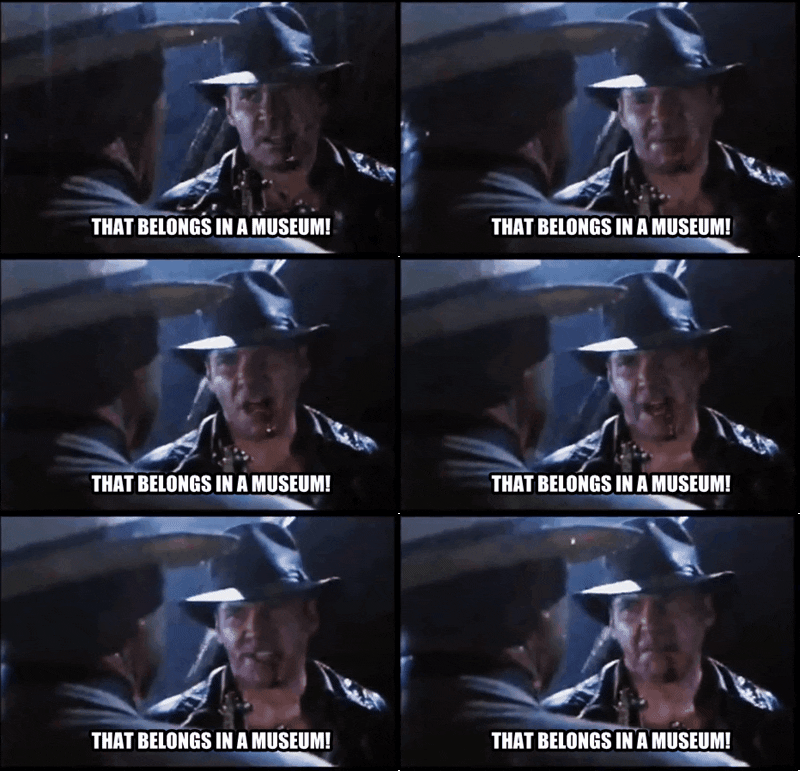
Indiana Jones That Belongs In A Museum GIF - Find & Share on GIPHY

Jamie-Lee Hearfield, Gwen Jackson, Clara Watson, Tristan Wadsworth.


Life Before Plastic: Final Thoughts

All good things must come to an end, and so this post marks the final blog in our Life Before Plastic series (here’s part one, two and three if you’ve missed any). Speaking of endings, today we’re going to be looking at what happens to the stuff we buy once it’s reached the end of its lifespan. Rubbish might seem simple but one man’s trash really is another man’s treasure, and it’s not always clear what is or isn’t ‘junk’.

Apart from the fact she’s a little bit broken, how could anyone think this beautiful porcelain doll/figurine was trash. Image: C. Watson.

In 19th century Christchurch there were a few different options available for getting rid of rubbish. Animal bones and food waste could be burnt in the fire or sold to the glue works. Rubbish could be buried in the backyard or used to infill an old privy or to level uneven ground. Rubbish could also be collected, similar to modern times. In April 1862 land was surveyed and set aside for a rubbish dump  and from January 1864 the Hadfield Brothers were contracted to collect refuse, slops, dry rubbish and ashes from bins left outside of houses. Prior to this, there was no organised, municipal collection of rubbish, and individual households or business had to deal with all their own trash. Whilst this rubbish collection was meant to be weekly, sometimes many weeks went by without collection, and there was little enforcement of making people use the collection service, hence why we find household rubbish pits with material dating later than the 1860s. Whilst rubbish collection eventually started to become more regular (we don’t bury our waste in the backyard these days…mostly) landfills themselves have problems of their own, namely that they contaminate the ground and that they eventually fill up. By the late 19th century Christchurch was facing these very problems, leading to the council investing in a rubbish incinerator known as the Destructor, which you can read more about here.

Most butchers and abattoirs likely sent their left-over bones to the glue factory, although as this advertisement shows glue works would accept bones from anyone. Image: Evening Star 27/05/1874.
Rubbish pits, one of the most common ways to dispose of waste in the 19th century. Image: J. Hearfield.
The middle black band you can see on the above stratigraphy is an old gully that was infilled in the 19th century with a mixture of foundry waste, household waste and commercial waste. Image: H. Williams.
Whilst rubbish collection did exist, it wasn’t as efficient as it is today. The writer of this article complains about the lack of collection from properties not located in the immediate city centre and business district, as well as the unsanitary conditions created by dumping waste in the backyard. Image: Globe 30/02/1881: 2.

19th century rubbish, whether it was buried in the backyard or carted away to a dump, almost always ended up in the ground. And the same is true for most of the rubbish created in the 20th and 21st centuries. From excavating 19th century rubbish pits we know that a lot of the material buried in the ground doesn’t break down quickly; we often still find organic material such as animal bones in perfect condition. In the 19th century the rubbish being generated was far less than it is today, both because of a lower population and because there was less single-use packaging. These days it’s estimated that New Zealanders currently generate 734 kg of waste EACH per year. There aren’t any statistics to compare back to the 19th century to see how much more that is but given that 734 kg was already a 20% increase from 2015, it’s safe to say that it’s a lot more. It’d be nice to think that burying waste in the ground means out of sight, out of mind, but given all the recent problems with the Fox River Dump it’s safe to say that that isn’t the case.

The introduction of recycling to New Zealand in the 1970s meant not all rubbish was going to landfills. These days paper, cardboard, plastic, aluminium, steel and glass are all able to be recycled into new products and reused again. Yet with China refusing to take any more plastic waste, material that could be recycled is once again being sent to landfills. Recycling, in of itself, has problems. New material is still being created, not everything that can be recycled is, and contamination means even when stuff gets recycled it can still end up in the landfill. In some ways that’s where our 19th century counterparts were ahead of us. The system of bottle reuse for example, where bottles were commonly washed and refilled, meant that not only were new bottles not needing to be made (or at least not at the levels they would be if bottles were single-use), but that there weren’t the contamination issues that exist with modern day recycling as all bottles were washed in the process. Yet the 19th century system of bottle reuse had nothing to do with reducing waste and everything to do with cost.

Money. I think that if we’ve learnt anything over the past four blog posts it’s that money is everything. Our Victorian ancestors might have made things to last a lifetime, but that’s because things had to last a lifetime as they were too expensive to be replacing every year. And as soon as things went down in price because of technological developments, people started spending and buying more. The reason we have a plastic waste problem is because plastic is cheap to manufacture. And because it’s cheap to manufacture it’s used for everything.

It’s pretty easy to feel helpless when thinking about the state of the world. Just walking down the supermarket aisles reveals how bad our plastic addiction has gotten. And here at UnderOver we’re just as guilty- we use plastic bags for all of our artefacts and despite writing a blog on Kmart culture we still ordered plastic trays from them.

The ultimate hypocrite: writing one blog moaning about packaging and another on Kmart culture and still ordering cheap trays from Kmart that came heavily packaged. Image: C. Watson.

I think at the end of the day there’s two things we can take away from this blog series. Firstly, if money is the main driver for plastic consumption, then as consumers we can take profits away from companies by choosing to only purchase from businesses that are environmentally friendly. Secondly, we can remember that there was life before plastic. Plastic has only been around for just over 100 years, for the rest of human history there was no plastic. And whilst life might be a little bit less convenient without it, surely giving up some convenience is worth saving the planet.

Clara Watson

References

Globe. Available online: paperspast.natlib.govt.nz
Press. Available online: paperspast.natlib.govt.nz
Lyttelton Times. Available online: paperspast.natlib.govt.nz

Life Before Plastic: Kmart Culture

Last time on the blog we talked about packaging and how our Victorian ancestors made do without plastic trays to wrap their cans of coke in (and all the rest of it). This week we’re going to take a closer look at plastic in the household. Plastic in the household isn’t quite as bad as plastic in the supermarket, but there still is a lot of it. There’s the plastic laundry basket, the plastic on the fridge door handles, the polyester clothes in the wardrobe and the plastic bucket in the laundry, to name a few.

If we were to go back in time to a Victorian house, we wouldn’t see any of those things. The clothes would be made of wool, or cotton, or linen, the bucket of metal, there wouldn’t be a fridge and the laundry basket would be an actual wicker basket. Now I could go through object by object and compare what we have today to what the Victorians used, but that would get a bit repetitive and boring. Instead what I want to do is take a look at the bigger picture and the different social and economic systems between now and 150 years ago. (A quick note, I make some big generalisations about purchasing habits in the next few paragraphs. Obviously, people’s purchasing habits are completely dependent on their individual economic situation and personal beliefs, and not every single object out there is cheap plastic junk. I’m just generalising to make a point about a certain type of behaviour).

A 19th century bone toothbrush and its modern-day plastic equivalent. Image: C. Watson.

Something you hear all the time is that things aren’t made to last like they used to. It’s a cliché, but it’s also true. As we discussed when talking about packaging, the main benefit of plastic is that it’s cheap to manufacture, meaning that plastic items are cheap to purchase. In the current economic climate, where manufacturers are focused on maximising profit and lowering the bottom line, plastic is often the most economical choice for goods to be made of. For some manufacturers that are using plastic the focus isn’t on making a high-quality product that will last a lifetime, but on making money. If we want to be really cynical, manufacturers benefit when products have a short lifespan as it means the customer has to keep purchasing the same product over and over again.

These cheaply manufactured plastic objects can be purchased from many stores, but I’m going to use one store that’s very popular at the moment to illustrate my point- Kmart- and what I’m going to refer to as “Kmart Culture”. If you’ve been paying attention on the internet for the past few years, you’ll have seen people going absolutely nuts for Kmart homewares. From the throws to the cushions, candles, and wall prints, there’s always a new trend.

Just a few of the many Kmart memes that exist on the internet. Image: Google.

Kmart Culture is completely focused on what’s new, because there’s always something new. There’s no consideration of the fact that there’s only so many places in the household that can be decorated with a throw blanket and a cushion. Instead new cushions are purchased, the old cushions are put in a cupboard, and they sit out of sight until there’s a Marie Kondo inspired cleaning spree and they go to the tip.  And the thing that facilitates being able to purchase new home décor, despite already owning various homewares, is the cheap price point, which is only possible because of plastic. You might be picking up on the fact that there’s a bit of a cycle going on here. Plastic makes goods cheap. People can afford to purchase non-essential items (eg. Home décor) because it’s cheap. People can afford to purchase even more non-essential items, even when they already have those items at home, because it’s cheap. People have no qualms about throwing out the old items, because they were cheap. Cheap plastic items end up in landfills.

With that pattern of behaviour in the forefront of our minds, let’s jump now to 19th century Christchurch where there was no plastic. By the mid-19th century the industrial revolution was in full swing. The introduction of mass-manufactured goods through the development of factories in Britain, combined with the discovery of new resources through world exploration and the creation of a global trade market through British and European colonisation meant products were cheaper than in previous centuries and there was a wider variety of things that could be bought (Rafferty 2019). This growth meant people had more money and there was a shift from people making things at home to purchasing them from shops.

All of this sounds relatively similar to modern times, and that’s because, in a way, it is. In the 19th century we see the beginning of the social and economic systems that led to modern day Kmart Culture. Whilst things weren’t as cheap as they are today, they were still cheaper than they had been in the past. In some ways it’s hard to compare the cost of goods in the 19th century with the cost of goods today. Whilst we can compare prices and index them (see here if you’re interested in more detail), in many ways it’s comparing oranges and apples. How do you compare the cost of a kettle in the 19th century, made of cast iron and designed to be heated on a range, with a modern electrical jug? And which electrical jug would you even choose to compare it with, the $10 one from Kmart or the $270 Breville one from Briscoes? Even if you chose to compare it with a cast iron jug they range from $30 to over a $100 in price.

Another way to compare is not looking at the cost of goods, but at what was thrown away. In Kmart Culture old items are being replaced by new items, despite the fact the old items are still useable. Think back over the past ten years, what household items have you thrown out? Nic nacs? Ornaments? Paintings? Cushions? Furniture? Clothing? Utensils? Pots and pans? Plates? If I think of my parents house 20 years ago and compare it to now, nearly everything in it has been replaced over the past two decades.

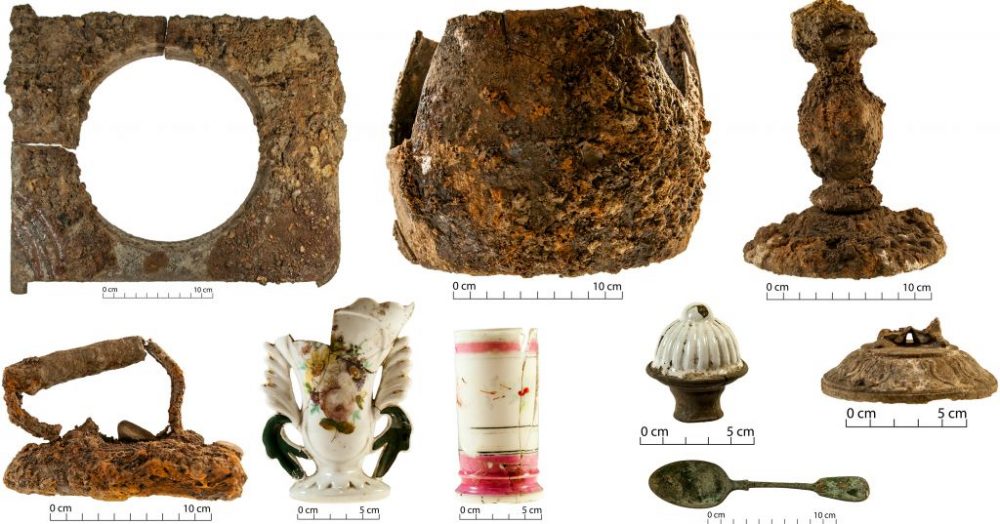
When we look at the archaeology of 19th century Christchurch, and in particular at rubbish pits and what people were throwing away, there’s two big patterns. Firstly, we don’t find homeware items that often, but we do come across them. We’ve found things like kettles, pots, cast iron ranges, irons, and bed knobs, but they’re rare and we definitely don’t find them in every site. There are other household items that aren’t rare, but we don’t find in every site. Things like cutlery, knives, vases and ornaments.

Some of the more unusual household items we come across. Image: C. Watson.

The relative scarcity of these objects in the archaeological record suggests there wasn’t a 19th century Kmart Culture around their purchase. People purchased these items and held onto them until they broke. In fact, a lot of the items shown in the above photograph came from a site where the occupants both passed away and we think the objects were thrown out by their children preparing the house for sale- proving that some things were intended to last a lifetime.

What we do find in nearly every single rubbish pit we excavate are ceramics. Plates, side plate, cups, teapots, platters, sugar bowls, tureens, jugs, chamber pots, bowls, basins, ewers- you name it and we’ve found it a thousand times over. And we find them in every form possible, from a single rim sherd to half a vessel that can be refitted to a fully complete item. It’s likely that a lot of the vessels we find are things that people have dropped or knocked and they’ve broken, and that’s why they’ve been thrown out, but given the quantities that we find either the 19th century residents of Christchurch were the clumsiest people in the world, or there was another reason why things were being thrown out.

Some of the many, many ceramic vessels we find in Christchurch archaeological sites. Image: C. Watson.

And so, ladies and gentlemen, I give you the Kmart Culture of the 19th century: ceramic dinner sets and tea sets. The industrial revolution led to pottery factories in the Staffordshire region of England producing large quantities of ceramic vessels for the export market. The scale of production meant it was possible for a range of different designs to be produced, and different fashion trends are apparent throughout the century. As new styles of ceramics became popular, people threw out their old sets and replaced them with new pieces.

19th stores were constantly advertising the arrival of new tea and dinner sets in the latest fashions. This 1893 advertisement shows both the availability of new ceramic vessels and the price range. Image: Star

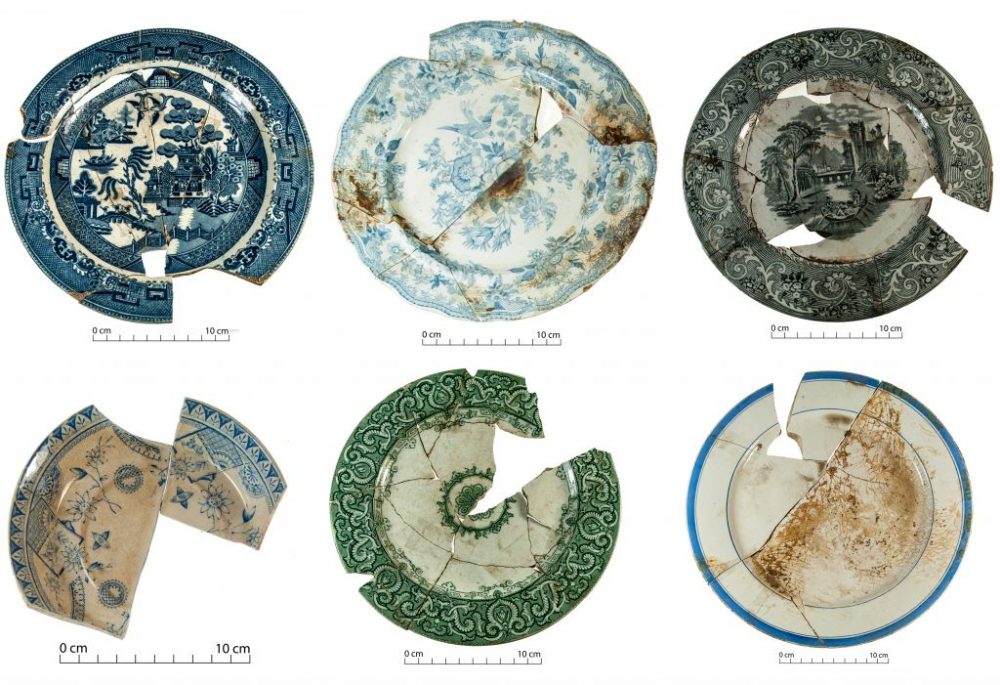
Just a few of the ceramic pattern styles popular through the 19th century. The top left is the Willow pattern, an example of the Chinese inspired designs popular at the beginning of the 19th century (with Willow pattern itself popular throughout the 19th and 20th centuries). Top middle is the Asiatic Pheasants pattern, a floral pattern with Chinese influences. On the top right is the Rhine pattern, an example of the romantic landscape designs inspired by European scenery and buildings, popular around the middle of the century. The bottom left is the Cairo pattern. The style of the Cairo pattern, with a design that breaks the pattern of ‘central scene with border’ shown on the plates in the top row, was inspired by the Aesthetic Movement of the 1870s. Bottom centre is the Albert Star pattern, with a simple design featuring a central motif and a border pattern. Bottom right is a simple banded design, seen on plates and cups from the end of the century. Image: C. Watson.

When we take this concept of “Kmart Culture” and compare modern purchasing habits to Victorian era ones, we see they’re not all that different. When people’s wages are high enough to allow for casual spending, and the goods they’re purchasing are cheap enough, then people will buy stuff. In the 19th century not every item met these criteria- cups and plates might have but not furniture, and that’s one of the reasons why we find tea wares and table wares in nearly every archaeological site but not table-tops and chair legs. In modern times almost everything can be bought cheaply, meaning that we can throw away nearly everything, and if our Victorian era ancestors had been able to buy a new kettle for $10 (or the equivalent of $10), then I’m sure we would be finding kettles in the archaeological record as well.

Clara Watson