French Farm: an archaeologist’s observations*

After a couple of weeks off from the blog, we thought it’d be a good idea to give you a run-down of what we learnt at French Farm. These are preliminary observations only, and could well change as we do more research! In no particular order, here you are.


 The ground floor, French Farm house. Image: K. Webb.


The ground floor, French Farm house. Image: K. Webb.

 Circular saw marks on timbers on the south wall of the first floor. Photo: K. Watson.


Circular saw marks on timbers on the south internal wall of the first floor. The house was built in at least two phases, with the first phase built by the French navy in the early 1840s. The timbers from the first phase were pit sawn and those from the second phase were circular sawn.  Image: K. Watson.

 Beaded match-lining like this lined a number of the rooms but the circular saw marks indicated that much of it was a later addition to the house. Photo: K. Watson.


Beaded match-lining like this in Room 7 (with Room 6 visible in the rear) lined a number of the rooms but the circular saw marks indicated that much of it was a later addition to the house. This in turn suggests that the original lining had been replaced. Image: K. Watson.

 The wall between Rooms 1 and 2, looking south from Room 1. Circular saw marks on the wall lining indicated that at least part of this wall was a later addition. Image: K. Watson.


The wall between Rooms 1 and 2, looking south from Room 1. Circular saw marks on the wall lining indicated that at least part of this wall was a later addition. There was once a doorway to the right of the collapsed fireplace but it was boarded up at some stage. Probably after it was boarded up, access to the first floor was moved from its original location (in Room 7) to the right of the collapsed fireplace – it’s just possible to make out the ladder in this image. Image: K. Watson.

 Part of the floor upstairs. The hole at right was probably the original means of accessing the first floor. And the hole would originally have been bigger, as the floorboards at left are circular sawn, unlike the pit sawn floorboards used for the remainder of the first floor (and the ground floor).


Part of the floor upstairs. The hole at right (above Room 7) was probably the original access to the first floor. And the hole would originally have been bigger, as the floorboards at left are circular sawn, unlike the pit sawn floorboards used for the remainder of the first floor (and the ground floor). Image: K. Watson.

 Top: 1860 newspaper. Bottom: 1861 newspaper. These are on the wall between Rooms 1 and 2, next to the fireplace. Image: K. Watson & K. Webb.


Top: 1860 newspaper (yes, sorry, it’s very hard to make out the date on this image). Bottom: 1861 newspaper. These are on the wall between Rooms 1 and 2, right next to the fireplace, and the timbers they are stuck on were circular sawn. This could indicate that there was a circular saw operating in the area by 1860-61. And it could indicate that Phase 2 dates as early as 1860-61. Of course, this is based on the untested assumption that the newspapers were actually stuck on the wall in 1860-61. It’s equally possible that it had been stockpiled and was stuck on at a later date. And don’t forget the potential time delays with shipping material to New Zealand. Image: K. Watson & K. Webb.

Left: window into Room 1, east elevation. Right: door into Room 7, east elevation. Cut marks in the weatherboards indicated that this door and window had effectively switched plans: the window in Room 1 was originally a door and the door into Room 7 was a window.

Left: window into Room 1, east elevation. Right: door into Room 7, east elevation. Cut marks in the weatherboards indicated that this door and window had effectively switched places: the window in Room 1 replaced an original door and the door into Room 7 replaced an original window. Image: K. Watson.

 The stones used as a footing underneath what was originally an external door into Room 1. Photo: K. Watson.


The stones used as a footing underneath what was originally an external door into Room 1. Image: K. Watson.

 The first floor, looking south. The circular saw marks on the dividing wall indicate that it was a later addition. Photo: K. Watson.


The first floor, looking south. The circular saw marks on the dividing wall indicate that it was a later addition, and this upstairs space may originally have been just one room. Image: K. Watson.

 This is a detail of a window frame upstairs, showing that the original window had been replaced. And either at the same time or later, this room had been lined with scrim (that's what all the small nails were for).


This is a detail of a window frame upstairs, showing that the original window had been replaced. And either at the same time or later, this room had been lined with scrim (that’s what all the nails were for). Image: K. Watson.

 Bottles under the floorboards in Room 2. The floorboards on the ground floor are butted, rather than tongue and groove, so I was expecting that we’d find some things under the floor. But small things, like fragments of glass and china, buttons, pins, that sort of thing. We did find that sort of thing, but we also found large bottles, and pieces of cutlery, which are not the sort of thing that’d just fall between the cracks in the floorboards. So, how did they get there? There are a couple of possible explanations: they could have been deliberately buried there before the floor was laid, or the floorboards may have been replaced at some stage. Image: K. Watson.


Bottles under the floorboards, Room 2. The floorboards on the ground floor are butted, rather than tongue and groove, so I was expecting that we’d find some things under the floor. But small things, like fragments of glass and china, buttons, pins, that sort of thing. We did find those small artefacts, but we also found large bottles, and pieces of cutlery, which are not the sort of thing that’d just fall between the cracks in the floorboards. So how did they get there? There are at least a couple of possible explanations: they could have been deliberately buried there before the floor was laid, or the floorboards may have been replaced at some stage. Image: K. Watson.

None of the artefacts we found could be readily identified as French. This doesn’t mean that they weren’t used by the early French occupants of the house, but it does make it difficult to prove. Further, at first glance, none of the artefacts found seemed to date from the 1840s and/or 1850s. Again, this doesn’t mean they weren’t used during the period – many common 19th century artefacts were made for long periods of time.

Even though we didn’t find anything particularly ‘French’ in the way of artefacts, the house itself is clearly not English in origin. It’s the layout that’s the real give away. It’s just so different from the standard central hall with rooms opening off it that we usually see in Christchurch. French Farm house is at least 30 years older than most of the houses we’ve looked at in the city, but even those 1850s houses we’ve recorded still have a central hall – which, when you think about it, is a bit of a waste of space really (and something we’ve moved away from in more recent times). And once you take out the central hall, everything else changes, including the house footprint – French Farm is significantly longer than it is wide. It also changes the flow of people through rooms, meaning you have to pass through one room to get to another – not the case in a house with a central hall. Maybe the logical extension of this is less privacy?

 Excavating in Room 1. Image: K. Watson.


Excavating in Room 1. Image: K. Watson.

The last thing that I learnt is that archaeology is fun! Maybe this seems a silly thing to say. But most of our work takes place on construction sites, surrounded by large diggers and other construction chaos, and – more often than not – we don’t find anything of note. For me personally, I spend most of my time sitting behind a desk, not doing any field archaeology. In either of these circumstances, it’s easy to forget how fascinating and enjoyable the process of simply digging or recording is. It’s also easy to lose sight of the fact that archaeology is all about learning more about the past, rather than simply recovering information for the sake of it.

Katharine Watson

* With thanks to Stephen Cashmore and David Brailsford for insightful conversations on site.

Allons creuser! Let’s go digging!

Working in archaeology here in New Zealand we most often encounter the material remains of Māori settlement and colonisation by the British Empire in the 19th century. Groups such as the New Zealand Company and the Canterbury Association laid out the blueprint for the shape and style of British colonisation, particularly in urban centres. So the opportunity to examine a different cultural context in Canterbury using archaeological techniques doesn’t come along that often, and when it does we jump at the chance! This weekend the Underground Overground Archaeology team are heading out to Banks Peninsula to help the Akaroa Civic Trust record and preserve an important site related to the French colonial effort in New Zealand.

French Farm house. Image: Jan Cook.

French Farm house. Image: Jan Cook.

French Farm Bay is situated across the harbour from the town of Akaroa on Banks Peninsula. Akaroa, the site of French settlement in the 1840s, is well known for its distinctly French character and several 19th century buildings still survive. In contrast the settlement at French Farm, once more populated than Akaroa, is now represented by a single structure. French Farm house was constructed in the early 1840s by the French navy. Its early date and unique context makes it a special site on Banks Peninsula. Archaeological recording techniques can be especially useful for this kind of site, combining meticulous examination of the built structure with an understanding of the surrounding landscape and the potential for below-ground archaeological remains.

Akaroa in 1866. Image: Buick 1928: 256.

In the 1830s Akaroa Harbour was a frequent stop-over point for European whaling ships.[1] In 1838 Jean François Langlois, the captain of a French vessel, acquired Banks Peninsula from some of the local Ngai Tahu chiefs. Returning to France he campaigned for the formation of the Nanto-Bordelaise Company for the purpose of establishing a French colony in the South Island. The company was given financial backing  by the French Government in the hope that it would help curb British expansion in the Pacific. And so in 1840, 59 colonists set out for New Zealand under the protection of the French navy.

Arriving at Banks Peninsula the French colonists discovered that the British had claimed sovereignty over the South Island under the Treaty of Waitangi, and their dreams of an independent French Colony were shattered. However, they decided to stay and the civilian settlement at Akaroa was established on the east side of the harbour.

 Figure 4. A French map of Akaroa Harbour in 1843. French Farm is shown on the west side of harbour, Akaroa (“Principal établissement français”) on the east side, and English, French and Māori settlement around the harbour

A French map of Akaroa Harbour in 1843. French Farm is shown on the west side of harbour, Akaroa (“Principal établissement français”) on the east side, and English, French and Māori settlement around the harbour.

At the outset of the expedition the French government had agreed that the navy would help to feed the colonists until their settlement was self-sustaining. The Nanto-Bordelaise Company purchased 300 acres in French Farm Bay for use as a farm. Approximately 16 sailors were sent by the navy to clear the land for cultivation. Potatoes, beetroot, cabbages, trees, vines and barley were all planted, and livestock was purchased from Hobart to supplement the farm’s crops. By 1843 the farm had buildings for housing and storage, and a jetty and roads had been constructed. At this time the farm settlement had grown to outnumber Akaroa, with around 150 French naval officers engaged in farm work and scientific research (NZHPT 2007). One of these men recorded details of the farm’s buildings in a letter home. He noted that the farm consisted of two large huts (one for housing crew and the other for an observatory) and 8-10 smaller houses for the officers. French Farm house is probably one of the officers’ residences mentioned in this letter.

French Farm house is the only surviving building in New Zealand built by the French navy. An architectural examination of the building has suggested that it was constructed using a technique known as poteaux en terre, meaning “post-in-ground” (Bowman 2007). This technique was commonly used by French colonists in Canada and the United States of America in the 17 and 18th centuries. Other aspects of the house, such as the use of plain weatherboards, are evocative of 19th century farm buildings in Normandy. Part of our focus this weekend will be examining the construction of French Farm house using buildings archaeology methods. This will allow us to further explore unique building techniques and consider them within their cultural and historical context.

Detail of poteaux en terre construction at Vital St Gemme Beavais house in Missouri, built in 1785. Image: Marsh 1985.

In 1846 the French navy left Banks Peninsula and the farm was entrusted to Emeri de Malmanche, one of the original French settlers. However, in 1849 the Nanto-Bordelaise Company’s interests were purchased by the New Zealand Company and in 1850 the Canterbury Association included the farm in Rural Section 100 of their survey. The section was sold to Joseph Dicken, a settler from Staffordshire. Over the years French Farm was used for dairy farming, timber milling and even a private boy’s school. French Farm house was probably occupied as a residence until c. 1900, and today it is the only structure from the once bustling naval settlement to survive.

This weekend we will be examining and recording the French Farm house and surrounding site using archaeological techniques. We will be posting photographs and videos of our work on the Underground Overground Archaeology facebook page, so check it out if you’re interested in the work we’re doing at this fascinating and important site.

References

Akaroa Civic Trust, n.d. Langlois-Eteveneux House (Museum) [photograph]. [online] Available at: http://www.heritage.org.nz/the-list/details/264. Accessed July 2014.

Anon, 1843. Croquis de la baie d’Akaroa. – Nouvel Zelande. [map]. In: “Les Europeens a la Nouvelle Zealande”, Le Magasin Pittoresque, XI, 47 (November 1843), p. 376. [online] Available at: http://gallica.bnf.fr/ark:/12148/bpt6k31426m/f380.image.r=Nouvelle-Zelande.langEN. Accessed March 2014.

Bowman, I., 2007. Conservation plan: French Farm house. Unpublished report.

Buick, T. L., 1928. The French at Akaroa. Wellington: New Zealand Book Depot.

Marsh, J. Q., 1985. Drawing of Poteaux-en-Terre in the Beauvais House in Ste Genevieve MO [drawing]. Historic American Buildings Survey; Record MO-1121. [Online] Available at: http://en.wikipedia.org/wiki/Post_in_ground#mediaviewer/File:Drawing_of_Poteaux-en-Terre_in_the_Beauvais_House_in_Ste_Genevieve_MO.png. Accessed July 2014.

New Zealand Historic Places Trust, 2007. French Farm House, French Farm Bay, Akaroa Harbour, Banks Peninsula, Canterbury: registration report. Unpublished report.

[1]This history of French Farm is summarised from Bowen 2007 unless otherwise stated.


Frequently asked questions #1

Training and working as an archaeologist can be an interesting experience, not just because of the work we do, but thanks to the preconceptions and opinions of the people around us. Like so many other professions, archaeology is an extremely broad field of work and study, encompassing all manner of skills, time periods and subject matters. It’s also one that is misrepresented enough in the media that people often have a skewed notion of what it is that we actually do.

So, this week on the blog, we thought we’d have a go at answering some of the more frequently asked questions that have been posed to those of us working here in New Zealand. It will be the first of a couple of posts, since, as it turns out, there are quite a few questions we face on a regular basis.

We’ll start with the big ones:

1)      You’re an archaeologist? Like Indiana Jones*¹?

Actually, no. Not really like him at all. There have been many, many discussions of this in popular culture over the years (including this memorable letter). It’s generally agreed that Indiana Jones is a terrible archaeologist and most archaeologists would make a terrible, and very probably dead, Indiana Jones. The main differences are in comparative methods and objectives: archaeology is ultimately about understanding people in the past, collectively and individually, through ALL the physical traces they leave behind, while Indiana Jones is about the finding and collection of precious objects with little regard for their surrounding context.

Actual archaeology: less whips, pistols and mystical artefacts and more just a whole lot of digging. Image: H. Williams.

Actual archaeology: less whips, pistols and mystical artefacts and more just a whole lot of digging and recording. Image: H. Williams.

2)      That’s so cool! What’s your favourite dinosaur?*²

Similar questions to this include, “Were there many dinosaurs in New Zealand?”, “Oh, cool, like Ross from friends?” and “Found any dinosaur bones lately?”

As many of you will know, palaeontology and archaeology, while they do share some methods and a predilection for physical remnants of the past, are not the same thing. Put very simply, archaeologists focus on the human past, while palaeontologists work with fossils, including dinosaurs, from the more distant past.

Although, it should be noted that the difference between our professions doesn’t mean that archaeologists dislike dinosaurs. My favourite is Archaeopteryx, for the record, followed by actually-not-a-dinosaur Quetzalcoatlus.  A quick survey of the rest of the office tells me that archaeologists are fans of Triceratops, Velociraptor, Saurolophus, Stegosaurus, Tyrannosaurus rex, Deinonychus and also-not-a-dinosaur Megalodon.

T-Rex: not the purview of archaeologists, but still awesome. Image:

T-Rex: not the purview of archaeologists, but still awesome. Image: David Monniaux

3)      Archaeology? That’s like rocks and pyramids and stuff, right?

Er, sort of. There’s a bit more to it, really. As those of you who read this blog regularly will know, archaeology is far more varied and complex than just pyramids and rocks. Egyptology is just one small part of our profession and rocks (usually stone tools) are just one of the materials we deal with.

It’s one of my favourite things about archaeology, actually: that it covers all of human history, and thus anything and everything that people have done in the past, be it constructing massive monuments to gods and kings, making important advances in industrial technology, or figuring out how to make better toothbrushes. The infinite variety to be found in people, past and present, will never ever cease to amaze me.

Some of the artefacts found in Christchurch this year. Less pyramids and rocks and more remnants of everyday life. Image: J. Garland.

Some of the artefacts found in Christchurch this year. Less pyramids and rocks and more remnants of everyday life. Image: J. Garland.

4)      What’s the coolest thing you’ve ever found?

Variations on this include, “have you ever found treasure?”, “found any gold?” and “what’s the oldest thing you’ve ever found?”

I’d say that this is probably the question we hear the most. The problem with answering it is that in the course of their careers, most archaeologists will have found a LOT of things, many of which are cool and interesting. Picking just one can be a bit like asking someone to choose their favourite dinosaur (see what I did there?). It’s made even more difficult to answer by the fact that what is amazing to us is not always amazing to other people. The explanation of why an otherwise unremarkable object (like a brick, or a sherd of pottery) is so interesting is usually far longer and much, much, drier than the questioner wanted.

It may not help that, in my experience, this question is usually asked in bars or in the small-talk associated with first meeting someone. Very few people want to hear about the socio-cultural implications of changes in brickmaking in the 19th century in that situation. Or that most of the artefacts we deal with in Christchurch are less than 160 years old and we pretty much never find gold.

As a result, some of us may or may not have taken to answering this question with “a unicorn skull.” Another quick survey of the office suggests that other answers may include “a harmonium”, “a crystal skull”, “lots of stuff”,  “this [insert object] that someone else actually found but I am pretending that I found for the sake of this conversation” and the phrase “well, it depends…”

Moving on to more serious matters…

5)      There’s not that much archaeology in New Zealand though, is there?*

This is one of the more frequent questions asked here in New Zealand and it can be a little dispiriting to be reminded of how many people don’t realise what a rich, interesting and unique archaeological record we have in this country.

From the very first Polynesian settlers, arriving here c. 1300 AD (Jacomb et al. 2014), through to the most recent periods of immigration and settlement, New Zealand has a fascinating and globally significant archaeological record. It may be short, compared to other places in the world (such as our neighbour, Australia), but that lack of time depth is part of what makes it interesting. Archaeologists have used our relatively condensed archaeological record to look at the impact of human settlement on the environment, to better understand patterns of settlement, migration and  trade, motivations for warfare, the processes of social and cultural change, and how people adapt to new social and physical environments (among many, many other things).

Excavations at a 14th century archaeological site in the Catlins. Image: K. Webb.

Excavations at a 14th-16th century archaeological site in the Catlins. Image: K. Webb.

Archaeology in New Zealand is protected by the Heritage New Zealand Pouhere Taonga Act 2014, which “defines an archaeological site as a place associated with pre-1900 human activity, where there may be evidence relating to the history of New Zealand” (Heritage New Zealand Pouhere Taonga 2014). The modification or destruction of any such site, which includes standing structures, requires the permission of Heritage New Zealand, and usually involves one or more archaeologists recording and salvaging any archaeological features or material found during that process.

As those of you who follow our work here in Christchurch will have realised, this means that there is in fact a lot of archaeology in New Zealand. Even more than that, the wide scope of the work that is being carried out throughout the country has huge potential to add to our understanding of people in the past and their influence on the world around them.

6)      Who pays for all that?

Simplified, there are two main types of archaeological work undertaken in New Zealand: research archaeology, or those investigations carried out by the universities and/or independent researchers, and cultural resource management, carried out by consulting or contracted archaeologists in response to the modification or destruction of sites, as governed by the 2014 act. As a result, there are different methods of paying for that work.

Research archaeology is usually funded through the universities themselves or through research grants such as those provided by the Marsden Fund. Cultural resource management archaeology functions as a ‘polluter pays’ system, in which the authority holder covers the cost of recording and salvaging the archaeological information being lost through the modification or destruction of an archaeological site.

Cultural heritage management archaeology in Christchurch. Image: M. Carter.

Cultural heritage management archaeology in Christchurch. Image: M. Carter.

7)      Huh. Why? What’s the point?

To put it simply? Because our heritage is important. Because understanding where and who and what we’ve come from, as individuals, as a society, as a culture and as a country, is invaluable in understanding where we are now and where we may be in the future.  Because future generations deserve the opportunity to explore that heritage for themselves without wondering why we didn’t do more to save it for them. Because the actions and creations and lives of the people who’ve gone before us deserve to be remembered. Because there are things we learn from the archaeological record that would otherwise be lost to us. Because archaeology allows us to expand our horizons, to catch a glimpse of people and places that are so different to our own, yet linked to us through time and across cultures thanks to the things that they left behind.

Because, ultimately, people are important, and at its heart, archaeology is all about people.

 Jessie Garland

*¹ Less frequently, Indiana Jones may be switched out for Lara Croft.
Apparently, palaeontologists often get the same question in reverse and have responded with t-shirts.


References

Jacomb, C., Holdaway, R.N., Allentoft, M.E., Bunce, M., Oskam, C.L., Walter,
R., Brooks, E., 2014. High-precision dating and ancient DNA profiling of moa (Aves: Dinornithiformes) eggshell documents a complex feature at Wairau Bar and refines the chronology of New Zealand settlement by Polynesians. In Journal of Archaeological Science (2014), doi: 10.1016/j.jas.2014.05.023. [online] Available at www.sciencedirect.com

Peeling back the onion of time

Recording standing structures not only involves architectural drawings and photography, but can also be quite destructive. In an attempt to modernise an old house owners will often cover “old fashioned” features with new materials, plasterboard being the chief culprit. So, during building recording part of our job often involves removing these modern linings (by any means necessary) to reveal the fabrics beneath, going back in time to see what the building was like originally. And, as you can imagine, taking to a wall with a hammer and crowbar is also good for stress relief.

Through extensive use of the notorious hardboard previous owners of this house had gone to great lengths to cover nearly every inch of original decoration inside the house in order to cut down on the weekly chore of dusting.

Through extensive use of the notorious hardboard previous owners of this house had gone to great lengths to cover nearly every inch of original decoration in the house. Every moulded shirting board, architrave and door panel was covered.

Every moulded skirting board, architrave and door panel in the house was covered with hardboard. Photo: K. Webb.

  Hardboard was used on the exterior of the house too. To cover up weatherboards and this decorative cast iron frieze along the top of the veranda.

Hardboard was used on the exterior of the house too. To cover up weatherboards and this decorative cast iron frieze along the top of the veranda. Photo: K. Webb.

Extensive investigation of the kitchen uncovered this finely moulded paper mache dado. This is the only example found so far of this product in Christchurch.

Extensive investigation in the kitchen uncovered this finely moulded paper mache dado. This is the only example of this product found so far in Christchurch. Photo: K. Webb.

Plasterboard and other modern wall linings sometimes have their merits though. They often have the unintended function of doing a really good job of preserving what is beneath it, particularly wallpaper.

wallpaper-layers

Wallpaper is usually found in multiple layers with a backing of scrim. It is sometimes possible to separate the layers right back to the original wallpaper, as long as no one has painted over it of course. Photo: L. Tremlett.

newspaper-wall-lining

We may even get a pleasant surprise when we get to the bottom layer. If there was not much money available for decorating, or for extra draft protection, people would often line their walls with newspaper. Photo: L. Tremlett.

This hand written note was found adhered to the tongue and groove match lining of a cottage in Lyttelton.

This hand written note was found adhered to the tongue and groove match lining of a cottage in Lyttelton. It was well preserved beneath a layer of scrim and plasterboard. It gives details of the sailing of the S. S. Grafton from Hokitika in (we think) 1880. What it was doing stuck in the middle of the front room wall of a cottage is a mystery. Photo: J. Garland

Digging deeper into the fabric of a building one may come across some interesting and sometimes, perhaps, elusive objects inside the walls and under the floors.

This book published by the Scottish Temperance movement in 1877 was found behind the tongue and groove lining in a house in Ashburton.

This book entitled Three Years in a Man-Trap published by the Scottish Temperance League in 1877 was found behind the tongue and groove lining in a house in Ashburton. In this case the books were used as a filler, instead of strips of wood, to even up the gap between the match lining and wall. Photo: J. Garland, H. Williams.

Quite often shoes are found concealed beneath the floors of houses.

Shoes are often found concealed beneath the floors of houses in Christchurch. During the 19th century in Britain and some European countries it was a common custom to conceal shoes within the fabric of the building as magical charms to protect the occupants of the building agains evil influences such as witches and ghosts. We can’t say for sure if this was always the case in Christchurch. Photo: K. Webb

We quite often find other items under the floors of houses, such as animal bones, bottles and other domestic rubbish, as well as the odd mummified cat. These items were most likely not deposited under the house for superstitious reasons, we hope. The cats are later given a proper burial.

This cane riding crop was found beneath the floor of the house of John Cracroft Wilson.

This cane riding crop was found beneath the floor of the house of John Cracroft Wilson. Image: I. Hill.

Beyond the superficial appearance of a structure there is a lot we can learn by quite literally peeling back the layers of a building, or excavating it, if you will. Buildings like these can be more than just houses once lived in. There’s history written in the walls, from the changing tastes in interior decoration to things intentionally hidden, covered up or accidentally lost. Whatever the reasons for these hidden bits and pieces, be they mundane, superstitious or inexplicable, they show us that it’s always worth looking beyond the surface of a building to find the treasures within.

Kirsa Webb

Oh, the irony: a tale of unexpected survival (or how the little things can last the longest)

Over the last few weeks, as archaeologists do, I’ve found myself thinking about the physical legacies people leave behind them. In particular, I’ve been thinking about the contrast between the monumental (buildings, in this case) and the artefactual and how, oddly enough, it is not always the large or the supposedly permanent legacies that survive. We’ve come across this contrast before in Christchurch’s archaeology, in cases like that of J. G. Ruddenklau and the City Hotel or the china from Sydenham House, where the structural legacies are long gone, but the story – the memory – can still be found in the a single fragment or a single object. In small things forgotten, as the saying goes.

This came to mind again recently, thanks to a clay smoking pipe we found in the CBD, incised with the mark of Messrs Twentyman & Cousin, “whole sale and retail ironmongers”. It’s a simple cutty-shaped pipe, with a slightly angled bowl and no heel or spur evident at the base. Were it not for the circular stamp of “TWENTYMAN / COUSIN N.Z” at the back of the bowl, it would be unremarkable. The stamp renders it unusual, by virtue of the fact that it is rare to find clay pipes in New Zealand with the marks of local retailers or manufacturers.

We found another New Zealand branded pipe at this site, this time stamped with the mark of Twentyman & Cousin. Messrs Twentyman & Cousin (wonderful names!) were Christchurch retailers

The Twentyman & Cousin clay smoking pipe found in Christchurch. Interestestingly, the mark is only on one side of the bowl – the one facing the smoker. Image: J. Garland.

We don’t really know why the clay pipe bears the mark of Twentyman & Cousin. The only other examples of similarly branded pipes that I’ve come across were associated with tobacconists and hotels, both of which are more easily related to the practice of tobacco smoking than an ironmonger and agricultural merchant would have been. Was it advertising, perhaps? Maybe the business branched out into a few examples of personalised merchandise? Maybe it was commemorative in some way? Whatever their reason for marking the clay pipe, I suspect it had little to do with preserving a legacy. Yet, in a way, that is what it does now.

Twentyman & Cousin was first established in the late 1860s in Cathedral Square (Lyttelton Times 10/8/1867: 1), by John Holm/e Twentyman and his cousin, Alfred Charles Twentyman (hence the name). Although it is unclear when the latter arrived in the city, we know that Mr J. H. Twentyman arrived in Christchurch in late 1865, along with his family (Star 6/3/1900: 1). By all accounts he was a particularly well-read man (one advertisement details a lecture he gave to the Young Men’s Christian Association on Egypt in the ancient and modern eras) and heavily involved in Christchurch’s church community (Star 17/06/1879:3, 13/08/1879: 3, 16/04/1890:3). Less information is available about Alfred, unfortunately, although we do know that the partnership between the two men was dissolved in 1888 (Press 10/08/1888: 1).

Early advertisements for the business indicate that Twentyman & Cousin imported and sold a range of materials, from woolpacks  to corn sacks and sheep shears (Lyttelton Times 23/12/1868: 1, 10/8/1867:1). In later years, they were known for their ironmongery, particularly their selection of agricultural, pastoral and gardening tools and machinery. One advertisement from 1881 mentions products such as “garden syringes” and the “Ward & Paynes bow pattern solid crucible cast steel sheep shears”, a phrase that I challenge you all to try and say fast five times (Star 9/11/1881: 4). In that following year, numerous advertisements tell of their sale of reapers and binders and their participation in a “trial of reaping and binding” (which, to me, suggests some kind of demonic exorcism as much as it does agricultural work; Wanganui Herald 25/01/1882: 2 ). They didn’t limit themselves to agricultural and pastoral tools, though: other advertisements for the business promote the sale of “an assortment of guns, which for finish and cheapness surpass anything ever brought into the market” (Star 31/05/1883: 1).

An 1881 advertisement for Twentyman & Cousin. Image: Star 25/11/1881: 4

An 1881 advertisement for Twentyman & Cousin, listing all manner of machinery and tools (shovels, rakes and implements of destruction, even). Image: Star 25/11/1881: 4.

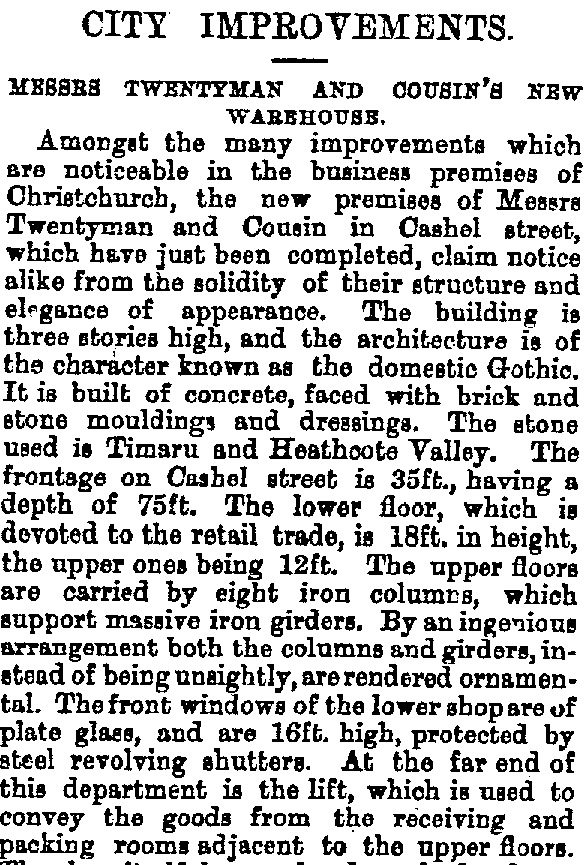
By 1880, the company had moved from Cathedral Square to a new building on Cashel Street west, one designed by renowned Gothic revival architect Benjamin Mountfort. Mountfort is most famous for his involvement in the design of the Canterbury Provincial buildings, which still stand today. The new Twentyman & Cousin building on Cashel street was constructed from concrete, brick and stone, and cost somewhere in the region of four thousand pounds to construct, a hefty sum in those days. Contemporary accounts described it as being in the domestic Gothic style, having “solidity of structure and elegance of appearance” and ornamented “sufficiently so as to relieve it from the sombre and barn like appearance of too many of our other buildings” (Press 10/4/1880: 1, Star 8/04/1880: 4). It was, it seems, the talk of the town.

Extract from an 1880 newspaper article on the new Twentyman & Cousin building in Cashel Street. You can see images of the building here. Image:

Extract from an 1880 newspaper article on the new Twentyman & Cousin building in Cashel Street. You can see images of the building here. Image: Press 10/4/1880: 1.

Although this building is of note for a number of reasons (the architectural design not least among them), I find it particularly interesting to think about it as an example of branding, of legacy, in comparison with the clay pipe. The building was elaborate (ostentatious, even), durable (remember that “solidity of structure”) and, presumably, deliberately built to carry the Twentyman & Cousin name into the future, be it 10 years or 100 years distant. There is an intention of permanence in its construction, in everything from the materials used to the style of the building. The clay pipe, on the other hand, emits no such sense of intentional durability. It’s a disposable item, meant to be used until it no longer works and can be discarded. Yet, it survives (albeit slightly the worse for wear), and the building does not.

The contrast (and irony) in this particular story is not just in the difference between the intended purpose of the pipe and the building, but in the manner of their survival. It’s fair to say, I think, that the clay pipe has survived where the building has not because it was discarded, kept safely in the ground over the decades. This often seems to be the way in archaeology, especially in circumstances like those found in Christchurch: the big things are lost and it is the small, disposable, things – the forgotten things – that slip through and keep the past alive. A legacy is a legacy, after all, even if it is not quite as originally intended.

Jessie Garland

References

Lyttelton Times. [online] Available at www.paperspast.natlib.govt.nz

Press. [online] Available at www.paperspast.natlib.govt.nz

Star. [online] Available at www.paperspast.natlib.govt.nz

Wanganui Herald. [online] Available at www.paperspast.natlib.govt.nz