Good beard, bad beard, red beard, blue beard: facial hair in Victorian Christchurch

Part the First

Movember is upon us once again, and to celebrate Undershaved Overgrown Archaeology brings to you a brief history of facial hair in Aotearoa. Movember is all about men’s health, and we’ve previously covered health in the blog before, both mental health and otherwise, so this week it’s all beards and moustaches. Gird your goatees for a hirsute history of facial hair in the nation, followed by a review of classic beards of old Canterbury.

Important Māori who wore tā moko necessarily removed their facial hair in order to show it off, and trimmed their tui tufts by plucking with mussel shell. They may also have shaved with razor sharp tūhua/obsidian, as it was otherwise used for cutting hair (McLintock, 1966; Robley, 1896). However, some of the earliest Pākehā imagery we have of Māori – drawings done by Sydney Parkinson, the Scottish botanical illustrator on Cook’s first voyage – show a range of facial hair and top knots. It is not clear if within 3-4 years the top knots would all be replaced with the same vague haircut of shaved back and sides, and a floofy combover on top – you Millennials know who you are.

This painting was evidently done before Pākehā got the hang of drawing moko. The guy in the upper middle is so fed up with this man-bun business. Image: Parkinson, Sydney, 1745?-1771. Parkinson, Sydney, 1745-1771 :The heads of six men natives of New Zealand, ornamented according to the mode of that country. S. Parkinson del. T Chambers sculp. London, 1784. Plate XXIII.. Parkinson, Sydney, 1745-1771 :A journal of a voyage to the South Seas, in his Majesty's ship, 'The Endeavour'. Faithfully transcribed from the papers of the late Sydney Parkinson. London; Printed for Charles Dilly, in the Poultry, and James Phillips, in the George-Yard, 1784.. Ref: PUBL-0037-23. Alexander Turnbull Library, Wellington, New Zealand. http://natlib.govt.nz/records/23044298

This painting was evidently done before Pākehā got the hang of drawing moko. The guy in the upper middle is so fed up with this man-bun business. Image: Parkinson, Sydney, 1745?-1771. Parkinson, Sydney, 1745-1771 :The heads of six men natives of New Zealand, ornamented according to the mode of that country. S. Parkinson del. T Chambers sculp. London, 1784. Plate XXIII.. Parkinson, Sydney, 1745-1771 :A journal of a voyage to the South Seas, in his Majesty’s ship, ‘The Endeavour’. Faithfully transcribed from the papers of the late Sydney Parkinson. London; Printed for Charles Dilly, in the Poultry, and James Phillips, in the George-Yard, 1784.. Ref: PUBL-0037-23. Alexander Turnbull Library, Wellington, New Zealand. http://natlib.govt.nz/records/23044298

During Pākehā settlement of Aotearoa, the beard was a fairly recent phenomenon, growing in popularity during the Victorian period along with changing ideals of masculinity, at a rate roughly equivalent to Queen Vicki’s bloomers. Like the modern hipster beard, the Victorian beard craze coincided with conflict in the Crimea. During the Crimean War (1854-1856), the British army relaxed their long-standing ban on beards – due to the freezing winters and difficulty in obtaining shaving soap – and servicemen were russian to grow them. Beards soon became a mark of those who had served, and the fashion subsequently spread across the British Empire. Beards could be seen on the patriotically named Mount Victoria in Auckland and Wellington, the proud imperial city of Victoria in British Columbia, the humble Victoria harbour in Hong Kong, and probably even on Lake Victoria. It is no surprise then, that on the rugged outskirts of Wikitoria’s empire, the beard held particular sway.

God Save the Queen

God Save the Queen

The beard was also considered healthy, and recommended by doctors. The face tangle was believed to filter out impurities in the air, and prevent sore throats.

A Lyttelton Times article relating a ‘stache survey provides insight into just why men of the 1860s chose the old dental duster as an accessory (Lyttelton Times, 27/4/1861: 5). Helpfully for you dear reader, I’ve put it into a table! (please send your thanks and appreciation monies to T. Wadsworth C/- Underground Overground).

Reasons for wearing a moustache, 1861.

Given reason No.
To avoid shaving 69
To avoid catching cold 32
To hide their teeth 5
To take away from a prominent nose 5
To avoid being taken as an Englishman abroad 7
Because they are in the army 6
Because they are Rifle Volunteers 221
Because Prince Albert does it 2
Because it is artistic 29
Because you are a singer 3
Because you travel a deal 17
Because you have lived long on the continent 1
Because the wife likes it 8
Because it acts as a respirator 29
Because you have weak lungs 5
Because it is healthy 77
Because the young ladies admire it 471
Because it is considered “the thing” 10
Because he chooses 1

The most common reason to wear a moustache was to impress the ladies, but there are also reasons of vanity (“to hide their teeth, to take away from a prominent nose”), and again, the perceived health benefits (“because it is healthy, because it acts as a respirator, because you have weak lungs, to avoid catching cold”). The association of moustache and military is also clear, with “because they are Rifle Volunteers” the second most common reason given for the old Magnum P.I. It is not clear if the two who responded “because Prince Albert does it” had further ornamentation for similar reasons.

Prince Albert of ‘Stache-Moburg and Goatee.

Prince Albert of ‘Stache-Moburg and Goatee. Image: Wikimedia Commons.

When the Victorians kept a stiff upper lip, they need to make sure it looked good. Moustaches were tinted and combed, and fashions changed. In 1883, a local purveyor of cosmetics said that “a year ago the fashion was to have the end stick out in a fluffy fashion, but now they want me to make it drop at the corners of the mouth” (Star, 29/8/1883: 4). There were of course products to keep it looking fresh. The below bottle of Rowland’s Macassar oil – found on several sites in Christchurch – is  described as “unsurpassed as a brillantine for the beard and moustaches, to which it imparts a soft and silky appearance” (Press, 16/10/1897: 11). We’ve also found bottles of “bay rum”, which formed part of a recipe to darken grey hair and beards (Otago Daily Times, 9/3/1915: 8).

Rowland’s Macassar Oil. Like most 19th century products, this is essentially snake oil, but without the fun of being made from actual snakes. Image: J. Garland.

Rowland’s Macassar Oil. Like most 19th century products, this is essentially snake oil, but without the fun of being made from actual snakes. Image: J. Garland.

Bay Rum. Don’t drink it, just rub it on your face and head. Image: J. Garland.

Bay Rum. Don’t drink it, just rub it on your face and head. Image: J. Garland.

But how to keep one’s soup strainer from acting in its name? On a site in Christchurch, we found a fragment of a cup with a “moustache protector”. This “yankee notion” kept one’s lip toupee clean of coffee by way of a protrusion within the cup, as modelled here by our own beard-having Hennessey (Star, 15/2/1878: 2).

In the midnight hour, he cried mo, mo, mo.

In the midnight hour, he cried mo, mo, mo.

Part the Second

In which we focus on the facial hair of the founding fathers of our fair city. We revisit some of the figures from Christchurch and the blog’s past and Tristan provides a highly subjective fever dream review of their moustaches and beards.

James Jamieson

The man:

James Jamieson carried on the proud Victorian tradition of Firstname Firstname-son and together with his brother William ran one of the leading construction companies in Christchurch, including the Roman Catholic Cathedral and the Government buildings in Cathedral Square. We’ve talked on the blog before about Jamieson’s love of spreadable cheese long before Koromiko was a thing.

The moustache:

Jamieson grew the classic ‘walrus‘ moustache, and chose to draw maximum attention to it by banishing all other hair from his countenance. His care and attention in maintaining the structural integrity of his weighty moustache – enough to cause any lesser man to topple forwards – informed his construction style, and it is said[1]  that his own chrome-y dome inspired those of the basilica.

9/10

Draw your own conclusions. Confirmed Illuminati. Image: Photograph of Cathedral of the Blessed Sacrament by Greg O’Beirne.

Draw your own conclusions. Confirmed Illuminati. Image: Photograph of Cathedral of the Blessed Sacrament by Greg O’Beirne.

Charles Obins Torlesse

The man:

Nephew to New Zealand company agent Arthur Wakefield, Torlesse became a surveyor working under Captain Thomas, chief surveyor for the Canterbury Association. Torlesse made the very first sketch map of Canterbury in 1849, illustrating the vast plains and resources that would draw Pākehā settlers to the area (Montgomery and McCarthy, 2004). He is said to have made the first ascent of a Southern Alps peak – now Mount Torlesse – by a Pākehā. He was a pretty cool bloke, more (t) or less (e).

Sketch map of the country intended for the settlement of Canterbury. Charles Obin Torlesse, 1849. Image: Wikimedia Commons. (Attentive readers will note the originally intended location of Christchurch at the head of Lyttelton Harbour. Inattentive readers GET NOTHING).

Sketch map of the country intended for the settlement of Canterbury. Charles Obin Torlesse, 1849. Image: Wikimedia Commons. (Attentive readers will note the originally intended location of Christchurch at the head of Lyttelton Harbour. Inattentive readers GET NOTHING).

The moustache:

Torlesse sported what is known as ‘friendly’ mutton chops, as popularised by Lemmy from Motorhead, and the general Burnside, for whom sideburns are named (seriously). These are not the distinctly un-friendly sideburns worn by Hugh Jackman/Wolverine, Elvis, and every jerk from the 70s. Ever the surveyor, Torlesse surveyed himself 75% facial hair, leaving the lower lip and jaw free for you to swipe right on Chinder.

8/10

charles_torlesse

Charles Obin Torlesse. He’s seen some things. Image: Wikipedia Commons.

John George Ruddenklau

The man:

John George Ruddenklau, his name is my name too. Ruddenklau was one of Christchurch’s early success stories, being a self-made man who worked his way up from an hotelier in 1864 to a retired hotelier in 1869, and from Mayor of Christchurch in 1881 to a retired former Mayor of Christchurch in the late 1880s. Ruddenklau’s City Hotel was successful enough that it had its own brand of dinnerware, which we have found on other hotel sites in Christchurch.

Fragments of a saucer, teacup and mask jug (with beard!), decorated with the City Hotel pattern and the initials J. G. R. Image: J. Garland.

Fragments of a saucer, teacup and mask jug (with beard!), decorated with the City Hotel pattern and the initials J. G. R. Image: J. Garland.

The beard:

Old J.G. had the kind of dense ruggedy beard typical of big deal businessmen in the 19th century, modern hipsters, and, er, delicious mussels. This particular photo of sad Ruddenklau shows just how he kept it so lush: it was well watered by his mayoral tears. Poor, sad-looking Ruddenklau.

John George Ruddenklau, blinging it up. Image: Wikimedia Commons.

John George Ruddenklau, blinging it up. Image: Wikimedia Commons.

Dr Alfred Charles Barker

The man:

Dr A.C. Barker was one of Christchurch’s earliest amateur photographers, and is responsible for many of the earliest photographs of our city. Here at Underlit Overexposed, we’ve used Barker’s photography to illustrate how useful even the most mundane details of these images are in terms of historical information. So feel free to continue to capture your messy room in the background of your selfies, or even better, just go take photos of street kerbs! For anyone that’s interested in either selfies or photographs as a historical resource in little old New Zealand, you can go here to listen to oral historian Rosemary Baird discuss that very thing.

The beard:

Speaking of selfies, Barker took a few himself.

Here, Barker poses nonchalantly with his camera equipment, while showing off some serious mutton chops. If Bigfoot photographic evidence was this clear, he would have his own talk show by now. But nobody would watch it because podcasts fill that place in society these days. Get with the future Bigfoot!

dr_a-_c-_barker

“To gild refined gold, to paint the lily, to shave the face, is just friggin silly”. Apologies to Tim Minchin. Image: Wikimedia Commons.

This photo shows Bigfoot later in life, with a big old beard. Or Barker, probably. By this stage, Barker’s beard is perfectly complimented by a faux-Shakespeare haircut, which you don’t see enough these days. “There’s many a man has more hair than wit” the bard said, but considering Barker’s beard, I’m not sure what that says.

Sir John Cracroft Wilson

The man:

Wilson was a pioneering figure in Christchurch, being a former British army officer in India, who brought a number of his Indian servants with him when he settled in Christchurch. Cashmere is named for Kashmir in India/Pakistan, where Wilson served, and the adjacent suburb of Cracroft is named for…something. I forget. We’ve talked about Wilson’s home, now gone, before, but Wilson’s stone servant’s quarters still stands, and small portion of a mighty drain built by WIlson’s Indian servants remains nearby. This is a rare example of a drain lined with dressed stone, because, well, the dude liked stone. And who can blame him.

Cracroft's stone-line drain. Image: K. Webb.

Cracroft’s stone-line drain. Image: K. Webb.

The beard:

Wilson lived into his blankety blanks, and had the rare opportunity to grow a solid white beard. But as can be seen in the photo, Wilson’s facia hair went beyond the simple Santa beard and itself slipped into the snowy fey realm from which that fatherly character came, becoming an almost imperceptible, ethereal beard-shaped hole between realities. Wilson’s ghostly beard and eerie floating face were perfectly suited to snow-bound late 19th century Christchurch. Wilson would prowl the snows, camouflaged by his beard, shielding his nose with his hand to sneak up on unknowing foxes and seals. Or I might be thinking of polar bears. It is now impossible to tell.

10/10

cracroft

Sir John Cracroft Wilson, slowly fading from this photograph. Quick, somebody play “Johnny B. Goode”. Image, Acland, 1975.


Show your support for Movember, by visiting its website. Show your support for moustaches in general by doing the finger guns to the next person you see with one. Pew-pew-pew!

References

Acland, L.G.D., 1975. The Early Canterbury Runs. Fourth ed. Christchurch, N.Z.: Whitcoulls Ltd.

McLintock, A.H., 1966. Stone Tools. In: An Encyclopedia of New Zealand. [online] Te Ara, The Encyclopedia of New Zealand. Available at: <http://www.teara.govt.nz/en/1966/maori-material-culture/page-8>.

Montgomery, R., and McCarthy, K., 2004. The map that made Canterbury – or, how a little-known sketch map by Charles Obins Torlesse was transformed into Canterbury Association advertising in London. Records of the Canterbury Museum, 18, pp.51–65.

Robley, H.G., 1896. Moko; or Maori Tattooing. London: Chapman and Hall Ltd.


[1] By me, just now, completely unfounded.

Whisky, that philosophic wine, that liquid sunshine

It is a well-known truth, in this office at least, that archaeology and whisky go well together. Or, perhaps more accurately, that archaeologists and whisky go well together. With a few exceptions (you know who you are, gin drinkers), it is not at all uncommon to find yourself in the company of an archaeologist with a fine appreciation for a single malt (or two, or three). With that in mind, it’s a bit of a wonder that we haven’t thought to write a blog post combining the two before now (honestly, archaeology and whisky are two of my favourite things, what were we thinking).

It won’t surprise any of our readers, I think, to hear that alcohol bottles are one of the most common artefacts we find on 19th century sites (here in Christchurch and throughout New Zealand). Despite the temperance movement in the late 19th century and the many discussions and testimonies about the evils of the demon drink, alcohol remained a popular product. As with the gin bottles we discussed a while back, however, it can be difficult to know exactly which types of alcohol were originally contained in these bottles – unless we have a label or embossing (and even then, these bottles were reused over and over again for a variety of products). Fortunately for this post, as it happens, we’ve been lucky enough to find a few examples that do have labels, each with their own story to tell about whisky consumption in Christchurch.

dsc_7168ed1

“Black  beer” bottles of various sizes found in Christchurch. While a large number of these were probably used for beer, the larger quart sizes in particular would also have been commonly used for spirits like whisky and gin. Image: J. Garland.

Johnnie Walker.

Old Johnnie Walker. Established in Kilmarnock in the mid-19th century, John Walker (and then John Walker and Sons) has making whisky for far longer than some of you might be aware. It’s advertised in New Zealand newspapers throughout the latter decades of the 19th century. This particular bottle, found on a site in Rangiora, has been cut with a hot wire around the shoulder of the bottle to create a preserving jar out of the base (the jar like shape of the cut base would be used to store fruit or preserves and sealed with wax). Image: C. Dickson (left), Southland Times 16/04/1887: 4 (right).

Genuine pure whisky will never injure the system.

Advertisements for whisky in the 19th century were many and varied. This one, for Teacher and Sons, makes the oft-used claim that “Genuine pure whisky will never injure the system; it is the common inferior stuff which is the curse of the world.” Image: Akaroa Mail and Banks Peninsula Advertiser 3/06/1904: 2.

removing the drunk from whisky

In which an enterprising chemist with only the best of intentions claims to have removed the “drunk” from whisky, but not the exhilarating powers. Amazingly, his discovery doesn’t seem to have taken off. Image: Dunstan Times 30/08/1909: 2.

saucel-paisley

This label has a bit of a story behind it. We sent it off to the good folks at Whisky Galore, who managed to trace it to the Saucel distillery in Paisley, Scotland – one of the biggest distilleries of the late 19th century (apparently producing over a million gallons a year in the 1890s), but one that has now been completely erased from the landscape. The distillery was established c. the 1790s and continued through into at least the early 20th century (it was taken over by the Distiller’s Company in the early 1900s). It was bought by James Stewart and Co. in 1825 and, although it was resold in 1830 to Graham Menzies, continued to carry the Stewart name for quite some time. There are several advertisements to be found in New Zealand newspapers in the 1860s and 1870s for Saucel or ‘Stewart’s’ whisky from Paisley. Image: J. Garland (left), Taranaki Herald 05/03/1864: 4 (right).

squirrel whisky

Squirrel whisky! We do not recommend. Image: Tuapeka Times 8/07/1908: 1.

Kirkliston

Another old establishment, the Kirkliston distillery was established in 1795 in West Lothian, Scotland. It had a series of owners during the 19th century, including Andrew Stein, who installed a Stein continuous triple still, John Buchanan and Co. and, eventually, John Stewart and Co., who bought it in 1855. Stewart and Co. installed a Coffey still, taking the distillery back to large scale grain distilling rather than using pot-stills. John Stewart and Co., and the Kirkliston distillery, were one of the six Scottish whisky manufacturers who formed the Distillers Company in 1877 (see below!). The Kirkliston distillery was apparently also a large producer, with estimates of 700 000 gallons a year in the 1880s. It’s quite often mentioned in New Zealand newspapers, especially in the 1860s and 1870s. Image: (from top right down) C. Dickson, Press 4/01/1865: 2Otago Daily Times 1/09/1865: 1Press 16/11/1864: 5 and Dickson, C. (right).

doctor's special

See? Whisky is totally medicinal. Image: New Zealand Herald 29/07/1925: 12. 

thom-and-cameron-for-blog

Thom and Cameron may be the most common whisky manufacturer we’ve come across in the archaeological record (this is not to say that they were the most commonly consumed, just that their bottles may survive better in the ground that most). They were established in 1850 and had premises in Glasgow, although I’m not sure if this is where the distillery was or not. They made a variety of whiskies, including Glenroy, Rob Roy, Hawthorn, Old Highland Whisky, Special Reserve Whisky and, my personal favourite, Long John Whiskey (named after Ben Nevis whisky distiller John Macdonald, who was apparently quite tall). A description of their distillery in 1888 mentions “immense vats of American oak’, including some that held 10 000 gallons. Image: J. Garland (left), Press 03/10/1895: 1. 

Thom and Cameron

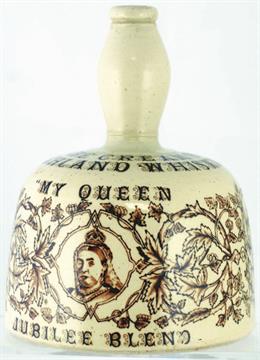
We also found the fragments of a Thom and Cameron jubilee whisky jug on a site on St Asaph Street last year. The jug, which depicts a particularly sour faced looking Victoria (she has definitely got her eye on you), would have been made in 1887 to celebrate Queen Victoria’s 50 years on the throne. Image: C. Dickson (left) and The Sale Room (right).

idle men need duff's whisky

Idle men need Duff’s whisky. Now you know. Image: Auckland Star 9/09/1933: 8.

Distiller's Company

This flask has a metal capsule seal with the mark of the Distillers Company Ltd, or D. C. L. These guys were formed in 1877 by six Scottish distilleries. By the early to mid-20th century, they had become one of the leading whisky (and pharmaceuticals) companies in Scotland. Image: J. Garland (left), Press 22/04/1916: 5. 

heddle leith

We don’t know much about this one, unfortunately. James Heddle was a whisky, gin and cordial manufacturer or distributor based in Leith, Scotland during the latter half of the 19th century. We have advertisements for his products in New Zealand during the 1870s, including for lime cordial, old tom gin and scotch whisky. Image: C. Dickson (left),  Wanganui Herald 16/05/1879: 4Press 22/03/1871: 4Press 13/01/1925: 10.

Occidental

As well as importing bottles of whisky, people imported casks and bottled the spirits here. This bottle label says “SCOTCH WHISKY, bottled in New Zealand by B. Perry, OCCIDENTAL HOTEL.” The Occidental was a well-known and well-loved establishment on Hereford Street in Christchurch that was still running until just before the earthquakes. Benjamin Perry, who was proprietor of the hotel during the late 19th and early 20th centuries, holds the distinction of being one of the only licensed victuallers in the city to never be in breach of his liquor license. We couldn’t find any specific reference to whisky being bottled at the hotel (although we did find other references to whisky at the hotel…), but we did find a notice in the paper in the 1910s advertising for washed whisky bottles, presumably for that very same purpose. Image: J. Garland (left), Sun 27/07/1918: 11 (top right), Press 17/01/1903: 8.

ruining the whisky punch

And, last but not least, whatever you do, don’t ruin the whisky punch with water. Image: Evening Star 23/01/1884: 2.

Jessie Garland

References

Papers Past. [online] Available at www.paperspast.natlib.govt.nz.

Townsend, B., 2015. Scotch Missed: The Original Guide to the Lost Distilleries of Scotland. Neil Wilson Publishing, England.

The acclimatisation affair (or how we learned not to underestimate the power of the possum)

The first feeling that strikes everyone on coming to New Zealand is its intense want of animal life. Mountains, plains, rivers, – mere features without a soul; for you can hardly dignify the miserable ground lark, the wailing weka, or the ghoul-like eel with such a title.

– Lyttelton Times 18/02/1864: 5

When I first read the above quote, taken from a letter to the editor of the Lyttelton Times in 1864, I will admit to doing a double take. Then, to a sense of outrage and a strange urge to defend the ‘soulless’ landscape and wildlife of New Zealand from this 150 year old attack on its very being (despite the author of that sentence being unable to hear – or, I suspect, care about – my opinion). It’s such an odd, jarring statement to read about a country that now considers its natural landscape and native wildlife to be a source of pride, a country that places its mountains and plains and rivers at the heart of its national identity. Yet, this sentiment and others like it formed the impetus for one of the most influential colonial endeavours of the 19th century, one that irrevocably changed the land in which we live – to an extent that most of us don’t fully realise.

The wailing weka and the ghoul-like eel. Just not good enough, apparently. Image: Wikimedia Commons.

The wailing weka and the ghoul-like eel. Just not good enough, apparently. Image: Wikimedia Commons.

It went by the name of ‘acclimatisation’ and consisted of the deliberate introduction of “beasts, birds, fishes, and vegetable productions, of such species as may be acclimatised with probable advantage to this province and to the colony” (Lyttelton Times 8/03/1864: 2). In New Zealand, and the rest of the British colonial world, the acclimatisation movement was largely driven by ‘Acclimatisation Societies’, who made it their mission to improve the plant and animal life of the lands they had chosen to settle. Basically, they imported a bunch of animals into the country from all over the world in a venture that seems to have been part scientific curiosity[1], part hunger[2], part boredom[3] and part an apparently inescapable need to rectify the “remarkable deficiency” of local wildlife.

There is perhaps no country in the world the natural zoology of which supplies so little to the subsistence or enjoyment of its inhabitants, as New Zealand. Of game there is almost none; quail, formerly plentiful, have nearly disappeared; pigeons and kakas are to be found only in the woods; ducks, eels and wild pigs complete the list. And if there are so few useful animals, those which add to the grace and enjoyment of life are scarcer still; of singing birds there are but the tui tui and the bell bird; neither of them ever heard, except in the neighbourhood of the forests…If, however, we turn from land to water, the inducements to engage in this enterprise are greater still. Our great snow rivers are absolutely without fish…At present, such rivers as the Waimakariri, the Rakaia or the Rangitata are worse than useless, obstructing travelling without assisting navigation.

– Press 17/08/1861: 1 (emphasis mine)

The Canterbury Acclimatisation Society was first formed in 1864, modelled on the example of the London society, which aimed to introduce animals from the colonies into England, and the Victorian society, which aimed to introduce English and other colonial animals into Australia. Societies already existed in Auckland and Otago and the Canterbury branch followed in their footsteps, with the same stated intention of improving the fauna of the new colony (Lyttelton Times 8/03/1864: 2).

Excerpts from a letter about a proposed Acclimatisation Society in Canterbury.

Excerpts from a letter about a proposed Acclimatisation Society in Canterbury. Press 17/08/1861: 1.

Early supporters and members included some of the more well-known names of the early settlement, including Edward Wakefield, Sir John Cracroft Wilson, William Guise Brittan, Joseph Brittan, W. L. Travers, William Rolleston, William Sefton Moorhouse and John Edward Fitzgerald. Some of these men had already made their own individual efforts to introduce new species to New Zealand. William Guise Brittan had imported several ‘English singing birds’, as had John Watts-Russell. Sir John Cracroft Wilson had apparently made “an attempt…on a scale of oriental magnificence to introduce the game from the North of India” (Press 17/08/1861: 1). While their stated intention included the practical provision of food for the colony, their emphasis seems to have largely been on the aesthetic and sporting (i.e. hunting and fishing) advantages of acclimatisation.

crazy menu image

The Acclimatisation Society of Victoria, on the other hand, while also interested in the practical and sporting advantages of new animals, seem to have also had an intense interest in eating as many creatures as they could. This menu, if I may draw your attention to some of the more unusual dishes, included patty of frogs, curried opossum, jugged kangaroo and ‘fricandeau of wombat’. Image: Lyttelton Times 4/12/1861: 4. 

It is worth noting – in fact, important to note – that the acclimatisation societies of New Zealand weren’t the first to introduce new animals into New Zealand. Sealers, whalers, missionaries and early European visitors to the country brought with them chicken and pigs and sheep and other animals for food and companionship. Sir George Grey, the early governor of the colony, had his own collection of exotic birds and other creatures that he had imported into the country. And, of course, long before all of this, Māori had brought kiore (the Pacific rat), kurī (dog), kūmara and the ‘Polynesian suite’ of cultigens with them when they first arrived on these shores. For as long as humans have been moving around the world, they’ve been modifying the fauna and flora of the places they visit. The thing about the acclimatisation societies, though, that I think is worth emphasising, is that they were part of an organised, concerted and deliberate effort to change – to improve – the ecology of the country. It wasn’t just a hobby or a side effect of human migration. It was a bonafide movement.

Here in New Zealand, the species they introduced (and must take the blame for) include a selection of birds, fish, mammals, rodents and other creatures (bees!) – many of them now considered pests. Many of them were considered pests within a one or two decades of their introduction, to be honest. Some of them were creatures you might not have thought of as imported species, such as Ligurian bees (from Italy), bumble bees (sometimes referred to as ‘humble bees’) and lobsters. The article I found on lobsters begins with the sentence “Mr Purvis, chief engineer of the Iconic, has succeeded in bringing nine lobsters alive out of twelve” (Star 19/10/1892: 3). Well done, Mr Purvis, well done.

Ligurian bees and a picture of Patrick Stewart in a lobster costume (barely relevant, yet hilarious). Images: Wikimedia Commons and Twitter.

A Ligurian bee and a picture of Patrick Stewart in a lobster costume (barely relevant, yet hilarious). Images: Wikimedia Commons and Twitter.

Birds seem to have been a particular area of interest and focus, which seems odd for an ecosystem already constructed around avian life. As well as game birds, like pheasants, quail, ducks and geese, there was an effort to introduce singing birds (clearly, Joseph Banks’ deafening dawn chorus of 1770 had lost its voice by the 1860s) and, to be honest, as many birds as they damn well could. Interestingly, the introduction of birds wasn’t a one-way street: there’s at least one account in 1872 of a shipment of 1000 tui, wax-eyes and parroquets from New Zealand to England (and a return shipment of English birds to this country).

Some of the birds introduced to New Zealand included the chukor (an Indian game bird), the magpie (thanks Australia, thanks a lot), the laughing jackass (amusingly mentioned in the papers as the Australian jackass), Virginian quail, Canadian geese, Teneriffe grouse, chickens from Kansas, swans, sparrows and German owls. The German owls are possibly my favourite, because the acclimatisation of German owls in the 19th century had turned into the GERMAN OWL MENACE by the 1930s (and yes, the caps are entirely necessary). So much so that the Canterbury association was indignant when the papers suggested that they were responsible for releasing more owls into the wild. A close second would have been the “peculiarly inoffensive” emu named Jack, who terrorised horses by trying to fraternise with them all the way back in 1865.

GERMAN OWL MENACE

GERMAN OWL MENACE. Image: Press 19/07/1935: 22.

There was also a strong emphasis on the introduction of fish, especially trout and salmon, into the otherwise “useless” rivers of the Canterbury plains. Millions of fish were “liberated” into the streams and rivers of the district , born from ova shipped into Lyttelton from all over the world and raised in purpose-built fish ponds in the Christchurch Botanic Gardens. We excavated the site of the fish-ponds a while back, but there was nothing left of what was once the gateway for Canterbury’s freshwater fish populations (the Otago ones do still exist, though, and have been the subject of some cool archaeological projects over the last few years).

A survey plan of the Canterbury Acclimatisation Society grounds in 1913, including the fish ponds.

A survey plan of the Canterbury Acclimatisation Society grounds in 1913, including the fish ponds. Source: Land Information New Zealand (LINZ) and licensed by LINZ for re-use under the Creative Commons Attribution 4.0 International licence (link is external).

As well as the birds and the fishes, however, there were the beasts. Let us not forget the beasts. Possums and rabbits and deer, oh my. Polecats, even. There appear to have been wildly differing levels of success with mammals and rodents. Some, like the kangaroo or the “game from the north of India” attempted by Cracroft Wilson, weren’t hugely successful. Others, like rabbits (described as ‘evil’ as early as the 1870s), possums, hares, deer and, of course, sheep, took to New Zealand in a flash. Most of them were imported as game, rather than food (with a couple of obvious exceptions). Yes, that’s right. We have so many possums and rabbits because it seemed like a fun idea at the time.

TS18930819.2.45-a2-424w-c32

Yep. Good plan. Image: Star 19/08/1893: 5.

And when I say ‘in a flash’, it’s almost an understatement. Some of their greatest successes very quickly became their greatest headaches. By 1876, the New Zealand government had to pass the Rabbit Nuisance Act in response to the success of that species. By 1882, societies were recommending that hares be killed all year round rather than just during specific seasons. By 1898 they were suggesting that people could do so without a license. By the turn of the century there were suggestions for some measure of governmental control over the power of societies and individuals to import “animals or birds that might become nuisances to the community” (Press 23/05/1894: 5) and by the mid-20th century it was generally acknowledged that many of these introduced species had done irreparable damage to the native and other introduced species of New Zealand. Let’s not forget the German Owl Menace, everybody. At the same time, despite the increasing awareness of the problems of introduced species evident among acclimatisation societies as the decades progressed, they didn’t stop doing it, even importing other species to deal with problematic ones (why hello, stoats and ferrets).

I find the whole notion of acclimatisation societies quite weird to wrap my head around, to be honest. Especially in light of the biosecurity that is now so much a part of New Zealand life. Yet, the effects of their work are everywhere. If we look at it from an archaeological perspective the efforts of these societies are present in every assemblage of animal bones we excavate from 19th century sites in Christchurch – chicken, duck, sheep, cow, pig, horse, turkey, cat, rat, goose or dog, they’re all there.

bones

Bones, bones, bones. Image: Underground Overground Archaeology.

We don’t even blink at them most of the time, because we’re so used – so ‘acclimatised’ – to having these species around. They’re a part of our normal, a statement that says as much about how much the Acclimatisation Society of Canterbury (and its brethren throughout the country) changed and constructed our present day world as anything else I’ve written here.  Because 150 years ago, like the settlers who brought them here, these animals were very much strangers in a foreign land. And their impact, like the impact of the colonial settlement itself (and all colonial settlements), has changed this land forever, for better or for worse. You be the judge.

Jessie Garland

[1] “Hmm, I wonder if these ones will survive?”

[2] “They wanted practically to benefit the country by increasing the food of the people, and a plant or an animal that would not thrive on the ordinary conditions of English life and cultivation was of no use to them” (Lyttlelton Times 4/12/1861: 4).

[3] “What ho, old chap, where’s all the fish and game at?”

The heady nature of pseudo-science

One of the most interesting things about being an archaeologist or a historian is seeing the development of ideas and knowledge throughout the ages. We are reminded, time and time again, that the ideas and theories that we consider primitive or even ridiculous in hindsight were the cutting edge of scientific enquiry or social theory at the time. It follows that at least some of the things we consider to be cutting edge here and now will be primitive or ridiculous to our children and grandchildren in the decades to come.

comparativephysi00redf_0067

Comparative physiognomy. One of the more, uh, interesting theories humans have come up with. Image: J. Redfield 1852, Public Domain Review.

At the same time, it is easy to see the foundations of our current knowledge base and thinking in those same primitive or ridiculous ideas. Every theory or discovery that was later proven to be wrong or misapplied was still, in fact, part of a conversation – a social, philosophical and scientific discourse – that came to inform our understanding of the world in the present day. They either provided the building blocks for the development of an idea (the four humours of the body to miasma theory to germ theory, for example); a point of contention which forced the development of a more accurate theory; or used approaches and ideas that later proved to be useful, even if they were misapplied at the time. From geocentrism, the four elements of all matter (earth, fire, wind, water…heart! Oh wait…) and Copernican astronomy to the miraculous cough curing properties of heroin, our history is littered with theories and ideas that were wrong, but without which our current knowledge base would not be what it is.

One such subject – and the thing that got me thinking about this in the first place – is the now much maligned science of phrenology, a subject brought to our attention a while back by the discovery of a crumpled up poster inside the walls of a 19th century house in Christchurch. The poster depicted the head of a man in profile, with the skull divided into a quilt of small images, numbered and labelled with various character traits, including sublimity (“conception of the grand, awful and endless”), mirthfulness (“wit”), causality (“desire to know the why and wherefore of things”) and alimentiveness (“appetite”). Above this arresting image, a headline read “Phrenological Head of Charles Peace, The Burglar.”

The Phrenological Head of Charles Peace. Image: J. Garland.

The Phrenological Head of Charles Peace, The Burglar, 1879. Image: J. Garland.

As it turns out, Charles Peace was quite the well-known figure in the late 19th and early 20th centuries, a sort of combination of Sherlock Holmes’ master of disguise and Catwoman (this is not at all an accurate description, but it amuses me). His fame – or infamy – was on par with what we now attribute to Jack the Ripper or Bonnie and Clyde and his story has all the elements of a great melodrama (which, indeed, it became later on). A cat burglar with a limp who “could scale a wall like a fly”, the “man with many faces”, a master of disguise who “could change his face in a moment”, the “prince of housebreakers”, betrayed by his mistress after a daring near-escape from the police, having evaded the police as a wanted man for years. It’s a blockbuster in the making. Probably starring Peter Sellers (or the current equivalent – Steve Carrell?).

Peace was a Sheffield-born criminal executed in 1879 for two murders and a long, long list of burglaries committed during his adult life. Having plied his thieving trade in Sheffield and its environs during the 1860s and 1870s, he shot the husband of a couple that he had befriended and fled to Peckham, London. There, he continued to rob the houses of the wealthy, while living under a pseudonym (and under the very noses of Scotland Yard). He was arrested in 1878 after an altercation with police during a robbery, and eventually hanged (Auckland Star 14/05/1932: 3).

charles peace joke

Image: Cromwell Argus 20/05/1918: 7.

Contemporary and later newspapers described him as the “cleverest burglar that ever lived”, a figure so famous that “even Dick Turpin could not hold a candle to him” (Alexandra Herald and Central Otago Gazette 4/12/1929:1). He became the subject of waxworks, of crime fiction, a stage play (which outraged society by depicting his hanging on stage, carried out by an actual retired executioner) and increasingly outrageous and dramatised depictions and characterisations in popular culture. One 1930s newspaper, for example, said of him “Peace is shown as he was, a dwarf of phenomenal strength, a colossal braggart, repulsive in mind and body and a perfect burglar.” Another went even further and called him “almost a monkey of a man…an unrestrained savage.” More interestingly, from the perspective of our phrenological head, is an article that equates his prominent ears and “head of enormous size”, with his criminal proclivities.

cropped

“Peace’s greatest asset…was an immense lower jaw which he could manipulate at will.” Image: Dunstan Times 14/03/1927: 7.

And this is the thing. It is no wonder that, notorious as he was, Charles Peace became the subject of phrenological investigation. The science of phrenology, particularly in its heyday, was often associated with criminals and criminal behaviours, used in an attempt to make sense of why certain people did such unreasonable things – and perhaps, to impose an order on a world that didn’t always seem to make a whole lot of sense.

The ‘science’ was first ‘discovered’ in the late 18th century, by Franz Joseph Gall, a German neuroanatomist and physiologist. It was based on the premise that the various personality traits of a person corresponded to different parts of their brains, the size and shape of which could be ‘read’ in the bumps and indents of their skull. While ultimately discredited, Gall’s theories influenced the development of neurological science as we know it today, particularly when it comes to different parts of the brain being used for different functions (not a neuroscientist – am hoping I’ve paraphrased this correctly!).

description cropped

A description of the science of phrenology, as told in a lecture in 1865. Image: North Otago Times 20/07/1865: 3.

(On a side note, I had great plans to apply the phrenological model to our office full of archaeologists in an attempt to determine the most criminal amongst us. However, as it turns out, practicing the science of phrenology involves feeling for the bumps and cavities of a person’s skull with your palms and fingertips, which seemed like it would cross a boundary from which there is no going back. We’re all friends here, but there’s a line, right?)

1895-Dictionary-Phrenolog

The various phrenological organs and how to find them. A full how-to of phrenology is available here, if you feel like trying it out on yourself/someone whose scalp you’re comfortable exploring. Image: Wikimedia Commons. 

Phrenology was most popular during the mid-19th century, but continued to be given credence by a small fringe of society through into the early 20th century. During the height of its popularity in various parts of the world, it was applied to criminal proceedings – both to understand the criminal defendant and to be assured of the character of the jurors, recommended to ladies as a subject of study that would ensure happiness in marriage and suggested as a way to “determine what should be restrained, what cultivated and the pursuit of in life best adapted” in children. One account even has it used to determine which of a lady’s suitors she ought to marry. It was also, in its most infamous applications, used to reinforce racial stereotypes, equating negative cultural and behavioural traits with physical – and racial – appearance. Essentially reducing human people, cultures and personalities to bumps on a skull.

Untitled-1

This one cracks me up. Image: Vaught’s Practical Character Reader (1902).

In New Zealand, phrenology makes an appearance here and there throughout the 19th century, with varying degrees of sincerity and skepticism. French naturalist and phrenologist, Pierre-Marie Dumoutier, for example, took four casts of Māori heads during his travels with Durmont d’Urville around the country in 1840, adding them to a collection of phrenological busts of indigenous peoples that he later displayed in Paris (photographic portraits of two of those busts, of rangatira Takatahara and Piuraki, are currently on display in the Christchurch Art Gallery). Several phrenological professors and consultants were active throughout the country, including in Christchurch, throughout the latter half of the century (sometimes these consultants also offered palmistry readings and séances, for what it’s worth). Demonstrations using “a large collection of the sculls of murderers, bushrangers, Maoris and notorious and eminent characters” were incredibly popular. And phrenological assessments of criminals and famous figures continued to turn up in popular culture well into the early 20th century.

p-besomo-phrenological-chart-of-the-head-of-sir-george-grey-sydney-builder-print-1891-sir-george

An 1891 phrenological chart of Sir George Grey, Governor of New Zealand. Image: Auckland Libraries.

At the same time, in the 1840s and 1850s, jokes about the empty skulls of those who believed in phrenology and long arguments over the merits of the ‘science’ were being published in New Zealand newspapers. The lectures of a vocal and eminent phrenologist, Mr A. S. Hamilton, were treated and reviewed with a healthy degree of skepticism (and an appreciation for the appeal of spectacle) in the 1860s. In the 1870s, demonstrations of phrenology also included lectures on mesmerism, palmistry and electrical psychology. By the 1890s and early 1900s – both in New Zealand and throughout the rest of the world – it seems to have been more of a novelty than a science.

NZCPNA18430331.2.14-a6-559w-c32

Image: New Zealand Colonist and Port Nicholson Advertiser 31/03/1843: 3.

There’s this great argument printed in the letters to the editor of the Colonist in the 1850s about the merits of phrenology as a science that really brings home the weird juxtaposition of ideas that it encapsulated in the subject. Because the arguments made in favour of it ring just as true to a modern scientific mind as those made against.

For example: “Phrenology depends neither on speculation nor on theory…it is essentially the science of observation, like chemistry and botany. It was discovered by observing facts, was perfected by comparison and induction, and every man with sufficient capacity may with his own eyes, test and verify its truth.” – Colonist 9/02/1858: 3.

It’s just that as far as the application of phrenology went, those arguments simply weren’t true. Rather than being a ‘science of observation, like chemistry and botany’, it was actually a system of flawed assumptions and correlations, used to perpetuate a very narrow perspective of character and personality that failed to account for the effects of experience, cultural background, social upbringing and any of the other myriad factors that make a person who they are. Whoops, got a bit ranty there.

Enough said. Image:

Enough said. Image: Colonist 29/01/1858: 3.

The truth is, as an anthropologist and an archaeologist, phrenology both intrigues and terrifies me. Intrigues, because it is ultimately about understanding people, about trying to understand why and how people work. Because the analytical approach that it incorporates also forms the foundation of much of what I do as an artefact analyst, what so many analysts and scientists do (even little social scientists like us). But terrifies, because it is also so narrow, so rigid, so structural that it fails to employ the holistic approach necessary to truly understand a person – or, in our case, a culture or society. It sees correlation as cause, takes something – character – that is the result of a myriad of factors and experiences and distills it down to a series of boxes to check.

But it is, ultimately, part of that progression of ideas and knowledge that I talked about at the beginning of the post (remember that, doesn’t that seem like ages ago?). Call it a pathway, a tree, a foundation, whichever analogy or metaphor suits – however much of a misstep it was (and it really, really was), phrenology had its part to play in this ongoing human struggle to – and, ironically, I believe the definition of phrenological causality sums it up best – “understand the why and wherefore of things.”

Jessie Garland

References and Acknowledgements

Jeremy Habberfield-Short, for excavating and sharing his excellent discoveries.

The Langlois Eteveneaux cottage, Akaroa

The Langlois Etevenaux cottage, built in c. 1843, as it stands in 2016. The cottage is one of the oldest buildings in Canterbury and the only building constructed by French colonists that still stands in Akaroa. Image: L. Tremlett.

The Langlois Eteveneaux cottage, built in c. 1843, as it stands today. The cottage is one of the oldest buildings in Canterbury and the only building constructed by French colonists that still stands in Akaroa. Image: L. Tremlett.

The front door to the cottage. Note the ventilation grate partly hidden behind the front step and the arrow decoration in the transom above the door. Image: L. Tremlett.

The front door to the cottage. Note the ventilation grate partly hidden behind the front step and the arrow decoration in the transom above the door. Image: L. Tremlett.

Langlois Etevenaux cottage

A close up of the arrow detail in the transom. “Enter here”, perhaps? Image: L. Tremlett.

One of the two original exterior windows, with an inward opening casement. In our humble opinion, this is a superior example of a casement window. Again, note the arrow motif above the window itself. Image: L. Tremlett.

One of the two original exterior windows, with an inward opening casement. In our humble opinion, this is a superior example of a casement window. Again, note the arrow motif above the window itself. Image: L. Tremlett.

Close up of the arrows above the window. Look at the detail in the fletching! Image: L. Tremlett.

Close up of the arrows above the window. Look at the detail in the fletching! Image: L. Tremlett.

A close up of the decorative lion’s head found above the window. Image: L. Tremlett.

A close up of the decorative lion’s head found above the window. Image: L. Tremlett.

Decorative corbels beneath the sill of the same exterior window. Image: L. Tremlett.

Decorative corbels beneath the sill of the same exterior window. Image: L. Tremlett.

The window from the interior, set off by floral wallpaper and a shining autumn day. Image: L. Tremlett.

The window from the interior, set off by floral wallpaper and a shining autumn day. Image: L. Tremlett.

Looking out, with Akaroa beautifully framed in the background – the view from this cottage for at least the last century. Image: L. Tremlett.

Looking out, with Akaroa beautifully framed in the background – the view from this cottage for at least the last century. Image: L. Tremlett.

Hinges! This is a barrel door hinge from a door in the southern part of the cottage – it’s a type of hinge rarely seen in other Canterbury cottages, especially with the shaped ends. Image: L. Tremlett.

Hinges! This is a barrel door hinge from a door in the southern part of the cottage – it’s a type of hinge rarely seen in other Canterbury cottages, especially with the shaped ends. Image: L. Tremlett.

Another rare hinge! This one is known as an ‘HL’ hinge, with plain ends – also unusual in Canterbury cottages we’ve seen to date. Image: L. Tremlett.

Another rare hinge! This one is known as an ‘HL’ hinge, with plain ends – also unusual in Canterbury cottages we’ve seen to date. Image: L. Tremlett.

So, this is particularly cool. It’s the front door lock to the cottage, but if you look closely you’ll see that the door lock, key hole and escutcheon are upside down. On top of this, the hinge strike plate is shaped like a key, just to keep it all in theme. Image: L. Tremlett.

So, this is particularly cool. It’s the front door lock to the cottage, but if you look closely you’ll see that the door lock, key hole and escutcheon are upside down. On top of this, the hinge strike plate is shaped like a key, just to keep it all in theme. Image: L. Tremlett.

The maker’s mark on the front door lock. It reads “No. 60, Jas. Carpenter, Patentee” on the lower half with the British crest on the upper half. James Carpenter was a well-known locksmith based in Willenhall, England, from the late 18th century until his death in 1844 (his business continued after his death under the name of Carpenter and Tildesley). The No. 60 was a famous patent of Carpenter’s, patented in 1830 and popular around the world, including in the United States. Such locks are often found on buildings constructed in the 1830s and 1840s (Garvin 2001: 84), so that fits! Image: L. Tremlett.

The maker’s mark on the front door lock. It reads “No. 60, Jas. Carpenter, Patentee” on the lower half with the British crest on the upper half. James Carpenter was a well-known locksmith based in Willenhall, England, from the late 18th century until his death in 1844 (his business continued after his death under the name of Carpenter and Tildesley). The No. 60 was a famous patent of Carpenter’s, patented in 1830 and popular around the world, including in the United States. Such locks are often found on buildings constructed in the 1830s and 1840s (Garvin 2001: 84), so that fits! Image: L. Tremlett.

Lastly, an image of the cottage in the 1960s, before it was repainted. The timber pilasters which frame the door and windows are an interesting stylistic feature originating from Ancient Greek and Roman architecture – a nice compliment to the Louis-Phillipe style of furniture with which the cottage was furnished. Image: L. Tremlett.

Lastly, an image of the cottage in the 1960s, before it was repainted. The timber pilasters which frame the door and windows are an interesting stylistic feature originating from Ancient Greek and Roman architecture – a nice compliment to the Louis-Phillippe style of furniture with which the cottage was furnished. Image: L. Tremlett.

Jessie Garland and Luke Tremlett

References and acknowledgements

Christchurch City Council.

Garvin, J., 2001. A Building History of Northern New England. University Press of New England, New Hampshire.

Insight Unlimited.