Brewery to bonded store (or a tale involving beer, misfortune and the casualties of long distance trade)

From Staffordshire pottery to American made glass-ware, we’ve come across artefacts from all over the world on archaeological sites here in Christchurch. This prevalence of internationally made artefacts, and what it means for the city’s history, is something that’s come up frequently in previous posts on this blog. Today’s post continues to discuss that theme, albeit from a slightly different perspective – that of the importer.

Over the last little while, we’ve been looking at the artefact assemblage from a site in the central city that was associated with a bonded store from the 1860s onwards. Bonded stores (also known as bonded warehouses) were buildings in which goods could be stored and remain exempt from customs duties. They were usually used to store goods and bulk merchandise until they were distributed for retail, at which time those duties and taxes would have to be paid.

We found numerous archaeological features (mostly rubbish pits) on the site, almost all of which contained artefacts. Many of these rubbish pits contained a large number of alcohol bottles. This is not particularly unusual. What is unusual is that within each feature most of the alcohol bottles were identical and almost all of the bottle tops found were still sealed – with cork, wire seal and metal capsule.

One of the rubbish pits found at the site, containing a large number of J & R Tennent sealed bottles.

One of the rubbish pits found at the site, containing a large number of J & R Tennent sealed bottles. Image: J. Hughes.

One rubbish pit contained a total of 130 artefacts (in 454 fragments), 126 of which were black beer bottles. Although the bottles were broken, the tops and bases were almost equal in number. More significantly, all of those black beer bottles were still sealed, or found in association with their corks and capsule seals, and every single seal bore the distinctive trademarks of J & R Tennent’s Pale Ale, brewed at the Wellpark Brewery, Scotland. Most of the capsules were also stamped with the mark of Betts & Co, the company who patented and manufactured this type of metal capsule seal for bottles. Similarly trademarked bottle capsules have been found at other 1860s-1880s sites throughout New Zealand, although not in such large quantities (Petchey and Innanchai 2012).

A couple of the J & R Tennent sealed tops found in the rubbish pit. The side of the seal reads: "Bottled by J & R Tennent" and (not pictured) "Betts & Co/Patent/Patent/ Trade Mark/ London."

A couple of the J & R Tennent sealed tops found in the rubbish pit. The side of the seal reads: “Bottled by J & R Tennent” and (not pictured) “Betts & Co / Patent / Patent / Trade Mark / London.” Betts & Co were the original patentees and manufacturers of metal bottle capsules like these. They were founded in 1804, but weren’t established in London until 1840. The company continued to manufacture bottle capsules until the 1960s: these particular seals were probably made between 1860 and 1915 (Nayton 1991). Images:  J. Garland.

J & R Tennent capsule drawing

A drawing of one of the J & R Tennent bottle capsules found at this site. Note that the beer is a pale ale, and the reference to Wellpark Brewery in Glasgow. Image: J. Garland.

John and Robert Tennent were Glaswegian brewers and bottlers who began operating in the 1770s. Their business continued to be run by their descendants throughout the 19th and 20th centuries, right up until the present day (Petchey and Innanchai 2012). By the end of the 19th century they were increasingly known for the quality of their beer and were a relatively large presence in the export market for bottled beer throughout the English speaking world (Hughes 2006). In Christchurch, Tennent’s Pale Ale was sold in large quantities from the 1850s onwards by a number of Christchurch merchants such as Robert Symington, Charles Wesley Turner (my great great grandfather!), Longden & Le Cren, Robert Wilkin & Co, and Tonks, Norton & Co, among others (Lyttelton Times 6/11/1852: 312/8/1865: 1Star 22/10/1869: 4; Press 18/9/1879: 3,14/1/1891: 8).

A second rubbish pit at the site contained a similar assemblage: 125 artefacts, 88 of which were identical dark green beer bottles. Like the Tennent bottles, almost all of these were still sealed or found in association with metal capsules, wire seals and corks. Unfortunately, the seals from this feature weren’t in the best condition: only eight of them could be definitively identified to the bottler, T. B. Hall & Co, Liverpool. It seems likely, however, given the similarity of the bottles (a handful of which still had the remnants of T. B. & Hall labels on the glass), that all 88 were originally T. B. Hall & Co products.

Some of the T. B. Hall & Co bottle capsules found in the second rubbish pit. Image: J. Garland.

Some of the T. B. Hall & Co bottle capsules found in the second rubbish pit. Image: J. Garland.

This drawing of one of the T. B. Hall & Co metal capsules shows the distinctive boar trademark used by the company. Image: J. Garland.

This drawing of a T. B. Hall & Co bottle seal shows the distinctive boar trademark used by the company. Image: J. Garland.

T. B. Hall refers to Thomas Bird Hall, who operated an export bottling company in Liverpool in the latter half of the 19th century. The company became well known for their ‘Boar’s Head’ brand, which we see on the bottles found in Christchurch.  They started bottling beer under this brand in 1874, much of which was exported to British colonies, including Australia and New Zealand. They bottled a range of beers, spirits and liqueurs, including the well-known Bass and Guinness ales and stouts (Hughes 2006: 131). We have evidence for the brand being sold in Christchurch from at least 1878 until the late 1890s (Press 22/4/1878: 2; Press 23/10/1899: 4).

Interestingly, during the excavation of this rubbish pit, it was noted that most of the bottles were complete, but cracked, while they were still in the ground. Many of them fell apart as they were lifted out, suggesting that they had broken or cracked from the impact of being thrown – complete and still sealed – into the pit.

The partially excavated rubbish pit containing numerous T. B. Hall & Co sealed bottles. A couple of complete bottles are visible, sticking out of the top of the feature: one of these fell apart as it was lifted, due to the cracks already present in the glass. Image: J. Garland.

The partially excavated rubbish pit containing numerous T. B. Hall & Co sealed bottles. A couple of complete bottles are visible, sticking out of the top of the feature: one of these fell apart as it was lifted, due to the cracks already present in the glass. Image: J. Garland.

As archaeologists, we’re used to finding old or broken artefacts in archaeological assemblages  – objects that have clearly been used and discarded, due to damage, age, changes in fashion or simply because they’ve reached the end of their uselife. The fact that two rubbish pits at this site contain artefacts that have clearly not been used and, in one case, were complete when they were discarded, indicates that there must be another reason for their disposal.

Given the association of the site with a bonded store, it seems likely that these bottles were originally imported and stored at the warehouse with the intention of being distributed to local retailers and consumers. The question then remains: why were they thrown out? There are numerous potential answers to this, from damages incurred during transport to a bad quality batch of beer, a lack of demand or old, unsaleable stock. Bottled beer was a hell of a lot more unpredictable – both in quality and preservation – during the 19th century than it is now, and it wasn’t uncommon for batches to go bad, or simply be bad.

This extract from a legal case involving the supply and sale of bad beer lists just a few of the ways beer could go bad in the 19th century. Image: Colonist 26/07/1911

This extract from a legal case involving the supply and sale of bad beer lists just a few of the ways beer could go bad in the 19th century. Image: Colonist 26/7/1911: 4.

It’s easy to forget, in this age of air freight and controlled temperatures, that these goods had to come a very long way in relatively difficult conditions in order to reach our shores (and our stomachs) in the 19th century. British export beers travelled to colonies like Australia and New Zealand by ship, a journey that could take anything upwards of 100 days (by clipper, the fastest non-steam powered ship at the time). These voyages often encountered rough seas and extreme temperatures, both of which could damage cargoes of bottled beer (Hughes 2006). High temperatures (when sailing through the tropics, for example) could cause the beer itself to go off: sometimes, if it caused rapid fermentation, the bottles would explode (my personal favourite). On top of the sea voyage, of course, the bottles had to survive loading and unloading as well as transport over rough roads to their final destination. It’s hardly surprising that breakages occurred!

There were also issues with supply and demand: agents in New Zealand would have been ordering the stock well in advance (remember, 100 days or more to get here), based on predicted demand. If their predictions were wrong, products might not sell and be left, instead, to age to the point where they were both undrinkable and unsaleable, and had to be discarded. All of which leads to rubbish pits such as these, containing the physical casualties and failures of the 19th century import/export trade.

Analysis of this site is continuing but, as you can see from the small part of it that I’ve discussed here, it has the potential to provide us with a window into the realities of the goods trade in Christchurch – internationally and locally. It’s also an excellent example of the importance of archaeological context in the interpretation of artefacts and archaeological features.  Just one of these bottles, out of context, wouldn’t have nearly such an interesting story to tell.

Jessie Garland

References

Colonist. [online] Available at www.paperspast.natlib.govt.nz

Hughes, David. 2006. “A Bottle of Guiness Please”: the Colourful History of Guiness. Phimboy: Berkshire, England.

Lyttelton Times. [online] Available at www.paperspast.natlib.govt.nz

Nayton, G., 1992. Applying frontier theory to a Western Australian site: the problem of chronological control. Australasian Historical Archaeology 10: 75-91.

Petchey, P. and Innanchai, J., 2012. Bottle top capsules in New Zealand historic archaeological sites. Journal of Pacific Archaeology 3 (2): 1-16.

Press. [online] Available at www.paperspast.natlib.govt.nz

Star. [online] Available at www.paperspast.natlib.govt.nz

Tales of a house

So, that message in a bottle? Well, it turns out it wasn’t the only interesting thing about the site it came from. A fellmongery, German Danes, shoes… read on!

First up, the bottle came from under a house built in 1887 (the land transaction records had suggested 1885, when the first mortgage was taken against the land; LINZ 1885). From the outside, this looked like a fairly standard 1880s villa (albeit modified), but inside – and its history – were not quite so standard. The differences inside weren’t that huge, but you have to understand that, in the 1880s and 1890s, there was little deviation from the standard plan for single-storey villas, so even the smallest difference is telling. On the outside, your standard villa might be flat-fronted or have a bay or two, and there might be some variation in the number of windows on the street-facing façade (depending on how much money you wanted to spend). Inside, villas of this type tended to have four rooms in the main body of the house, two on each side of a central hall. And there might have been some additional service rooms to the rear of this.

 The house. The conservatory on the left was originally a veranda. Photo: K. Webb.


The house. The conservatory on the left was originally a veranda. Photo: K. Webb.

As I said, this one wasn’t so very different. Instead of a central hall, it had a sort of T-shaped hall, with six rooms opening off it. Not only was the hall a different shape, but there were more rooms than usual in the main body of the house, although the house was roughly the same footprint as the standard villa (and the house’s layout had barely been modified since it was built). And only one of the front rooms opened off the front hall – normally both did. While this detail seems particularly small, it’s actually more significant than the hall shape/position.

In the standard villa design, the front hall and the two front rooms, both of which opened off it, were the ‘public’ part of the house, where visitors were likely to be entertained. Usually, this part of the house was separated from the ‘private’ part by an arch in the hall, and guests were unlikely to pass from the public area to the private area. One of the front rooms was the parlour or drawing room and the other was the master bedroom, where guests might leave their coats (Stewart 2002). It’s always seemed slightly odd to me that the master bedroom was part of the public area of the house, and clearly it wasn’t in this house. Visitors would only have gone into the parlour, nowhere else.

The house’s history revealed that it was built for Neils Carl Heinrich Püschel (without recourse to a mortgage) and transferred shortly thereafter to Tryphona Püschel, his wife. The Püschels owned the house until 1896, when it appears to have been sold as a mortgagee sale (LINZ 1888).

Püschel. Not a very English name, that. The family was of German origin, although Neils – who was generally known as Carl – was born in Denmark. In fact, three Püschel brothers came to Canterbury, only one of whom was born in Germany. John, the eldest, and Carl established a fellmongery (where sheepskins were prepared) in Rangiora, before setting up a fellmongery in Avonside in the late 1870s. That’s right, Avonside – hard to imagine now! By 1887, however, Carl Püschel was no longer part of the business, which William Püschel continued to run on his own, albeit with funding from John Püschel (Macdonald n.d.: P610, 611;  Watson 2013).

So could the layout of the house be explained as a fusion of New Zealand and German/Danish architecture? We don’t know, but it’s an intriguing possibility.

During our work on the house, we were fortunate enough to meet Jenny, the most recent owner. Jenny’s parents had bought the house in the 1920s, and Jenny had grown up there and lived there until the earthquakes changed everything. Jenny told us some awesome stories about the house, including how, after they’d bought the house, her parents journeyed to Christchurch on the train, complete with Dolly the cow. As a teenager, Jenny and her friends had played tennis on the lawn in front of the house (where Dolly had once grazed), with the aim of catching the eye of the local lads!

Not only did Jenny share her stories with us, she also shared her collection of early 20th century shoes –  her father was a Pannell of the Pannell bootmaking business. And she showed us a catalogue produced by the Pannells in c.1903-1904, containing all sorts of information about the most wonderful  sounding shoes: Goloshed Balmorals, Watertight Bluchers or Lorne Shoes, anyone?

Lace-up lady's ankle boots, with a military stacked heel and machine stitching along the vamp, tip and back quarter of the upper, c.1900-1920. Photo: J. Garland.


Lace-up lady’s ankle boots, with a military stacked heel and machine stitching along the vamp, tip and back quarter of the upper, c.1900-1920. Photo: J. Garland.

And then there’s that message in a bottle. But first, the bottle itself, which a number of you commented on, with a couple of you identifying the label. Jessie’s research indicates that the label represents two different companies: Read Brothers and Bass Brewery. The Read Brothers Bottling Company was founded in 1877 by William Thomas Read and John Walter Read. They were based in London and were among the largest, if not the largest, of the London bottling companies, inventing their own bottling machines as well as buying up and reusing old alcohol bottles from across London. The Bull Dog trademark, along with the ‘Dog’s Head’ brand, was registered by them in 1877 and featured the image of a bull dog in a circle on the label (Hughes 2006).

DSC_0088ed1_web

Read Brothers were closely associated with the Bass Brewery and their products, originally bottling only Bass sparkling champagne, cider and Guinness. By the early 1900s they were the largest exporter of Bass Pale Ale in the world.  Bass Brewery, usually represented by the red triangle seen on the label, was founded in 1777 by William Bass in Burton upon Trent. Their characteristic red triangle has the distinction of being the first trademark registered in the UK, under the Trademark Registration Act of 1875 (Hughes 2006).

DSC_0091ed1_web Advertisements in New Zealand newspapers frequently link the two companies from 1878 until 1886, after which the two are mentioned in separate advertisements for quite a time. Then in 1911, they appear again in the same advertisements. We’re not sure exactly what this means!

 An 1878 advertisement for Bass's Pale Ale, bottled by the Read brothers. Image: New Zealand Herald 13/6/1878: 4.


An 1878 advertisement for Bass’s Pale Ale, bottled by the Read brothers. Image: New Zealand Herald 13/6/1878: 4.

As for the message itself, well, I reckon that one of my colleagues got it right when he suggested it was a prank. Why? Well, there are a few reasons. Firstly, although the names on the message are difficult to make out, we couldn’t find any of the possibilities we tried in Papers Past – or at least, we couldn’t make any that we found work, in terms of time, place and/or occupation. And you’d expect an ‘Hon.’ to turn up the newspapers, even if a humble labourer didn’t. Secondly, the spelling mistakes, including of some quite basic words, such as bottle. Thirdly, since the earthquakes, we’ve seen a number of time capsules reported on. There’s something about time capsules that’s undeniably appealing, perhaps through that sense of a very direct message from the past. So, perhaps some workers on the site thought they’d have a good laugh by aping those time capsules and leaving their own message for the future.

Kirsa Webb, Jessie Garland & Katharine Watson

References

Hughes, D., 2006. “A Bottle of Guinness Please”: The colourful history of Guinness. Phimboy, Berkshire.

LINZ, 1885. Certificate of Title CB105/33. Landonline.

LINZ, 1888. Certificate of Title CB133/286. Landonline.

Macdonald, G. R., n.d. Macdonald dictionary of Canterbury biography. Canterbury Museum.

New Zealand Herald. Available at: http://paperspast.natlib.govt.nz.

Stewart, D., 2002. The New Zealand Villa: Past and present. Penguin, Auckland.

Watson, K., 2013. Avonside wool scour: an archaeological assessment. Unpublished report for CERA.

The Standard Hotel: beer, burlesque and a “sketchy kind of farce”

This week we’re delving into the seedier side of the life in early Christchurch with the story of the Standard Hotel, an establishment that found itself on the fringes of Victorian respectability during its short existence in the 1860s. At the heart of this tale are two brothers, James and William Willis, who appear to have trod very different paths to success (or not, as the case may be) after their arrival in the city.

Portrait of Joseph Brittan, founder of the Canterbury Standard. Image: Wikimedia Commons & Rolleston 1971.

Portrait of Joseph Brittan. Image: Wikimedia Commons & Rolleston 1971.

The story begins with James Willis, a printer by trade, who arrived in Christchurch in the early 1850s (Lyttelton Times 7/5/1853: 6). By 1855, he was the official printer to the Canterbury Provincial Council (Lyttelton Times 20/01/1855: 4). It’s here that he probably made contact with Joseph Brittan, one of Christchurch’s prominent early citizens and the founder of the Canterbury Standard, the third newspaper to be established in the city (Lyttelton Times 13/8/1853: 12). James went on to work with Brittan on the paper, becoming the printer, part owner and eventual proprietor of the publication in the late 1850s and early 1860s (Burke Manuscript n.d.: 114).

An article in the Lyttelton Times in 1853, announcing the establishment of the Canterbury Standard, to be

An announcement of the Canterbury Standard‘s founding in the Lyttelton Times in 1853 claimed that “the public good will be it’s guiding principle [and] the advancement of the interests of the Province its constant aim.” Image: Lyttelton Times 13/8/1853: 12.

The Canterbury Standard was produced and printed in a building located on the corner of Hereford Street and Oxford Terrace in central Christchurch, just across the road from Brittan’s home on the other side of Hereford Street. Early images of the building show a two storey façade at the front, facing onto Oxford Terrace, with the printing sheds (to house the printing press) extending along Hereford Street.

Burke's Manuscript cropped

Sketch of the Canterbury Standard building and proprietor, James Willis. Image: Burke Manuscript: 114, accessed through the Christchurch City Libraries.

James continued to operate a printing press in this location until his death in 1866, under the eventual auspices of the Telegraph Printing Press (Press 8/12/1866: 2). During the last few years of his life, however, he shared the premises with his brother, William Willis, who took the old Standard offices at the front of the building and transformed them into a hotel.

The old Canterbury Standard building, transformed into the Standard Hotel in 1864. Image: Dr. A. C. Barker Collection, Canterbury Museum. Permission of the Canterbury Museum must be obtained before any re-use of this image.

The old Canterbury Standard building, transformed into the Standard Hotel in 1864. Image: Dr. A. C. Barker Collection, Canterbury Museum. Permission of the Canterbury Museum must be obtained before any re-use of this image.

Well, I say hotel…

Advertisement for the opening of the Standard Hotel in July 1864, emphasising the selection of alcohol available. Image: Lyttelton Times

Advertisement for the opening of the Standard Hotel in July 1864, emphasising the selection of alcohol available. Image: Lyttelton Times 9/7/1864: 5.

The Standard Hotel, which opened in July 1864 (Lyttelton Times 9/7/1864: 5), appears to have had very little to do with offering accommodation and a great deal more to do with drinking beer and providing ribald entertainment. Only one reference to accommodation at the hotel was found in the newspapers of the period and this from an unemployed man staying at the hotel, suggesting that the accommodation available was fairly cheap (LytteltonTimes 6/8/1866: 1). In contrast, advertisements for the opening of the hotel in 1864 place particular emphasis on the selection of ales and wines available for consumption (Lyttelton Times 9/7/1864: 5). We excavated the section next to the hotel earlier this year, where we found a lot of beer bottles. While many of these are associated with the warehouse on that section in the 1870s, some of them may also have been debris from drinking sessions at the Standard in the 1860s.

Some of the black beer bottles excavated from the Standard Hotel site in May 2013. Image: J. Garland.

Some of the black beer bottles that may have been related to the Standard Hotel, excavated from the adjacent site in May 2013. Image: J. Garland.

Advertisement for a performance of Poses Plastique at Willis's Assembly Rooms in 1866.

Advertisement for a performance of Poses Plastique at Willis’s Assembly Rooms in 1866. Image: Press 10/4/1866: 1.

The tone of this particular establishment becomes clear when we look at historical records for William Willis’s Assembly Rooms, opened in 1865 and located next to the Standard Hotel on Oxford Terrace (Press 8/11/1865: 1; 15/02/1866: 1). Although these rooms hosted public auctions and were used by the Canterbury Jockey Club for meetings (Lyttelton Times 1/01/1866: 3; Press 8/11/1865: 1), they were also the setting for a variety of musical entertainments, from vaudeville-style theatre and burlesque to the more risqué Poses Plastique (Lyttelton Times 10/3/1866: 2; 12/3/1866: 2; Press 10/4/1866: 1).

Entertainment at Willis's Assembly Rooms

Advertisements for entertainments held at Willis’s Assembly Rooms in 1866, including burlesque, a “sketchy kind of farce” and “nigger eccentricities”. Images: Lyttelton Times 12/3/1866: 2; 10/03/1866: 2.

While vaudeville theatre may be a form of entertainment familiar to many, the term ‘burlesque’ didn’t mean quite the same thing in a 19th century context as it does now. Rather than involving Dita von Teese-like figures and the sultry dance routines it’s now known for, burlesque in the mid-1800s was simply a form of musical entertainment, often involving elaborate or farcical costumes, parodies and caricatures of well-known historical and literary figures (Oxford English Dictionary).

Clockwise: Advertising poster from 1899 for a vaudeville and ‘hurly-burly’ extravaganza; 1870 advertisement for performance of an Aladdin burlesque at the Theatre Royal in Christchurch; 1897 excerpt from a burlesque titled ‘Doing a Moose.’ Images: Library of Congress Prints and Photographs Collection, accessed through Wikimedia commons; Star 16/5/1870: 3; Observer 15/5/1897: 10.

Poses Plastique, on the other hand, was definitely a form of entertainment that only flirted with the notion of respectability. It was a form of Tableau Vivant, or ‘living scene’, a 19th century performance in which the performers, both women and men, acted as living statues on stage. These performances often involved various states of undress, justified and made ‘classy’ by references to Classical mythology and the imitation of Greek and Roman statues (Anae 2008). Sometimes the performers would wear nude body stockings, so as to give the appearance of undress yet not be completely indecent.

Woodcut of a performance of poses plastique at the Coal Hole in the Strand, c. 1854. Image: Wikimedia commons.

Woodcut of a performance of poses plastique at the Coal Hole in the Strand, c. 1854. Image: Wikimedia commons.

tableau vivant

Advertisement for performances of tableau vivant based on well-known fairy tales. Image: Poverty Bay Herald 25/5/1881: 3.

I should mention that while Poses Plastique was a form of Tableau Vivant, not all examples of the 19th century living statue involved the same degree of undress or risqué material. Tableau Vivant was often used to present famous literary, artistic or historical scenes, such as battles, famous paintings or moments from well-known works like Cinderella (Poverty Bay Herald 25/5/1881: 3).

The performance at Willis’s Rooms in 1866 is one of only two examples of Poses Plastique advertised in New Zealand newspapers before 1900 (Nelson Evening Mail 25/2/1884: 2), although there are numerous references to burlesque and vaudeville shows being held throughout the country (see Papers Past). Clearly, the semi-nude living statue never really took off here, despite enjoying great popularity in London and Australia during the same period.

In Christchurch, at least, one reason for this may have been the disapproval with which such entertainment was viewed by the general authorities and community. While it was not illegal (that we’ve been able to find), we did note that William Willis had his liquor license refused in 1866 due to reports of “objectionable entertainment, low women and noisy people” in the vicinity of his Assembly Rooms late at night (Lyttelton Times 2/5/1866: 2). Interestingly, this notice came soon after the advertised performances of Poses Plastique. Coincidence? I think not.

License refusal

Details of the refusal to renew William Willis’s general license in 1866, citing objectionable entertainment, low women and noisy people. Image: Lyttelton Times 6/5/1866: 2.

The Standard Hotel, along with Willis’s Assembly Rooms, closed its doors in 1867 after only three years of operation (Lyttelton Times 4/7/1867: 1). Later that same year, a fire in the offices of the Telegraph Printing Press next door so badly damaged the building that it was abandoned and moved to Bealey Avenue in early 1869 (Lyttelton Times  4/1/1869: 3). For reasons unknown to us, the section on the corner of Hereford Street and Oxford Terrace remained empty and unused during the following decades, until a suite of offices was constructed there in the early 20th century (Press 16/9/1905: 9).

During its life the Standard Hotel building was home to two very different sides of the social and commercial spectrum, personified in the figures of James and William Willis. From its origins in Joseph Brittan’s, and later James Willis’s, Canterbury Standard, with its guiding principles of “public good [and] the advancement of the province”, to its eventual demise in William’s den of alcohol and “low women”, it showcases a diversity of character and commerce in Christchurch’s early history that we don’t always get to see. Hopefully, as we work our way through the rest of the archaeological material from this site, even more of that variety will be revealed.

Jessie Garland

References

Anae, N. 2008., Poses, plastiques: the art and style of ‘statuary’ in Victorian visual theatre. Australasian Drama Studies. Available at http://eprints.usq.edu.au/7003/.

Andersen, J. 1949. Old Christchurch in Picture and Story. Simpson & Williams Ltd: Christchurch.

Burke Manuscript, 1860s. [online] Available through the Christchurch City Libraries Digital Collection at http://christchurchcitylibraries.com/Heritage/Digitised/Burke/

Canterbury Museum Digital Collections

Lyttelton Times. [online] Available at http://paperspast.natlib.govt.nz.

Nelson Evening Mail. [online] Available at http://paperspast.natlib.govt.nz.

Observer. [online] Available at http://paperspast.natlib.govt.nz.

Oxford English Dictionary. Available online via the Christchurch City Libraries subscription service.

Poverty Bay Herald. [online] Available at http://paperspast.natlib.govt.nz.

Press. [online] Available at http://paperspast.natlib.govt.nz.

Star. [online] Available at http://paperspast.natlib.govt.nz.

Wikimedia Commons. [online] Available at http://commons.wikimedia.org.

“the marvellous antiquity…of our beloved ritual” – Past Master G. W. Speth, 1893.

Context is an important concept in archaeology. Everyday artefacts, often mundane and fragmented, can take on a powerful meaning due to an unusual placement or an association with other material of a different type or function. These circumstances will often nudge the archaeologists towards stories about the past that are easily overlooked in favour of the stronger, overarching narrative of a site’s archaeology. The excavation of Grubb cottage in Lyttelton in 2010 provided an opportunity to contemplate the broader meaning of two common artefacts recovered from unusual contexts. This incongruity, combined with a consideration of the broader context of the cottage’s history, informs an interpretation of the cottage’s occupants that extends beyond the daily domestic activities so often reflected in the archaeology of historical residences in New Zealand.

Grubb cottage is one of the oldest standing residential buildings in Christchurch. John Grubb, a ship’s carpenter from Scotland, was stranded in Wellington in 1847 when the ship on which he was employed was condemned due to leaks on a voyage between London and Melbourne (Cyclopedia 1903a). He made his way down to the newly established port of Lyttelton in search of work, and he liked it so much he decided to settle there and bring out his family from Scotland. His wife, Mary, and their three daughters arrived in 1850 on the Charlotte Jane, one of the “first four ships”.

John and Mary Grubb. Image: Cyclopedia 1903a.

John and Mary Grubb. Image: Cyclopedia 1903a.

With them they brought the building tools with which John established a thriving shipwright’s business at the port (Amodeo and Chapman 2003: 88). In 1851 John was the first to purchase a town section in Lyttelton after the balloted sections were allotted. On this section in London Street he built a simple timber cottage. The Grubb family grew as John’s business prospered and John himself became a figure of importance in the local community. He served on the borough council, as did his son James who became the Mayor of Lyttelton in 1902. When John died in 1898 (LINZ c.1860: 5W237), James inherited the cottage, which had been enlarged by a significant addition to the south elevation (Cyclopedia 1903b). The cottage remained in the Grubb family for over a century until it was sold in 1961 (HMS 2008: 8).

James Grubb. Image: Cyclopedia 1903b.

James Grubb. Image: Cyclopedia 1903b.

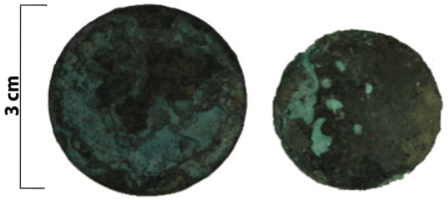
The archaeological excavation of Grubb cottage highlighted two themes: the deposition of the material debris of a century’s worth of occupation by the Grubb family, and changes made to the cottage and surrounding landscape as the Grubb family grew in number and community prominence. However, within these overarching narratives two small artefacts stood out due to their unusual context. During the excavation of new pile holes two timbers were uncovered, one under the other, running north-south along the line of the east elevation of the original cottage. Two coins were found lying on these timbers, later identified as a British bronze halfpence and a bronze penny (Clayton 2013). Unfortunately much of the detail on these coins was corroded but the material, dimensions and remaining detail were enough to date their issue to 1860-1890 and 1874 respectively.

The bronze penny (left) and half-penny (right) recovered from Grubb cottage.

The bronze penny (left) and half-penny (right) recovered from Grubb cottage.

Archaeologists often find coins during excavations and these can be useful for dating the context in which they were found. However, these coins were under the original cottage, which was built in the early 1850s and therefore predated the coins’ issue.  It is here that the physical context in which the coins were found provided a possible explanation for the dating discrepancy. The coins appeared to have been deliberately placed – what if their placement had a ritual purpose, rather than being the result of careless discard? It is likely that the east elevation of the original cottage was the location of the formal entrance until the addition, which included a new front door, was made to the south elevation at an unknown date. The date of the coins precludes any association with the opening of the original cottage entrance, but was it possible that they were used to ceremonially close that entrance before the opening of another? In which case, the coins would date the construction of the southern addition to sometime after 1874.

This possibility is evocative of common ceremonies such as the laying of time capsules, a custom that has been identified at several Christchurch buildings including an early 20th century Masonic lodge. Freemasons held elaborate ceremonies to lay the foundation stones of Masonic buildings, and these almost always included the laying of a time capsule containing a newspaper and coins (Speth 1893). Mention of Freemasonry often conjures notions of conspiracy theories and Dan Brown books, but ‘the brotherhood’ was a real and powerful influence in New Zealand’s male-dominated colonial society. The first lodge in New Zealand opened in Wellington in 1842 and by 1890 New Zealand boasted 151 lodges (Phillips 2012).Members included important society and political leaders, such as Richard Seddon, New Zealand premier and the Most Worshipful Grand Master of the Masonic Lodge of New Zealand.

Now this is where the broader context of the archaeology of Grubb cottage affects the meaning of those two little coins found in the ground – both John Grubb and his son James were Freemasons. Not only were they Freemasons, but they were leaders of the Masonic community in Lyttelton for almost 40 years. Together with several others they succeeded in founding the Canterbury Kilwinning lodge in 1875 (Press 3/12/1875; 21/2/1898). This was the second Masonic lodge in Lyttelton, the first being the Lodge of Unanimity, which was established in 1851 (Cyclopedia 1903c). Three years later John Grubb was elected lodge treasurer while James was elected a senior warden (Press 6/12/1878). The Kilwinning Lodge commissioned the construction of a hall on Canterbury Street, for which James Grubb as Worshipful Master laid the foundation stone in a ceremony in 1881 (Press 30/5/1881). John Grubb remained treasurer of the Kilwinning lodge for 18 years, resigning shortly before his death in 1898 (Press 3/12/1896).

So, if the placement of the coins was related to change in the cottage structure, it is possible that the Grubb cottage coins had a ritual significance that echoed the traditions of Freemasonry. But why were coins and newspapers used in such ceremonies? The reason seems obvious – to provide temporal information concerning the construction of the building for posterity in case of the building’s destruction. However, one would expect that the future destruction of the building was not a desirable result. Could there be an underlying explanation for these ritual actions?

George Speth, a prominent English Mason, related components of Masonic tradition to the folklore of construction. After all, a mason is a builder, and the Freemasons traced their origins to the cathedral builders of medieval Europe, and building tools were treasured symbols of the society (Newton 1921: 97-124). Speth associated common builders’ rites with the ancient belief that in order to ensure the permanence and stability of a structure it must be imbued with a soul (Speth 1893: 3). He suggested that originally this was undertaken by human sacrifice. Legends from around the world connect death to construction and Speth cited instances where human bones have been uncovered in the foundations of ancient buildings (Speth 1893: 4-22). He maintained that over time such sacrifice became symbolic in nature, with the use of animals and animal products, images and effigies. It is this symbolic form of sacrifice that Speth related to the custom of including coins in foundation ceremonies – ”…coins bearing the effigy, impressed upon the noblest of metals, the pure red gold of the one person to whom we are all most loyal, and whom we all most love, our Gracious Queen…” (Speth 1893: 22) – even if the conscious intention of imbuing the structure with a protective spirit had been shed over time.

A stained glass window depicting Saint Columba in Iona Abbey, Scotland.

A stained glass window depicting Saint Columba in Iona Abbey, Scotland. Legend has it that Columba buried alive his companion, Odran, to ensure the lasting stability of his chapel there. Image: Wikipedia 2008.

John Grubb was a builder by trade and a Freemason of high standing in Lyttelton. It is entirely likely that he was aware of the traditions and rites associated with construction. It is even possible that, on the closing of the old entrance to his cottage, he buried two coins to ceremonially mark the occasion. He didn’t necessarily do this while fully conscious of all the connotations of this little ritual. Perhaps it was done out of deference to Masonic practice, or perhaps it was done out of habit – an old superstition he picked up during his time in the building trade in Scotland. Whatever his motivation, this interpretation of past events was only made possible through consideration of two mundane objects within their immediate and broader context.

Rosie Geary Nichol

References

Amodeo, C. and Chapman, R., 2003. The Forgotten Forty-Niners: being an account of the men and women who paved the way in 1849 for the Canterbury pilgrims in 1850. Christchurch: Caxton Press.

Clayton, T., 2013. Coins of England and Great Britain. [online] Available at: http://www.coins-of-the-uk.co.uk/coins.html.

Cyclopedia of New Zealand, 1903a. Professional, Commercial and Industrial: Mr. John Grubb. [online] Available at: http://nzetc.victoria.ac.nz//tm/scholarly/tei-Cyc03Cycl-t1-body1-d3-d60-d2.html.

Cyclopedia of New Zealand, 1903b. Lyttelton: His Worship the Mayor, Mr. James Grubb, J.P. [online] Available at: http://nzetc.victoria.ac.nz//tm/scholarly/tei-Cyc03Cycl-t1-body1-d3-d60-d1.html.

Cyclopedia of New Zealand, 1903c. Orders and Friendly Societies: Masonic: New Zealand Constitution: Unanimity Lodge. [online] Available at: http://nzetc.victoria.ac.nz//tm/scholarly/tei-Cyc03Cycl-t1-body1-d3-d22-d3.html.

Heritage Management Services (HMS), 2008. Grubb Cottage Conservation Report. Unpublished report.

Land Information New Zealand (LINZ), c.1860. Probate Index – 5W237. Archives New Zealand, Christchurch Office.

Newton, J. F., 1921. A Story and Study of Masonry. [online] Available at: http://www.gutenberg.org/files/19049/19049-h/19049-h.htm#CHAPTER_IB.

Philips, J., 2012. ‘Men’s clubs – Masons’. [online] Available at: http://www.TeAra.govt.nz/en/mens-clubs/page-4.

Press. [online] Available at: http://paperspast.natlib.govt.nz.

Speth, G. W., 1893. ‘Builders’ Rites and Ceremonies: Two Lectures on the Folk-Lore of Masonry. Delivered by G. W. Speth to the Members of the Church Institute, Margate, On the 30th October and 13th November, 1893. [online]. Available at: http://www.slv.vic.gov.au/.

Fizz, bang, pop!: Christchurch’s early soda water industry.

Coke. Fanta. Lemonade. Lemon and Paeroa. Mountain Dew. Ginger beer. Dr Pepper. Seven Up. Ice-cream soda. Coke and raspberry. Lift.

Cartoon of soft drink rivals Coke and Pepsi battling it out. Image from Neatorama

Cartoon of soft drink rivals Coke and Pepsi battling it out. Image: Neatorama.

Fizzy drinks, or sodas, are everywhere in our society. In all the flavours and colours of the rainbow, they grace our televisions, billboards, magazines, movies, and our fridges. They are (to the chagrin of so many nutritionists) a staple of the modern diet. They are also, in a slightly different way, a staple of 19th century archaeology. Locally and internationally, soda-water (or aerated water) bottles are common finds on archaeological sites and can be some of the most informative artefacts we recover.

Advertisement for Schweppe’s aerated water from the Lyttleton Times, 5/02/1862.

Advertisement for Schweppe’s aerated water (Lyttleton Times, 5/2/1862).

The soda water industry has its origins in the latter half of the 18th century. It began as a medicinal product, created and sold by apothecaries for ailments like “putrid fevers, scurvy, dysentery, bilious vomiting etc” (Emmins 1991: 9). The first person to artificially carbonate water is believed to have been Dr Joseph Priestly, who wrote a book called Directions for Impregnating water with Fixed Air in the 1760s. Later, in 1792, Jacob Schweppe (yes, that Schweppe), established his first commercial scale soda water factory in London and the fizzy drink industry as we know it was born (Emmins 1991: 10).

Even after Schweppe started the ball rolling on the non-medicinal consumption of soda waters, the industry was still somewhat restricted by the available methods of bottling and storing their product. Glass and stoneware (ceramic) bottles were both used, but difficulties were encountered because of the internal pressure generated by the ‘fizz’ of the drink. Manufacturers had to use bottles with thick glass and find ways to seal the soda bottle and keep the cork or seal from being pushed out by the carbonation.

Two 1887 paintings by William Henry Hamilton Trood, showing the somewhat explosive uncorking of a torpedo shaped soda water bottle. Image: Munsey 2010: 3-4.

Two 1887 paintings by William Henry Hamilton Trood, showing the somewhat explosive uncorking of a torpedo-shaped soda water bottle. Image: Munsey 2010: 3-4.

In the early 1800s, one solution was the ‘torpedo’ bottle, which was constructed with a rounded or pointed base. This meant it had to be laid on its side, with the liquid inside the bottle keeping the cork moist so that it was less likely to shrink, fly out and unseal the bottle (Emmins 1991; Lindsey 2013; Munsey 2010: 4-9).

A torpedo shaped soda water bottle found in Christchurch and embossed with the details of Thomas Raine, Soda Water Manufacturer, Christchurch. Image: K. Bone.

A torpedo-shaped soda water bottle found in Christchurch and embossed with the details of Thomas Raine, soda water manufacturer, Christchurch. Image: K. Bone.

Lamont style soda bottle found in Christchurch, embossed with Lees & Evans, Reliance, Christchurch (1891-1913). Image: J. Garland.

Lamont style soda bottle, embossed with Lees & Evans, Reliance, Christchurch (1891-1913). Image: J. Garland.


Eventually, in the early 1870s, a man named Hiram Codd patented a new kind of soda water bottle, now known as the Codd bottle (or ‘marble bottle’). His invention used a marble to seal the bottle, in combination with the natural pressure of the carbonated liquid and a rubber seal, and quickly became a common and popular method of bottling soda water, particularly in the United Kingdom (Munsey 2010). Other inventions and adaptations were also applied to soda water bottles over the decades, including the Hogben patent, Hutchinson patent and, eventually, the crown finish (which we find on beer bottles today; Lindsey 2013). But none were quite so famous as the Codd patent.

Two different variations on the Codd patent, both found in Christchurch. Note the wide indent on both bottles, there to keep the marble at the top of the bottle after it was opened. The smaller indents above it stopped the marble from resealing the bottle when the drinker tilted it a certain way. The bottle on the left is embossed with T. C. Hill, Waltham, ChCh, Zebra Trade Mark Regd (1904-1914), while the one on the right reads Smith & Holland, Christchurch, Trade Mark (c. 1920-1924). Image: J. Garland.

Two different variations on the Codd patent, both found in Christchurch. Note the wide indent on both bottles, to keep the marble at the top of the bottle after it was opened. The smaller indents above it stopped the marble from resealing the bottle when the drinker tilted it a certain way. The bottle on the left is embossed with ‘T. C. Hill, Waltham, ChCh, Zebra Trade Mark Regd’ (1904-1914), while the one on the right reads ‘Smith & Holland, Christchurch, Trade Mark’ (c. 1920-1924). Image: J. Garland.

 Crown top soda bottle embossed with Ballin Brothers, Trade Mark Christchurch (1914 +). Image: J. Garland.

Crown top soda bottle embossed with ‘Ballin Brothers, Trade Mark Christchurch’ (1914 +). Image: J. Garland.

These bottles, in all their various forms, are the artefacts of the soda water industry that we find on archaeological sites throughout Christchurch. Here, soda water production began in the early 1860s (possibly slightly earlier) with manufacturers like Thomas Raine (later known as ‘Soda Pop Raine’), the Milsom family, and James Swann (among many others). Later, names like Henry Mace, the Sharpe brothers, Lees & Evans, the Ballin Brothers and George Ellingford came to dominate the industry (Donaldson et al. 1990). As the industry grew, it remained the province of small, almost boutique, manufacturers rather than large companies or conglomerates (Wilson 2005). Most of the factories employed only a couple of people to work on the bottling process (Press 20/7/1908: 8) and produced soda water for the local, rather than national or international, market.

An 1885 sketch of McPherson’s Aerated Water Manufactory on the corner of Worcester Street and Cambridge Terrace. Image: Christchurch City Libraries, File Reference CCL PhotoCD 12 IMG0064. Source: Lyttelton Times, 28 June 1851, p. 3.

An 1885 sketch of McPherson’s Aerated Water Manufactory on the corner of Worcester Street and Cambridge Terrace. Image: Christchurch City Libraries, File Reference CCL PhotoCD 12 IMG0064. Source: Lyttelton Times, 28 June 1851, p. 3.

Local soda water manufacturers branded their bottles with their names and company logos, and it’s these embossed designs that make these bottles so informative for archaeologists. As well as using the physical shapes of the bottles to understand the bottling technology being used in Christchurch, we can use the designs and names embossed on the glass to understand the who and the what and the when of the local soda water industry. Alterations to these designs can tell us when a bottle was made and, perhaps, when it might have been placed in the ground. We can see changes in the history of a company, like when it might have passed from father to son or when a new partner was brought on board.

Some of the bottle designs we come across are also tied to personal events or stories in the lives of the manufacturers, giving us a glimpse of the people behind the industry. Henry Mace, who operated a soda water factory on St Asaph Street from the 1880s until his death in 1902 (although the business continued until the 1920s), used a dog trademark on his bottles, supposedly in tribute to a dog that saved a member of the family from drowning (Donaldson et al. 1990: 244-245). Another manufacturer on St Asaph Street, John Robinson, used the image of a bicycle on his bottles in reference to his previous occupation as a cycle engineer (Donaldson et al. 1990: 254).

Left) A Henry Mace stoneware bottle, also found in Christchurch, showing the ‘Dog’ trademark; Right) A crown top J. Robinson bottle found in Christchurch, with the image of a bicycle embossed in the center. Images: J. Garland

Left: A Henry Mace stoneware bottle, showing the ‘Dog’ trademark; Right: A crown top J. Robinson bottle found in Christchurch, with the image of a bicycle embossed in the centre. Images: J. Garland

Yet, these bottles, despite their personal and commercial branding, were not made in New Zealand. The first New Zealand bottle production plant wasn’t started until the 1920s (Auckland Star 11/12/1925: 11), which means that every local manufacturer in Christchurch, and throughout the rest of the country, had to source their bottles from overseas. Fortunately, as well as the name of the contents manufacturer, many bottles were also embossed with the initials, logo or name of the bottle manufacturer. Manufacturers that we’ve come across include Australian, British and American glass-making factories, some of which made bottles for multiple Christchurch companies.

This George Ellingford & Sons bottle, although embossed with the details of the Christchurch based company, was made by Cannington, Shaw & Co, bottle makers based in St Helens, England. We know this, thanks to the C. S. & Co also embossed on the base of the bottle. Image: J. Garland.

This George Ellingford & Sons bottle, embossed with the details of the Christchurch-based company, was made by Cannington, Shaw & Co, bottle makers based in St Helens, England. We know this thanks to the ‘C. S. & Co’  embossed on the base of the bottle. Image: J. Garland.

It’s worth remembering that this also took place long before any kind of high speed communication was common in business endeavours. To get their personalised bottles, Christchurch manufacturers would have had to send off for them months in advance and wait for their purchases, not necessarily knowing whether or not their order had been received, processed or even produced correctly. It shows a kind of risk taking, a leap of faith, that those of us in the present day, with our instant communication and electronic transactions, can’t really comprehend.

There’s an interesting pattern to see here too, in the relationships between the local (grass-roots even) Christchurch soda water industry and the much larger industry of glass making in the late 19th and early 20th century. We’ve talked about global relationships on the blog before, in relation to importing overseas products like Wolfe’s Aromatic Schnapps, various pharmaceutical products and ceramics, and it’s something that leaps out again in this case. No matter how small the scale of production, how local the market, or how personal the branding, the Christchurch aerated water industry was part of a much wider, much more global industry. Frankly, it’s kind of cool that every time we pick up a soda water bottle at a site, we can see that connection right there in our hands, embossed onto the glass.

Jessie Garland

References

Auckland Star. [online] Available at: <http://paperspast.natlib.govt.nz>.

Donaldson, B., Hume, G. & Costello, S., 1990. Antique Bottle and Containers of Christchurch and District. Christchurch Bottle and Collectibles Club: Christchurch.

Emmins, C., 1991. Soft Drinks: Their Origins and History. Shire Publications: Buckinghamshire.

Lindsey, B., 2013. Historic Glass Bottle Identification and Information Website. [online] Available at: <http://www.sha.org/bottle/>.

Lyttelton Times. [online] Available at: <http://paperspast.natlib.govt.nz>.

Munsey, Cecil, 2010. Codd (Marble In the Neck) Soda Water Bottles: Then and Now. [online] Available at <http://www.sha.org/bottle/pdffiles/coddarticleMunsey.pdf>.

Press. [online] Available at: <http://paperspast.natlib.govt.nz>.

Wilson, J., 2005. Christchurch City Contextual History Overview. Theme IV: Industry and Commerce. [online] Available at: <http://resources.ccc.govt.nz>.