A poetic reflection on heritage buildings

As building archaeologists we record and analyse the form, structure and ornamentation of 19th century dwellings to learn about the lives led by past occupants.

The Victorian era was a time of invention and achievement. Society was dominated by middle-class morality as they relentlessly pursued comfort and material wealth. Their houses expressed the energy and exuberance of this time, as they presented their best face to the public.

These efforts can be directly observed through the choice of internal linings used in 19th century dwellings. Wealthy homes were commonly lined with timber laths and lime plaster, while poorer houses used roughly sawn butted sarking boards. When we recorded a modest workman’s cottage in the Avon Loop we uncovered some of these roughly sawn butted sarking boards in the parlour, a room purposely decorated for public display.

Roughly sawn butted sarking boards used in parlour of workman's cottage. Image: F. Bradley.

Roughly sawn butted sarking boards used in parlour of workman’s cottage. Image: F. Bradley.

Over time, however, seven layers of wallpaper had been applied to this room to disguise the poor lining material.

Original layer 1

The first layer of wallpaper applied was a mid-Victorian pattern design of purple and light brown diamond shapes dating to between the 1860s and 1870s. Image: F. Bradley.

Layer 2

Applied on top of the original layer was a brown wallpaper with a blue flowers and leaves pattern design, dating to the 1880s. Image: F. Bradley.

Layer 4

The fourth layer of wallpaper dated to the 1850s and had design elements of the Edwardian period, with green diamond shapes and pink roses. Image: F. Bradley.

top layer 7

The last layer was a pearlescent wallpaper with a design pattern of white, pink and yellow flowers, dating to between the 1920s and 1930s. Image: F. Bradley.

When we record these historic dwellings, we try decipher the social conventions at play during the Victorian era and how they influenced the way in which their dwellings were decorated. But when it came to recording this workman’s cottage in the Avon Loop, we were confronted with the juxtaposition of how 19th century society decorated their houses and a very unique way one 21st century occupant had decided to decorate her humble abode.

IMGP6129

Street-facing elevation of workman’s cottage in the Avon Loop. Image: F. Bradley.

In its irreparable state the creative owner of this house took to it with a fine paint brush and turned its rough-cast plastered walls into a mural of poetry.

The street-facing south elevation bore the words of Percy Shelley’s sonnet ‘Ozymandias’.

IMGP6135

Percy Shelley’s poem ‘Ozymandias’ painted on the street-facing south elevation. Image: F. Bradley.

Ozymandias – Percy Bysshe Shelley

I met a traveller from an antique land
Who said: “Two vast and trunkless legs of stone
Stand in the desert. Near them on the sand,
Half sunk, a shattered visage lies, whose frown
And wrinkled lip and sneer of cold command
Tell that its sculptor well those passions read
Which yet survive, stamped on these lifeless things,
The hand that mocked them and the heart that fed.
And on the pedestal these words appear:
`My name is Ozymandias, King of Kings:
Look on my works, ye mighty, and despair!’
Nothing beside remains. Round the decay
Of that colossal wreck, boundless and bare,
The lone and level sands stretch far away”.

(Source: Wikipedia, 2001).

‘Ozymandias’ was one of English romantic poet Percy Bysshe Shelley’s most famous works, first published in 1818. Shelley’s works often attracted controversy as they spoke out against oppression, convention and religion (Source: Wikipedia, 2001).

His poem ‘Ozymandias’ acts as a a metaphor for the ephemeral nature of political power. Its central theme explores the indiscriminate and destructive power of history, by contrasting all leaders’ pretentions to greatness and their inevitable decline. It is a powerful statement about the insignificance of human beings to the passage of time (Wikipedia, 2001).

Along the north elevation of the cottage were the words of Denis Glover’s iconic New Zealand poem ‘The Magpies’.

IMGP6145

Denis Glover’s poem ‘The Magpies’ painted along the north elevation of the cottage. Image: F. Bradley.

IMGP6139

First section of ‘The Magpies’. Image: F. Bradley.
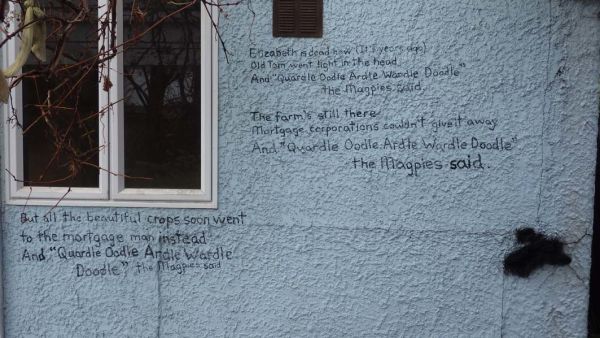
IMGP6142

Second section of ‘The Magpies’. Image: F. Bradley.

The Magpies – Denis Glover

When Tom and Elizabeth took the farm
The bracken made their bed,
And Quardle oodle ardle wardle doodle
The magpies said.

Tom’s hand was strong to the plough
Elizabeth’s lips were red,
And Quardle oodle ardle wardle doodle
The magpies said.

Year in year out they worked
While the pines grew overhead,
And Quardle oodle ardle wardle doodle
The magpies said.

But all the beautiful crops soon went
To the mortgage-man instead,
And Quardle oodle ardle wardle doodle
The magpies said.

Elizabeth is dead now (it’s years ago)
Old Tom went light in the head;
And Quardle oodle ardle wardle doodle
The magpies said.

The farm’s still there. Mortgage corporations
Couldn’t give it away.
And Quardle oodle ardle wardle doodle
The magpies say.

(Source: Xyphir, 2011).

‘The Magpies’ by Denis Glover is one of New Zealand’s most famous poems, first published in 1941. This poem relates to the passage of time as it laments the fate of farmers in hard economic times (Wikipedia, 2006). The hard-working farming couple become victims of an oppressive social system that exploits the working man. In this poem, the cruel and impartial nature of time is personified by the distinctive caw of the magpies, as they watched the farmers struggle away (Shieff, 2008).

As architectural styles and their decorative features can help us understand the conditions of bygone generations, the choice of poetry used here to decorate this workman’s cottage may be a reflection on the current post-quake social condition of Canterbury. Or perhaps the owner was merely commenting on the passage of time and its indiscriminate treatment of her home. Who knows, as archaeologists we can only speculate…

IMGP6137

Words of wisdom painted next to the dwelling’s front door. Image: F. Bradley.

Francesca Bradley.

References

Wikipedia, 2001. Ozymandias. [online] (22 September 2015) Available at: https://en.wikipedia.org/wiki/Ozymandias [Accessed 1 October 2015].

Xyphir, 2011. The Magpies – Denis Glover. A poem a day, [online] 26 April 2011. Available at: http://nzpoems.blogspot.co.nz/2011/04/magpies-denis-glover.html [Accessed 1 October 2015].

Wikipedia, 2006. The Magpies. [online] (2 May 2015) Available at: https://en.wikipedia.org/wiki/The_Magpies [Accessed 1 October 2015].

Shieff, Sarah, 2008. Denis Glover, 1912 – 1980. [online] Wellington: Victoria University. Available at: file:///Users/Shebitch/Downloads/716-622-1-PB%20(1).pdf [Accessed 1 October 2015].


The dilapidatedly grand villa

This week we are treating you to a photographic tale of the life of a Cantabrian abode. Come with us now on a journey through time and space, to the wonderful world of dilapidated Victorian villas…

FOH

Between 1904 and 1905 Mr. Andrew McNeil Paterson, a salesman, built this rather grand residence. In its former glory the house had a total of eight rooms, including a scullery, pantry and bathroom. Image: Kirsa Webb.

dining

Mr. Paterson’s dining room with faceted bay windows. Image: Kirsa Webb.

cornice

Detail of decorative cornice in the dining room. Image: Kirsa Webb.

P1060130

The perforated ceiling rose in the dining room. Perforated ceiling roses helped ventilate rooms with fireplaces. This one was the most decorative ceiling rose that remained in the villa. Image: Peter Mitchell.

turret

The turret bay window of the drawing room. The door on the left led to the modern addition of a bathroom, where the original verandah would have run. Image: Kirsa Webb.

P1060132

Detail of unperforated ceiling rose in drawing room. Image: Peter Mitchell.

Untitled-1

Original perforated ceiling rose in the hallway. Image: Peter Mitchell.

P5050081

Ornate cornice detail of the original hallway. Image: Kirsa Webb.

P1060242

Detail of a perforated ceiling rose in a bedroom, which was significantly smaller than the other remaining ceiling roses in the house. Image: Peter Mitchell.

Despite its grandiose design, Mr. Paterson soon grew tired of the villa and sold the house just four years later. Over the next couple of decades the dwelling was home to a collection of different occupants. However, as was common practice in Christchurch during the Depression, this ornate villa was eventually divided up into a jigsaw puzzle of single bedroom flats.

plan

2011 plan of Mr. Paterson’s former residence divided into four flats. Image: Francesca Bradley.

And it was this jigsaw of four derelict flats Underground Overground Archaeology had to piece together to bring you the story of Mr. Andrew McNeil Paterson and his once grandiose residence.

Francesca Bradley

An architectural interlude

We’re taking a short break between perfume posts this week and veering off in another direction entirely to present you with a photographic essay on one of the historic buildings we’ve recorded recently (but never fear, we’ll be back on course next week!).

The building, a Victorian villa,  appears to have been built in 1899 by the delightfully named Matilda Sneesby (very Roald Dahl-esque), wife of Christchurch printer William Sneesby. They lived there with their family until the 1920s. The building itself has some fascinating architectural features and additions, laid our for your perusal in the photographs below.

North elevation of 34 Harvey Terrace with bull nosed veranda, cast iron laces work, chamfered timber posts, timber fretwork brackets. The east end has been walled in.

North-facing entrance to the house, with bullnose veranda, cast iron lace work, chamfered timber posts and timber fretwork brackets. The east end has been walled in, as you can see. Image: P. Mitchell.

2.Bay window on the east elevation. Identical bay windows have been found on other houses suggesting that they were available pre-built or as a kitset (not sure of wording for this).

Bay window on the east elevation. Identical bay windows have been found on other houses. Image: P. Mitchell.

Fireplace removed from the parlour.

Beautiful fireplace removed from the parlour. As you can see, the chimney piece has been made to look like black marble, which was, of course, far more expensive than a wooden imitation. A manufacturer’s trademark – a single Scotch thistle bloom with “REGISTERED / TRADEMARK” around it – was found on the back, suggesting possible Scottish origins. Image: P. Mitchell.

Hallway arches like these were used to separate the ‘public’ and ‘private’ areas of houses. The front rooms of a dwelling were considered public because these were the rooms most likely used when entertaining guests.

Hallway arches like these were used to separate the ‘public’ and ‘private’ areas of houses. The front rooms of a dwelling were considered public because these were the rooms intended for entertaining guests. Image: P. Mitchell.

Traditional moulded skirting boards and architraves. These went out of fashion in the early 20th century as they became more expensive to produce. Note the child’s scrawl. Touches like this remind us that these buildings were people’s homes

Traditional moulded skirting boards and architraves. These went out of fashion in the early 20th century. Note the child’s scrawl on the wall above. Touches like this remind us that these buildings were people’s homes as well as the architectural remnants of a bygone era. Image: P. Mitchell.

Another ceiling rose, in another room.

A ceiling rose. This house was unusual in that there were three identical ceiling roses – of this design – in three different rooms. Typically, they vary from room to room. Image: P. Mitchell.

Ceiling roses. 34 Harvey Terrace was unusual in that there were three identical ceiling roses in three different rooms.

Another, slightly different ceiling rose, found in one the smaller rooms of the house. Image: P. Mitchell.

his double window was at the south end of the Phase 1 (original) build. The window on the right was boarded up when the house was reconfigured at some time in the early 20th century

This double window was at the south end of the original part of the house. The window on the right was boarded up when the house was reconfigured at some time in the early 20th century. Image: P. Mitchell.

The south wall of this room held a fireplace or coal range associated with the kitchen which had been removed. The kitchen is most likely to have been the room beyond the opening, which was still being used as a kitchen in 2011.

The south wall of this room held a fireplace or coal range associated with the kitchen that had been removed. The original kitchen is most likely to have been the room beyond the opening, still used as such in 2011 (albeit somewhat different in appearance). Image: P. Mitchell.

This wall is something of a puzzle. The ceiling shows evidence of a wall having been removed, and the wall shows evidence of a door having been removed. The wall was probably removed first, and the wall relined. Then the door was filled in at a later time. The main hallway lies beyond the filled in door way. The wainscoting was not original.

This wall is something of a puzzle. The ceiling shows evidence of a wall having been removed, and the wall shows evidence of a door having been removed. The wall was probably removed first, and relined. Then the door was filled in at a later time. The main hallway lies beyond the filled in door way. The wainscoting was not original. Image: P. Mitchell.

2014. What a year!

As another year comes to an end, we present you with a selection of our favourite sites, discoveries and archaeology moments from 2014. It’s been a good year.

We did a lot of digging….

OLYMPUS DIGITAL CAMERA

So much mud. Image: H. Williams.

10408800_725235584204694_9163478434946771762_n

Our biggest site of the year, this excavation yielded over a hundred boxes of artefacts and almost two hundred archaeological features, including the industrial complex being excavated in this photo. Image: H. Williams.

10526074_734651889929730_3636277507067447724_n

In July, we got to spend a weekend out in Akaroa working on the French Farm homestead, built in the 1840s by French settlers. You can read more about the history of the house and our initial impressions of the archaeology here and here. Image: K. Watson.

Digging, digging, digging. So much digging.

Digging, digging, digging. So much digging. Image: K. Bone.

…and recording.

OLYMPUS DIGITAL CAMERA

Drawing and recording a brick floor excavated in Christchurch’s central city. Image: H. Williams.

1610759_734598319935087_1541143217145108568_n

Kirsa recording the French Farm site, using a theodolite to create a survey plan, while the rest of us drew elevations of the building itself. Image: K. Watson.

One of the elevation drawings of the French Farm building.  Image: L. Tremlett.

One of the elevation drawings of the French Farm building. Image: L. Tremlett.

While recording this Lyttelton house, built in the 1850s, we found this handwritten note fragment on one of the interior wall boards. We're not entirely sure what it says, but it's something about Hokitika. Image: K. Webb.

While recording this Lyttelton house, built in the 1850s, we found this handwritten note fragment on one of the interior wall boards. We’re not entirely sure what it says (something about Hokitika), but it’s pretty fantastic. Image: K. Webb.

We found some cool things…

OLYMPUS DIGITAL CAMERA

An industrial complex on Lichfield Street, constructed from 19th century bricks. It’s pretty rare for us to find such substantial floors and foundations from long demolished buildings, so this was a pretty cool find. Image: H. Williams.

IMGP0505

The floor and foundations of an 1850s business, found on Cashel Street, another rare find for us. During our research on this site, we found a story about the owner opening a bar on the section, which he named ‘The Blighted Cabbage’ in response to the Mr William ‘Cabbage’ Wilson’s strenuous objections to the very same establishment. An excellent name for a bar. Image: K. Bone.

OLYMPUS DIGITAL CAMERA

This epic barrel-lined well was one of the more notable ones we excavated this year. It’s also the deepest, extending down to 3.8 metres below the ground surface. You can just make out the barrel timbers at the base of the feature, where two barrels were stacked on top of each other, with a length of iron pipe extending down through them into the water bearing alluvial gravel strata below. A limestone block was also found at the base, evidently functioning as a filter for the water. Image: H. Williams.

2014-05-29_12-26-55_522

We found this hundred and thirty five year old footprint in concrete foundations (poured in 1879). We worked out that it’s the equivalent of a modern men’s size 9 (American): it probably belonged to one of the workers on the site. Image: L. Tremlett.

10270828_725870430807876_2352858826434568202_n (1)

One of the absolute coolest finds of the year, a clay smoking pipe shaped like a skull and complete with bright blue glass eyes. The pipe resembles a style of decoration that was particularly popular in France in the latter half of the 19th century. Image: C. Dickson.

Artefacts

A (very) small selection of some of the exciting things we’ve found this year, including an immense number of shoes and hats, lovely transfer printed ceramics, children’s artefacts, books, bottles and clay pipes. Image: J. Garland.

During analysis of a time capsule that we found last year, we discovered this beautifully preserved

During analysis of a time capsule that we found last year, we discovered this beautifully preserved notice detailing the laying of the very foundation stone in which we found the capsule. It certainly doesn’t look 120 years old! Image: J. Garland.

Definitely the oldest thing we've found this year, this 1825 Georgian shilling was found at an 1850s house site on Cashel Street. Image: J. Garland.

Definitely the oldest thing we’ve found this year, this 1825 Georgian shilling was found at an 1850s business site on Cashel Street. Image: J. Garland.

Some of us also mucked about in boats…

OLYMPUS DIGITAL CAMERA

One of our team was lucky enough to complete an archaeological survey of the Lyttelton Port, finding over sixty archaeological sites and getting to spend some time out on the water. Image: M. Carter.

…built the occasional box-fort…

DSC_2349ed1

As it happens, the box-fort around my desk functions as an excellent defensive fortress in the nerf-gun wars that frequently take hold of the office. Image: J. Garland.

DSC_2348ed1

This is actually more of a box-maze, constructed from all the boxes of artefacts we’ve found and/or analysed this year, but it’s still impressive (and a little terrifying, if you’re the artefact analyst!). It also provides an excellent defensive position from which to leap out and startle people. Image: J. Garland.

… and made friends with some animals.

061cropped

Chelsea having a conversation with a feline visitor to one of our sites. Honestly, the cat doesn’t look that impressed with whatever it is that she’s saying. Image: J. Hughes.

P1210205

Cows! Also not looking impressed. Image: K. Bone.

IMG_20141211_094027cropped

This curious chicken followed Kim around site one day. Image: K. Bone.

All things considered, it’s been a busy year. Frankly, we’re exhausted.

photo 1

See? Totally shattered. Image: C. Dickson.

Thank goodness it’s the holidays. Merry Christmas and a happy new year to you all!

We’ll see you again in February 2015.

The Underground Overground team

  The team at Underground Overground Archaeology Ltd

Put this in your pipe and smoke it!

A few weeks ago, there was an interesting interview on Radio New Zealand with historian Jock Phillips, on the history of tobacco use in New Zealand. In the interview, Jock talked about the ways in which people consumed tobacco in the past, the types of people smoking tobacco at different points in New Zealand’s history and the rituals that surrounded the habit. One of the things he touched on was the use of the clay tobacco pipe as the method of choice for most smokers during the 19th century, whether in social situations or in the privacy of the home.

Clay smoking pipes are relatively common finds on 19th century archaeological sites here in Christchurch, although, given the prevalence of smoking in 19th century society and the ease with which the pipes were discarded after use, it’s surprising that we don’t find more of them. Clay pipes were, on the whole, cheap and easily obtained, although some of the more elaborately decorated pipes would have been more expensive and, consequently, less disposable. Many of the cheaper, plainer pipes may have been used only once before being discarded, particularly in certain contexts: hotels and taverns, for example, used to provide disposable clay pipes for their customers to use and throw away while on the premises (Phillips 2014).

Broken pipes

The pipes found on archaeological sites are usually broken, often at the stem of the pipe, and their bowls blackened from use. Some of these have ‘bites’ at the ends of the stems, in the form of raised ridges or glazed sections where the smoker put the pipe in their mouth. Sometimes, there are teeth marks at the end of broken stems, suggesting that the stems were cut and the pipes reused until they were no longer useable. Occasionally, however, we do find unused pipes, indicating that they may have been broken before they could have been smoked. Image: J. Garland.

Clay pipes are one of my favourite kinds of artefacts and a big part of that, I think, is due to the elaborate styles of decoration we sometimes find. They’re just so cool. Most of the pipes we find are plain, made from white clay, with no decoration on the bowl, but others are moulded and sculpted in fantastic ways. We’ve found fish head pipes; bowls as eggs cradled in the talons of an eagle; effigy pipes sculpted to look like skulls and caricatures; basket pipes; pipes with steam-ships and trains on them; military pipes; naval pipes and, notably, a pipe with the figure of a woman riding side-saddle along the stem.

A selection of clay pipes found in Christchurch. Clockwise from the top left: fish head pipe bowl; talon pipe; pipe decorated with the insignia of the Royal Iniskilling Fusiliers; basket pipe; effigy pipe from three sides; pipe decorated with a ship and anchor. Image: J. Garland.

A selection of clay pipes found in Christchurch. Clockwise from top left: fish head pipe bowl; talon pipe; pipe decorated with the insignia of the Royal Iniskilling Fusiliers; basket pipe; effigy pipe from three sides; pipe decorated with a ship and anchor. Image: J. Garland.

Like most decorated objects, there’s information in the decorative styles of these pipes – fashions that can be dated to period of popularity, references to events or figures or organisations that can tell us something about Victorian society and the culture of pipe smoking. Many of the pipes are also marked with the initials or names of their manufacturers, identifying pipe makers in Glasgow, Edinburgh, Liverpool, London, Manchester or Sydney (among other places), who shipped their goods to New Zealand.

Scotland and England had particularly strong export markets, supplying clay smoking pipes to the colonies in Australia and New Zealand during the Victorian era (Gojak and Stuart 1999, Sudbury 2006). Certain manufacturers – Thomas White, Charles Crop and Duncan McDougall, for example – are frequently represented amongst pipe fragments found here and in Australia. Other pipes may have been made on the continent, particularly in France, where there was also a strong clay pipe manufacturing industry, but, as yet, we’ve not found any recognisably French pipes in Christchurch (Ayto 2002).

Possibly the coolest pipe we've found in Christchurch.

Possibly the coolest pipe we’ve found in Christchurch. A person would look completely badass smoking this. Skull pipes similar to this one have been identified as French in origin (the French industry specialised in ‘figurals’ and portrait pipes), although there is no way of telling if this particular example was made in France. Image: J. Garland.

We’ve also found pipes with local connections, marked with the names of Christchurch retailers and merchants. Pipes with the names of Cathedral Square retailers Twentyman & Cousin and coffee, flax and chicory merchants the Trent Brothers were both found on central city sites earlier in the year. It seems likely that these companies ordered pipes from overseas, branded with their own names, to be sold in their stores or as part of their merchandise. Similarly, in Australia, we know of at least one Sydney tobacconist – Hugh Dixon – who also sold clay pipes bearing his name.

Two clay pipes marked with the names of local Christchurch retailers. Image: J. Garland.

Two clay pipes marked with the names of local Christchurch retailers. Image: J. Garland.

These pipes are found in a range of contexts, some of which can add to or confirm our knowledge about the rituals of pipe smoking in 19th century Christchurch, as well as the methods by which they were imported and sold in the city. We find pipes in domestic assemblages, pipes that would have been smoked by the residents of those households (probably the men – as far as we know, pipe smoking was an almost exclusively male thing amongst European settlers). Smoking was a common habit in Victorian society, particularly in the home. There are numerous articles and advertisements surrounding both the rituals or practice of smoking and the pipes used in the process (Daily Southern Cross 23/04/1852: 1, Evening Post 6/08/1872: 2 Star 10/03/1892:10, Taranaki Herald 2/10/1909: 6, Thames Star 5/02/1892:1).

One thing I found interesting, actually, while researching this, was the number of articles discussing tobacco smoking that referred to the health issues associated with it – good and bad. The most astonishing, I think, was an article from 1867 which decried tobacco as a poison that “benumbs the brain, extinguishes the memory, brings on giddiness, and finally engenders those horrible diseases, cancer in the mouth, and softening of the spinal marrow” (New Zealand Herald 17/12/1867: 5). We tend to think of health concerns with tobacco as a modern phenomenon: clearly, they were not.

 “Tobacco, says Michelet, has killed kissing; it has done more, it has closed the drawing room…The increasing consumption of tobacco is frightful, children ten years of age already smoke. It is time to think of a remedy, tobacco is a poison – a slow one if you will – but certainly a poison, for it benumbs the brain, extinguishes the memory, brings on giddiness, and finally engenders those horrible diseases, cancer in the mouth and softening of the spinal marrow. In concert with its comrade alcohol, it ravages the organisation and dwarfs the species. Tobacco injures the human race, not only physically but morally. It strikes thought with atrophy, and paralyses action; with every whiff of tobacco a man exhales a virtue, or an energy. Germany smokes and dreams; Spain smokes and sleeps; Turkey, who has been smoking these last three hundred years, has no longer strength to stand on her legs.” – New Zealand Herald 17/12/1867: 5

The ritual of smoking in the home has some interesting accompaniments: for example, Victorian literature often speaks of the ‘smoking room’, as a room in a house (presumably a middle – upper class house), specifically set aside for the males of the household to use for smoking (Phillips 2014). We’ve only identified one house with a smoking room in Canterbury (near Ashburton) and then, only because we had the plans for the house that labelled the room accordingly. Without those plans, it’s difficult to know which room in a house may have been used as a smoking room, if one existed at all.

We also find pipes on hotel sites, as I mentioned above, where they may be evidence for the social side of pipe smoking (much like ‘social’ smokers today, perhaps, who smoke only when they drink), or simply an indication of the provision of ‘home comforts’ to hotel guests. Interestingly, one of the pipes found on the site of the Zetland Arms hotel here in Christchurch was not a cheap, disposable example, but one of the most elaborately decorated clay pipes we’ve come across. It was unused, so perhaps it was ornamental, displayed above the bar or used as a display to advertise other pipes or tobacco sold on the premises. It seems a waste, if this was the case: one would look completely awesome (or possibly a little pretentious?) smoking that pipe.

Elaborately decorated pipe with a female figure riding sidesaddle along the stem. Sadly, her head went missing somewhere along the way. Image: J. Garland.

Elaborately decorated pipe with a female figure riding sidesaddle along the stem and an alternative use for a clay pipe in social situations. Sadly, the lady’s head went missing somewhere along the way. Image: J. Garland and Auckland Star 19/11/1936: 26.

On one notable site, we even found a large collection of broken and unused clay pipes, all decorated with either a steam ship or a traction engine design. It turned out that the site had originally been occupied by a grocer, and the pipes were probably damaged or unwanted stock that had been disposed of on-site (Watson et al. 2012). As we can see from these pipes, and the Twentyman and Cousin and Trent Brothers examples, smoking paraphernalia was sold by a range of different merchants and retailers, not just tobacconists (although tobacconist’s shops did exist in Christchurch: Lyttelton Times 18/04/1867: 1).

A concentration of unused clay pipes found on the site of a grocer's business. Image: M. Hennessey.

A concentration of unused clay pipes found on the site of a grocer’s business. Image: M. Hennessey.

It’s interesting, I think, that such a small artefact can provide evidence for or be a part of so many different aspects of society and life in the 19th century. Clay pipes can represent everything from international connections between New Zealand and the rest of the world to local businesses and business owners. They can shed light on contemporary styles and symbolism, on social rituals, on gendered activities, on class, on the beginnings of disposable consumerism. They were intrinsically linked with individual health, good and bad, even a hundred and fifty years ago. In America, pipes even played a part in the workings of the justice system, and, in one of my absolute favourite articles on the subject, pipe smoking is condemned as the murderer of romance, the cause of moral injury and the instigator of national apathy.

I’ve said it before, but I’ll say it again: sometimes it’s the smallest things that tell us the tallest tales.

Jessie Garland

References

Auckland Star. [online] Available at www.paperspast.natlib.govt.nz 

Ayto, E. G., 2002. Clay Tobacco Pipes. Shire Publications, Buckinghamshire.

Daily Southern Cross. [online] Available at www.paperspast.natlib.govt.nz 

Gojak, D. and Stuart, I., 1999. The Potential for the Study of Clay Tobacco Pipes from Australian Sites. Australasian Historical Archaeology, Vol. 17: 38-49.

New Zealand Herald. [online] Available at www.paperspast.natlib.govt.nz 

Phillips, J., 2014. Pundit: Life and Times of the Long White Cloud. Radio New Zealand, aired 15/09/2014. [online] Available at www.radionz.co.nz

Star. [online] Available at www.paperspast.natlib.govt.nz 

Sudbury, J., 2006. Historic Clay Tobacco Pipe Studies, Volume 1. Phytolith Press, Oklahoma.

Taranaki Herald. [online] Available at www.paperspast.natlib.govt.nz 

Thames Star. [online] Available at www.paperspast.natlib.govt.nz 

Watson, K., Carter, M., and Hennessey, M., 2012. 134 Hereford Street, Christchurch: report on archaeological monitoring. Unpublished report for CERA.