Tales of a house

So, that message in a bottle? Well, it turns out it wasn’t the only interesting thing about the site it came from. A fellmongery, German Danes, shoes… read on!

First up, the bottle came from under a house built in 1887 (the land transaction records had suggested 1885, when the first mortgage was taken against the land; LINZ 1885). From the outside, this looked like a fairly standard 1880s villa (albeit modified), but inside – and its history – were not quite so standard. The differences inside weren’t that huge, but you have to understand that, in the 1880s and 1890s, there was little deviation from the standard plan for single-storey villas, so even the smallest difference is telling. On the outside, your standard villa might be flat-fronted or have a bay or two, and there might be some variation in the number of windows on the street-facing façade (depending on how much money you wanted to spend). Inside, villas of this type tended to have four rooms in the main body of the house, two on each side of a central hall. And there might have been some additional service rooms to the rear of this.

 The house. The conservatory on the left was originally a veranda. Photo: K. Webb.


The house. The conservatory on the left was originally a veranda. Photo: K. Webb.

As I said, this one wasn’t so very different. Instead of a central hall, it had a sort of T-shaped hall, with six rooms opening off it. Not only was the hall a different shape, but there were more rooms than usual in the main body of the house, although the house was roughly the same footprint as the standard villa (and the house’s layout had barely been modified since it was built). And only one of the front rooms opened off the front hall – normally both did. While this detail seems particularly small, it’s actually more significant than the hall shape/position.

In the standard villa design, the front hall and the two front rooms, both of which opened off it, were the ‘public’ part of the house, where visitors were likely to be entertained. Usually, this part of the house was separated from the ‘private’ part by an arch in the hall, and guests were unlikely to pass from the public area to the private area. One of the front rooms was the parlour or drawing room and the other was the master bedroom, where guests might leave their coats (Stewart 2002). It’s always seemed slightly odd to me that the master bedroom was part of the public area of the house, and clearly it wasn’t in this house. Visitors would only have gone into the parlour, nowhere else.

The house’s history revealed that it was built for Neils Carl Heinrich Püschel (without recourse to a mortgage) and transferred shortly thereafter to Tryphona Püschel, his wife. The Püschels owned the house until 1896, when it appears to have been sold as a mortgagee sale (LINZ 1888).

Püschel. Not a very English name, that. The family was of German origin, although Neils – who was generally known as Carl – was born in Denmark. In fact, three Püschel brothers came to Canterbury, only one of whom was born in Germany. John, the eldest, and Carl established a fellmongery (where sheepskins were prepared) in Rangiora, before setting up a fellmongery in Avonside in the late 1870s. That’s right, Avonside – hard to imagine now! By 1887, however, Carl Püschel was no longer part of the business, which William Püschel continued to run on his own, albeit with funding from John Püschel (Macdonald n.d.: P610, 611;  Watson 2013).

So could the layout of the house be explained as a fusion of New Zealand and German/Danish architecture? We don’t know, but it’s an intriguing possibility.

During our work on the house, we were fortunate enough to meet Jenny, the most recent owner. Jenny’s parents had bought the house in the 1920s, and Jenny had grown up there and lived there until the earthquakes changed everything. Jenny told us some awesome stories about the house, including how, after they’d bought the house, her parents journeyed to Christchurch on the train, complete with Dolly the cow. As a teenager, Jenny and her friends had played tennis on the lawn in front of the house (where Dolly had once grazed), with the aim of catching the eye of the local lads!

Not only did Jenny share her stories with us, she also shared her collection of early 20th century shoes –  her father was a Pannell of the Pannell bootmaking business. And she showed us a catalogue produced by the Pannells in c.1903-1904, containing all sorts of information about the most wonderful  sounding shoes: Goloshed Balmorals, Watertight Bluchers or Lorne Shoes, anyone?

Lace-up lady's ankle boots, with a military stacked heel and machine stitching along the vamp, tip and back quarter of the upper, c.1900-1920. Photo: J. Garland.


Lace-up lady’s ankle boots, with a military stacked heel and machine stitching along the vamp, tip and back quarter of the upper, c.1900-1920. Photo: J. Garland.

And then there’s that message in a bottle. But first, the bottle itself, which a number of you commented on, with a couple of you identifying the label. Jessie’s research indicates that the label represents two different companies: Read Brothers and Bass Brewery. The Read Brothers Bottling Company was founded in 1877 by William Thomas Read and John Walter Read. They were based in London and were among the largest, if not the largest, of the London bottling companies, inventing their own bottling machines as well as buying up and reusing old alcohol bottles from across London. The Bull Dog trademark, along with the ‘Dog’s Head’ brand, was registered by them in 1877 and featured the image of a bull dog in a circle on the label (Hughes 2006).

DSC_0088ed1_web

Read Brothers were closely associated with the Bass Brewery and their products, originally bottling only Bass sparkling champagne, cider and Guinness. By the early 1900s they were the largest exporter of Bass Pale Ale in the world.  Bass Brewery, usually represented by the red triangle seen on the label, was founded in 1777 by William Bass in Burton upon Trent. Their characteristic red triangle has the distinction of being the first trademark registered in the UK, under the Trademark Registration Act of 1875 (Hughes 2006).

DSC_0091ed1_web Advertisements in New Zealand newspapers frequently link the two companies from 1878 until 1886, after which the two are mentioned in separate advertisements for quite a time. Then in 1911, they appear again in the same advertisements. We’re not sure exactly what this means!

 An 1878 advertisement for Bass's Pale Ale, bottled by the Read brothers. Image: New Zealand Herald 13/6/1878: 4.


An 1878 advertisement for Bass’s Pale Ale, bottled by the Read brothers. Image: New Zealand Herald 13/6/1878: 4.

As for the message itself, well, I reckon that one of my colleagues got it right when he suggested it was a prank. Why? Well, there are a few reasons. Firstly, although the names on the message are difficult to make out, we couldn’t find any of the possibilities we tried in Papers Past – or at least, we couldn’t make any that we found work, in terms of time, place and/or occupation. And you’d expect an ‘Hon.’ to turn up the newspapers, even if a humble labourer didn’t. Secondly, the spelling mistakes, including of some quite basic words, such as bottle. Thirdly, since the earthquakes, we’ve seen a number of time capsules reported on. There’s something about time capsules that’s undeniably appealing, perhaps through that sense of a very direct message from the past. So, perhaps some workers on the site thought they’d have a good laugh by aping those time capsules and leaving their own message for the future.

Kirsa Webb, Jessie Garland & Katharine Watson

References

Hughes, D., 2006. “A Bottle of Guinness Please”: The colourful history of Guinness. Phimboy, Berkshire.

LINZ, 1885. Certificate of Title CB105/33. Landonline.

LINZ, 1888. Certificate of Title CB133/286. Landonline.

Macdonald, G. R., n.d. Macdonald dictionary of Canterbury biography. Canterbury Museum.

New Zealand Herald. Available at: http://paperspast.natlib.govt.nz.

Stewart, D., 2002. The New Zealand Villa: Past and present. Penguin, Auckland.

Watson, K., 2013. Avonside wool scour: an archaeological assessment. Unpublished report for CERA.

A message in a bottle

Look! Kirsa found a message in a bottle under a house. Here’s how we got the message out.

Following advice from our consultant conservator, Jessie spent half an hour carefully easing out the  cork (all the while worrying the cork would snap off!). Photo: K. Bone.


Following advice from our consultant conservator, Jessie spent half an hour carefully easing out the cork (all the while worrying the cork would snap off!). Photo: K. Bone.


 Easy does it: slowly pulling out the cork. Photo: K. Bone.


Easy does it: slowly pulling out the cork. Photo: K. Bone.

 Next step: getting the message out. Kirsa is carefully holding the bottle while Jessie uses the tweezers. Photo: K. Bone.


Next step: getting the message out. Kirsa is carefully holding the bottle while Jessie uses the tweezers. Photo: L. Tremlett.

 Tantalisingly close! Photo: K. Bone.


Tantalisingly close! Photo: L. Tremlett.

Special equipment: Jessie & Kirsa couldn't get the message out, so Sasha (our conservator) made some special tweezers. Here's how Sasha described her tweezers: "They're made of coat hanger wire with tips doubled over and beaten flat, covered in shrink tubing for smooth grippy surface.  The photo Jessie sent me of the message half tweezed out of the bottle was the first attempt using shorter, gentler tweezers, producing a cone shape which would have wedged in the neck.  To pull it out safely maintaining the diameter at less than the bottle neck, I needed to grab the paper at the lower inner corner and coil inwards.  It was tricky spreading the grippy tweezers either side of the paper while lowering into the bottle, which was why I gave the shorter tweezers a try first before committing and steeling myself for the job at hand." Photo: S. Stollman.

Special equipment: Jessie & Kirsa couldn’t get the message out, so Sasha (our conservator) made some special tweezers. Here’s how Sasha described her tweezers: “They’re made of coat hanger wire with tips doubled over and beaten flat, covered in shrink tubing for smooth grippy surface. The photo Jessie sent me of the message half tweezed out of the bottle was the first attempt using shorter, gentler tweezers, producing a cone shape which would have wedged in the neck. To pull it out safely maintaining the diameter at less than the bottle neck, I needed to grab the paper at the lower inner corner and coil inwards. It was tricky spreading the grippy tweezers either side of the paper while lowering into the bottle, which was why I gave the shorter tweezers a try first before committing and steeling myself for the job at hand.” Photo: S. Stollman.


 Sasha makes a start on extracting the message. Photo: J. Garland.


Sasha makes a start on extracting the message. Photo: J. Garland.


 Nearly there! Photo: J. Garland.


Nearly there! Photo: J. Garland.

 Carefully cleaning the message. Photo: K. Bone.


Carefully cleaning the message. Photo: K. Bone.

 What do you think it says? Photo: J. Garland.


What do you think it says? Photo: J. Garland.

Katharine Watson


A lot of old rubbish!

…this yard being kept in a disreputable state, there are no cinder pits in proper places to throw the refuse of cooking and things in general, as at home, so old bones, vegetable remains, scrapings of plates, cinders, tea leaves, every conceivable thing is flung anywhere over these yards…

From Taken In by “Hopeful”, 1887.

Imagine that you live in 1860s Christchurch. Although it’s officially a city, there’s not much here that’s like the cities of Europe. The roads aren’t paved – in fact, most of them have hardly been formed. Your house is wooden, rather than being stone or brick. There’s no running water, and nothing to speak of in the way of drains between your house and the street. There are rubbish collection services, but only within the four avenues and you have to pay for them yourself. Fortunately, though, there’s a lot more space than back home. So, instead of paying the night-soil man or the town scavenger(s), you can just bury your rubbish in your backyard, throw it under your house (or even out the back door, if you don’t care too much about the smells and ‘nuisances’) or toss it into the Avon River.

This post is a bit different from others we’ve written to date. It’s the first in an occasional series that looks at the process of archaeology, and the factors that we consider before we interpret a site, or a particular artefact. In this case, it’s rubbish, because that’s largely what we find. When we find rubbish, we have to think about what was deposited, where and how was it deposited and why. When it was deposited is pretty important too, but we’ll look at that in another post. This post only provides the briefest of overviews over rubbish disposal practices, but it’ll give you an idea of how we think about these things.

 The motion passed by the Christchurch City Council, outlining how the council would charge for rubbish collection (Press 25/11/1863: ).


The motion passed by the Christchurch City Council, outlining how the council would charge for rubbish collection (Press 25/11/1863: ).

From 1863, the disposal of waste within the area bounded by Bealey Avenue, Fitzgerald Avenue, Hagley Park and Moorhouse Avenue  was regulated by the Christchurch City Council (the council was formed in 1862). The council set aside a rubbish dump very early on in the piece (Press 5/4/1862: 3), but it was not until January 1864 that the council contracted the Hadfield brothers to collect “refuse, slops, etc”, and instructed the Inspector of Nuisances “to cause the dry rubbish and ashes in every house or yard to be placed in bins provided for that purpose, the same to be conveniently accessible to the contractor at stated periods for removal, and to see that this authority be exercised within the cess-pan district…” (Lyttelton Times 28/1/1864: 5). It had been decided late the previous year that the council would recover the cost of this service directly from ratepayers, although subsequent council reports suggest that this was sometimes difficult (Press 25/11/1863: 3).

 An official report on rubbish collection (Press 12/1/1865: 4).


An official report on rubbish collection (Press 12/1/1865: 4).

While an official report in early 1865 suggested that this system was working well (Press 12/1/1865: 4), there were also reports of rubbish not being collected or people failing to pay for the service and people sweeping rubbish into gutters (Press 22/3/1865: 2, Lyttelton Times 28/3/1865: 3). A year later it was noted that “The Committee thought it desirable to make inquiries as to the removal of ashes and other dry rubbish, but they do not find that any systematic plan has been adopted in the manner or time of removal, nor as to the description of removal.” (Press 21/3/1866: 2). Whether or not any changes followed this report is not known but it is clear that there was a system of removal of rubbish in place in 1867 (Press 24/12/1867: 2). After 1870, there’s not much information about rubbish collection in the council reports in the newspapers, although in 1871 it became illegal to throw rubbish into “any public sewer or drain”, suggesting that this was a problem (Press 1/4/1871: 4).

 Problems with rubbish collection (Press 22/3/1865: 2).


Problems with rubbish collection (Press 22/3/1865: 2).

 Rubbish collection, 1867 (Press 24/12/1867: 2).


Rubbish collection, 1867 (Press 24/12/1867: 2).

Charging for rubbish collection continued until at least the late 1870s (Press 11/4/1878: 2). By 1886 the fee for this service seems to have been taken from rates (it wasn’t possible to work out exactly when this change took place; Star 9/3/1886: 4).

Even though rubbish in Christchurch could be collected from your property by at least 1864 (and it appears to have been a legal requirement that rubbish was removed from your property), archaeology tells us that families and businesses continued to dispose of their rubbish themselves throughout the 19th century (as a number of the posts on this blog illustrate).

A purpose-dug rubbish pit. Photo: L. Tremlett.


A purpose-dug rubbish pit. Photo: L. Tremlett.

So how did people do this? Mostly, they buried their rubbish it in purpose-dug pits, which were sometimes lined with tins – this may have been to prevent noxious material leaching into the city’s water. Because there are no soil or sand layers in these pits, we know that people weren’t throwing dirt or sand into the pit (which would have helped stop those noxious odours). The pits may have been covered is some way, which would also have reduced the odours – and the rodents – and  stopped loose sand or soil blowing into the pit. No physical evidence of such a cover has been found to date. Elsewhere in New Zealand, people threw their rubbish into abandoned privies or wells, but we’ve not found any examples of this in Christchurch so far.

 An under-floor accumulation. Photo: K. Webb.


An under-floor accumulation. Photo: K. Webb.

Some people were evidently too lazy to dig a pit and simply threw  the rubbish under their house (archaeologists call this an ‘under-floor accumulation’ (Butcher and Smith 2010)), while others took advantage of neighbouring sections that weren’t occupied and buried their rubbish there – nasty! The rubbish we’ve found at the Theatre Royal may be the result of this sort of activity. And apparently sometimes people just threw their rubbish out their back door or in a pile in the backyard (a surface accumulation or surface layer). That’s what the quote at the start of this post is referring – it’s from a book written by a young woman who was rather disillusioned by 1880s Christchurch (Hopeful 1974).

1890-11-20_8 Press


The Papanui Bone Mill produced ‘bonedust’ (a fertiliser) from bones (Press 20/11/1890: 8).

Like us today, the residents of Victorian Christchurch threw out items that were beyond repair or had fallen out of fashion. But fashions changed a lot less quickly then than they do today and there was a whole lot less packaging than there is now. And people rarely threw out objects of monetary value, such as jewellery or watches. There was also reuse, particularly of bottles, and bones leftover from meals were often collected and turned into ‘bonedust’ (a form of fertiliser). People tended not to throw out complete or unbroken objects – it’s rare that we find something that’s not broken, and in many cases we only find one fragment from a given plate or bottle. When we do find complete or nearly complete artefacts, we start to think a bit harder about why someone might have thrown something like that out, and that’s when the out-of-fashion argument can come into play.

 A nearly complete plate that someone threw out. Photo: J. Garland.


A nearly complete plate that someone threw out, possibly because it was no longer in fashion. Photo: J. Garland.

These are just some of the things we have to take into account before we interpret an artefact or assemblage, and before we can get to the heart of what archaeology’s about: people.

Katharine Watson

References

Butcher, M. and Smith, I., 2010. Talking trash: classifying rubbish-bearing deposits from colonial New Zealand sites. Journal of Pacific Archaeology 1(1): 53-61.

Hopeful (pseudonym), 1974 [1887]. Taken In: Being a sketch of New Zealand life. Capper Press, Christchurch.

Lyttelton Times. [online] Available at: <http://paperspast.natlib.govt.nz>.

Press. [online] Available at: <http://paperspast.natlib.govt.nz>.

Star. [online] Available at: <http://paperspast.natlib.govt.nz>.

“the marvellous antiquity…of our beloved ritual” – Past Master G. W. Speth, 1893.

Context is an important concept in archaeology. Everyday artefacts, often mundane and fragmented, can take on a powerful meaning due to an unusual placement or an association with other material of a different type or function. These circumstances will often nudge the archaeologists towards stories about the past that are easily overlooked in favour of the stronger, overarching narrative of a site’s archaeology. The excavation of Grubb cottage in Lyttelton in 2010 provided an opportunity to contemplate the broader meaning of two common artefacts recovered from unusual contexts. This incongruity, combined with a consideration of the broader context of the cottage’s history, informs an interpretation of the cottage’s occupants that extends beyond the daily domestic activities so often reflected in the archaeology of historical residences in New Zealand.

Grubb cottage is one of the oldest standing residential buildings in Christchurch. John Grubb, a ship’s carpenter from Scotland, was stranded in Wellington in 1847 when the ship on which he was employed was condemned due to leaks on a voyage between London and Melbourne (Cyclopedia 1903a). He made his way down to the newly established port of Lyttelton in search of work, and he liked it so much he decided to settle there and bring out his family from Scotland. His wife, Mary, and their three daughters arrived in 1850 on the Charlotte Jane, one of the “first four ships”.

John and Mary Grubb. Image: Cyclopedia 1903a.

John and Mary Grubb. Image: Cyclopedia 1903a.

With them they brought the building tools with which John established a thriving shipwright’s business at the port (Amodeo and Chapman 2003: 88). In 1851 John was the first to purchase a town section in Lyttelton after the balloted sections were allotted. On this section in London Street he built a simple timber cottage. The Grubb family grew as John’s business prospered and John himself became a figure of importance in the local community. He served on the borough council, as did his son James who became the Mayor of Lyttelton in 1902. When John died in 1898 (LINZ c.1860: 5W237), James inherited the cottage, which had been enlarged by a significant addition to the south elevation (Cyclopedia 1903b). The cottage remained in the Grubb family for over a century until it was sold in 1961 (HMS 2008: 8).

James Grubb. Image: Cyclopedia 1903b.

James Grubb. Image: Cyclopedia 1903b.

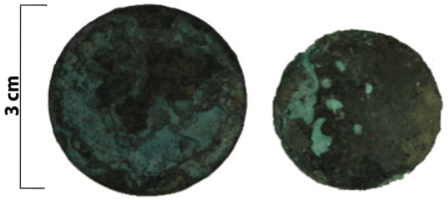
The archaeological excavation of Grubb cottage highlighted two themes: the deposition of the material debris of a century’s worth of occupation by the Grubb family, and changes made to the cottage and surrounding landscape as the Grubb family grew in number and community prominence. However, within these overarching narratives two small artefacts stood out due to their unusual context. During the excavation of new pile holes two timbers were uncovered, one under the other, running north-south along the line of the east elevation of the original cottage. Two coins were found lying on these timbers, later identified as a British bronze halfpence and a bronze penny (Clayton 2013). Unfortunately much of the detail on these coins was corroded but the material, dimensions and remaining detail were enough to date their issue to 1860-1890 and 1874 respectively.

The bronze penny (left) and half-penny (right) recovered from Grubb cottage.

The bronze penny (left) and half-penny (right) recovered from Grubb cottage.

Archaeologists often find coins during excavations and these can be useful for dating the context in which they were found. However, these coins were under the original cottage, which was built in the early 1850s and therefore predated the coins’ issue.  It is here that the physical context in which the coins were found provided a possible explanation for the dating discrepancy. The coins appeared to have been deliberately placed – what if their placement had a ritual purpose, rather than being the result of careless discard? It is likely that the east elevation of the original cottage was the location of the formal entrance until the addition, which included a new front door, was made to the south elevation at an unknown date. The date of the coins precludes any association with the opening of the original cottage entrance, but was it possible that they were used to ceremonially close that entrance before the opening of another? In which case, the coins would date the construction of the southern addition to sometime after 1874.

This possibility is evocative of common ceremonies such as the laying of time capsules, a custom that has been identified at several Christchurch buildings including an early 20th century Masonic lodge. Freemasons held elaborate ceremonies to lay the foundation stones of Masonic buildings, and these almost always included the laying of a time capsule containing a newspaper and coins (Speth 1893). Mention of Freemasonry often conjures notions of conspiracy theories and Dan Brown books, but ‘the brotherhood’ was a real and powerful influence in New Zealand’s male-dominated colonial society. The first lodge in New Zealand opened in Wellington in 1842 and by 1890 New Zealand boasted 151 lodges (Phillips 2012).Members included important society and political leaders, such as Richard Seddon, New Zealand premier and the Most Worshipful Grand Master of the Masonic Lodge of New Zealand.

Now this is where the broader context of the archaeology of Grubb cottage affects the meaning of those two little coins found in the ground – both John Grubb and his son James were Freemasons. Not only were they Freemasons, but they were leaders of the Masonic community in Lyttelton for almost 40 years. Together with several others they succeeded in founding the Canterbury Kilwinning lodge in 1875 (Press 3/12/1875; 21/2/1898). This was the second Masonic lodge in Lyttelton, the first being the Lodge of Unanimity, which was established in 1851 (Cyclopedia 1903c). Three years later John Grubb was elected lodge treasurer while James was elected a senior warden (Press 6/12/1878). The Kilwinning Lodge commissioned the construction of a hall on Canterbury Street, for which James Grubb as Worshipful Master laid the foundation stone in a ceremony in 1881 (Press 30/5/1881). John Grubb remained treasurer of the Kilwinning lodge for 18 years, resigning shortly before his death in 1898 (Press 3/12/1896).

So, if the placement of the coins was related to change in the cottage structure, it is possible that the Grubb cottage coins had a ritual significance that echoed the traditions of Freemasonry. But why were coins and newspapers used in such ceremonies? The reason seems obvious – to provide temporal information concerning the construction of the building for posterity in case of the building’s destruction. However, one would expect that the future destruction of the building was not a desirable result. Could there be an underlying explanation for these ritual actions?

George Speth, a prominent English Mason, related components of Masonic tradition to the folklore of construction. After all, a mason is a builder, and the Freemasons traced their origins to the cathedral builders of medieval Europe, and building tools were treasured symbols of the society (Newton 1921: 97-124). Speth associated common builders’ rites with the ancient belief that in order to ensure the permanence and stability of a structure it must be imbued with a soul (Speth 1893: 3). He suggested that originally this was undertaken by human sacrifice. Legends from around the world connect death to construction and Speth cited instances where human bones have been uncovered in the foundations of ancient buildings (Speth 1893: 4-22). He maintained that over time such sacrifice became symbolic in nature, with the use of animals and animal products, images and effigies. It is this symbolic form of sacrifice that Speth related to the custom of including coins in foundation ceremonies – ”…coins bearing the effigy, impressed upon the noblest of metals, the pure red gold of the one person to whom we are all most loyal, and whom we all most love, our Gracious Queen…” (Speth 1893: 22) – even if the conscious intention of imbuing the structure with a protective spirit had been shed over time.

A stained glass window depicting Saint Columba in Iona Abbey, Scotland.

A stained glass window depicting Saint Columba in Iona Abbey, Scotland. Legend has it that Columba buried alive his companion, Odran, to ensure the lasting stability of his chapel there. Image: Wikipedia 2008.

John Grubb was a builder by trade and a Freemason of high standing in Lyttelton. It is entirely likely that he was aware of the traditions and rites associated with construction. It is even possible that, on the closing of the old entrance to his cottage, he buried two coins to ceremonially mark the occasion. He didn’t necessarily do this while fully conscious of all the connotations of this little ritual. Perhaps it was done out of deference to Masonic practice, or perhaps it was done out of habit – an old superstition he picked up during his time in the building trade in Scotland. Whatever his motivation, this interpretation of past events was only made possible through consideration of two mundane objects within their immediate and broader context.

Rosie Geary Nichol

References

Amodeo, C. and Chapman, R., 2003. The Forgotten Forty-Niners: being an account of the men and women who paved the way in 1849 for the Canterbury pilgrims in 1850. Christchurch: Caxton Press.

Clayton, T., 2013. Coins of England and Great Britain. [online] Available at: http://www.coins-of-the-uk.co.uk/coins.html.

Cyclopedia of New Zealand, 1903a. Professional, Commercial and Industrial: Mr. John Grubb. [online] Available at: http://nzetc.victoria.ac.nz//tm/scholarly/tei-Cyc03Cycl-t1-body1-d3-d60-d2.html.

Cyclopedia of New Zealand, 1903b. Lyttelton: His Worship the Mayor, Mr. James Grubb, J.P. [online] Available at: http://nzetc.victoria.ac.nz//tm/scholarly/tei-Cyc03Cycl-t1-body1-d3-d60-d1.html.

Cyclopedia of New Zealand, 1903c. Orders and Friendly Societies: Masonic: New Zealand Constitution: Unanimity Lodge. [online] Available at: http://nzetc.victoria.ac.nz//tm/scholarly/tei-Cyc03Cycl-t1-body1-d3-d22-d3.html.

Heritage Management Services (HMS), 2008. Grubb Cottage Conservation Report. Unpublished report.

Land Information New Zealand (LINZ), c.1860. Probate Index – 5W237. Archives New Zealand, Christchurch Office.

Newton, J. F., 1921. A Story and Study of Masonry. [online] Available at: http://www.gutenberg.org/files/19049/19049-h/19049-h.htm#CHAPTER_IB.

Philips, J., 2012. ‘Men’s clubs – Masons’. [online] Available at: http://www.TeAra.govt.nz/en/mens-clubs/page-4.

Press. [online] Available at: http://paperspast.natlib.govt.nz.

Speth, G. W., 1893. ‘Builders’ Rites and Ceremonies: Two Lectures on the Folk-Lore of Masonry. Delivered by G. W. Speth to the Members of the Church Institute, Margate, On the 30th October and 13th November, 1893. [online]. Available at: http://www.slv.vic.gov.au/.

The house that Thomas built

I’d like you to meet the Reverend Thomas Richard Fisher, a devout Wesleyan whose ill-health – preacher’s throat, no less – unfortunately prevented him from preaching for some time. He arrived in New Zealand in 1857 and promptly set himself up in business in Christchurch (apparently he arrived with quite a lot of money, and made even more – but don’t say I told you). Since his arrival in Christchurch, he’s devoted himself to worthy activities – a founder of the British and Foreign Bible Society and a minister for the Wesleyan church, and he’s even preached for the Congregationalists and the Presbyterians from time to time. Such a religious chap. It’s 1885 now, and he’s 79 and he’s slowing and settling into his retirement, during which he and his wife Sarah would love to spend as much time as possible with their ever-increasing family of children, grandchildren and great-grandchildren (of whom there will be 36 by 1890; Press 13/1/1890: 5). Such a fortunate man! Colonial life has been so good to him!

Cotswold House, 2012. Photo: M. Hennessey.

Cotswold House, 2012. Photo: M. Hennessey.

Unfortunately, we don’t have a picture of Thomas or Sarah Fisher, but until the earthquakes, we had two buildings that Thomas was intimately associated with, both of which we recorded. Many of you will be familiar with the Fisher building, one of the central city’s most prominent 19th century buildings. But you’re probably less familiar with Cotswold House, the house the Fishers built in Parlane Street (then Clifton Street).

An 1860s advertisement for Fisher's business. Image: Lyttelton Times 22/12/1864: 6.

An 1860s advertisement for Fisher’s business. Image: Lyttelton Times 22/12/1864: 6.

Thomas Fisher set up shop on the corner of High and Hereford streets in c.1860, establishing a grocery shop there. By the late 1870s, Thomas’s son William had joined the business, and they built new premises, designed by no less an architect than William Armson. Clearly, the rumours of wealth were more than just rumours…

The resulting building was a glorious Venetian Gothic number, as suited the prosperous businessman in the years before Commercial Classicism became the style du jour. Built in brick with limestone detailing, it occupied its corner site well. This was a three-storey building, with a stone-lined basement underneath. The numerous limestone carvings drew on nature for inspiration (echoing some of the themes in last week’s post). The underside of the veranda was pressed tin and the veranda brackets were an excellent example of Victorian excess.

The basement found under the Fisher building. Photo: M. Hennessey.

The basement found under the Fisher building. Photo: M. Hennessey.

Rondels on the Fisher building. Photo: K. Watson.

Rondels on the Fisher building. Photo: K. Watson.

Veranda post on the Fisher building. Photo: K. Watson.

Veranda post on the Fisher building. Photo: K. Watson.

A window, Cotswold House. Photo: M. Hennessey.

A window, Cotswold House. Photo: M. Hennessey.

But what about Richard and Sarah Thomas’s house? It was built in 1885, but we don’t know who the architect was (not Armson, as he’d died in 1883). Thomas and Sarah’s new house was a bay villa. Although it looked relatively plain, after studying the building, I am left with the sense that it was richly decorated, but in a calm, restrained way. There was little in the way of Victorian excess here, with the exception of the cast iron fretwork around the veranda. The richness came in the little details: the corbels, the pediments, the angle-stops, the panels under the windows, the porthole-style ventilation holes. Small details, well executed.

It was big. About 16 rooms (although the newspaper advertisements said 11 or 12, but apparently some rooms just don’t count). With seven bedrooms. Why did a retired couple need seven bedrooms? I guess there were all those children, grandchildren and great-grandchildren to come and stay. And there must have been at least one servant, although all the bedrooms were generously sized, and all had fireplaces.

The breakfast room fireplace. Photo: J. Hughes.

The breakfast room fireplace. Photo: J. Hughes.

Most of the original decorative features inside the house were long gone when we recorded it, but some fireplaces remained, as did skirting boards, a ceiling rose and some cornices. The original fireplaces weren’t those from very best rooms, but there was one from the breakfast room and two in the upstairs bedrooms. And the interesting thing about these was that they matched – not just each other, but also the external decoration. Oh, the one from the breakfast room was a bit fancier, but all three were of the same basic design, and they matched the corbels on the exterior. Not immediately obvious, but it’s these small things that matter. We all know that Victorians were fairly over-the-top by our interior decorating standards, and often every fireplace in the house was different. Not in this case. Maybe it was cheaper to buy a bulk lot, but I prefer to think that the Fishers were paying close attention to the decoration of their home, and ensuring a consistency of design throughout.

The first floor, upside down. Photo: M. Hennessey.

The first floor, upside down. The tongue & groove floorboards are at the bottom, with the insulation boards above, running between the joists & supported by fillets. Photo: M. Hennessey.

There’s just one other detail about the house I’d like to draw your attention to: the floor of the upper storey was sound-proofed. Yep, that’s right. We’ve only seen this in two other 19th century buildings in Christchurch, and they were both commercial. Not a common thing to do then. So why did the Fishers go to the trouble of sound-proofing their home? Good question. Maybe it was those hordes of grandchildren and great-grandchildren, creating a ruckus upstairs and disturbing the genteel entertainments of the Reverend and Mrs Fisher.

Two buildings representing the two different faces of the Reverend Thomas Richard Fisher. The central city business, designed to catch the eye and draw the customer in, reflecting the successful businessman. The suburban residence, presenting a restrained, genteel façade, reflecting the refined tastes of the Wesleyan minister and his wife.

(As a side note, it’s interesting to compare Cotswold House to William Bowen’s house, featured a few weeks back.)

Katharine Watson

References

Lyttelton Times. [online] Available at: http://paperspast.natlib.govt.nz/.

Press. [online] Available at: http://paperspast.natlib.govt.nz/.