Peeling back the onion of time

Recording standing structures not only involves architectural drawings and photography, but can also be quite destructive. In an attempt to modernise an old house owners will often cover “old fashioned” features with new materials, plasterboard being the chief culprit. So, during building recording part of our job often involves removing these modern linings (by any means necessary) to reveal the fabrics beneath, going back in time to see what the building was like originally. And, as you can imagine, taking to a wall with a hammer and crowbar is also good for stress relief.

Through extensive use of the notorious hardboard previous owners of this house had gone to great lengths to cover nearly every inch of original decoration inside the house in order to cut down on the weekly chore of dusting.

Through extensive use of the notorious hardboard previous owners of this house had gone to great lengths to cover nearly every inch of original decoration in the house. Every moulded shirting board, architrave and door panel was covered.

Every moulded skirting board, architrave and door panel in the house was covered with hardboard. Photo: K. Webb.

  Hardboard was used on the exterior of the house too. To cover up weatherboards and this decorative cast iron frieze along the top of the veranda.

Hardboard was used on the exterior of the house too. To cover up weatherboards and this decorative cast iron frieze along the top of the veranda. Photo: K. Webb.

Extensive investigation of the kitchen uncovered this finely moulded paper mache dado. This is the only example found so far of this product in Christchurch.

Extensive investigation in the kitchen uncovered this finely moulded paper mache dado. This is the only example of this product found so far in Christchurch. Photo: K. Webb.

Plasterboard and other modern wall linings sometimes have their merits though. They often have the unintended function of doing a really good job of preserving what is beneath it, particularly wallpaper.

wallpaper-layers

Wallpaper is usually found in multiple layers with a backing of scrim. It is sometimes possible to separate the layers right back to the original wallpaper, as long as no one has painted over it of course. Photo: L. Tremlett.

newspaper-wall-lining

We may even get a pleasant surprise when we get to the bottom layer. If there was not much money available for decorating, or for extra draft protection, people would often line their walls with newspaper. Photo: L. Tremlett.

This hand written note was found adhered to the tongue and groove match lining of a cottage in Lyttelton.

This hand written note was found adhered to the tongue and groove match lining of a cottage in Lyttelton. It was well preserved beneath a layer of scrim and plasterboard. It gives details of the sailing of the S. S. Grafton from Hokitika in (we think) 1880. What it was doing stuck in the middle of the front room wall of a cottage is a mystery. Photo: J. Garland

Digging deeper into the fabric of a building one may come across some interesting and sometimes, perhaps, elusive objects inside the walls and under the floors.

This book published by the Scottish Temperance movement in 1877 was found behind the tongue and groove lining in a house in Ashburton.

This book entitled Three Years in a Man-Trap published by the Scottish Temperance League in 1877 was found behind the tongue and groove lining in a house in Ashburton. In this case the books were used as a filler, instead of strips of wood, to even up the gap between the match lining and wall. Photo: J. Garland, H. Williams.

Quite often shoes are found concealed beneath the floors of houses.

Shoes are often found concealed beneath the floors of houses in Christchurch. During the 19th century in Britain and some European countries it was a common custom to conceal shoes within the fabric of the building as magical charms to protect the occupants of the building agains evil influences such as witches and ghosts. We can’t say for sure if this was always the case in Christchurch. Photo: K. Webb

We quite often find other items under the floors of houses, such as animal bones, bottles and other domestic rubbish, as well as the odd mummified cat. These items were most likely not deposited under the house for superstitious reasons, we hope. The cats are later given a proper burial.

This cane riding crop was found beneath the floor of the house of John Cracroft Wilson.

This cane riding crop was found beneath the floor of the house of John Cracroft Wilson. Image: I. Hill.

Beyond the superficial appearance of a structure there is a lot we can learn by quite literally peeling back the layers of a building, or excavating it, if you will. Buildings like these can be more than just houses once lived in. There’s history written in the walls, from the changing tastes in interior decoration to things intentionally hidden, covered up or accidentally lost. Whatever the reasons for these hidden bits and pieces, be they mundane, superstitious or inexplicable, they show us that it’s always worth looking beyond the surface of a building to find the treasures within.

Kirsa Webb

Oh, the irony: a tale of unexpected survival (or how the little things can last the longest)

Over the last few weeks, as archaeologists do, I’ve found myself thinking about the physical legacies people leave behind them. In particular, I’ve been thinking about the contrast between the monumental (buildings, in this case) and the artefactual and how, oddly enough, it is not always the large or the supposedly permanent legacies that survive. We’ve come across this contrast before in Christchurch’s archaeology, in cases like that of J. G. Ruddenklau and the City Hotel or the china from Sydenham House, where the structural legacies are long gone, but the story – the memory – can still be found in the a single fragment or a single object. In small things forgotten, as the saying goes.

This came to mind again recently, thanks to a clay smoking pipe we found in the CBD, incised with the mark of Messrs Twentyman & Cousin, “whole sale and retail ironmongers”. It’s a simple cutty-shaped pipe, with a slightly angled bowl and no heel or spur evident at the base. Were it not for the circular stamp of “TWENTYMAN / COUSIN N.Z” at the back of the bowl, it would be unremarkable. The stamp renders it unusual, by virtue of the fact that it is rare to find clay pipes in New Zealand with the marks of local retailers or manufacturers.

We found another New Zealand branded pipe at this site, this time stamped with the mark of Twentyman & Cousin. Messrs Twentyman & Cousin (wonderful names!) were Christchurch retailers

The Twentyman & Cousin clay smoking pipe found in Christchurch. Interestestingly, the mark is only on one side of the bowl – the one facing the smoker. Image: J. Garland.

We don’t really know why the clay pipe bears the mark of Twentyman & Cousin. The only other examples of similarly branded pipes that I’ve come across were associated with tobacconists and hotels, both of which are more easily related to the practice of tobacco smoking than an ironmonger and agricultural merchant would have been. Was it advertising, perhaps? Maybe the business branched out into a few examples of personalised merchandise? Maybe it was commemorative in some way? Whatever their reason for marking the clay pipe, I suspect it had little to do with preserving a legacy. Yet, in a way, that is what it does now.

Twentyman & Cousin was first established in the late 1860s in Cathedral Square (Lyttelton Times 10/8/1867: 1), by John Holm/e Twentyman and his cousin, Alfred Charles Twentyman (hence the name). Although it is unclear when the latter arrived in the city, we know that Mr J. H. Twentyman arrived in Christchurch in late 1865, along with his family (Star 6/3/1900: 1). By all accounts he was a particularly well-read man (one advertisement details a lecture he gave to the Young Men’s Christian Association on Egypt in the ancient and modern eras) and heavily involved in Christchurch’s church community (Star 17/06/1879:3, 13/08/1879: 3, 16/04/1890:3). Less information is available about Alfred, unfortunately, although we do know that the partnership between the two men was dissolved in 1888 (Press 10/08/1888: 1).

Early advertisements for the business indicate that Twentyman & Cousin imported and sold a range of materials, from woolpacks  to corn sacks and sheep shears (Lyttelton Times 23/12/1868: 1, 10/8/1867:1). In later years, they were known for their ironmongery, particularly their selection of agricultural, pastoral and gardening tools and machinery. One advertisement from 1881 mentions products such as “garden syringes” and the “Ward & Paynes bow pattern solid crucible cast steel sheep shears”, a phrase that I challenge you all to try and say fast five times (Star 9/11/1881: 4). In that following year, numerous advertisements tell of their sale of reapers and binders and their participation in a “trial of reaping and binding” (which, to me, suggests some kind of demonic exorcism as much as it does agricultural work; Wanganui Herald 25/01/1882: 2 ). They didn’t limit themselves to agricultural and pastoral tools, though: other advertisements for the business promote the sale of “an assortment of guns, which for finish and cheapness surpass anything ever brought into the market” (Star 31/05/1883: 1).

An 1881 advertisement for Twentyman & Cousin. Image: Star 25/11/1881: 4

An 1881 advertisement for Twentyman & Cousin, listing all manner of machinery and tools (shovels, rakes and implements of destruction, even). Image: Star 25/11/1881: 4.

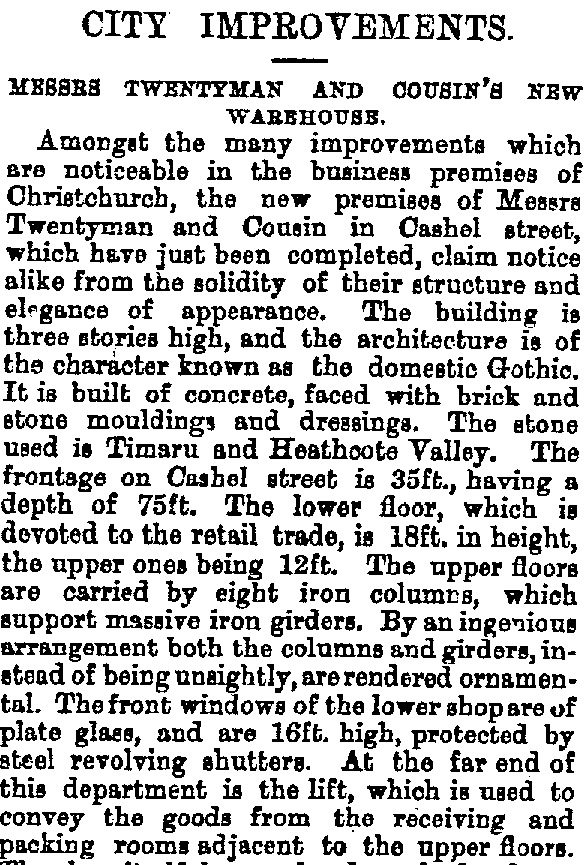
By 1880, the company had moved from Cathedral Square to a new building on Cashel Street west, one designed by renowned Gothic revival architect Benjamin Mountfort. Mountfort is most famous for his involvement in the design of the Canterbury Provincial buildings, which still stand today. The new Twentyman & Cousin building on Cashel street was constructed from concrete, brick and stone, and cost somewhere in the region of four thousand pounds to construct, a hefty sum in those days. Contemporary accounts described it as being in the domestic Gothic style, having “solidity of structure and elegance of appearance” and ornamented “sufficiently so as to relieve it from the sombre and barn like appearance of too many of our other buildings” (Press 10/4/1880: 1, Star 8/04/1880: 4). It was, it seems, the talk of the town.

Extract from an 1880 newspaper article on the new Twentyman & Cousin building in Cashel Street. You can see images of the building here. Image:

Extract from an 1880 newspaper article on the new Twentyman & Cousin building in Cashel Street. You can see images of the building here. Image: Press 10/4/1880: 1.

Although this building is of note for a number of reasons (the architectural design not least among them), I find it particularly interesting to think about it as an example of branding, of legacy, in comparison with the clay pipe. The building was elaborate (ostentatious, even), durable (remember that “solidity of structure”) and, presumably, deliberately built to carry the Twentyman & Cousin name into the future, be it 10 years or 100 years distant. There is an intention of permanence in its construction, in everything from the materials used to the style of the building. The clay pipe, on the other hand, emits no such sense of intentional durability. It’s a disposable item, meant to be used until it no longer works and can be discarded. Yet, it survives (albeit slightly the worse for wear), and the building does not.

The contrast (and irony) in this particular story is not just in the difference between the intended purpose of the pipe and the building, but in the manner of their survival. It’s fair to say, I think, that the clay pipe has survived where the building has not because it was discarded, kept safely in the ground over the decades. This often seems to be the way in archaeology, especially in circumstances like those found in Christchurch: the big things are lost and it is the small, disposable, things – the forgotten things – that slip through and keep the past alive. A legacy is a legacy, after all, even if it is not quite as originally intended.

Jessie Garland

References

Lyttelton Times. [online] Available at www.paperspast.natlib.govt.nz

Press. [online] Available at www.paperspast.natlib.govt.nz

Star. [online] Available at www.paperspast.natlib.govt.nz

Wanganui Herald. [online] Available at www.paperspast.natlib.govt.nz

Three years on…

People often ask what we’re learning as a result of all this post-earthquake archaeology. Quite a lot, as this blog reveals. But, to date, the blog has focused on the individual sites and/or stories – there’s not been much of the big picture stuff. So, as the third anniversary approaches, we thought we’d share some of that higher level stuff with you. These are not well-researched, academic observations. These are our own personal observations about what all this archaeological work is telling us.

Buildings

Old houses fascinate me: there’s that sense of walking into someone else’s life and, as with all archaeology, that sense of mystery and the possibility of discovery. In spite of this, when I started to think about this post, I was surprised to realise that I rarely imagine the lives of those who lived in these houses. It turns out that I’m more of a scientist than I thought: I want to quantify the details of these buildings, and establish chronologies and typologies, and then think about what those patterns mean. I guess that’s what makes me an archaeologist.

A double-pane sash window with no lugs, in a c.1875 house. Image: K. Watson.


A double-pane sash window with no lugs, in a c.1875 house. Image: K. Watson.

Thus far, we’ve learnt little details about houses (there’s been no time yet for any detailed overarching study). The progression from double-pane sash windows without lugs, to the same with lugs and then onto single pane sash windows (and then to casement windows, in the early 20th century). There was a change, too, from bow to box bay windows. And a change from match-lining to lath and plaster, although that may have been a class difference (and in some cases room lining related to room function). Rusticated or ship-lapped weatherboards were big in the 1870s. Rooflines changed in shape and pitch as the villa became the predominant house type. And the villa reached maturity in the 1880s.

 A match-lined room in a c.1875 house. Image: K. Watson.


A match-lined room in a c.1875 house. Image: K. Watson.

I love the variables that tell us about class, status and use of space: the hallway arch that differentiates public and private spaces; the skirting boards that shrink from the front to the rear of the house; the ceiling roses (far fewer around than I expected, although that may be a product of how well they survive); and that the number of windows into your front rooms (two or three) tells me something about the wealth of the builder/occupant, as does the size of the house.

 1870s sash windows used in a late 1880s villa. Image: K. Watson.


1870s sash windows used in a late 1880s villa. Image: K. Watson.

 A c.1875 house with rusticated weatherboards on the street front and plain weatherboards on the side. Image: K. Watson.


A c.1875 house with rusticated weatherboards on the street front and plain weatherboards on the side. Image: K. Watson.

And these details add up to much more. The fact that you used sash windows without lugs in an 1880s villa tells me that you’re using recycled building materials (yes, even then). The fact that you have rusticated weatherboards on the street front of your house but not the sides tells me that you were aware of fashions but couldn’t quite afford to keep up with them. Your skirting boards are the same size throughout your house? Well, clearly you were well-off – or had more money than sense. Likewise if you had quite an odd arrangement going on with your skirting boards and architraves. Or if you built a brick house – although in this case it was equally likely that you were a bricklayer or a brickmaker.

 An arrangement of skirting board and door surrounds only found (thus far) in the 'grander' houses. Image: K. Watson.


An arrangement of skirting board and door surrounds only found (thus far) in the ‘grander’ houses. Image: K. Watson.

So you see, by observing and recording those small details and, yes, by quantifying them, I’m starting to build up a picture of the people who lived in the house. As the book title goes: “in small things forgotten”. And it’s seeing these things in bulk, as it were, that makes a difference. That’s what makes us so lucky to be carrying out archaeology in Christchurch right now: the size of the sample. In the space of three years, we’ve generated the quantities of data that would normally take decades to come by. The next challenge is to do something more with that data.

Artefacts and people

Just a fraction of the material culture excavated from sites in Christchurch over the last three years. So many boxes!


Just a fraction of the material culture excavated from sites in Christchurch over the last three years. So many boxes! Image: J. Garland.

It’s quite difficult to articulate some of the things that we’ve learned from the archaeology of Christchurch over the last three years, largely, I think, because of the sheer scale of material that’s been found. There’s just so much information to be gained from individual objects and individual sites and from those sites and objects as whole assemblages or landscapes.

As an artefact specialist, I have to say that one of the things that has jumped out at me most during my time working here is the diversity of Christchurch’s archaeology and past. It’s not just the variety of artefacts that’s noteworthy – although we are finding a range of artefacts on a scale that’s unusual and exciting – but also the diversity among the people who owned and used them.

A selection of the various artefacts found in Christchurch over the last three years. Top row from left:


A selection of artefacts found in Christchurch over the last three years. Top row from left: trepanned bone toothbrushes, effigy pipe bowl, frozen Charlotte doll, children’s ‘Father Lion’ cup. Middle row from left: toy horse, Pickering’s polish pot, ladies’ fobwatch, ‘Bouquet’ decorated plate. Bottom row from left: bottle (originally found with message inside) with Bass Pale Ale label, Nassau selter water bottle, Codd patent soda water bottle, black beer bottle, torpedo bottle (top), child’s shoe (bottom), clay pipe decorated with lady riding side-saddle (top), 19th century penny (bottom). Image: J. Garland.

As an archaeologist and anthropologist, the variety that exists among people isn’t something that I should be surprised by, but I have been a little, I think, in this context. The ‘English’ origins and culture of Christchurch are so often talked about as one of its defining characteristics as a city, yet we’re finding connections to places all over the world in its archaeological record.

What do you think it says? Photo: J. Garland.

Our message in a bottle, found in a bottle of English beer on a Christchurch site with German and Danish history. Photo: J. Garland.

We’ve found artefacts from  Australia,  England,  Scotland Ireland, Wales, Germany, France, the Netherlands, Denmark, the USACanada  and China on sites throughout the city. Many of these are just as varied in their uses as they are in their origins, from children’s toys to unusual foodsmessages in bottles and barbaric or ill-conceived medical products. We’ve also come across the stories of settlers from as far afield as Palestine  and as close to home as Australia, settlers who came from every echelon of society, with all kinds of social and professional backgrounds. Connections like these – to people, places and materials – remind me that Christchurch wasn’t just a small colonial settlement at the bottom of the world. Instead it was an integrated part of a much broader story of migration, trade, globalisation, and changing ways of living in the English-speaking world during the 19th century. The archaeology of this city has as much to contribute to that story as it draws from it.

However, it’s not just where these people have come from that stands out to me, but also what we’ve learned of their lives here in Christchurch, particularly the way so many of them contributed to building of this city. There’s a real sense of entrepreneurship in much of the archaeology and history of Christchurch, in the stories and products of people like John George Ruddenklau, James and William Jamieson, H. F. Stevens, John Baxter and George Bonnington, James and William Willis , John Grubb, Thomas Raine and all of the city’s soda water manufacturers – even Charles Henry Cox, our resourceful shoe-polish fraudster. So many of these people built and ran successful businesses from the ground up, in a totally new and untested environment and, regardless of whether those businesses were successful or not, it’s this adventurous, entrepreneurial spirit that, I think, plays a large part in the character of Christchurch – both at its origins and now, as the city rebuilds after the earthquakes.

Katharine Watson and Jessie Garland

Tales of a house

So, that message in a bottle? Well, it turns out it wasn’t the only interesting thing about the site it came from. A fellmongery, German Danes, shoes… read on!

First up, the bottle came from under a house built in 1887 (the land transaction records had suggested 1885, when the first mortgage was taken against the land; LINZ 1885). From the outside, this looked like a fairly standard 1880s villa (albeit modified), but inside – and its history – were not quite so standard. The differences inside weren’t that huge, but you have to understand that, in the 1880s and 1890s, there was little deviation from the standard plan for single-storey villas, so even the smallest difference is telling. On the outside, your standard villa might be flat-fronted or have a bay or two, and there might be some variation in the number of windows on the street-facing façade (depending on how much money you wanted to spend). Inside, villas of this type tended to have four rooms in the main body of the house, two on each side of a central hall. And there might have been some additional service rooms to the rear of this.

 The house. The conservatory on the left was originally a veranda. Photo: K. Webb.


The house. The conservatory on the left was originally a veranda. Photo: K. Webb.

As I said, this one wasn’t so very different. Instead of a central hall, it had a sort of T-shaped hall, with six rooms opening off it. Not only was the hall a different shape, but there were more rooms than usual in the main body of the house, although the house was roughly the same footprint as the standard villa (and the house’s layout had barely been modified since it was built). And only one of the front rooms opened off the front hall – normally both did. While this detail seems particularly small, it’s actually more significant than the hall shape/position.

In the standard villa design, the front hall and the two front rooms, both of which opened off it, were the ‘public’ part of the house, where visitors were likely to be entertained. Usually, this part of the house was separated from the ‘private’ part by an arch in the hall, and guests were unlikely to pass from the public area to the private area. One of the front rooms was the parlour or drawing room and the other was the master bedroom, where guests might leave their coats (Stewart 2002). It’s always seemed slightly odd to me that the master bedroom was part of the public area of the house, and clearly it wasn’t in this house. Visitors would only have gone into the parlour, nowhere else.

The house’s history revealed that it was built for Neils Carl Heinrich Püschel (without recourse to a mortgage) and transferred shortly thereafter to Tryphona Püschel, his wife. The Püschels owned the house until 1896, when it appears to have been sold as a mortgagee sale (LINZ 1888).

Püschel. Not a very English name, that. The family was of German origin, although Neils – who was generally known as Carl – was born in Denmark. In fact, three Püschel brothers came to Canterbury, only one of whom was born in Germany. John, the eldest, and Carl established a fellmongery (where sheepskins were prepared) in Rangiora, before setting up a fellmongery in Avonside in the late 1870s. That’s right, Avonside – hard to imagine now! By 1887, however, Carl Püschel was no longer part of the business, which William Püschel continued to run on his own, albeit with funding from John Püschel (Macdonald n.d.: P610, 611;  Watson 2013).

So could the layout of the house be explained as a fusion of New Zealand and German/Danish architecture? We don’t know, but it’s an intriguing possibility.

During our work on the house, we were fortunate enough to meet Jenny, the most recent owner. Jenny’s parents had bought the house in the 1920s, and Jenny had grown up there and lived there until the earthquakes changed everything. Jenny told us some awesome stories about the house, including how, after they’d bought the house, her parents journeyed to Christchurch on the train, complete with Dolly the cow. As a teenager, Jenny and her friends had played tennis on the lawn in front of the house (where Dolly had once grazed), with the aim of catching the eye of the local lads!

Not only did Jenny share her stories with us, she also shared her collection of early 20th century shoes –  her father was a Pannell of the Pannell bootmaking business. And she showed us a catalogue produced by the Pannells in c.1903-1904, containing all sorts of information about the most wonderful  sounding shoes: Goloshed Balmorals, Watertight Bluchers or Lorne Shoes, anyone?

Lace-up lady's ankle boots, with a military stacked heel and machine stitching along the vamp, tip and back quarter of the upper, c.1900-1920. Photo: J. Garland.


Lace-up lady’s ankle boots, with a military stacked heel and machine stitching along the vamp, tip and back quarter of the upper, c.1900-1920. Photo: J. Garland.

And then there’s that message in a bottle. But first, the bottle itself, which a number of you commented on, with a couple of you identifying the label. Jessie’s research indicates that the label represents two different companies: Read Brothers and Bass Brewery. The Read Brothers Bottling Company was founded in 1877 by William Thomas Read and John Walter Read. They were based in London and were among the largest, if not the largest, of the London bottling companies, inventing their own bottling machines as well as buying up and reusing old alcohol bottles from across London. The Bull Dog trademark, along with the ‘Dog’s Head’ brand, was registered by them in 1877 and featured the image of a bull dog in a circle on the label (Hughes 2006).

DSC_0088ed1_web

Read Brothers were closely associated with the Bass Brewery and their products, originally bottling only Bass sparkling champagne, cider and Guinness. By the early 1900s they were the largest exporter of Bass Pale Ale in the world.  Bass Brewery, usually represented by the red triangle seen on the label, was founded in 1777 by William Bass in Burton upon Trent. Their characteristic red triangle has the distinction of being the first trademark registered in the UK, under the Trademark Registration Act of 1875 (Hughes 2006).

DSC_0091ed1_web Advertisements in New Zealand newspapers frequently link the two companies from 1878 until 1886, after which the two are mentioned in separate advertisements for quite a time. Then in 1911, they appear again in the same advertisements. We’re not sure exactly what this means!

 An 1878 advertisement for Bass's Pale Ale, bottled by the Read brothers. Image: New Zealand Herald 13/6/1878: 4.


An 1878 advertisement for Bass’s Pale Ale, bottled by the Read brothers. Image: New Zealand Herald 13/6/1878: 4.

As for the message itself, well, I reckon that one of my colleagues got it right when he suggested it was a prank. Why? Well, there are a few reasons. Firstly, although the names on the message are difficult to make out, we couldn’t find any of the possibilities we tried in Papers Past – or at least, we couldn’t make any that we found work, in terms of time, place and/or occupation. And you’d expect an ‘Hon.’ to turn up the newspapers, even if a humble labourer didn’t. Secondly, the spelling mistakes, including of some quite basic words, such as bottle. Thirdly, since the earthquakes, we’ve seen a number of time capsules reported on. There’s something about time capsules that’s undeniably appealing, perhaps through that sense of a very direct message from the past. So, perhaps some workers on the site thought they’d have a good laugh by aping those time capsules and leaving their own message for the future.

Kirsa Webb, Jessie Garland & Katharine Watson

References

Hughes, D., 2006. “A Bottle of Guinness Please”: The colourful history of Guinness. Phimboy, Berkshire.

LINZ, 1885. Certificate of Title CB105/33. Landonline.

LINZ, 1888. Certificate of Title CB133/286. Landonline.

Macdonald, G. R., n.d. Macdonald dictionary of Canterbury biography. Canterbury Museum.

New Zealand Herald. Available at: http://paperspast.natlib.govt.nz.

Stewart, D., 2002. The New Zealand Villa: Past and present. Penguin, Auckland.

Watson, K., 2013. Avonside wool scour: an archaeological assessment. Unpublished report for CERA.

“the marvellous antiquity…of our beloved ritual” – Past Master G. W. Speth, 1893.

Context is an important concept in archaeology. Everyday artefacts, often mundane and fragmented, can take on a powerful meaning due to an unusual placement or an association with other material of a different type or function. These circumstances will often nudge the archaeologists towards stories about the past that are easily overlooked in favour of the stronger, overarching narrative of a site’s archaeology. The excavation of Grubb cottage in Lyttelton in 2010 provided an opportunity to contemplate the broader meaning of two common artefacts recovered from unusual contexts. This incongruity, combined with a consideration of the broader context of the cottage’s history, informs an interpretation of the cottage’s occupants that extends beyond the daily domestic activities so often reflected in the archaeology of historical residences in New Zealand.

Grubb cottage is one of the oldest standing residential buildings in Christchurch. John Grubb, a ship’s carpenter from Scotland, was stranded in Wellington in 1847 when the ship on which he was employed was condemned due to leaks on a voyage between London and Melbourne (Cyclopedia 1903a). He made his way down to the newly established port of Lyttelton in search of work, and he liked it so much he decided to settle there and bring out his family from Scotland. His wife, Mary, and their three daughters arrived in 1850 on the Charlotte Jane, one of the “first four ships”.

John and Mary Grubb. Image: Cyclopedia 1903a.

John and Mary Grubb. Image: Cyclopedia 1903a.

With them they brought the building tools with which John established a thriving shipwright’s business at the port (Amodeo and Chapman 2003: 88). In 1851 John was the first to purchase a town section in Lyttelton after the balloted sections were allotted. On this section in London Street he built a simple timber cottage. The Grubb family grew as John’s business prospered and John himself became a figure of importance in the local community. He served on the borough council, as did his son James who became the Mayor of Lyttelton in 1902. When John died in 1898 (LINZ c.1860: 5W237), James inherited the cottage, which had been enlarged by a significant addition to the south elevation (Cyclopedia 1903b). The cottage remained in the Grubb family for over a century until it was sold in 1961 (HMS 2008: 8).

James Grubb. Image: Cyclopedia 1903b.

James Grubb. Image: Cyclopedia 1903b.

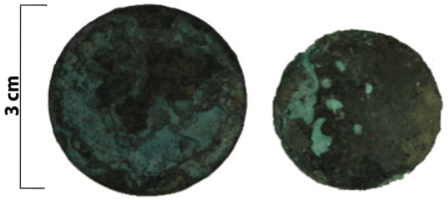
The archaeological excavation of Grubb cottage highlighted two themes: the deposition of the material debris of a century’s worth of occupation by the Grubb family, and changes made to the cottage and surrounding landscape as the Grubb family grew in number and community prominence. However, within these overarching narratives two small artefacts stood out due to their unusual context. During the excavation of new pile holes two timbers were uncovered, one under the other, running north-south along the line of the east elevation of the original cottage. Two coins were found lying on these timbers, later identified as a British bronze halfpence and a bronze penny (Clayton 2013). Unfortunately much of the detail on these coins was corroded but the material, dimensions and remaining detail were enough to date their issue to 1860-1890 and 1874 respectively.

The bronze penny (left) and half-penny (right) recovered from Grubb cottage.

The bronze penny (left) and half-penny (right) recovered from Grubb cottage.

Archaeologists often find coins during excavations and these can be useful for dating the context in which they were found. However, these coins were under the original cottage, which was built in the early 1850s and therefore predated the coins’ issue.  It is here that the physical context in which the coins were found provided a possible explanation for the dating discrepancy. The coins appeared to have been deliberately placed – what if their placement had a ritual purpose, rather than being the result of careless discard? It is likely that the east elevation of the original cottage was the location of the formal entrance until the addition, which included a new front door, was made to the south elevation at an unknown date. The date of the coins precludes any association with the opening of the original cottage entrance, but was it possible that they were used to ceremonially close that entrance before the opening of another? In which case, the coins would date the construction of the southern addition to sometime after 1874.

This possibility is evocative of common ceremonies such as the laying of time capsules, a custom that has been identified at several Christchurch buildings including an early 20th century Masonic lodge. Freemasons held elaborate ceremonies to lay the foundation stones of Masonic buildings, and these almost always included the laying of a time capsule containing a newspaper and coins (Speth 1893). Mention of Freemasonry often conjures notions of conspiracy theories and Dan Brown books, but ‘the brotherhood’ was a real and powerful influence in New Zealand’s male-dominated colonial society. The first lodge in New Zealand opened in Wellington in 1842 and by 1890 New Zealand boasted 151 lodges (Phillips 2012).Members included important society and political leaders, such as Richard Seddon, New Zealand premier and the Most Worshipful Grand Master of the Masonic Lodge of New Zealand.

Now this is where the broader context of the archaeology of Grubb cottage affects the meaning of those two little coins found in the ground – both John Grubb and his son James were Freemasons. Not only were they Freemasons, but they were leaders of the Masonic community in Lyttelton for almost 40 years. Together with several others they succeeded in founding the Canterbury Kilwinning lodge in 1875 (Press 3/12/1875; 21/2/1898). This was the second Masonic lodge in Lyttelton, the first being the Lodge of Unanimity, which was established in 1851 (Cyclopedia 1903c). Three years later John Grubb was elected lodge treasurer while James was elected a senior warden (Press 6/12/1878). The Kilwinning Lodge commissioned the construction of a hall on Canterbury Street, for which James Grubb as Worshipful Master laid the foundation stone in a ceremony in 1881 (Press 30/5/1881). John Grubb remained treasurer of the Kilwinning lodge for 18 years, resigning shortly before his death in 1898 (Press 3/12/1896).

So, if the placement of the coins was related to change in the cottage structure, it is possible that the Grubb cottage coins had a ritual significance that echoed the traditions of Freemasonry. But why were coins and newspapers used in such ceremonies? The reason seems obvious – to provide temporal information concerning the construction of the building for posterity in case of the building’s destruction. However, one would expect that the future destruction of the building was not a desirable result. Could there be an underlying explanation for these ritual actions?

George Speth, a prominent English Mason, related components of Masonic tradition to the folklore of construction. After all, a mason is a builder, and the Freemasons traced their origins to the cathedral builders of medieval Europe, and building tools were treasured symbols of the society (Newton 1921: 97-124). Speth associated common builders’ rites with the ancient belief that in order to ensure the permanence and stability of a structure it must be imbued with a soul (Speth 1893: 3). He suggested that originally this was undertaken by human sacrifice. Legends from around the world connect death to construction and Speth cited instances where human bones have been uncovered in the foundations of ancient buildings (Speth 1893: 4-22). He maintained that over time such sacrifice became symbolic in nature, with the use of animals and animal products, images and effigies. It is this symbolic form of sacrifice that Speth related to the custom of including coins in foundation ceremonies – ”…coins bearing the effigy, impressed upon the noblest of metals, the pure red gold of the one person to whom we are all most loyal, and whom we all most love, our Gracious Queen…” (Speth 1893: 22) – even if the conscious intention of imbuing the structure with a protective spirit had been shed over time.

A stained glass window depicting Saint Columba in Iona Abbey, Scotland.

A stained glass window depicting Saint Columba in Iona Abbey, Scotland. Legend has it that Columba buried alive his companion, Odran, to ensure the lasting stability of his chapel there. Image: Wikipedia 2008.

John Grubb was a builder by trade and a Freemason of high standing in Lyttelton. It is entirely likely that he was aware of the traditions and rites associated with construction. It is even possible that, on the closing of the old entrance to his cottage, he buried two coins to ceremonially mark the occasion. He didn’t necessarily do this while fully conscious of all the connotations of this little ritual. Perhaps it was done out of deference to Masonic practice, or perhaps it was done out of habit – an old superstition he picked up during his time in the building trade in Scotland. Whatever his motivation, this interpretation of past events was only made possible through consideration of two mundane objects within their immediate and broader context.

Rosie Geary Nichol

References

Amodeo, C. and Chapman, R., 2003. The Forgotten Forty-Niners: being an account of the men and women who paved the way in 1849 for the Canterbury pilgrims in 1850. Christchurch: Caxton Press.

Clayton, T., 2013. Coins of England and Great Britain. [online] Available at: http://www.coins-of-the-uk.co.uk/coins.html.

Cyclopedia of New Zealand, 1903a. Professional, Commercial and Industrial: Mr. John Grubb. [online] Available at: http://nzetc.victoria.ac.nz//tm/scholarly/tei-Cyc03Cycl-t1-body1-d3-d60-d2.html.

Cyclopedia of New Zealand, 1903b. Lyttelton: His Worship the Mayor, Mr. James Grubb, J.P. [online] Available at: http://nzetc.victoria.ac.nz//tm/scholarly/tei-Cyc03Cycl-t1-body1-d3-d60-d1.html.

Cyclopedia of New Zealand, 1903c. Orders and Friendly Societies: Masonic: New Zealand Constitution: Unanimity Lodge. [online] Available at: http://nzetc.victoria.ac.nz//tm/scholarly/tei-Cyc03Cycl-t1-body1-d3-d22-d3.html.

Heritage Management Services (HMS), 2008. Grubb Cottage Conservation Report. Unpublished report.

Land Information New Zealand (LINZ), c.1860. Probate Index – 5W237. Archives New Zealand, Christchurch Office.

Newton, J. F., 1921. A Story and Study of Masonry. [online] Available at: http://www.gutenberg.org/files/19049/19049-h/19049-h.htm#CHAPTER_IB.

Philips, J., 2012. ‘Men’s clubs – Masons’. [online] Available at: http://www.TeAra.govt.nz/en/mens-clubs/page-4.

Press. [online] Available at: http://paperspast.natlib.govt.nz.

Speth, G. W., 1893. ‘Builders’ Rites and Ceremonies: Two Lectures on the Folk-Lore of Masonry. Delivered by G. W. Speth to the Members of the Church Institute, Margate, On the 30th October and 13th November, 1893. [online]. Available at: http://www.slv.vic.gov.au/.