Theo Schoon- the matter of interpretation

Oh hi – if you are an avid reader of our blog a couple (ok a few) years ago one of our historians (me) went rogue writing about the artistic life of Tony Fomison – who was known as an archaeologist amongst the said historian’s archaeology peers. Amongst the tangent of found art and ramblings of an avid fan, mention was made of a very polarizing individual, Theo Schoon, who crossed paths and opinions with Fomison and pretty much everyone else. Such was the topic of Schoon that it was worthy of its own blog post, and a promise was wildly made to said colleagues. Well folks, here is the promise fulfilled; another art/archaeology crossover special – this time a controversial tale of a colonial childhood, a misaligned love of art form that resulted in cultural appropriation, and a white saviour mentality only to be topped off by a perceived bitter rejection. I know it sounds grim, but read on, these topics are relevant in our current climate and form a delicate balancing act, reflecting on our past to improve our future. For this blog post, we will be focusing on the archaeology lens of Schoon the polymath.

But before we ‘dig’ into the archaeology, here is a quick summary of the life and times of Theodorus Johannes Schoon (1915-1985) #youalwaysneedcontext. Schoon was of Dutch heritage and was born in Kebumen, Java, Dutch East Indies (which would become known as Indonesia). Schoon grew up as the child of a Dutch civil servant and, as a result, was educated alongside the children of Javanese nobility. It was within this environment that Schoon learnt classical Javanese dance. The Javanese way of life would permeate into many aspects of Schoon’s life as an adult. Schoon’s education continued in the Netherlands where he attended the Rotterdam Academy of Fine Arts during the 1930s (Skinner, 2000). Schoon returned to Java in 1936, establishing a studio creating photographic folios of the local environment, people and their lifestyles. In 1939 Schoon’s family immigrated to New Zealand, and Theo, aged 23, followed his family to New Zealand where they settled in Christchurch. Schoon ensconced himself into the New Zealand art world, briefly attending Canterbury University College School of Art, before a move to Wellington in 1941. If you imagine the art world that Schoon entered, you would have seen Schoon rubbing shoulders with the likes of Rita Angus, what we know as ‘The Group’ or ‘Bloomsbury South’, Gordon Walters, and Dennis Knight Turner (Skinner, 2000).

Portrait of Theo Schoon posed and wearing a Balinese costume. Image: Spencer Digby Studios, 1943.

The year 1946 brings us to our lens, a time and place of discovery for Schoon, and it is here where Schoon’s upbringing within the Javanese culture (albeit with a colonial perspective) and art education would colour his approach to and interpretation of his exposure to Māori rock shelter drawings. The Māori rock art would leave a permanent impression on Schoon, who recognised the significance of the work much earlier than many Pākehā, and for that we should acknowledge Schoon, but that of course comes with a caveat.

Cue Damien Skinner, biographer of Schoon. It is a role that Skinner is especially well equipped for; as a researcher and writer Skinner is acutely aware of the responsibility of reformatting Pākehā thinking. To quote: “I would call it decolonisation. Schoon is my problem” (Lopesi, 2019).

In Skinner’s biography, Schoon’s first encounter with Māori rock shelter art was reading an article in the Journal of Polynesian Society by historian G. B. Stevenson from 1943, which noted rock drawings observed in the Waitaki Valley, Te Waipounamu (Skinner, 2018: 94). To preface this interest, you must note Schoon’s art education in Europe, which had included the African and Pacific art that inspired the development of art movements such as Cubism. Schoon, cognisant of this link, also knew that Māori rock drawings were somewhat underrepresented (at the time) in anthropology and archaeology. New Zealand artists were preoccupied with establishing a New Zealand style of art based on regionalism and a sense of local identity that still had roots in Europe’s art movements (Ministry for Culture and Heritage, 2012).

Schoon travelled to South Canterbury to see the drawings for himself. As luck would have it, earlier in 1945 Roger Duff, the ethnologist at Canterbury Museum, had very recently surveyed the rock drawings in the area and concluded that the drawings he had observed required accurate protection and recording in the form of site photos, drawings, and tracings (Skinner, 2018: 94-98). Enter the ubiquitous Theo Schoon with his uncanny knack (here I quote Anthony Bryt from 2019, call him a ‘Zelig’ if you like) to suddenly appear at the scene of an opportunity (Byrt, 2019).  As a result, Schoon was employed on a project where he travelled to Gordon’s Valley, South Canterbury, with Duff and recorded the drawings. The resulting copies were in oil on canvas boards. Duff was impressed with the faithfulness and accuracy of the works. This initial work acted as a segue to recording rock art in the South Canterbury region. Funding for eight weeks was provided by the Department of Internal Affairs and was endorsed by no other than William Vance, the local department officer and author of High Endeavour (ok I sense another blog post), and the works were to be supervised by the Canterbury Museum.

What could go wrong? Māori rock art around Aotearoa was being accurately recorded and catalogued, and the project was fine until some of the rock drawings got “schooned”… WTF? Schooned (McCulloch, 1985)? Yeah, that was me too… read on dear reader for the term “schooned” exists within a context… although I could coin the phrase “schooned” for use in many a situation. So, to provide you with the said “context” I will cast you back to Duff from the Canterbury Museum mentioning in his initial survey that the drawings required protection measures…

Imagine heraldic triumphant noises and in rides from stage left, Theo Schoon and his trusty box of crayons, ooh and some red raddle, why not…to retouch the rock drawings complete with a flourish of his signature… you may now facepalm. It is here that we can concede that the state of the drawings was subject to agricultural and environmental conditions (Skinner, 2018: 130). You could argue that retouching the work was an act of ‘preservation’, not unlike the processes in place by museums and art galleries maintaining the condition of their artefacts. The difference was a lone restorer (yes, I know you are thinking of the Ecce Homo fresco), not aware of his material impacts on the original drawing, and not to mention the most important factor, lack of consultation with local iwi and professionals. By 1946, Duff was overseeing Schoon’s work in South Canterbury and Duff’s field books record accounts of Schoon’s retouching. This was referred to in Fomison’s report to the New Zealand Archaeological Association regarding the topic of ‘Theo Schoon and the Retouching of Rock Art’ (Fomison, 1987). To be honest, the retouching was something that Duff also struggled with if his field books are anything to go by. In October 1946 Duff notes that in a ‘judicious restoration’ Schoon had brought to light a ‘previously scarcely recognisable figure’ of Gould’s Taniwha cave. By March 1947, Duff had not been in the field with Schoon for four months, and his take on Schoon’s flagrant ‘schooning’ had time for reflection. Fomision’s report recounts Duff asking Schoon not to restore any figures in the future. Fomison went on to say that the retouching of the work in ‘grease crayon’ had so far proved ‘irremovable’. The crayons used were black and a red raddle (for marking sheep) – despite the fact the rock art varied from a ‘near-purple’ through to the ochre ‘yellow-orange’ (Fomison, 1987; Skinner, 2018: 102). Schoon also did not attempt to cover mark for mark (well here you could argue ICOMOS principles that you can delineate between the original work and the assumed restoration…? No, Nah, didn’t think so). Fomison’s report recounted that the retouching work was done prior to the photography that was also used to record the drawings (Fomison, 1987).

“Birdmen,” a recreation of Maori rock drawings in Frenchman’s Gully, Pareora, by Theo Schoon, at the Robert McDougall Art Gallery. Image: Press, 25/9/1985: 26.

It’s very conflicting stuff, right? Probably why it’s taken so long to write this blog (and my tendency to overthink things). Fomison’s report culminated in a description of a recorded interview of Schoon before he returned to Sydney for his final year . Fomison quipped:

‘In a matter of days, film footage and sound tapes had been used up; and Theo had picked enough fights to confirm his decision to return to Sydney, which he did.’

Schoon’s approach to recording and restoration was forthright, much like his approach to life in general. Schoon, I guess, held at one point a great certainty in himself and not much self-awareness, which I think enabled a type of clarity in his observations, especially that of Māori archaeology and art and its much-needed inclusion in the New Zealand narrative.’ (Skinner, 2018: 297).

By the 1960s, Fomison had become part of the emergence of recorded archaeology in New Zealand, surpassing Schoon’s efforts on a far more scientific level, with one very pointed observation that most of the Māori rock art was found not in caves but in undercuts/ledges in the bases of limestone bluffs (Skinner, 2018: 297). Schoon was given the chance to respond to Fomison’s findings and opinions on his preservation work, which was published in the New Zealand Archaeological Association Newsletter (it was edited as I guess you could imagine). Schoon acknowledged that the retouching was undesirable, but wetting the works did nothing to bring out the deteriorated drawings for the photography. Thus, Schoon stated that he resorted to retouching. Schoon was taking on a task that no one else was prepared to do, and he was willing to stand accused of vandalism if it meant some sort of record was preserved… #rescuearchaeology anyone (Skinner, 2018: 300)? It’s here I defer to one of my colleagues, the superstar archaeologist and inadvertent ‘found art’ artist T. Wadsworth, to explain that Schoon’s vandalism was also scientific:

“So we now have methods of analysing pigments and dating rock art based on charcoal content, but a recent study (O’Regan et al. 2019. Dating South Island Māori rock art: Pigment and pitfalls) found that Schoon’s retouching has resulted in false results and compromised such analysis. We also have new digital technology and better methods to record and identify faded rock art, which has also been complicated by Schoon’s retouching (pers comm. Wadsworth, 2023).”

Wadsworth’s morning teas have been exclusively photographed by A.E. Gibson as found art and have featured for the past three years on Instagram. Image: Gibson, 2021.

I guess the report and his rebuttal cemented Schoon’s malaise (well bitterness as the story goes) of New Zealand entirely, one of the final nails if you will (Skinner, 2018: 297). This negative perception of New Zealand blindsided his insight into Māori art. Schoon thought it should be preserved in time, and as such, his aggrieved conclusion of New Zealand did not account (or did he just not live long enough?) for Māori art to evolve into the current narrative, now firmly translated into New Zealand modernism. Sydney, Australia, was his next and final stop with his 34 boxes of possessions (Skinner, 2018: 300). It has to be noted that while Fomison’s account of Schoon’s interview in his report was articulate and focused on Schoon there was a typical artistic melee around the production of the audio and film. An ad hoc team assembled for the event at Fomison’s house, as Schoon’s accommodation was too small, but still, it was not a comfortable environment for the now-infirmed Schoon. In attendance were art historian Michael Dunn, John Edgar (stone carver) and David Simmons (anthropologist), all friends of Schoon and who managed to steer the conversation to bring out an informed and approachable flow. By Skinner’s account, this was interjected by a drunk foetal positioned Fomison and fellow (likely intoxicated) artist Allen Maddox playing stuck riffs of Jimi Hendrix records (Skinner, 2018: 300).

In Anthony Byrt’s review “Book of the Week: That total asshole Theo Schoon” of Skinner’s book as ‘a tortured biography’, Bryt’s opinion of Schoon is described as being ‘hinged on whether he’s master or mulch’ (Bryt, 2019).  I mentioned this in my last blog post in a more measured account… In Skinner’s biography, Schoon’s achievements in championing others are highlighted as are his drawing attention to traditional Māori art forms (rock drawing and gourd carving) for a ‘new New Zealand art’. Byrt sees Skinner’s struggle to navigate all the positives that Schoon’s perceptive eye was capable of uncovering only for Schoon to obfuscate it all with his infuriating personality. Ok yes, as Bryt says, he could be a right dick sometimes. Can I say that? Too late.

All this confusion around Schoon, and his misaligned, but nonetheless important contribution to archaeology, does raise questions about our own approach. Schoon is the unravelling thread. We too will no doubt in the future will be called to account around best practices in archaeology. It is that evaluation of our past to improve our future. It is part of being a historian, to be the recall in the current realm – reminding us we need balanced research so that we don’t repeat ourselves but also admit to our own ‘schooning’. Simply put, try not to make dick moves; you’ve got the benefit of hindsight.

The Artistic Historian

References

Byrt, Anthony, 2019. Book of the Week: That total asshole Theo Schoon. The Spinoff [online] Available at: <https://thespinoff.co.nz/books/28-02-2019/book-of-the-week-that-total-asshole-theo-schoon> Accessed June 2023.

Fomison, Tony, 1987. Theo Schoon and the retouching of rock art. Archaeology in New Zealand 30: 158-160. [online] Available at:  https://nzarchaeology.org/download/theo-schoon-and-the-retouching-of-rock-art. Accessed February 2023.

ICOMOS New Zealand Te Mana o Nga Pouwhenua o Te Ao, 2010. The ICOMOS New Zealand Charter, Te Pumanawa o ICOMOS o Aotearoa Hei Tiaki I Nga Taonga Whenua Heke Iho o Nehe. [online] <https://icomos.org.nz/charters/> Accessed June 2023.

Jones, Sam, 2018. How ‘Monkey Christ’ brought new life to a quiet Spanish town. The Guardian [online] Available at: <https://www.theguardian.com/world/2018/dec/28/how-monkey-christ-brought-new-life-to-a-quiet-spanish-town> Accessed June 2023.

Lopesi, Lana, 2019. The debate over Theo Schoon, who built his career on the backs of Māori artists. The Spinoff [online] Available at: <https://thespinoff.co.nz/art/08-08-2019/the-debate-over-theo-schoon-who-built-his-career-on-the-backs-of-maori-artists> Accessed June 2023.

McCulloch, Beverley, 1985. Maori Rock Drawings: A Matter of Interpretation. Robert McDougall Art Gallery and Canterbury Museum. [online] Available at: < https://christchurchartgallery.org.nz/media/uploads/2010_08/TheoSchoon.pdf> Accessed June 2023.

Ministry of Culture and Heritage, 2012. A new New Zealand art. [online] Available at: <https://nzhistory.govt.nz/culture/nz-painting-history/a-new-new-zealand-art> Accessed February 2023.

Press, 1861-1979. [online] Available at: <https://paperspast.natlib.govt.nz/> Accessed June 2023.

Skinner, Damian, 2000. ‘Schoon, Theodorus Johannes’, Dictionary of New Zealand Biography, first published in 2000. Te Ara – the Encyclopedia of New Zealand. [online] Available at:  <https://teara.govt.nz/en/biographies/5s4/schoon-theodorus-johannes> Accessed February 2023.

Skinner, Damian, 2018. Theo Schoon. A Biography. Auckland: Massey University Press.

Spencer Digby Studios, 1943. Portrait of Theo Schoon posed and wearing a Balinese costume. [online] Available at:  Te Papa Collections Online < https://digitalnz.org/records/176921/tn-theo-schoon> Accessed June 2023.


Where did that wood come from?

Archaeology is a broad discipline, with a multitude of subsects and specialisations. One of these is buildings archaeology, where we use archaeological methods to record and analyse buildings and see what that can tell us about the people that constructed them. We’ve written various blogs before about some of the different houses that we’ve recorded, and while this blog is also within the realm of buildings archaeology, it’s also quite different to those other blogs. Part of our work as archaeologists is to place things within the historical context of the period that they date to. If we were excavating a Roman villa and we found glass windowpanes, then we’d be interpreting that villa as probably belonging to a pretty wealthy individual. However, when we find window glass in Christchurch, that doesn’t really tell us anything about the status of the person that built that house, as window glass was readily available and used in the majority of buildings. We’re really lucky as historical archaeologists that there are large historical datasets that we can use to help us with determining the context of the period that our sites date to. However, there’s hours and hours of research that goes into building a database from raw historical data, and even more hours spent looking at patterns and trends to help us establish that historical context.

Returning to buildings archaeology, one of the key elements that we look at when we record a building is what it was made from. Here in Christchurch, that’s almost always timber. From our recording, we know what types of timbers were typically used here in Christchurch for houses, but that’s only half the story. By doing detailed historical research on the timber industry, we can find out if there were patterns in what species were available for purchase and then use that historical information to provide more context to what we find in the archaeological record. It all sounds so simple, but let me tell you it’s not. I’ve spent countless hours doing research into the Christchurch timber industry, and I’ve only gotten through the first 20 years. That period is going to be the focus of this blog.

That sure is some nice timber, I wonder where it came from?

Prior to 1850, the year that the city of Christchurch was founded, the Canterbury Plains were largely devoid of forests. Although opinion is divided on the exact extent of forested area in Canterbury at the time of Pākehā settlement, Roche (1990) estimates that the combined forest area in the Canterbury settlement added up to only 240,000 acres, or 12 % of the total land area (Roche 1990: 75). Near Christchurch there was a small forest of 54 acres where Christchurch’s most notable pioneers, the Deans brothers, established their Riccarton farm in 1843 (Orwin 2015: 25-26). The largest areas of forest were located some distance away. These included the native podocarp forest of Banks Peninsula, comprised mainly of matai (then known as black pine), kahikatea (white pine) and totara (for some reason just known as totara); and the mixed podocarp and beech forest at Harewood Forest, with kahikatea, rimu (red pine), matai and totara, with silver and black beech (they called it birch back then and were big time into their colour naming system; Roche 1990a).

Map of bush cover in Canterbury collated and reconstructed from 1850s and 1860s surveyor’s notebooks and maps by W. B. Johnson and redrawn for Pawson and Holland (2005: 171).

An 1851 sketch of the upper reaches of the Waimakariri River showing Harewood Forest, one of the largest areas of bush close to the city of Christchurch. Image: Fox, W. and Allom, T., 1850-1851.

Suitable building timber was not readily available in Christchurch and so Canterbury’s pioneer settlers built their houses from materials that they either brought with them from elsewhere, such as canvas, calico and sheets of iron to form tents and rudimentary temporary dwellings, or resources that might have been available on or near their chosen sections. These included volcanic stone, rammed earth, sod or mud brick for the walls and thatched or slab roofs made from raupo, toetoe, tussock, or bark (Bowman 1941, Isaacs 2015, Salmond 1986). In areas where timber was more plentiful wooden slabs or logs were used to build basic wooden structures, but even then, some timber had to be imported because of the difficulty in getting the logs milled once they were cut down.

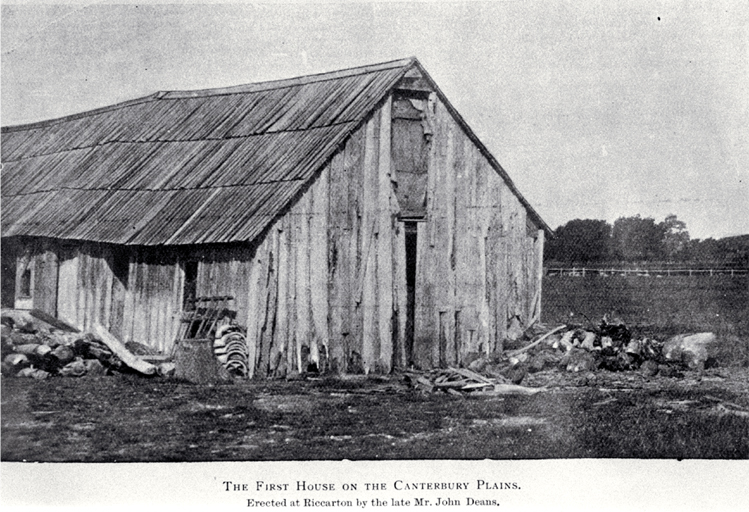
Although it was located right beside one of the largest stands of forest near Christchurch, Deans Bush, the first house on the Canterbury Plains built by the eponymous Deans brothers was constructed from framing timber that they brought with them from Wellington (Bowman 1941).

Photograph of the first house built by the Deans brothers near Riccarton Bush in 1843. The house was built with timber brought from Wellington but was dismantled in the late 1890s. Image: Canterbury Times, 1900.

With the founding of Christchurch city and the rapid expansion of its Pākehā population, an increasing number of settlers had to obtain the materials they needed to construct their permanent residences, fuel their fires, and fence their farms. Although Canterbury was comparatively bereft of a sustainable supply of timber, wood was still the dominant building material for houses in Canterbury in the nineteenth century (Government Statistician, Registrar-General’s Office 1874). This all led to the establishment of a burgeoning timber importation trade (Roche 1990).

Banks Peninsula was the largest and most easily accessible source of timber close to Christchurch, meaning this region was one of the major suppliers of building timber and firewood to the colony. If you want to read more about sawmilling on the peninsula and what happened after the timber arrived in Christchurch, I highly recommend that you read Lydia’s excellent post on the topic from earlier in the year. The timber supply from Banks Peninsula was, however, short lived and the capacity to saw and ship it was limited, so in this post we’re going to explore exactly where Christchurch got all its wood from.

By combining the magic of PapersPast and the dark arts of Excel, I tracked the ups and downs of the Canterbury’s timber economy over the first few decades of Pākehā settlement in Christchurch to figure out where the town was getting its timber from and how this changed over time.

January 11, 1851, was the first issue of the Lyttelton Times to be published and the first issue to include a list of vessels that had arrived in Lyttelton Port since the previous December, including the first four ships carrying the pioneer settlers and all of their possessions to Lyttelton (Lyttelton Times 11/1/1851: 5). Included was a schedule of the cargo each vessel carried, with the schooner, Phoebe, the first reported timber carrying vessel arriving from Wellington carrying a load of timber. For the first few years of settlement Wellington was to be the predominant supplier of Canterbury’s timber.

Not the Phoebe. Also not Lyttelton, but this is probably what it looked like when the first load of timber arrived in Lyttelton. Image: Frederick Nelson Jones.

Although several gangs of pit sawyers had established themselves in many of the bays of Banks Peninsula by this time, their contributions to the overall timber supply in the first years of settlement were negligible in comparison to other regions. Timber imports soon picked up though, as did the quantity of timber arriving in the city from Banks Peninsula. By the mid to late 1850s, imports from Tasmania were contributing a significant quantity of timber to the market, and from the early 1860s vessels from North America and the Baltic region were bringing large cargoes of Northern Hemisphere timber, such as Baltic pine, Douglas fir and cedar.

Within the first ten years of the arrival of the settlers, timber imports had increased considerably. This coincided with an increase in the population of Canterbury, as well as the number of wooden dwellings that were being built. This was a pattern observed across the study period, although population tended to increase in a more or less linear fashion, while timber imports fluctuated more but trended upwards almost exponentially overall.

A steep decline in the quantity of timber being imported to Christchurch and Lyttelton occurred in the late 1860s. There were several factors that probably contributed this. The population had continued to grow, and wooden dwellings were also being constructed at an increasing rate, so it was not likely a lack in demand for house building materials. The market commentary in the newspapers around this time suggests that the timber supplies were overstocked, likely due to huge shipments arriving from overseas and the from the Nelson and Marlborough region. On several occasions in 1866 newspaper correspondents reported that the timber market was depressed, Sales were low and likewise timber prices had tanked (Lyttelton Times 7/7/1866: 2, 2/11/1867: 2). This glut in the market likely caused timber merchants to refrain from importing new stocks until the oversupply had diminished and prices had increased. Due to the time lag between orders and shipment this reduction in imports was not fully realised until 1867-1868.

Customhouse Street wharf area, Wellington, circa 1868, with the harbour and Queens wharf in the background. The sailmaking premises of John S Burn, a boat under construction, and a timber yard, are visible.  Couchman, (Mrs), active 1967. Customhouse Street wharf area, Wellington. Ref: 1/2-029401-F. Alexander Turnbull Library, Wellington, New Zealand. /records/22751906

A notable shift in the regions supplying timber occurred after 1864. Shipments from the Wellington and Auckland/Northland regions declined towards the late 1860s, but were replaced with considerable supplies from the upper South Island. Imports from the West Coast were non-existent until around 1867, which coincided with the end of the gold rush in this region. The milling industry in Westland was initially established in order to supply the requirements of gold miners, but, after the rush was over, had expanded significantly. By the 1870s the West Coast milling industry was supplying sawn timber to other regions, including Canterbury, as well as a thriving trans-Tasman export trade (Roche 1990a: 179).

While mainland Australia was a consistent, albeit minor, contributor to timber imports over the study period, Tasmania remained an important supplier to the Canterbury timber economy, from the first cargoes that arrived with the pioneer settlers in 1850, up until at least the early 1870s. It is likely that most, if not all of the timber that was imported from Tasmania at this time was harvested by convict labour. From 1804 convicted felons were transported to Van Diemen’s Land, as it was then known, and forced undertake hard labour while also forming a founding population for the new British colonies. Convict labour was employed in the harvesting of timber, a task that served both as punishment and progressed the economic ambitions of the colony by generating an exportable commodity, which found a ready market in Christchurch (Tuffin and Gibbs 2020; Tuffin et al 2020).

The original human centipede? Convicts hauling a log at Port Arthur c.1836. Image: State Library of Victoria: ML 185. 

The predominant target species were varieties of Eucalyptus, mainly stringy bark and blue gum. Stringy bark was favoured for construction and blue gum was used as a general-purpose timber and for ship building (King 2019; Tuffin et al 2020). The Tasman Peninsula remained a timber production centre until the closure of the Port Arthur penal settlement and prison in 1877. Although Tasmanian timber was available on the Christchurch market, imports from there declined towards the 1870s, possibly as a result of the decline in the use of convict labour.

The number of inward arrivals and quantity of timber being imported dramatically increased again towards the mid-1870s when large quantities of timber began arriving from Auckland. Commonly known as ‘The Vogel Era’, the 1870s was a boom time for the New Zealand economy, stimulated by the flow of money from the gold rushes of the previous decade and the success of the wool export market, and accelerated by a public borrowing programme instituted by Julius Vogel (McLintock 1966). Vogel instigated heavy public investment in infrastructure, such as a roads and railways, which saw a corresponding expansion in timber milling, including the revival of milling at Harewood Forest (Roche 1990a). This increase in arrivals to Christchurch is, therefore, predictable, as millers geared up to supply timber for railways and ports.

Over the course of the entire study period Banks Peninsula supplied the greatest quantity and the highest proportion of timber in total, though this supply began to decline towards the end of the study period. Roche (1990a: 79) notes that the number of sawmills in operation on Banks Peninsula had dropped from at least ten in the late 1850s to just four by 1876; although those that remained were by all accounts “doing a brisk trade”. Milling on the Peninsula had all but ceased by the 1880s, and although the study period doesn’t cover these later years, the data for 1875 seems to reflect the decline of the milling industry on Banks Peninsula with a diminishing contribution to the Christchurch timber market.

Unfortunately, I wasn’t able to continue the shipping research beyond the latter 1870s. Scrolling through PapersPast collecting this data takes an extraordinary amount of time, but I really want to know what happened to the Canterbury timber economy in final decades of the nineteenth century, through the decline in milling on Banks Peninsula (and the regions that replaced this supply), the 1880s depressions era and the subsequent economic recovery. I probably wouldn’t get your hopes up, but one day I might write a sequel to this story.

Kirsa Webb

References

Bowman, A., 1941. The study of the historical development of domestic architecture in Canterbury, New Zealand. Thesis submitted for membership of the Royal Institute of British Architects.

Government Statistician, Registrar-General’s Office, 1874. Results of a Census of the Colony of New Zealand taken for the night of the 1st March 1874. Wellington, NZ: Government Printer.

Isaacs, N.P., 2015. Making the New Zealand House 1792-1982. Thesis submitted for the degree of Doctor of Philosophy. Victoria University of Wellington, Wellington, New Zealand.

King, S., 2019. The Architecture of Van Diemen’s Land Timber. Fabrications, 29(3): 338-358.

Lyttelton Times 1851-1920. Newspaper [online]. Retrieved from https://paperspast.natlib.govt.nz/newspapers/lyttelton-times. Accessed: April 2022.

McLintock, A. H. (ed.), 1966. “The Vogel Era: economic history”. An Encyclopaedia of New Zealand [online].Retrieved from: http://www.teara.govt.nz/en/1966/history-economic/page-3. Accessed: July 2022.

Orwin, 2015. Riccarton and the Deans Family – History and Heritage. Auckland: David Bateman Ltd.

Pawson, E. & Holland, P., 2005. Lowland Canterbury landscapes in the making. New Zealand Geographer, 61:167-175.

Roche, M., 1990. History of New Zealand Forestry. Wellington: New Zealand Forestry Corporation.

Salmond, J., 1986. Old New Zealand Houses 1800 – 1940. Auckland: Heinemann Reed.

Tuffin, R. and Gibbs, M., 2020. The Archaeology of the Convict Probation System: The Labor Landscapes of Port Arthur and the Cascades Probation Station, 1839–55. International Journal of Historical Archaeology, 24: 589–617.

Tuffin, R., Gibbs, M., Clark, D., Clark, M. and Rigozzi, P., 2020. ‘…One of the Most Severe Duties …’: Landscapes of Timber-getting at a Former Tasmanian Convict Station. Industrial Archaeology Review 42(2): 126-140.

Bits and Pieces

Today’s blog post is a collection of bits and pieces that we have catalogued recently and thought were particularly interesting or unusual. Enjoy!

Clara

While many of the patterns that decorated ceramic vessels in the mid-19th century were formulaic in their design and consisted of a series of set elements, there were designs produced that were inspired by current and historical events. This fantastic pattern is aptly named Hannibal Passing the Alps and depicts the Carthaginian general Hannibal crossing the Aps to battle with Roman soldiers in the Second Punic War. Hannibal is front and centre in the pattern, his sword holding arm outstretched as he leads the charge, with a soldier to the right of him helpfully pointing the way to Italy. The almighty Alps provide a backdrop to the scene, but perhaps the best detail is the elephant behind Hannibal. The war elephants that were part of Hannibal’s army are often included in artistic depictions of the crossing and its presence is a nice touch by the artist to clearly convey that the scene depicts the historical event. This pattern was produced by Knight Elkin and Co., who were a partnership at the Foley Potteries in Fenton between 1826 and 1846. Given that the cup had to have been made by 1846, at the latest, the cup pre-dates the creation and settlement of Christchurch by European settlers in 1850. It is very likely that the cup was a treasured possession that was brought to Christchurch by a settler, perhaps a lover of history. While we know that the pattern wouldn’t have been able to purchase in Christchurch from the manufacture date, that this is the only cup to have been found with this pattern so far in the city also indicates to us that the cup was brought to the city by a settler, rather than imported by a retailer.

Similar to today, most bottles in the 19th century were sold with a paper label that advertised the contents of the bottle and the maker of the contents. While the use of a paper label was no doubt sensible to the manufacturers and retailers of the time, given that they were no doubt far cheaper to produce than purchasing specially designed embossed bottles, and they allowed for bottles to be reused by different manufacturers, they aren’t as helpful to us archaeologists given that by the time we’re digging back up the bottles, most of the time the labels are long gone. That made this small wine bottle fragment with a stamped blob seal all the more exciting, as it meant that we could identify the manufacturer of the wine that the bottle contained. Rodolphe Bay and Co. were a French company formed in April 1855 and based in St Estephe, Bordeaux. Unfortunately we were unable to find very little information about the company, other than some advertisements in a New Orleans newspaper. A New Orleans agent, V. and E. Maignan, imported French wines to the city between 1859 and 1861, indicating that the company had to have been in operation until at least 1861. No similar advertisements were found in New Zealand newspapers, suggesting that there wasn’t a similar agent here importing the wine, and online searches of the HNZPT digital library indicate that this is the only wine bottle with a Rodolphe Bay and Co. seal to be found in New Zealand, giving further evidence that the winery was not manufacturing for the New Zealand market. This makes the presence of the wine bottle all the more interesting. It may be that the bottle was purchased for a special occasion while the purchaser was overseas, and it was brought to New Zealand where it was opened in celebration.

This decorative porcelain tray was one of three matching vessels that we recently found that we were able to identify as being made by the Derby Porcelain Works. We don’t often find British porcelain vessels like these on our archaeological sites here in Christchurch. Most of the time we find cheaper whitewares, or we find cheap bone china that was decorated in common mass manufactured designs. To find vessels made by Derby then, was quite unusual. The Derby Porcelain Works were established in the mid-18th century and were well known to produce high quality porcelain wares. The factory was run by the Duesbury family, with the factory passing from generation to generation until 1815, when ownership of the factory passed outside the family to Robert Bloor. During the period of operation by the Duesbury family, the Duesburys were determined to ensure that the factory was well regarded for only producing high quality wares. Any vessel that did not meet their standards was not sold, and instead was stored in a back room of the factory. When Robert Bloor took over the factory in 1815, he held large auctions selling off this stock, resulting in a large quantity of Derby seconds flooding the market in the late 1810s and early 1820s. Under Bloor’s leadership, the quality of the porcelain produced decreased, particularly when compared to earlier years. Bloor operated at the pottery until 1845, after which the works were discontinued and sold. Some of the potters who worked at the pottery established their own business, based on King Street, producing Derby China. This operation continued until 1935 and operated under various names. In 1877, Edward Phillips purchased the old Derby factory and land and established the Derby Crown Porcelain Co., with this company still in operation today. Based on the maker’s mark that was found on this tray, which depicted a painted red crown with the letter D below it, the tray was made during Bloor’s period of operation. It may be then that the purchaser of the set knew that Derby porcelain was regarded as being of high quality and expensive, and purchased it knowing that while the vessels they were purchasing were not of the same quality as the earlier wares, they would still be able to gain social standing off the Derby reputation and social kudos by being the type of family that owned Derby Porcelain.

Sometimes it’s the simple things about an artefact that make it interesting. In the case of this glass bead, it was its similarity to a blackball lolly, albiet a slightly longer shape, that we enjoyed. From the copper metal accretions that were stuck to the bead, we suspect that it likely once had a brass attachment and was part of a piece of jewellery or something similar.

This saucer came from an 1850s feature. We don’t often find features dating to the first decade of Christchurch’s settlement. Most of our assemblages are from the 1860s onwards, which does make sense as by this time the population had increased and the city was well established. It is always interesting when we find features that date to the 1850s, as there are subtle differences in the material culture from this decade when compared to the 1860s assemblages that make it quite distinctive. Take this saucer, for example. While it didn’t have a maker’s mark, there were subtle differences in the ceramic body and the ware that helped to identify it as probably having been made in the 1840s or early 1850s. The design of the pattern, entitled Chase, is very different to the floral and romantic patterns that were popular at the time, and is quite unlike any pattern that I have ever seen from a Christchurch archaeological site. The British potteries were producing for a number of global markets, and would sometimes produce patterns and designs that were specially sold to a certain market. The design of the pattern is quite similar to other patterns that I have seen that were produced specially for eastern markets, such as those exported to countries like India, Singapore, and Indonesia among others. While it may be that the unusual design of the pattern is simply a temporal matter, and that we don’t see similar patterns because design styles and fashions had changed by the 1860s, I can’t help but wonder if this saucer was produced specifically for one of those eastern markets, but some how ended up in Christchurch instead.


And finally, these fragments from a bone china can that had A Present from Canterbury in gilt writing on it. No doubt these were sold as a souvenir for visitors to Christchurch to purchase and take home with them to remember their trip, or for residents to send to loved ones back home in Britain as a reminder that they had not forgotten them.


Hats: Curiouser and Curiouser

Hats are one of those clothing items that have mostly fallen out of modern fashion; we use them for warmth and keeping the sun out of our eyes, or for special occasions, but not much in between. Historically, hats were a required part of dress, but they fell out of fashion very quickly in the second half of the 20th century (Hughes, 2017: 9). It’s probably a surprise for most of us to learn that, for a now relegated clothing item, hats and hat making formed a substantial part of the economic, social, and moral fabric of the colonial world. A note on terminology before we disappear down the rabbit-hole of hats: hat makers created hats of felt, straw and eventually silk. This trade employed men, women, and children, who made both men’s and women’s hats. Millinery emerged as a distinct trade from the end of the 18th century, namely trimming and decorating existing hat blanks, although millinery manuals existed for the construction of hats from 1890-1920 (Bates, 2000). Millinery was predominantly staffed and patronised by women, and only created women’s hats (Hughes, 2017: 27). In New Zealand, 19th century dressmakers often completed millinery projects due to an insufficient market to support operating solely as a milliner (Hunter, 2011).

Hat making formed a significant part of England’s import and export trade from the 16th century onwards, to the extent of laws limiting the re-export of beaver skins and hat manufacture in the North American colonies being introduced in the 18th century following pressure from numerous English felt-makers (Nevell, 2007: 4-6). The industry employed both skilled and unskilled workers and remained a largely manual process even following industrialisation. The working conditions of both hat making and millinery were abysmal, even by 19th century standards, with long hours, high risk of fire in cramped workshops, and exposure to chemicals like mercury and sulfuric acid. Mercury poisoning is where we get the term ‘mad as a hatter’ from, as hat markers used mercury salts to break down the oil in beaver fur and breathed in mercury fumes from the furs while they dried (Hughes, 2017: 19).

The hat making and millinery industries also had substantial environmental impacts, namely in the use of beaver fur and bird feathers. Beavers went extinct in Europe in the 1600s, partially as a result of the hat trade, and fur traders turned to North America and Canada to meet supply demands (Hughes, 2017: 15

An example of an exceptionally furry beaver hat was worn by Joe Cannon upon his retirement from Congress circa 1922. Image: Library of Congress.

Bird feathers, wings and even whole birds were used in millinery, particularly towards the late 19th century as hats became larger and more extravagantly decorated (Regnault, 2021: 266). Millinery was held responsible for the extinction of species like the American passenger pigeon, and several pieces of legislation were introduced to curb the use and sale of feathers and skins of native bird species in America as a result (Cramer-Reichelderfer, 2019: 9; Regnault, 2021: 275).

A model wearing “chanticleer” hat, circa 1912. A chanticleer is another name for a rooster. The more you know and can avoid including in your hat decoration. Image: Library of Congress.

Gaby Deslys, an American singer, wearing an extravagantly feathered hat circa 1913. Image: Library of Congress.

An estimated 20,000 tonnes of plumage was shipped to England each year between 1870 and 1920 to be sold for use in millinery and clothing production, including from New Zealand. One London dealer advised an enquirer in 1880 that he had ‘something like 385’ kākāpo and ‘upwards of 90’ little spotted kiwi skins in stock and would be in the market for additional species of kiwi skins if any came available (Regnault, 2021: 264-5). Hector Liardet, a Wellington based ‘feather furrier’, sold a hat made of speckled shag plumage to Baroness Rothschild at the Paris Exhibition in 1890 (Hunter, 2011). Legislative protection for native bird species in New Zealand was slow to develop compared to other areas of the world, with full protection for native species only extended under the Animals Protection Amendment Act in 1910 (Regnault, 2021: 275).

A comic satirising the use of feathers in 19th century millinery with the caption ‘The cruelties of fashion, “fine feathers make fine birds”’. Image: John Hyde, 1883. Sourced from: Library of Congress.

While hats served a functional purpose, i.e. to protect one’s head from sun, hats were also a social and moral requirement, and often had implications for the wearer’s class and place in society. For example, wearing a top hat might indicate wealth and rank, but choosing a top hat that was too shiny, wrongly angled or worn could imply “duplicity, drunkenness or destitution” (Hughes, 2020). Churches, hotels, theatres, weddings, mourning periods, horse races and many other locations and events all required hats or head coverings of some variety for both sexes. Requirements for where and when hats may be worn, and where they must be removed, took up entire sections of society etiquette manuals, and transgressions of these rules were remarked upon in newspapers (Hughes 2016; 2020). For example, hats should be worn to the theatre by both men and women but should be taken off once seated ‘in consideration for those who sit behind’ (Wells, 1891: 338; Hughes, 2020).

Spectators at Riccarton Race Course, Christchurch circa 1905. The Press (Newspaper): Negatives. Ref: 1/1-008259-G. Alexander Turnbull Library, Wellington, New Zealand. /records/23220317. 

A substantial complaint was made by a Wellington reporter in 1907 regarding the size of hats worn to the cricket, and the practice of wearing the hats so “the crown of the hat is perched as far back as the law of gravity will permit” which apparently defeated the hat’s purpose in keeping the sun off the wearer’s face (Dominion 5/12/1907: 3). The same report has equal disdain for women who “look as though they were endeavouring to keep their hats on by their eyebrows”. There is an apparent middle ground for hat-wearing that the frequenters of this cricket match had missed entirely. I would also complain if I had to sit behind either of these women pictured below at the cricket.

A substantial hat worn by an unknown woman circa 1905-1926. Maclay, Adam Henry Pearson, 1873-1955 :Negatives. Ref: 1/2-184033-G. Alexander Turnbull Library, Wellington, New Zealand./records/30645320.

Another substantial hat worn by an unknown woman circa 1905-1926. Maclay, Adam Henry Pearson, 1873-1955: Negatives. Ref: 1/2-185754-G. Alexander Turnbull Library, Wellington, New Zealand./records/30119197

Outside of high society, hats were also a source of humour. There’s a rather lovely pencil sketch of an early surveyor around Moeraki lamenting his now squashed wide brimmed hat, which someone had sat on.

Sketch of a great hat tragedy from surveyor Walter Mantell, 1848. Mantell, Walter Baldock Durrant 1820-1895 :[Sketchbook, no. 3] 1848-1849. Ref: E-334-089. Alexander Turnbull Library, Wellington, New Zealand./records/23225090

The hats we encounter as part of the archaeological record in Christchurch are a far cry from those written about in high society pages or adorned with extinction levels of bird plumage. Most of the hats we find are simple, wide brimmed, woollen felt hats in various states of disrepair, like these ones below:

A mostly complete woollen felt hat that would have once had a hat band and possibly ribbon, or other trim stitched to the brim. Image: C. Watson.

A slightly plainer woollen felt hat with a possible hat band and not stitching or trim on the brim. Image: C. Watson.

A woollen felt hat with quite a bit of metal rusted to the surface. Some stitching remains around the brim, unclear as to whether there was a hat band due to the amount of metal rusted on there. Image: C. Watson.

And some further hats in worse states of repair:

Two woollen felt hats in various states of disrepair. note the double line of felt stitching around the brim. Image: C. Watson.

The problem with the archaeological record is that we mostly see items that people have discarded, and for clothing, that is mostly items that are too worn to be used any longer. Hats like those above are likely men’s hats based on the size, fabric, and what style we can make out after they’ve been flattened in the ground for 150 years or so. There are a significant range of hat styles shown in 19th and early 20th century photography in New Zealand, used both for working and for more formal occasions as shown by the images below.

Makohine viaduct workers wearing a variety of hats, between 1898-1902. If you look carefully one of the men in the front row has lost his serious photo expression when the dog jumped into the frame, or he had to sneeze. Child, Edward George, 1860-1949. Ref: 1/2-057719-F. Alexander Turnbull Library, Wellington, New Zealand. /records/22895851

A group of farm workers wearing a range of hats at the Mendip Hills sheep farm. Godber, Albert Percy, 1875-1949. Ref: APG-0469-1/2-G. Alexander Turnbull Library, Wellington, New Zealand. /records/22822271.

Four men sitting on top of a gate, likely wearing their Sunday best. Gant, Robert, 1854?-1936 :Photograph albums. Ref: PA1-q-962-32-1. Alexander Turnbull Library, Wellington, New Zealand./records/22886745

This produces an interesting question for us archaeologists, why are we only seeing men’s wide brimmed, wool felt hats in 19th century Christchurch archaeological samples? We know that men and women wore hats, and they wore a variety of styles to a number of different places as required in 19th century society, so why aren’t we finding fancy hats as well as simple ones? Straw, or silk hats rather than just wool? Why just men’s hats as far as we can tell?

There are several possible answers to the above questions. Firstly, a survival bias: we find things that people throw away because they’re too worn or damaged to be used anymore. Plain, everyday, work hats are more likely to be used until they can’t be anymore, and then discarded. Hats worn for special occasions or for church were carefully kept to avoid damage, as these hats were a little more expensive and people couldn’t afford to replace them as often. Women’s hats tended to be kept and re-trimmed or re-decorated to keep up with current fashions, and mostly only wealthy women could afford to buy and replace hats to keep up with changes in style. These hats were also unlikely to be thrown away, and were more likely passed on to servants, charities, or to the second-hand clothing market. The nicest examples of hats are kept and end up in museums and private collections.

We also have a taphonomic bias: wool is the most commonly recorded fabric in textile deposits in 19th century Christchurch. This may be due to a higher amount of wool being worn and deposited, but potentially also because the ground is slightly too acidic or alkaline for non-woollen fabric to survive as well as wool. As far as I can tell, our office hasn’t recorded any examples of hats of other fabrics like cotton, linen, straw or silk.

While most of our hats are recovered from domestic rubbish pits, we do have a neat example of a commercial deposit of hats from the Justice Precinct project. Right at the base of the gully that was found on the site were 29 hats, including nine nested hats, some in the process of being blocked, and some completed. These nine hats all had a gilt maker’s mark on the inside, which had transferred partially or completely to the surface of the hat underneath. The mark appears to have read BOURNE / CANADIAN / TRADE MARK around the symbol of a seated lion. Unfortunately, this could not be traced to a specific style or milliner. These hats were accompanied by a number of cotton reels and other fabric fragments, all of which showed signs of burning. This feature was interpreted as a mass deposition following a fire in a nearby dressmakers or tailors’ shop, who also engaged in hat-making and/or millinery (Williams, Garland and Greary Nichols, 2017).

One of the nested hats from the Justice Precinct excavation with the gold maker’s mark from the hat above adhered to the top of the hat. Image: J. Garland.

Hats have a surprisingly varied history, and a curious representation in the archaeological record within Christchurch. We generally seem to find only men’s woollen felt hats in archaeological deposits, even though we can see from the images included above that many more styles of hats were worn in and around Christchurch and New Zealand in the 19th and 20th centuries. This is odd, since hats were a social requirement up until the mid-20th century, and where and how they were worn was significant enough to earn comment in public newspapers. It is also truly saddening to think about the numbers of birds that are now extinct or endangered due, in part, to the millinery industry, especially since hats are no longer a required part of fashion today. Even if our selection of woollen felt hats doesn’t meet with your sartorial approval, the social, economic, and environmental impacts of the 19th century and early 20th century hat trade are interesting to learn about, given how infrequently we consider hats today. On the plus side, you’d have to be wearing a pretty extravagant hat to get written up in the paper in this day and age.

Neda Bawden

References

Bates, C. 2000. Women’s Hats and the Millinery Trade, 1840-1940: An Annotated Bibliography. Dress 27(1): 49-58.

Cramer-Reichelderfer, A. L. 2019. Fall of the American Dressmaker 1880-1920. Unpublished Masters Thesis. Write State University.

Hughes, C. 2017. Hats. London, New York: Bloomsbury Publishing.

Hughes, C. 2016. Hats On, Hats Off. Cultural Studies Review 22(1): 118-43.

Hughes, C. 2020. Review of Stutesman, D. 2019. Hat: Origins, Language, Style. London: Reaktion Books. Fashion Theory 24(7): 1043-1047.

Hunter, K. 2011. A Bird in the Hand: Hunting, Fashion and Colonial Culture. Journal of New Zealand Studies 12: 91-105.

Nevell, M, D. 2007. The rise and fall of the felt hatting industry. In Denton and the Archaeology of the Felt Hatting Industry, The Archaeology of Tameside 7. Tameside: Tameside MBC: 1-25.

Regnault, C. 2021. Dressed: fashionable dress in Aotearoa New Zealand 1840-1910. Wellington: Te Papa Press.

Wells, R. 1891. Manners, Culture and Dress of the Best American Society. Springfield: King, Richardson & Co.

Williams, H., Garland, J., and Greary Nichol, R. 2017. Christchurch Justice and Emergency Services Precinct Archaeological Report Vol 1-3. Unpublished report for the Ministry of Justice.

Messages from the bottles

Today’s blog is the last in our series on the St Asaph Street aerated water factory site (the first and second blogs in the series are available here and here). It comes as no surprise that we found a large amount of bottle glass at our aerated water factory site, along with plenty of other artefacts of course. In total we recovered 3653 fragments (NISP), which represented a minimum of 1206 artefacts (MNI/MNE), half of which were glass. Clara waded through this large assemblage and worked her usual magic to make some very cool interpretations. In this blog we will look at our commercial features and focus on what we can interpret from all that bottle glass. But first, let’s start off by looking at some attractive archaeology from the site.

Some good-looking rubbish pits!

Look at those layers! Anyone else craving tiramisu?

Soggy but still good.

A very cute pit with some complete black beer bottles at the base.

This pit had a curvaceous base. A good reminder that pits come in all shapes and sizes.

Look at all that bottle glass!

Two of our pits, which contained artefacts that were clearly connected with the commercial activities of the aerated water factory, contained artefacts that were manufactured in the 1860s or earlier, indicating these pits related to the earliest phase of the aerated water factory. Three pits were identified as relating to the operation of the soda water factory from the 1870s up to 1884, meaning they related to the operations of J. Milsom, R. and J. Milsom, J. Milsom and Co., and H. J. Milsom. Surprisingly, none of the pits related to the later phase of the aerated water factory when it was under the operation of Henry Mace. Much to my disappointment, we didn’t find even one bottle with Mace’s iconic dog head logo!

All of the aerated water bottles found in our commercial pits were broken. Based on the overall ratio of finishes to bases, it appears that bottles were thrown away already broken, rather than being complete but getting broken as they were thrown away. This isn’t particularly surprising as it would be poor management by the Milsoms if complete bottles, which could be cleaned, refilled, and sold again, were instead thrown out, especially when the only replacements had to be ordered and shipped from England.

Just a few of the many many broken torpedo bottle tops found at the site.

Torpedo bottles were the most common bottle that we found. Given that two of our pits dated to the 1860s, and the other three to the 1870s to early 1880s, this was expected, as the torpedo bottle was the main soda water bottle that was in use during that time. Lamont and Langely bottles, which are bottle styles that were patented in the latter half of the 1870s, appear in our later pits, indicating that the Milsom factory was keeping up to date with developments in the English bottle industry and was ordering in new bottle styles when they became available.

And now for the bases. Some of our torpedo bottles were very close to being complete, but there were also lots that were much more fragmentary than these.

Of the 439 non-alcoholic beverage bottles found at the site, 320 or 73% were not embossed, suggesting that the Milsom factory was mainly purchasing blank bottles and attaching paper labels. This was likely a cheaper and easier option than buying embossed bottles. Looking at the remaining glass soda water bottles that were embossed, some interesting patterns become apparent. Firstly, there are a range of different Milsom family soda water bottles across our pits, including bottles from G. P. Milsom, who was based in Kaiapoi, and R. Milsom, who was based in Lyttelton. It is possible that these bottles were accidentally returned to the wrong factory. Alternatively, it could be that these operations lent the St Asaph Street factory spare bottles when needed, or collected and reused any Milsom bottle, given the family connection. Somewhat surprisingly though, Milsom family bottles only made up a quarter of the embossed glass soda water bottles, despite the factory being owned and run by the Milsoms.

This table summarises the different aerated water manufacturers that were represented in our commercial pits, and how many times we found them.

A selection of J. Milsom and Co. Lamont patent bottles.

The only non-Milsom bottles that were from a Christchurch aerated water factory were two R. McPherson bottles. Robert McPherson ran an aerated water and cordial business on the corner of Cambridge Terrace between c. 1872 and 1887 (Christchurch Antique Bottle and Collectables Club Inc, 2022: 124). Both these bottles were located in the same pit. Interestingly, in the same pit we found 24 bottles from the Otago based Thomson and Co. factory. It was both illegal and frowned upon for aerated water factories to use another company’s trademarked bottles, although from newspaper articles we know that it did happen. If we assume that the Milsom bottles from the Lyttelton and Kaiapoi factories were probably used with the permission of those factories, given the family connection, then for the most part J. Milsom and Co. appear to have been very good at ensuring that they weren’t stealing another factory’s bottles. That the McPherson and Thomson bottles were all located within the one pit suggests that this use of other New Zealand factory’s bottles was restricted to a certain point of time, possibly a period when the Milsom factory were short on bottles. The pit that these bottles were in was filled sometime between 1878 and 1884, which is around the time that Henry J. Milsom took over the factory from his uncle. Could it be that Henry was not as ethical as his uncle, and was fine with grabbing some bottles from another factory, particularly if that factory was in a different city and thus probably less likely to be aware that their bottles had been stolen?

Just when you thought that you’d gotten away with a crime, some pesky archaeologist comes along and digs up the evidence some 140 years later.

In addition to the already described bottles, a range of British, and one Australian, soda water bottles were found in the commercial pits. Of these, Schweppes and Pitts bottles were the most common. This isn’t surprising as both these companies manufactured for the export market and their soda water was advertised as being available for purchase in New Zealand newspapers (New Zealand Herald, 22/11/1866: 2). Pitts and Schweppes likely exported their soda water on the assumption that the bottles would never be returned to them, given the physical and time constraints of doing so. Therefore, it makes sense that New Zealand aerated water factories would re-purpose their bottles meaning that the presence of these bottles at the site shouldn’t be viewed as the deliberate theft of another company’s bottles (unlike the McPherson and Thompson and Co. bottles). The Schweppes and Pitts bottles made up just under half of all of the embossed bottles, indicating that both companies were exporting to New Zealand in quite large quantities.

A few of the many Schweppes bottles from the site. And yes, if you were wondering if Schweppes was the same Schweppes that you can find on the supermarket shelves then it sure is- Schweppes basically pioneered the aerated water industry.

The remaining 7% of embossed bottles relate to five different soda water manufacturers. These were the Australian firm, W. G. Henfrey, and the British firms, Webbs, Norths, Street and Co., and R. Johnston. For the most part these companies didn’t advertise in New Zealand newspapers, suggesting that they weren’t really manufacturing for the export market. While these bottles show up occasionally on New Zealand archaeological sites, they’re not very common, which is to be expected if the companies weren’t typically targeting the New Zealand market. What is particularly interesting is that all of these bottles were found in the same pit at the site. This pit dated to the early 1860s, around the time that aerated water factory was established. It was the only pit that didn’t contain any Milsom bottles, and most of the Schweppes and Pitts bottles were found in this rubbish pit. The early date of this pit makes us think that it was probably created prior to Joseph Milsom ordering and receiving his own branded bottles. Jospeh Milsom’s factory was established at a time where there was only one other aerated water factory in Central Christchurch, meaning that there is unlikely to have been large supplies of surplus aerated water bottles in the city. It is possible that Milsom purchased his bottles when he first established his factory from a third-party bottle merchant that’s business model revolved around purchasing empty bottles from consumers, washing them, and selling them back to bottling factories.

We said that there’d be pictures of bottles, we didn’t promise that they’d be pretty pictures. These are the bottles used by British and Australian soda water manufacturers.

It would be reasonable to expect that a bottle-merchant operating in 1860s Christchurch would have amassed a collection of various bottles, particularly if they were purchasing empty bottles from ships coming into Lyttelton. Based on our research, the R. Johnston bottle found in the pit was manufactured at least 15 years prior to Milsom establishing his aerated water factory, indicating that the bottle had probably been in circulation for some time before it was purchased by Milsom. This gives further weight to our interpretation that the reason why all of these foreign bottles were in this one pit is that they’re just what Milsom had available to him when he started his factory. The fact that they don’t appear in the later pits and instead we start to see Milsom branded bottles shows that once Milsom had his own supply of embossed bottles, he mostly stuck to using either those or plain ones with labels.

Of course, another possibility was that Milsom intentionally imported a range of different soda waters into Christchurch as part of market research for developing his own product. Milsom might have deliberately ordered a range of British and Australian sodas to taste test, using the results to develop his own flavours. While we think that the former is probably the likely explanation, it’s always important to always be considering multiple interpretations (and of course the truth could be something that we haven’t even thought of).

In addition to considering the range of bottles identified, it is also worth considering what was missing from our site. Before we started our dig at the site, we thought that there was a high chance that we would find a large dump of Milsom branded bottles dating to when Henry Mace took over the factory. The Milsom bottles would have been surplus to Mace’s requirements, given that Mace both had his own branded bottles and, as we’ve already mentioned, it was illegal to use another business’s trade marked item. We thought that Mace probably would have dug a big pit and thrown out all of the Milsom bottles into it and that we’d get a heap of beautiful complete bottles. But no, he didn’t.  Instead, it seems likely that Mace paid for a dustman to remove the bottles, which were no doubt numerous due to the success of the Milsom factory. It also seems likely that Mace utilised a dustman regularly, as no bottles relating to his business were identified on site, and analysis of the domestic features suggest they all to relate to the Milsom era, rather than Mace.

Overall, our St Asaph Street aerated water factory site is of pretty high archaeological significance and the artefact assemblage includes some pretty rare pieces. While it is a bit disappointing that we didn’t get any complete bottles, this site shows we can pull just as much information from the fragments – Broken is still good!

Alana Kelly and Clara Watson

References

Christchurch Antique Bottle and Collectables Club Inc, 2022. Unearthed: Bottles of the Christchurch & District Soft Drink Industry 1860-1980. Christchurch Antique Bottle and Collectables Club Inc, Christchurch