The bitter waters of archaeology

This week on the blog, we delve – or dive, even (sorry, I can already tell you that this post will be filled with water puns) – into the bitter waters of the 19th century, by which I mean mineral and healing waters, not some kind of allegorical reference to a difficult period of the past. This watery submersion (sorry, can’t help myself) came about following the discovery of an unusual bottle in a recent assemblage that turned out to have originally contained German mineral water, exported from a small town called Friedrichshall to New Zealand from the 1870s onwards. It’s not the first example of German mineral water we’ve come across here in Christchurch and well, it got me thinking. And researching. Basically, I fell down the well (see what I did there?) into the world of healing waters and haven’t quite surfaced since.

Bottle base embossed with C. OPPEL / FRIEDRICHSHALL. The source of this descent into watery madness. Image: J. Garland.

Bottle base embossed with C. OPPEL / FRIEDRICHSHALL. The source of this descent into watery madness. Image: J. Garland.

The concept of water, specifically mineral water, as an elixir of health has been around for centuries – millennia, even. We’ve all heard stories of springs and pools that could miraculously cure the sick and restore the health of the ailing, in both the historical and fictional worlds. The notion of water – or rather, the ‘waters’ of certain places – as more than just a necessity of survival, as a life-giving (or life preserving) force is so prevalent in our collective psyche that it trickles through our pop culture, past (Jane Austen springs to mind) and present (Pirates of the Caribbean’s fountain of youth, for example).

During our period of study – the 19th and early 20th centuries – there are numerous references to springs, wells, pools, aquifers and other bodies of water with healing properties, sometimes bordering on the magical. The healing waters of Bath were, thanks to the Romans and Miss Austen, among many others, well-known for their alleged ability to cure anything from leprosy to rheumatism. There were several locations on the continent, including Royat in France, Pistyan in ‘Czecho-Slovakia’, Marienbad in Bohemia, Vichy in France, and Salsomaggiore in Lombardy. In California, the town of Carlsbad (not quite Carlsberg, as I thought for a while) was named after a famous Bohemian spa following the discovery of mineral water there in the 1880s. In Scotland, the well of St Maelrubha in Loch Maree, Ross-shire, “was credited with the wonderful powers of curing the insane” and, in possibly my favourite example, there was a pub in London that offered eye lotion made from the healing water in the cellar along with the normal beers and spirits. Apparently, the water contained high levels of zinc, which may have been “soothing to the eye.”

In which a publican has a strange clause in his lease regarding some mineral water in the cellar. Image:

In which a publican has a strange clause in his lease regarding some mineral water in the cellar. Image: Auckland Star 9/12/1932: 13.

New Zealand has its own tradition of healing waters, of course, the most famous of which is the thermal springs and waters at Rotorua. Other places in the country home to the miraculous springs of good health included Te Aroha, Puriri, and Waiwera. Dunedin soda water manufacturers the Thomson brothers also took advantage of the country’s natural resources and sold Wai-Rongoa (healing water), “the celebrated mineral water from the famed North Taeri Springs” during the early 20th century. Christchurch apparently tried to have healing waters, but the so-called mineral waters of Heathcote turned out just to be water. Nice try, Heathcote.

Advertisement for Wai-Rongoa, the healing water of the North Taeri Springs and Waiwera.

Advertisement for Wai-Rongoa, the healing water of the North Taeri Springs and the Waiwera Hot Springs. Image: Grey River Argus 21/09/1909: 4 and New Zealand Herald 15/05/1875: 4.

Archaeologically, here in Christchurch, the use of and belief in healing waters is represented through the bottled ‘bitter waters’ and ‘seltzer waters’ imported from Europe – like the Friedrichshall bottle – that survive in the archaeological record. To date, interestingly, all of the examples we’ve found have been German or Hungarian. We’ve mentioned the Nassau selter water bottles before on the blog, stoneware bottles that contained the waters of the Ober and Nieder Selters of Nassau, a Duchy (prior to 1866) and town in Imperial Prussia (after annexation in 1866). As well as these, and the aforementioned Friedrichshall bottle, we’ve also found examples of Hunyadi Janos, a Hungarian export which contained the waters of a spring in Ofen and was advertised as a medicinal remedy. Interestingly, both the Friedrichshall and Hunyadi products are referred to as ‘bitter waters’, marketed primarily as relief for constipation, obstruction of the bowels and congestions. Even more interestingly, Friedrichshall bitter waters also claimed that by “banishing lassitude and melancholy, [it] renders occupation a pleasure instead of labour”, while Hunyadi Janos was apparently “especially efficacious” in the treatment of obesity. So, you know, good to know.

Nassau selter waters (top left) and Hunyadi Janos bitter waters (top right), along with an advertisement for Hunyadi Janos extolling its healing properties. Images:

Nassau selter waters (top left) and Hunyadi Janos bitter waters (top right), along with an advertisement for Hunyadi Janos extolling its healing properties. Neither of these were supposed to taste very good, although I did find one advertisement that described the taste of bitter waters as “peculiarly pleasant”, which sounds like advertising speak if I ever heard it. Images: J. Garland (top left) Underground Overground (top right) and New Zealand Herald 2/11/1906: 2.

As a side note, searching for ‘bitter waters’ in old newspapers certainly brought home the melodrama of the 19th century. In addition to the actual products I was searching for, the phrase seems to have been something of a favourite among Victorian writers. Just a few of the examples I found included the bitter waters of sectarian intolerance, adversity, defeat, controversy, science (the bitter waters of science! Oh, science), national humiliation, penury, existence (existentialism was alive and well in the 1800s, apparently), class prejudices, tyranny and “the bitter waters of the cup of sorrow”, which seems excessively depressing.

Anyway, moving on. Back to the bitter waters of health. There’s two main things I find interesting about these Victorian healing waters. One is that, unlike so many of the other ‘medicinal’ remedies we’ve talked about here on the blog, the alleged health benefits of these mineral waters were not – and are not – wholly unfounded. They’re unlikely to have immediately cured rheumatism or leprosy through bathing (although there may have been other benefits, like the invigoration of muscles in warm water, relaxation etc.), but the ingestion of mineral waters may in fact have had some merit. I can’t speak for the specifics – presumably, mineral water didn’t really cure obesity or ‘render occupation a pleasure’ all by itself – but it’s fairly well established that certain minerals are an important part of human health and nutrition. Certainly, in the 19th and early 20th centuries, it wasn’t just quacks advocating for their use (I’m not a health professional and am leery of saying anything wrong here, can you tell?).

The second thing is the apparent scepticism with which these claims of healing waters were treated which, again, runs contrary to so many of the weird and wonderful products we’ve talked about here before. There’s numerous instances of waters being tested to determine the levels of minerals present and compared to various sources around the world. If they didn’t contain the acceptable levels of minerals, they were publicly outed as ‘just water’ (Heathcote, definitely looking at you). It’s telling that the truly reputable mineral waters of the 19th century are all derived from springs and wells in areas where the geological characteristics of the surrounding land have made possible the absorption of minerals and salts into the very waters of the earth, so to speak. Like little old geothermal New Zealand or Hungary and Germany, apparently, if we’re looking just at Christchurch’s archaeological record.

It's not completely related, but it made me laugh and it certainly illustrates that scepticism (and sarcasm) was alive and well in the 19th century. Image:

It’s not completely related, but it made me laugh and it certainly illustrates that scepticism (and sarcasm) was alive and well in the 19th century. Image: Patea Mail 21/04/1881: 4.

There’s so many things about this whole notion of healing waters that is fascinating to me and I can’t quite articulate all of them (I guess I still haven’t really surfaced from that well I mentioned at the beginning). Not just the physical properties of the waters themselves, but the things they tell us about our view of ‘health’ – I’m thinking here about emphasis placed on characteristics like ‘purity’ and descriptors like ‘natural’, ‘fresh’ ‘cool’ and ‘clean’ – and the ways that view of health has changed and endured over the centuries. Even here and now, we might scoff at the notion of ‘healing waters’, and I imagine very few of you would go and buy a bottle of mineral water to stave off constipation, but water is still intrinsically associated with health and some waters are still considered better – healthier – than others. New Zealand spring water, for example, is marketed in part through its connection to the idea of this country as clean, green, pure and natural: in other words, healthy. In that regard, at least, we’re just following in the footsteps of our ancestors.

Jessie Garland

A matter of perspective

Early photographs are the best. They encompass everything from the utterly absurd to the momentous to the mundane. They provide us with a window into the past that is rare and wonderful (especially from an archaeological perspective), putting faces to names and shapes to cities. We are indebted to those who took them, the pioneers and innovators who experimented with chemicals and light and hid under big black sheets in an attempt to freeze time into a single frame. Yet, most of the time, they’re no more than a name scribbled on the back of a photograph, if that. We so very rarely get to meet these photographers, to look behind the images in front of us to the people through whose lens we are now viewing the past.

Father Christmas from Gimblett collection CCL.

A seasonally appropriate and completely wonderful photograph of Father Christmas visiting Heathcote School in the early 1900s. It is quite possibly the best thing I have seen in a long time. Image: Christchurch City Libraries, File Reference Gimblett-0011.

A wee while ago now, we excavated a site on Oxford Terrace with several phases of occupation and activity, including the 1870s-1880s use of the section by a commercial bonded warehouse. We excavated rather a lot of artefacts from the site, some of them associated with the bonded warehouse and some of them associated with the occupation of a cottage on the section from its construction in 1851 until the mid-1870s. Over the decades, this cottage was occupied by a range of people, including a butcher and tailor (but not a candlestick maker). Just one of these occupants, however, was responsible for most of the material culture we found in association with this phase of activity on the site. Through a combination of product types and manufacturing dates (and historical records), we were able to trace the assemblage back to Mr Samuel Charles Louis Lawrence, photographer extraordinaire and resident of Oxford Terrace from the mid-1860s until the early 1870s.

An old photograph of Oxford Terrace west, showing the 1851 cottage (the building with a verandah) and a photograph of the site as we excavated it. Image:

An old photograph of Oxford Terrace west, showing the 1851 cottage (the third building from the corner with the verandah) next to Walton and Warner’s bonded store and a photograph of the site as we excavated it in 2013. Image: (above) Andersen 1949: 320; (below) M. Carter.

Mr Charles Lawrence, as he was known professionally, arrived in New Zealand in the 1860s and promptly set himself up as a photographer on Oxford Terrace West, next to Walton and Warner’s bonded store. We know that he offered a variety of photographic styles such as carte de visite, cabinet, miniature and “every description of picture taken in the most artistic style” (Southern Provinces Almanac, cited by Canterbury Photography). He appears to have become quite successful: he was advertised as “photographer by especial appointment to his excellency Sir James Fergusson” in 1873 and moved into larger premises, known as the Central Photographic Rooms, on High Street in 1874.

He was something of an innovator as well, as evident from a legal dispute described in the newspapers in 1888. Lawrence took F. H. von Schoeneberg to court for the sum of £25 over patent claims to a new camera front that they had developed together. As one account of the court case stated, “they had drunk laager beer over it, and talked religion over it, and the existence of God or a hereafter had been denied over it” (Press 18/05/1888: 6). As a side note, he appears to have been involved in another unrelated court case in 1871 regarding a group of photographers breaching the Distillation Act through the home use of stills to distill water for their photographic enterprises. They were let off with “the understanding that they were to memorialise the Commissioner of Customs for licenses” (Star 18/08/1871: 3).

0006ed3

Account of legal patent dispute between Charles Lawrence and H. F. von Shoenberg. Image: Press 18/05/1888: 6.

The artefacts we found at the site of Lawrence’s cottage included many of the types of artefacts that we find on domestic sites all over the city – such as tea and table wares, food containers (condiments!), alcohol bottles, personal hygiene items, pharmaceutical bottles, smoking pipes  and shoes,  as well as slightly more unusual artefacts, like decanters and toothbrushes. Some of the material reflects the 1860s-early 1870s date of use and discard, with manufacturing dates ranging from the late 1850s through into the late 1860s. Some of it provides evidence for the presence of children at the site: we found several pairs of children’s size gaitor boots (ankle boots with elastic sides), which could easily have belonged to Charles Lawrence’s children (although, being difficult to date, they may have belonged to earlier residents of the site).

Selection of artefacts likely to have been associated with Charles Lawrence's occupation of the site. Image: J. Garland.

Selection of artefacts likely to have been associated with Charles Lawrence’s occupation of the site. Image: J. Garland.

Unfortunately, what the assemblage didn’t really provide was material culture related to Charles’ photography business, with one exception. The only evidence we found of his photographic pursuits took the form of bottle from London based firm R. W. Thomas, who made all manner of chemicals and other sundries used in the practice of photography. We could speculate about the rest of the artefacts found – perhaps some of them could have been used to serve refreshments to or entertain clients who came to the Oxford Terrace house to have their photographs taken. We don’t know. Maybe some of the artefacts could have been used as props in his images, everyday objects used to make the studio staged photographs seem more real.

R. W. Thomas bottle from the site on Oxford Terrace. Image: J. Garland.

R. W. Thomas bottle from the site on Oxford Terrace. R. W. Thomas operated as a photogrraphic merchant from 1851 until 1894, becoming R. W. Thomas & Co. and then R. W. Thomas & Co. Ltd in the 1880s. Thomas sold all manner of photographic equipment, from dry plates, dark tents and cameras to the chemicals and products necessary for the development of the photographs. Image: J. Garland.

Fortunately for us, several of Charles Lawrence’s photographs have survived. Some of them are accessible through the Alexander Turnbull Library collections, others through the Canterbury Photography blog. They show a range of figures from a long since lost Christchurch, some of them known to history, some of them now just faces without names. They capture men, women and children looking off into the distance, staring inquisitively, uncertainly, decisively at the viewer, posing artfully against plinths, armchairs and walls. They do not, however, include any of the artefacts that we found on the site, in a turn of events that is disappointing but not surprising.

Photographs taken by Charles Lawrence in the 19th century. Notice the same arm chair and table popping up in different images, along with the same curtain, arranged in different ways. The different styles of clothing are also fascinating, although perhaps not indicative of everyday life (one would wear one's best to have a portrait taken, after all). Images: Canterbury Photography.

Photographs taken by Charles Lawrence in the 19th century. The different styles of clothing are also fascinating, although perhaps not indicative of everyday life (one would wear one’s best to have a portrait taken, after all). Images: Canterbury Photography.

The photographs themselves are interesting artefacts of life in 19th century Christchurch, though, when you look at them closely. The people in them are fascinating, from their clothes – spanning fashions from the 1860s into the 1870s – to their hairstyles, their expressions, their poses. There’s even one example of the classic ‘Victorian ghost mother’, in which a mother sits, covered in a rug for the sake of (ineffective) camouflage, holding on to a child in order to, presumably, stop it running away.

In which a child sits on the lap of a 'camouflaged' figure. Image: Canterbury Photography.

In which a child sits on the lap of a ‘camouflaged’ figure. Image: Canterbury Photography.

If you look closely enough, you can even see behind the scenes of the image, to the parts that make up the sum. Maybe because I’ve been looking at them with the photographer in mind more than the subject, thinking about his premises on Oxford Terrace and the process behind these images that he’s taken, it’s easy to see the pieces that make up the image. You can see the same props popping up in different images, the same plinth, the same balustrade, the same armchair. You can imagine the studio – perhaps not the carefully framed room visible in the images, but a collection of separate elements, artfully arranged to create the illusion of a whole when viewed from just the right angle. You can even imagine Mr Lawrence with his camera set up, directing his subjects to stand or sit just so, before capturing their likenesses with glass and chemicals and light.

charles lawrence photographs cropped 2

More photographs taken by Charles Lawrence. Notice the same arm chair and table popping up in different images (including some of those above). The balustrade in the right hand image shows up several times in other photographs on the Alexander Turnbull website as well. Images: Canterbury Photography.

Charles Lawrence continued to work as a photographer in Christchurch until the 1880s, when he went bankrupt and moved to Ashburton. He died there in 1891. He is survived by the footprint he left behind him in the archaeological record and the faces of the past that look back at us through his lens. One man and his camera, connecting present to past and past to present with the click of a shutter.

Jessie Garland

Our thanks to Natasha Wells, for pointing us in the direction of the Canterbury Photography blog, and our thanks to the author of that blog, who kindly allowed us to use some of Charles Lawrence’s photographs in this post.

Let’s paint the town, shall we?

So much of the archaeology that we deal with on a daily basis, particularly from an artefacts perspective, is associated with the everyday domestic lives of Christchurch’s 19th century residents that it becomes quite easy to forget about the other industrial and commercial aspects of life in the city in the 1800s. Every now and then, however, we are reminded that – as is the case today – there was another side to Christchurch that was just as important, if not quite as archaeologically obvious.

On that note, while working through a box of artefacts recently, I came across several stoneware jar stoppers with DAVID STORER AND SONS / GLASGOW impressed on the top, circling the image of a bell. As it turns out, David Storer and Sons were oil and paint manufacturers operating during the latter decades of the 19th century. They made all kinds of paint, oil and varnishes, from olive and linseed oils to white lead paints, yellow ochre paints and several types of varnish. Presumably, some of these were intended as artist’s paints, while others were made for more utilitarian or structural purposes (still artistic in a way, though, right?).

David Storer and Sons stoneware lid. Image: J. Garland.

David Storer and Sons stoneware lid. Image: J. Garland.

Their products show up in shipping manifestos and advertisements from the 1870s well into the 1890s, despite a plethora of notices in 1887 that the company ‘failed’ (i.e. went bankrupt). I have no idea what happened after this point or how their products continued to be sold in the 1890s – the aftermath clearly wasn’t as sensational or newsworthy as the failure. The lids that we found are likely to have belonged to one (or several) of the builders, carpenters and painters located on the site during the latter decades of the 19th century. The paint, oil or varnish contained within those jars could have been used to paint houses, furniture, cabinets, paintings, fences, machinery and who knows what else.

And, it got me thinking. Researching the life and times of David Storer and Sons led me to wonder about 19th century paint in general: how it was made, what it was used for, whether we have other archaeological evidence for its use in Christchurch. It’s not something we normally think about, archaeologically, but  – as it is today – it would have been everywhere back then.

A paint joke from 1890. One of the many strange results discovered during the research process. Image: Evening Star 3/11/1890: 2.

A paint joke from 1890. One of the many strange results discovered during the research process. Image: Evening Star 3/11/1890: 2.

As it turns out, there were several types of paint available to New Zealand residents in the 19th century, from lead and zinc based mixes to paint made from iron oxide, asbestos (yes, you read that right), hematite, rubber, potatoes and skim milk. Some of these were available wet, while others arrived in the country in powdered form (just add water!). There was luminous paint (used on buoys), sanitary paint (not what you think, or, at least, not what I thought…), disinfecting paint, heat sensitive paint and even fire-resistant paint. Several articles and advertisements detail experiments undertaken to see how well certain paints helped to prevent fires, most of them surprisingly successful.

Advertisements also suggest that a range of colours were also available, from yellow ochre to red and white lead paints, white zinc paints and ‘Prussian blue’ (apparently made from the ashes of horses hooves). Lead based paints were very common and, as you would expect, sometimes affected the health of those around them. One account tells the story of a whole family who suffered from lead poisoning thanks to a painter who lost his lead paint covered brush at the bottom of the rainwater tank and contaminated their drinking water.

The things you can do with milk. Who knew? Image: Bruce Herald 18/09/1900, p. 2.

The things you can do with milk. Who knew? Image: Bruce Herald 18/09/1900, p. 2.

Interestingly, New Zealand appears to have had its own paint manufacturing industry fairly early on, with the New Zealand Hematite Paint Company established operating in the 1880s with factories in Nelson and Collingwood. A Mr Louisson was making hematite paint in Timaru in the 1860s or 1870s (later bought out by the NZ Hematite Paint Company), and another paint manufacturing company based in Thames made oxide of iron paint in the 1880s. Smith and Smith, now a name synonymous with window glass repair, were also active as paint manufacturers and distributors from the early 20th century onwards (often with slightly less than PC advertisements).

Despite the strong local industry, still more types of paint were imported from overseas, with shipments coming from America (Vulcan paint!), Australia and the United Kingdom. Scotland does appear to have had its fair share of paint exporters, with several advertisements for Scottish paints appearing in contemporary newspapers.

The uses of paint in urban life haven’t changed much over the years, although there are perhaps fewer articles now suggesting that we should paint all our ships with luminous paint to prevent collisions. Hematite paint was used on everything from railways to most metal structures (it was less corrosive than lead paint on metal). Sanitary paint, despite it’s name, was used for internal walls and “all outside work in wood, irons or stone, from a steamship to a golf ball.” Other uses noted included priming, machinery, bridges and barns, agricultural implements and branding sheep.

Some of the proposed uses for luminous paint in the 19th century. Image: Evening Star 17/03/1883, p. 3.

Some of the proposed uses for luminous paint in the 19th century. Image: Evening Star 17/03/1883, p. 3.

Unfortunately, when it comes to archaeological evidence of paint use in the past – other than the occasional container lid – material is scarce, especially on 19th century buildings. Many buildings are, of course, repainted over the years (it would be very unusual to find the original coat of paint without any later layers over the top). Interior and exterior decoration of houses adapted to match the changing fashions of the last century and a half, so it stands to reason that very little evidence of 19th century house paint remains, particularly on external walls and weatherboards.

Additionally, in our experience, a lot of 19th century houses used wallpaper rather than paint as interior decoration. We occasionally find paint on skirting boards and trim (under several layers of later wallpaper and paint), but it doesn’t appear to have been used much on the internal walls themselves. Sometimes, we’ve come across instances where the floors or stairs of a building have been painted – often on either side of a rug – but it’s difficult to tell whether this is Victorian or not. Other times, we’ve seen paint used as a decorative element in the interior design – used to colour a ceiling rose, for example, or stencilled on to the ceiling.

A painted staircase. Note the unpainted strip in the center, where the rug would have gone. Image: K. Webb.

A painted staircase. Note the unpainted strip in the center, where the rug would have gone. Image: K. Webb.

A painted ceiling rose. Image: K. Webb.

A painted ceiling rose. Image: M. Hennessey. 

The relatively infrequent use of paint in the interior of houses may have been partly a cost or fashion issue, but was probably largely a result of the materials used to form the walls. Lath and plaster, for example, is far more suited to wallpaper than to paint, as is scrim – both of which were often used on internal walls. Tongue and groove match lining could sometimes be painted, but is far more likely to have been varnished instead. In truth, it seems like paint would have been used most often on exterior walls – which, of course, we’re unlikely to see. It’s weird really – for something so visible, paint is strangely invisible in the archaeological record.

There’s so many aspects of life that we take for granted – both in the past and now – things that are all around us all the time, which form the fabric of our material worlds and set the scene for the stageshow of our lives (to get all melodramatic and Shakespearian on you). The relative archaeological obscurity of something like paint is especially ironic, given the purpose for which it is intended. It’s just not something I thought about, until an unknown Scottish company and a small stoneware lid reminded me to look for it. Yet another reminder that the smallest of objects can have the greatest of stories to tell.

Jessie Garland

Pieces of the Past

This week on the blog we’re sending you over to Pieces of the Past, an online exhibition we’ve curated as part of Beca Heritage Week here in Christchurch. The exhibition features the staff of Underground Overground Archaeology and their favourite artefacts. There’s a wealth of different objects and stories there (and a suspicious number of caffeine related biographies for our archaeologists), from a sheep hoof on a stick to pocket watches, spinning tops and poems about cowboys.

In fact, we may have been so excited about it that we modified (or butchered, depends on your point of view) a famous song in our excitement.

Glass eyes on skulls and sheep hooves on sticks,
Old broken watches and bright orange bricks,
Upright pianos, still with their strings,
These are a few of our favourite things.

Lost spinning tops and pointy bone hooks,
Cheese jars and Marmite and Rantin’s old books,
Cowboys and boats and small figurines,
These are a few of our favourite things.

When the trowel scrapes,
When the glass breaks,
When we’re feeling bored,
We simply remember our favourite things,
And then we don’t feel so bad.

Check it out here. 

In which a fortune is made, an Oddfellow is not a type of mint, and archaeology happens

Earlier this year, we excavated a site on Armagh Street that revealed not only a large quantity of artefacts, but also a historical and material narrative set in the swampy bowels of a fledgling city, a tale of politics, commerce, secret societies, nefarious happenings and BETRAYAL (cue ominous music). Well, maybe not those last two.  And maybe not quite as melodramatic as all that.

This story, told in turns by the objects and features we found on site and the records of those who owned them, included everyone from Oddfellows and Freemasons (even the United Ancient Order of Druids) to radicals (free radicals, even!) and liberals and some of the prominent voices of early Christchurch. Among the many figures whose history formed a part of the tale of this site, one who stood out was a Mr Edward Hiorns, tinsmith, hotelier, victualler, and protagonist of this particular post.

Excavating an archaeological feature filled with artefacts at a site on Armagh Street. Image: K. Bone.

Excavating an archaeological feature filled with artefacts at our site on Armagh Street. Image: K. Bone.

Mr Hiorns first arrived in Christchurch in 1862 on board the Victoria. A plumber, tinsmith and metal-worker, he operated a business from premises on Armagh Street East during 1860s and 1870s. By 1872, however, he had branched out into hotel-keeping, becoming the proprietor of the Central Hotel (later the Masonic), located on the corner of Colombo and Gloucester streets. He seems to have had something of a colourful time as a hotel proprietor, appearing in the courts several times as plaintiff and defendant in cases ranging from stolen watches to bail forfeit, forgery and the inappropriate sale of alcohol.

Edward Hiorns, the man himsef. Image: Wikimedia Commons.

Edward Hiorns, the man himsef. Image: Wikimedia Commons.

Like so many of Christchurch’s early residents Hiorns was a man of many hats, not just in terms of how he made a living, but also in regard to his involvement in the community. Among other things, he was a prominent member of the Licensed Victuallers Association (yes, this was a thing) from the 1870s onwards, as well as involving himself in local politics, both successfully and unsuccessfully. In 1875, he ran for the city council but only managed to finagle 21 votes, a meagre offering when compared to the winning candidate’s 634. Not one to be easily put off, though, he ran again successfully in the 80s and 90s. Hiorns was also a member of the Canterbury Freehold Land Association in the 1860s, a liberal organisation that aimed to assist working men with the purchase of land (an important part of socio-political independence and status at the time).

A description of the Canterbury Freehold Land Association from 1866, when they were first formed. Image:

A description of the Canterbury Freehold Land Association from 1866, when they were first formed. Image: Press 27/01/1866: 1.

On top of all this,  he was also active in the Oddfellows society, attaining the rank of Provincial Grand Master, an occurrence which seems to have been something of a prerequisite for the residents of Armagh Street in the 19th century (no, seriously, they’re ALL Oddfellows and I have the flowchart to prove it). If they weren’t Oddfellows, they were Freemasons, and if they weren’t Freemasons there’s every possibility that they were Druids. To modern ears, these societies (and their unbelievably amazing names, thank you “The Mistletoe Lodge of Druids”) sound incredibly anachronistic, but they were one of the major vehicles by which people (when I say people, I mean men, sadly) interacted with and supported each other. In the case of the Oddfellows, that support was largely aimed at the working classes. Ostensibly apolitical, they also likely fostered the growth of political ideas and movements enacted outside of the organisations, helped by the membership of men like W. S. Moorhouse, W. Rolleston, Rowland Davis, William Pember Reeves and many others.

The initial date of Hiorns’ arrival at our site on Armagh Street is a bit unclear, thanks to the existence of the similarly named Mr W. Hyorns, who leased the section in 1867 and may be the same person, a completely different person or a 19th century typo made flesh. Nevertheless, we know that he was active on Armagh Street in the 1870s and had leased the section on which our site was located by at least 1878 (for the period of 14 years, at the grand total of £20 a year; LINZ 1878: 337). Interestingly, one of the clauses of his lease was that he had to make £1000 pounds of improvements to the section at his own expense over the following two years, suggesting that he had a reasonable yearly income at the time (this is a LOT of money for the time). As it turns out, he later went on to buy and reside in Linwood House, the super fancy Georgian/Regency style house first built for Joseph Brittan. Pretty good for a tinsmith turned hotelier.

Linwood House in 2003, Image: Wikimedia Commons.

Linwood House in 2003, Image: Wikimedia Commons.

Archaeological site plan of the Armagh Street section on which Edward Hiorns resided in the 1870s. Image: K. Webb.

Plan of archaeological features on site. Image: K. Webb.

From historic photographs and maps, we know that between 1878 and 1884, significant modifications were made to the site. Two smaller buildings that are present on an 1877 map have, by 1884, been replaced with a large two storey brick townhouse (visible in the image below). It seems likely that this building tied into Hiorns’s £1000 pounds of modification to the section.  Unfortunately, we found no structural evidence of either this building or the earlier one during our excavations. What we did find, however, were several other archaeological features, including a large depression to the rear to the building that was completely and utterly filled with artefacts (unfortunately for us, this was the asbestos site was we’ve talked about previously on the blog, in the case of which more definitely wasn’t merrier). A smaller, rectangular pit feature was also found at the front of the section, containing a large quantity of tin and iron and a handful of artefacts, in addition to another small rubbish pit filled with domestic artefacts.

Ceramic artefacts from one of the rubbish pits on the section. Image: J. Garland.

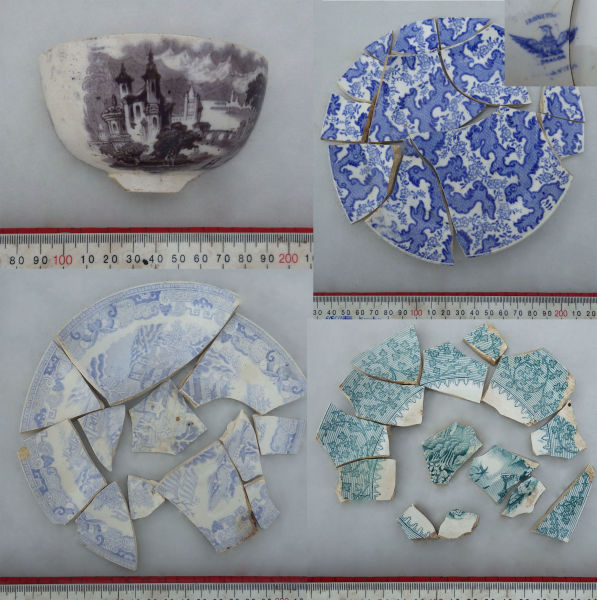
Ceramic artefacts from one of the rubbish pits on the section. Image: J. Garland.

While it is difficult to associate the features found on the site with any one resident during the 19th century, it is almost certain that some of them were deposited by Hiorns and his family, including some of the 1037 artefacts found in the large depression to the rear of the building. That particular feature looks to have been used for the disposal of rubbish over an unknown period of time, based on the presence of small concentrations of objects within the feature as a whole, the size of the assemblage, and the wide range of manufacturing dates found among the artefacts. Many of the artefact dates, however, fit in well with the period in which Hiorns was resident on the section. On top of this, the assemblage contained a large number of alcohol bottles and several artefacts which are considered to be “higher status” items, or objects more often associated with people of reasonable wealth. It would make sense for the man who a) ran a hotel and wine bar and was in court more than once on alcohol related charges and b) later purchased the prestigious Linwood House, to have owned items like these.

Selected glass bottles from the site, including Rowland's Macassar Oil, a Piesse and Lubin perfume bottle and part of an infant feeding bottle. Image: J. Garland.

Selected glass bottles from the site, including Rowland’s Macassar Oil (mid-right), a Piesse and Lubin perfume bottle (top right) and part of an infant feeding bottle (top left). Image: J. Garland.

The assemblage also contained large quantities of ceramic tea and table wares, as well as household and hygienic items like chamber pots, wash basins and ointment pots, a quantity of shoes and fabric, food containers, pharmaceutical bottles and children’s artefacts. One of the most interesting finds, however, was a cluster of clay tobacco pipes that included pipes with political motifs as decoration. These pipes – bearing the name and bust of William Gladstone, liberal English politician, and the name of Garibaldi, famously nationalist and progressive Italian general – can easily be tied into Hiorns’ political engagement (which I sort of alluded to above, but haven’t had time to go into detail about) and the politically charged narrative of this entire Armagh Street site (which I definitely haven’t had time to go into). They’re an example of material culture that is actively entangled with the more intangible ideas and ideals of the people and society by which they are made and used (a topic for another day, I think).

Clay smoking pipes found in Feature 3 (the depression to the rear of the house). Image: J. Garland.

Clay smoking pipes found in Feature 3 (the depression to the rear of the house). The Gladstone pipe is the one in the top row, while the Garibaldi pipe is second from the right in the second row from the top. Image: J. Garland.

I may have started this post with a melodramatic paragraph that reads more as pulp fiction than historical narrative, but in truth, the story of Edward Hiorns (and all of the residents of this block of Armagh Street) is not all that sensational. What it is, however, is a tale we come across all the time in Christchurch. There are many interesting themes to be found in the archaeological and historical records of his life, but two of the most interesting from my perspective are the way he “improved” his situation in life, so to speak, and the way he involved himself so readily in the governance and development of the city in which he had settled. It’s a combination that we see again and again in the lives of Christchurch residents from the 19th century.

People talk a lot about the fluidity of class and social affluence in the 19th century, especially in colonial settlements like New Zealand, and the significance of the capitalist ‘entrepreneurial spirit’ in the prospering of Victorian society. These are both more than evident in the case of Mr Edward Hiorns (and Mr Jamieson, and Mr Ruddenklau and Reverend Fisher). What is just as evident, however, is the active engagement made by people like Hiorns with the present and future of the community in which they lived – be it at the local, national or global level. I could, with the aid of Mr Hiorns and others, very easily take you all down the rabbit hole with me here into the fascinating world of political and social change in 19th century Christchurch (the labour movement! radicalism! women’s suffrage!) and the lives of the people who fought to change the world around them, but that is too much for any one blog post, let alone this one. Nevertheless, it bears remembering that theirs were the hands that shaped a city and, though the city, helped to shape a nation.

Jessie Garland.

References

LINZ, c. 1850. Deeds Index – A – Christchurch town sections and town reserves. Archives New Zealand, Christchurch Office.

McAloon, J., 2000. The Christchurch elite. In Cookson, J. and Dunstall, G., eds). Southern Capital Christchurch: Towards a City Biography, 1850-2000., pp. 193-221. Canterbury University Press, Christchurch.

Wright, G. R. 1998. The Petty Bourgeoisie in Colonial Canterbury; A Study of the Canterbury Working Mans’ Political Protection and Mutual Improvement Association (1865-66) and the Canterbury Freehold Land Association. MA Thesis, University of Canterbury.

Papers Past. [online] Available at www.paperspast.natlib.govt.nz.