In which breakfast is discussed and many pictures of food are shown

Breakfast. In this day and age it can consist of anything from a cup of coffee or a piece of toast to a full fry up. We eat it on the run (guilty!), over the newspaper (or smartphone, increasingly), at the table, in a café, in front of the television or at work. Often, we don’t eat it at all. We are told that it’s the most important meal of the day, yet for those of us who do eat breakfast, it can sometimes feel more like a chore, a meal without much variety (how many of you eat the same thing every morning?) and undeserving of much time or effort (except in the weekends!). Modern living often means that we don’t have the time, money or energy to devote to elaborate meals in the morning. In this, as with so much of what and how we eat, our breakfasts are a product of our social, cultural and economic environment as much as they are an indication of our personal tastes.

The breakfast of archaeologists. A snapshot of the different breakfasts eaten by the office today, some at home, some in the car and some at work.

The breakfast of archaeologists. A snapshot of the different breakfasts eaten by the office today, some at home, some in the car and some at work.

It was no different in the past. The history of breakfast in the Victorian era is a study in contrasts between the recommended or encouraged bill of fare and the realities of individual or household wealth and time, much like today, really (White 1994: 4-16). Cookbooks like Mrs Beeton’s Book of Household Management (1861) and The Breakfast Book (1865) suggest a massive range of appropriate breakfast foods, ranging from elaborate dishes like game pies, curries and devilled bones (ew!) to more recognisable fare such as porridge, eggs, bacon, bread and marmalade. One 1884 book, Breakfast Dishes for Every Morning of Three Months, suggests a Sunday breakfast menu of: fried skate and shrimp sauce, curried pigs feet, breakfast cakes, potted anchovy (so much ew!), devilled hot meat, hot buttered toast and jam.

Pie for breakfast anyone? Image:

Pie for breakfast anyone? Image: Wikimedia Commons

Other records, however, indicate that most households stuck to simpler meals for their breakfast, often including a combination of bacon, sausages or mutton chops, eggs, bread, porridge, cocoa, coffee and tea. Some families ate rehashed leftovers from the day before, hot or cold (White 1994: 20). One historian writes that Victorian cookery authors objected to this simplicity and were constantly encouraging their readers to “choose more than bacon and eggs” (White 1994: 9). Which, frankly, makes me empathise more with the readers than the authors. Bacon and eggs is a perfectly acceptable choice.

Bacon! And eggs! Good choice Victorians. Images: Wikimedia Commons.

Bacon! And eggs! Good choice Victorians. Images: Wikimedia Commons.

Whatever the contrast between the suggested ingredients for a Victorian breakfast and the realities of the meal, there definitely seems to be a greater emphasis on savoury breakfast foods during the 19th century, and a greater quantity of food consumed in the morning than is eaten today. Contemporary accounts emphasise the importance of a good breakfast (although then, as now, people skipped it altogether; Timaru Herald 25/11/1876:3, Star 12/07/1871: 3, 23/11/1898: 1).  Many of the accounts of 19th century breakfasts include meat of some kind, from bacon to fish. Cakes are mentioned, as are spreads like marmalade, and fruits, but sweeter foods seem to be far less common than their savoury counterparts (Oxford Observer 19/04/1892:4, White 1994: 9-20).

Perhaps the most glaring difference between then and now is the absence of cereal which, in the form that we know it today, wasn’t invented until the late 19th and early 20th century. As a strange, yet interesting aside, Cornflakes, created by the Kellogg brothers in the 1890s, were used as an anti-libido food by John Harvey Kellogg, who believed firmly in sexual abstinence and spent a substantial part of his life trying to get people to stop wanting sex (Kellogg 1888). Something to think about next time you eat cornflakes, huh?

Cornflakes and John Harvey Kellogg, a man with, ahem, interesting ideas about breakfast food. Image: Wikimedia Commons

Cornflakes and John Harvey Kellogg, a man with, ahem, interesting ideas about breakfast food. Image: Wikimedia Commons

Archaeologically, evidence for the nature of breakfast foods and rituals is scarce. Many of the objects involved in the meal, such as teacups, saucers, plates and serving dishes, are not specifically breakfast related, but representative of food service and consumption in general. As we’ve discussed before, our evidence for food types in the past is limited by what survives in the archaeological record, specifically items like bones, shells and embossed or labelled food containers. Even then, if the historical accounts are anything to go by, much of what we do recover may not be attributable to a certain meal: mutton chops are a prime example. It’s interesting to think about this from a modern perspective, as well: how much of what we eat for breakfast is exclusively breakfast food? Would a future archaeologist be able to determine your breakfast ritual from the foods and objects you use?

That’s not to say that breakfast is invisible in the archaeological record. Occasionally, we do come across items that, if not exclusively breakfast related, do have a much, much higher probability of being used or eaten during the morning meal. Eggs, for example, seem to have been one of the absolute staples of the Victorian breakfast menu, whether poached, fried, boiled or scrambled (Star 12/07/1871:3). We’ve found several egg cups during excavations in Christchurch, some of them better made than others, which would have been used at the breakfast table to eat boiled eggs (sadly, evidence of fried, poached and scrambled eggs is slightly harder to come by…). According to contemporary sources, how a person took their boiled eggs ‘betrayed’ their nationality (Star 17/04/1897: 3): a quick survey of the office tells me that we’ve got people of French habits, English habits and the not mentioned method of “peeling the egg and just eating it.”

Eggcups found on an archaeological site in Christchurch. Image: J. Garland.

Egg cups found on an archaeological site in Christchurch. Image: J. Garland.

Another breakfast food that we’ve found evidence for is marmalade, which seems to have been both a slightly higher class of breakfast food in some places as well as a particularly Scottish one (Star 13/05/1899: 7, White 1994: 20). In a survey of breakfast fare amongst different classes of Victorian families in Britain, it was the servant-owning families (household incomes over 26 shillings a week) who included marmalade as part of their morning meal, although it’s unclear how this applied to New Zealand. Marmalade was also a Scottish product, (likely) originating in Dundee in the late 18th century, and eventually becoming a characteristic of the Scottish breakfast (Star 13/05/1899: 7). It was also, apparently, the cause of religious fights and a title of nobility in 1850s Haiti, along with other “dignities of the jam-pot.” Who knew.

Keiller & Sons marmalade jar. Image: J. Garland.

Keiller & Sons marmalade jar. The first commercially produced brand of marmalade was made by Keiller & Sons in the late 18th century. The story goes that James Keiller’s wife, Janet, experimented with an over-ripe cargo of Seville oranges that had arrived in Dundee Harbour, eventually turning them into marmalade. Image: J. Garland.

It’s a curious thing, food. So basic and yet, so complicated. One of the most interesting things to think about, I find, in regard to breakfast and how it has changed over the last century and a half is how those changes reflect transformations in our cultures and societies. Why do we eat what we do and how we do? What does it say about our lives, about the world around us? Food is never just sustenance, not really. The ritual (or non-ritual, as the case may be) of eating, the foods we eat, even the packaging of that food, is all tied into a much wider representation of who we are and how we behave, collectively and individually.

Jessie Garland

References

Kellogg, J. H., 1888. “Treatment for Self-Abuse and Its Effects.” In Plain Facts for Old and Young. Ayer Publishing. [online] Available at Project Gutenberg

Oxford Observer. [online] Available at www.paperspast.natlib.govt.nz

Star. [online] Available at www.paperspast.natlib.govt.nz

Timaru Herald. [online] Available at www.paperspast.natlib.govt.nz

White, E., 1994. First things first: the great British breakfast. In C. A. Wilson, ed. Luncheon, Nuncheon and Other Meals: Eating with the Victorians. Sutton Publishing Ltd.

Gender matters

Gender matters. And it’s complicated, which is why writing this blog post has been particularly difficult. Why is it so complicated, from an archaeological standpoint? Well, let me try and explain.

Historical archaeology developed as a discipline in the mid-20th century and, at that time, its practitioners made all sorts of sweeping generalisations about the position of women – and other minorities – in the past (as many archaeologists at the time did, regardless of their period of expertise, and as I’m doing now). For the so-called historic period, these assumptions revolved around women as mother and domestic helpmeet, with no roles outside this, little value placed on this role, little recognition that maybe women wanted more than this and little room for any agency on the part of women.

Times have changed, and society now sees gender – and gender roles – quite differently. Historical archaeologists are no exception to this change. We now see considerable value in the role of women in the 19th century and are able to make far more nuanced interpretations about their lives and experiences.

For all this, women are still frustratingly elusive in the archaeological record. There are some artefacts that definitely indicate the presence of a woman at a site, such as a woman’s shoes, clothing or jewellery. It might be possible to use a perfume bottle to definitely link a woman to a site, or perhaps some specific medicines. The presence of girls might be able to be identified through dolls, but boys could just as easily have played with dolls. And anyway, these artefacts do little more than reinforce those gender stereotypes we’ve moved away from. They tell us that there was a woman at the site, and maybe she wore perfume. Or maybe someone gave her some perfume that she didn’t like. Who knows?

But if you’ve got a site that you know was almost exclusively occupied by women for over 40 years, that’s a whole different matter. Especially when that site was occupied by the same family for that period, which is pretty unusual in central Christchurch, regardless of the genders involved.

The site in question was that of Violet Cottage. Even the name sounds feminine, right? Well, that’s how it was known when Dr Thomas Moore – and his family – were living there. The Moore family had bought land in Canterbury in 1850, and emigrated the following year (Greenaway 2007, Lundy 2014). They settled at Charteris Bay initially, before moving to Violet Cottage. Unfortunately for Dr Moore, he only lived at the cottage for two or three years before his untimely death in 1860 (Lyttelton Times 15/2/1860: 4). Following his death, members of his family remained at  the cottage until the 20th century (H Wise and Co 1911). This included Mrs Elizabeth Moore, and the children: Elizabeth, Alice, Thomas, Jane, Ellen, Annie and Emma (H Wise & Co 1878-1979, Lundy 2014). Elizabeth lived at Violet Cottage until her death in 1887 and two of her daughters – Annie and Emma – continued to live at the cottage until the 20th century. We’ve not been able to identify how the women supported themselves after Thomas senior’s death, but there is some evidence to suggest that they had income from property near Violet Cottage (Hughes et al. 2014: 4).

 Violet Cottage, 1881. Image: Andersen 1949: 430.


Violet Cottage, 1881. Image: Andersen 1949: 430.

What we found at the site was perhaps surprising: there was nothing about the assemblage we recovered that suggested the artefacts were deposited by a predominantly female household. Or even that there were women living at the site: no women’s clothing, perfume bottles or shoes. Nothing specifically female at all. This is perhaps not surprising, given that we probably only recovered a fraction of the material culture discarded by the site’s occupants over the more than 40 years they lived there.

We found a fairly generic Victorian Christchurch domestic assemblage, with one exception. We only found three rubbish pits at the site, and one of these features contained almost nothing but alcohol bottles: 134 of the 146 artefacts we recovered from the feature probably contained alcohol (long-time followers of the blog will know that bottles were frequently re-used in 19th century New Zealand and may not have contained the contents suggested by their form). There was nothing about the rubbish pit that suggested the bottles had been deposited over a number of years, and the pit was probably filled over a relatively short period of time. So someone at the site may have been doing a lot of drinking – or it’s possible that the good doctor was using the alcohol for medical purposes.

 Just two of the many alcohol bottles recovered from a rubbish pit at Violet Cottage. Image: C. Dickson.


Just two of the many alcohol bottles recovered from a rubbish pit at Violet Cottage. Image: C. Dickson.

Most of the remainder of the artefacts recovered from the site were either ceramics or animal bones (i.e. food waste from the Moores’ meals). The ceramics included a range of serving wares that suggested a well-to-do middle class establishment. There was a tureen, a platter, a milk jug and dinner plates, as well as more utilitarian items, such as chamber pots, a colander and a rather fabulous wash basin. There was only one tea cup, one saucer and no teapots – while that may not seem that interesting, archaeologists have often identified the presence and role of women on 19th century archaeological sites through the ritual of afternoon tea, and the material remains of that ritual. There was some evidence, however, to suggest a matching set of sprigged ware – and this may have been a tea set, as the items from this set were a milk jug, a saucer and a side plate.

 Ceramics from Violet Cottage. Clockwise from top left: a tureen, a Fibre-decorated side plate, the base of a serving dish and a colander. Image: C. Dickson.


Ceramics from Violet Cottage. Clockwise from top left: a tureen, a Fibre-decorated side plate, the base of a serving dish and a colander. Image: C. Dickson.

 Fragments of sprigged porcelain recovered from Violet Cottage. Image: C. Dickson.


Fragments of sprigged porcelain recovered from Violet Cottage. Image: C. Dickson.

The animal bones tell us that the Moores were eating mutton and beef, with a preference for mutton, and a range of both cheap and expensive cuts present – beef cheek anyone? The cuts of mutton were from both the forequarter (or shoulder) and the leg, with the latter suggesting the consumption of roast mutton. In amongst all this evidence for food and its consumption, it is perhaps surprising that no condiment containers were recovered from the site – no vinegars, salad oils or pickles.

 A wash basin decorated with the Magnolia pattern, found at Violet Cottage. Image: C. Dickson.


A wash basin decorated with the Magnolia pattern, found at Violet Cottage. Image: C. Dickson.

The artefact from the site that I found most evocative was a porcelain platter, made by Spode, and decorated with a blue floral pattern. The interesting thing about this platter was that the maker’s mark indicated that it was made between c.1805 and 1830 (The Potteries 2008). That means that it was made before the Moores arrived in New Zealand, and that the Moores are very likely to have brought it with them from England, and kept it carefully and safely throughout their travels. For the family, this piece of china may have provided a direct and tangible link between the life they left behind in England and their new life here on the other side of the globe.

 A Spode platter, made between c.1805 and 1830 (The Potteries 2008). Image: C. Dickson.


A Spode platter, made between c.1805 and 1830 (The Potteries 2008). Image: C. Dickson.

We can’t relate this artefact to gender (at least, not without making a whole lot of assumptions that don’t sit comfortably), but it does tell us about the sort of items that new colonists – of a certain class – brought with them for their new lives, and their expectations of those lives: I don’t imagine that the holds of migrant ships were packed with Spode platters or ashets… This platter suggests that the Moore family expected to dine well, and possibly even to entertain, and to maintain certain standards in their new home.

Our experience at this site confirms that gender – and gender roles – can be difficult to explore archaeologically. But the question is an important one and needs to be considered carefully at any archaeological site, rather than simply making assumptions about the role of women in 19th century Christchurch.

Katharine Watson, Chelsea Dickson & Julia Hughes

References

Andersen, J. C., 1949. Old Christchurch in Picture and Story. Simpson and Williams Ltd, Christchurch.

Greenaway, R. L. N., 2007. Barbadoes Street Cemetery Tour. [online] Available at: http://christchurchcitylibraries.com/heritage/cemeteries/barbadoes/barbadoesstreetcemetery.pdf [Accessed June 2014].

H. Wise & Co., 1878-1979. Wises New Zealand Post Office Directories. Dunedin: H. Wise & Co.

Hughes, J., Dickson, C. and Geary Nichol, R., 2014. 89 Chester Street East, Christchurch: report on archaeological monitoring. Unpublished report for Hawkins Ltd.

Jacobson, H. C., 1914. Tales of Banks Peninsula. Akaroa: Akaroa Mail Office.

Lundy, D., 2014. Dr. Thomas Richard Moore. [online] Available at: <http://www.thepeerage.com/p44788.htm> [Accessed June 2014].

Lyttelton Times. [online] Available at: <www.paperspast.natlib.govt.nz>. Accessed April 2014.

The Potteries, 2008. A-Z of Stoke-on-Trent Potters. [online] Available at: www.thepotteries.org.

French Farm: an archaeologist’s observations*

After a couple of weeks off from the blog, we thought it’d be a good idea to give you a run-down of what we learnt at French Farm. These are preliminary observations only, and could well change as we do more research! In no particular order, here you are.


 The ground floor, French Farm house. Image: K. Webb.


The ground floor, French Farm house. Image: K. Webb.

 Circular saw marks on timbers on the south wall of the first floor. Photo: K. Watson.


Circular saw marks on timbers on the south internal wall of the first floor. The house was built in at least two phases, with the first phase built by the French navy in the early 1840s. The timbers from the first phase were pit sawn and those from the second phase were circular sawn.  Image: K. Watson.

 Beaded match-lining like this lined a number of the rooms but the circular saw marks indicated that much of it was a later addition to the house. Photo: K. Watson.


Beaded match-lining like this in Room 7 (with Room 6 visible in the rear) lined a number of the rooms but the circular saw marks indicated that much of it was a later addition to the house. This in turn suggests that the original lining had been replaced. Image: K. Watson.

 The wall between Rooms 1 and 2, looking south from Room 1. Circular saw marks on the wall lining indicated that at least part of this wall was a later addition. Image: K. Watson.


The wall between Rooms 1 and 2, looking south from Room 1. Circular saw marks on the wall lining indicated that at least part of this wall was a later addition. There was once a doorway to the right of the collapsed fireplace but it was boarded up at some stage. Probably after it was boarded up, access to the first floor was moved from its original location (in Room 7) to the right of the collapsed fireplace – it’s just possible to make out the ladder in this image. Image: K. Watson.

 Part of the floor upstairs. The hole at right was probably the original means of accessing the first floor. And the hole would originally have been bigger, as the floorboards at left are circular sawn, unlike the pit sawn floorboards used for the remainder of the first floor (and the ground floor).


Part of the floor upstairs. The hole at right (above Room 7) was probably the original access to the first floor. And the hole would originally have been bigger, as the floorboards at left are circular sawn, unlike the pit sawn floorboards used for the remainder of the first floor (and the ground floor). Image: K. Watson.

 Top: 1860 newspaper. Bottom: 1861 newspaper. These are on the wall between Rooms 1 and 2, next to the fireplace. Image: K. Watson & K. Webb.


Top: 1860 newspaper (yes, sorry, it’s very hard to make out the date on this image). Bottom: 1861 newspaper. These are on the wall between Rooms 1 and 2, right next to the fireplace, and the timbers they are stuck on were circular sawn. This could indicate that there was a circular saw operating in the area by 1860-61. And it could indicate that Phase 2 dates as early as 1860-61. Of course, this is based on the untested assumption that the newspapers were actually stuck on the wall in 1860-61. It’s equally possible that it had been stockpiled and was stuck on at a later date. And don’t forget the potential time delays with shipping material to New Zealand. Image: K. Watson & K. Webb.

Left: window into Room 1, east elevation. Right: door into Room 7, east elevation. Cut marks in the weatherboards indicated that this door and window had effectively switched plans: the window in Room 1 was originally a door and the door into Room 7 was a window.

Left: window into Room 1, east elevation. Right: door into Room 7, east elevation. Cut marks in the weatherboards indicated that this door and window had effectively switched places: the window in Room 1 replaced an original door and the door into Room 7 replaced an original window. Image: K. Watson.

 The stones used as a footing underneath what was originally an external door into Room 1. Photo: K. Watson.


The stones used as a footing underneath what was originally an external door into Room 1. Image: K. Watson.

 The first floor, looking south. The circular saw marks on the dividing wall indicate that it was a later addition. Photo: K. Watson.


The first floor, looking south. The circular saw marks on the dividing wall indicate that it was a later addition, and this upstairs space may originally have been just one room. Image: K. Watson.

 This is a detail of a window frame upstairs, showing that the original window had been replaced. And either at the same time or later, this room had been lined with scrim (that's what all the small nails were for).


This is a detail of a window frame upstairs, showing that the original window had been replaced. And either at the same time or later, this room had been lined with scrim (that’s what all the nails were for). Image: K. Watson.

 Bottles under the floorboards in Room 2. The floorboards on the ground floor are butted, rather than tongue and groove, so I was expecting that we’d find some things under the floor. But small things, like fragments of glass and china, buttons, pins, that sort of thing. We did find that sort of thing, but we also found large bottles, and pieces of cutlery, which are not the sort of thing that’d just fall between the cracks in the floorboards. So, how did they get there? There are a couple of possible explanations: they could have been deliberately buried there before the floor was laid, or the floorboards may have been replaced at some stage. Image: K. Watson.


Bottles under the floorboards, Room 2. The floorboards on the ground floor are butted, rather than tongue and groove, so I was expecting that we’d find some things under the floor. But small things, like fragments of glass and china, buttons, pins, that sort of thing. We did find those small artefacts, but we also found large bottles, and pieces of cutlery, which are not the sort of thing that’d just fall between the cracks in the floorboards. So how did they get there? There are at least a couple of possible explanations: they could have been deliberately buried there before the floor was laid, or the floorboards may have been replaced at some stage. Image: K. Watson.

None of the artefacts we found could be readily identified as French. This doesn’t mean that they weren’t used by the early French occupants of the house, but it does make it difficult to prove. Further, at first glance, none of the artefacts found seemed to date from the 1840s and/or 1850s. Again, this doesn’t mean they weren’t used during the period – many common 19th century artefacts were made for long periods of time.

Even though we didn’t find anything particularly ‘French’ in the way of artefacts, the house itself is clearly not English in origin. It’s the layout that’s the real give away. It’s just so different from the standard central hall with rooms opening off it that we usually see in Christchurch. French Farm house is at least 30 years older than most of the houses we’ve looked at in the city, but even those 1850s houses we’ve recorded still have a central hall – which, when you think about it, is a bit of a waste of space really (and something we’ve moved away from in more recent times). And once you take out the central hall, everything else changes, including the house footprint – French Farm is significantly longer than it is wide. It also changes the flow of people through rooms, meaning you have to pass through one room to get to another – not the case in a house with a central hall. Maybe the logical extension of this is less privacy?

 Excavating in Room 1. Image: K. Watson.


Excavating in Room 1. Image: K. Watson.

The last thing that I learnt is that archaeology is fun! Maybe this seems a silly thing to say. But most of our work takes place on construction sites, surrounded by large diggers and other construction chaos, and – more often than not – we don’t find anything of note. For me personally, I spend most of my time sitting behind a desk, not doing any field archaeology. In either of these circumstances, it’s easy to forget how fascinating and enjoyable the process of simply digging or recording is. It’s also easy to lose sight of the fact that archaeology is all about learning more about the past, rather than simply recovering information for the sake of it.

Katharine Watson

* With thanks to Stephen Cashmore and David Brailsford for insightful conversations on site.

In which goats frolic, pipes masquerade as baskets and camels do whatever it is that camels do.

Taking a break from our recent musings on society, smells and legacies, this week’s post features another selection of artefacts from the archives. All of these were found on the same site in Christchurch’s central business district over the last few weeks. Enjoy!

Glass lamp

How lovely is this? It’s the (nearly complete) base from a finger lamp. It would have originally had a glass chimney on the top, attached with a copper/brass fitting or burner, looking a bit like this. Image: J. Garland.

Plate with ... pattern

Saucer decorated with scenic pattern, Geneva, similar to the Lucerne patterned plate we featured a few weeks ago. Image: J. Garland.

Marble

A large glass marble, with swirl of coloured glass inside. Image: J. Garland.

DSC_4705ed1

The fragments of another children’s plate, similar to others that we’ve found. Image: J. Garland.

Goats!

Goats! Frolicking! This pattern is, aptly enough, titled “Goat” and seems to be associated with Scottish pottery manufacturer James Jamieson & Co and the Bo’ness (Barrowstouness) Pottery in the Central Lowlands (1829-1855). Image: J. Garland.

And camels!

And camels! Image: J. Garland.

Some patterned pipe bowls, including two with a 'basket weave' motif.

Some patterned pipe bowls, including two with a ‘basket weave’ motif. Image: J. Garland.

A ceramic egg. Eggs like this were used to encourage hens to lay in the nest, rather than elsewhere. Image: J. Garland.

A ceramic egg. Eggs like this were used to encourage hens to lay in the nest, rather than elsewhere. Image: J. Garland.

A small porcelain figurine, tragically missing it's head. Image: J. Garland.

A small porcelain figurine, tragically missing its head. Image: J. Garland.


“Today, tomorrow, Timaru”: souvenirs of early tourism in New Zealand

The idea of a ‘souvenir’, as a physical keepsake of a place or event, is not a new concept. It’s been around for as long as people have been bringing home exotic treasures from far-off lands, or trying to preserve the memory of past events in physical objects. From the explorers of the distant past, to the ‘grand tourists’ of more recent times, people have taken the material culture of the world and turned it into tangible tokens of personal experiences. It’s a quintessentially human trait and one that, I think, ties into the overall tendency of people to hold onto what has gone before.

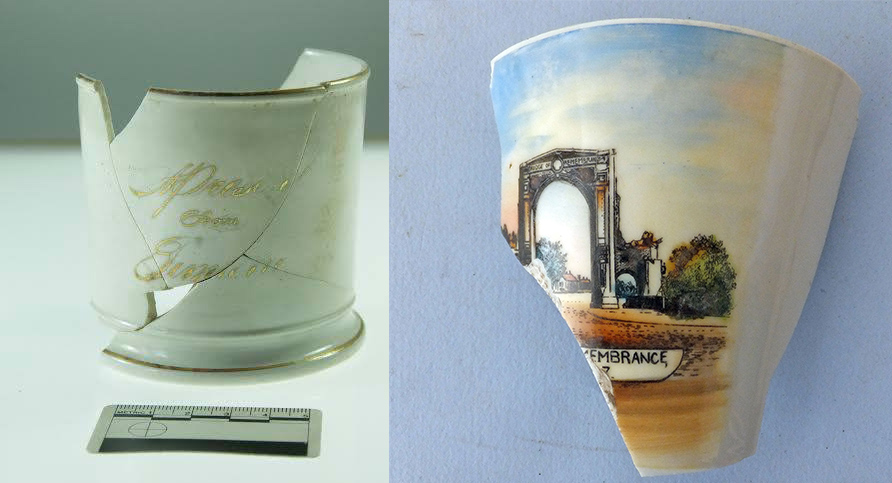
Over the last few years in Christchurch, we’ve found a multitude of artefacts from other places, many of which may have been souvenirs of past experiences, people or events to their owners. There are two, however, that stand out, not because they may have been treated as keepsakes, but because they seem to have been intended as such.

Souvenir cups found in Christchurch. Images: G. Jackson & Underground Overground Archaeology Ltd.

Souvenir cups found in Christchurch. Images: G. Jackson & Underground Overground Archaeology Ltd.

Both are cups and both are decorated with reference to places: one with the words ‘A Present from Timaru’ and one with an image of the Bridge of Remembrance in Christchurch. The latter has to have been made after the construction of that bridge in 1923, and objects matching the description of our Timaru cup were being advertised in the Timaru Herald in the early 1900s (Timaru Herald 13/7/1901: 1). The fact that both cups reference a place suggest that they were intended as travel souvenirs, keepsakes of visits to Timaru and Christchurch and, in the current age of global tourism and mass produced mementos, it’s easy to make that connection. Today, souvenirs are inextricably linked with travel, especially travel for leisure.

Advertisements for souvenirs from Timaru and Oamaru. Images: North Otago Times 6/1/1893: 2, Timaru Herald 13/7/1901: 1.

Advertisements for souvenirs from Timaru and Oamaru. Images: North Otago Times 6/1/1893: 2, Timaru Herald 13/7/1901: 1.

However, it wasn’t always so. For much of the 19th century, souvenirs were linked with events – with commemoration – rather than with anything approaching tourism. Newspapers of the 19th and early 20th century are filled with accounts of souvenir hunters, waiting eagerly at bridge openings to snag some of the ribbon, or casing the venue of a royal or dignitary’s visit to find a keepsake (New Zealand Herald 29/4/1910: 4; Te Puke Times 11/06/1920: 2). There are occasional descriptions of people returning from elsewhere with souvenirs, but they are almost always gifts, not purchases or acquisitions (Bruce Herald 3/6/1868: 4). A memorable exception to this is the party of townsmen who returned to Oamaru with a couple of boulders from Moeraki (or the ‘Devil’s Foundry’, as they referred to it; North Otago Times 17/8/1865:2).

Consequently, the fact that our cups, especially the ‘Present from Timaru’, appear to have been made to be souvenirs of travel is one that raises some interesting questions about the emergence of a souvenir culture and the greater framework of tourism, or travel for leisure, in New Zealand. Especially as it is such a key part of our national identity in the present day.

As we have mentioned many, many times here on the blog, the 19th century was a period of increasing global exploration and travel. The European settlement of New Zealand is itself evidence of that, but that long distance colonisation was accompanied and followed by increasingly regular travel between and within the northern and southern hemispheres. Much of this travel was commercial in nature, centred around international trade, politics, personal health and, to a degree, professional advances. Yet, tourism – travel for leisure – in the sense that we think of it today remained very much the province of the elite, who could afford both the time and the expense (McClure 2004: 79-80).

It wasn’t really under the late 19th (1880s onwards) and early 20th century that traveling for the sake of travel, the notion of going to see a place rather than visit a person, took off. In New Zealand, much of that very early ‘tourism’ seems to have been associated with the natural appeals of the country (much as it is today). The 1880s saw increasing numbers of mountaineers and tourists in and around Mt Cook, for example, leading to the construction of the Hermitage in 1884. Similarly, the Pink and White Terraces saw numerous tourist visits prior to their destruction in 1886, one of our first (and, perhaps, greatest) examples of a natural tourist attraction (McClure 2004: 79-80).

The stunning vista of Mt Cook, a prime spot for adventure tourism even in the 19th century. Image: C. M. Lynch.

The stunning vista of Mt Cook, a prime spot for adventure tourism even in the 19th century. Image: C. M. Lynch.

It can be difficult to determine from the available evidence, but travel between cities – urban tourism, if you will – is not referenced nearly as much. Don’t get me wrong, people were travelling between towns and villages from the earliest years of European settlement, but for different reasons and with different levels of comfort. Before the construction of the railway between Timaru and Christchurch, for example, travel between the two towns took the form of a sea voyage from Lyttelton or an overland carriage journey of 16 hours or more, often in bad weather and uncomfortable conditions. One description of the overland trip, written in the 1860s, calls it an “alarming undertaking”, greatly fatiguing “even for gentlemen” (Garner and Foster 2011: 90). It seems to have been a journey undertaken only when necessity called for it, rather than because a person simply wanted to. Even after the construction of the railway between the two settlements in the 1860s, the kind of travel that we now consider tourism – the kind that establishes a demand for souvenirs – still doesn’t appear to have been commonplace. Not until much later in the century, at least.

Early 20th century image of Stafford Street, Timaru. Image: Progress 1/7/1907: 338

Early 20th century image of Stafford Street, Timaru. Image: Progress 1/7/1907: 338

There are a number of interesting questions to be asked here, not least among them how and why our society shifted from viewing travel as a means to an end and starting viewing it as an end in and of itself. It’s a shift in perspective that seems to be tied up with a number of other changes in society as a whole. Among them is the the gradual transition from a society in which leisure is a luxury of the elite to the one we have now, where it can be considered a necessary part (a basic right, even) of ordinary life for everyone.

Souvenirs themselves are quite the contrast in meaning, as mass-manufactured objects that are simultaneously uniquely personal mementos. They’re also part of another shift in social perspective, I think, from a largely practical material culture, to the more frivolous form of consumerism found in the present day. They may take the form of practical objects, like our cups, but souvenirs are usually bought to be tokens of memory, not because they’re useful. There’s an element of display inherent in their purchase as well, which raises all kinds of interesting ideas regarding how souvenirs of travel are used in the modern world to project a certain image (this sparked a conversation in the office this morning about the hierarchies of travellers, from backpackers to luxury holiday-makers and how we judge people based on the kinds of things they bring back from trips).

Souvenirs from around the world. What do yours say about you? Image: Wikimedia Commons.

Souvenirs from around the world. What do yours say about you? Image: Wikimedia Commons.

Sadly, the discussion that these questions deserve is way beyond the scope of this particular blog post, but it’s certainly something to think about the next time you buy a souvenir or travel just to see something new in the comfort of modern transportation.

“I well remember one of my companions laughingly alluding to the time when our great-grandchildren, a hundred years thence, would be steaming over the plains, lolling back in a comfortable railway carriage, and wondering what sort of men their great-grandfathers could have been to have lived and laboured contentedly in a land without such a convenient means of getting about the country.”  – Alfred Cox, 1884.

Jessie Garland

References

Bruce Herald. [online] Available at http://paperspast.natlib.govt.nz

Cox, A., 1884. Recollections: Australia, England, Ireland, Scotland, New Zealand. Whitcombe and Tombs, Christchurch.

Garner, J. and Foster, K. (eds), 2011. Letters to Grace: writing home from colonial New Zealand. Canterbury University Press, Canterbury.

McClure, M., 2004. The Wonder Country: Making New Zealand tourism. Auckland University Press, Auckland.

New Zealand Herald. [online] Available at http://paperspast.natlib.govt.nz

North Otago Times. [online] Available at http://paperspast.natlib.govt.nz

Te Puke Times. [online] Available at http://paperspast.natlib.govt.nz

Timaru Herald. [online] Available at http://paperspast.natlib.govt.nz