Sublime weed, Lady Nicotine… the smoking vice!

‘Tobacco divine, rare, which goes far beyond all their panaceas, potable gold, a remedy to diseases…But, as it is commonly abused by most men, who take it as tinkers do ale, it’s a plague, a mischief, a violent purge of goods, lands, health, hellish, devilish, and damned tobacco, the ruin and overthrow of body and soul’ (Burton, 1948: 577).

Tobacco is a plant native to America, originally used in religious and medicinal practices by Native Americans. When Christopher Columbus arrived in America in 1492, the locals gave him dried tobacco leaves and then…consumption of tobacco took off among Europeans (Dayton University 2017).

This amazing French moulded clay pipe shows a Native American figure crouching at the front of the bowl, with a smoking pipe in his hand and tobacco leaves decorating the bowl on either side. We don’t yet know who the figure is, but it is the coolest artefact I’ve ever seen so far and also, it fits perfectly with our topic today, doesn’t it? Image: J. Garland.

Tobacco was likely first dried or toasted and chewed, or powdered for inhalation through the nose in what is known as ‘snuffing’. More recently, men and women started using pipes and the predecessors to modern cigarettes to smoke tobacco as a daily narcotic.

A slightly more modern container for ‘dried tobacco’. The label on this tin, found underneath the floors of a farmhouse on the outskirts of Christchurch, indicates that it originally contained cut cake tobacco, possibly originating in Antwerp. Cut cake tobacco was advertised for sale in tins in the late 19th and early 20th centuries (Mt Ida Chronicle 19/4/1888: 2): the most commonly referenced types appear to be Empire Cut Cake, from Dobie and Sons, and Four-Square Cut Cake (Auckland Star 29/6/1936: 14, Marlborough Express 8/8/1877: 3). Image: J. Garland.

The popularity of tobacco grew quickly in Europe due to its hypothetical curative properties, which were particularly encouraged by Jean Nicot, from whom the genus Nicotiana took the name (Rogers 2010). Over the years scientists began to investigate the chemicals in tobacco and came to understand the dangerous effects that smoking produces. As early as 1826, the pure form of nicotine was discovered and the conclusion drawn that it constituted a harmful poison (Rodgman and Perfetti 2013).

Left: Manawatu Times 18/04/1925: 3. Right top: Auckland Star 24/03/1931: 13. Right bottom: Northern Advocate 11/03/1932: 8.

While the English developed a predilection for the pipe, the Spanish preferred the cigar and The French took a liking to snuff. It was in Spain that the tobacco manufacturing industry produced the small and cheaper versions of the cigar, famously hand-rolled by women workers in Seville. That image captured the imaginations in France, and cigarritos became cigarettes, one of the most commonly used words in the world (Random History 2007-2017).

Snuff! Not just appreciated by the French, if this English bottle is anything to go by. Taddy & Co. snuff jar from London. Taddy and Co. were tobacconists and snuff merchants with a long history – this particular jar dates to their 19th century operations at 45 Minories, London. The company was established in 1740 in London as sellers of tobacco, snuff and tea (Matlach 2013). They became one of the most important tobacco companies in Britain and were well known for their cigarette cards showing famous actors, actresses, footballers or cricketers. The first of its kind that we’ve seen! Image: J. Garland.

‘Morris Cigarettes’ box. In 1847, the famous Philip Morris was established, selling hand rolled Turkish cigarettes. Cigarettes became popular around this time when soldiers brought them back to England from the Russian and Turkish soldiers. Philip Morris was a British tobacconist and cigarette importer, who first manufactured Morris cigarettes, known as ‘Philip Morris English ovals’, in 1854. The name was later used for ‘Philip Morris Inc. Ltd’, established in New York in 1902 (Wikipedia 2017), when he set up a New York headquarters to market its cigarettes, including a now famous Malboro brand. In 1924 Morris began to market its cigarettes to women and gained 38% of the market. ‘Morris Cigarettes’ were first advertised in New Zealand newspapers in 1910 (Temuka Leader 4/01/1910: 1). Image: M. Lillo Bernabeu.

Smoking for pleasure received its greatest endorsement from Sir Walter Raleigh in the 16th century (Latham 2017), and even today, smoking remains prevalent in many cultures, despite its increasing reputation as a bad habit.

A saucer, decorated with a Chinese scene in which a long pipe is smoked. How cool is that? CHANG is the pattern name. This Chinoiserie design featured two figures, dressed in oriental clothing, in a garden or house and the saucer. was made by Holland and Green, in production between 1853 and 1882 (Godden 1991: 331). Image: J. Garland.

Tobacco smoking arrived in New Zealand with the earliest European settlers and tobacco consumption increased quickly during the mid and late 19th century. It wasn’t just an elitist habit, but was also widely spread among the middle and lower classes, especially among working men. Tobacco was fairly accessible at all levels of society and, increasingly, the paraphernalia of smoking – such as clay tobacco pipes – were cheap and disposable.

One of our favourite artefact types, as you well know. In the second half of the 19th century the production of decorated clay pipes increased. These commemorated events, carried slogans and advertisements, animals, fruits or flowers, and they were categorised as fancy clays or fancies (Ayto 1994: 7). We’ve talked about them a few times in older posts either on the blog or Facebook because they are pretty, and we love them! A perfect example of these ‘fancies’ is this smoking pipe featuring the royal bust of Queen Victoria on one side and the words ROYAL JUBILEE PIPE on the other side. This pipe was made for commemorating 60 years of Victoria’s reign in 1897. Also, the name of DUNEDIN is impressed on the one side of the stem, while M[C]PHEE is impressed on the other, referring to George McPhee. He was a tobacco pipe maker in Glasgow from 1861 onwards with his wife, who was a tobacco pipe trimmer (White 2016: 16). George McPhee arrived in New Zealand in 1880. George’s son, John McPhee, started pipe making experiments with a concerted effort to re-launch the business in Dunedin around 1890 and he was making clay tobacco pipes until 1908 (White 2016: 27). The McPhees were at the front of a brand-new industry for New Zealand and they appeared to be the first New Zealand clay pipe makers (White 2016: 27-28). Image: M. Lillo Bernabeu.

The stem of this pipe, collected from a Christchurch site, is longer than 120 mm, indicating that it belonged to a long pipe like a churchwarden. This type of pipe was easily broken, and it was said that Charles Dickens invented that name or at least he was the responsible for perpetuating the name (Ayto 1994: 6). Churchwarden pipes were mentioned in New Zealand newspapers from at least 1872 onwards (West Coast Times 16/10/1872). The stem had a W. SOUTHORN & CO / BROSELEY maker’s mark, referring to William Southorn, a tobacco pipe manufacturer based in Broseley, Shropshire, England. He established his pipeworks as early as 1823 and they were making tobacco pipes until the 1950s (Science Museum 2017). Image: M. Lillo Bernabeu.

It wasn’t until 1900 when cigarritos became the most common tobacco product on the market. Along with modern advertising, a key innovation took place at the end of the 19th century century: Virginian James Bonsack patented a machine in 1881 that produced 200 cigarettes per minute, as many in a day as forty human employees rolling by hand! Cigarette smoking increased during the World Wars, during which they were given free to soldiers. An easy way for the companies to create loyal customers! Evidence of this universally widespread habit is recorded archaeologically – we’ve found a variety of American and British brands under the floors of Christchurch houses.

W.D. and H.O. Wills maker’s mark on the top of the lid. This company was founded in 1786 and went by various names before 1830 when it became W.D. and H.O. Wills. Tobaccos and cigarettes made by W.D. and H.O. Wills were very popular with New Zealand smokers. The company began manufacturing tobacco products in New Zealand in 1919 at its factory in Petone, Wellington (British American Tobacco New Zealand 2017). Tobacco was processed and sold under several brand names, some of which were still used by Imperial Tobacco until the second half of the 20th century. The company pioneered the use of cigarette cards within their packaging. Image: C. Dickson.

Top: Cardboard cigarette boxes. CHESS SPECIALLY SELECTED VIRGINIA LEAF/ HIGNETT Bros & Co / ENGLAND CIGARETTES. Bottom: THE ‘GREYS’ SILK CUT VIRGINIA TOBACCO. This second one was reused as a shopping list, headed with the words: ‘Supply Stores’. A range of items can be read: ‘butter, sugar, eggs, […], biscuits, soda, […], cornflour, cookies, jellies, […] fruit, […], dried fruit. What a splendid example of reusing and recycling! Image: M. Lillo Bernabeu.

Top and bottom view of a matchbox. Matchboxes are a relatively uncommon find on Christchurch archaeological sites. They are made of tin, which often remained heavily rusted but still identifiable by the shape. It is believed that Richard Bell from Wandsworth, London, was the earliest exclusive manufacturer of matches (as we know them now), from 1832 onwards (Anson, 1983). Unluckily, this example lacks embossing and we don’t have any information about manufacturer and/or brand, which is a shame. It is a good one though! Image: M. Lillo Bernabeu.

Luckily, we also have a tiny piece of an embossed matchbox! Bell and Black were a match making partnership operating during the mid- 19th century, although exact dates are unclear. Richard Bell began a match business in London in the 1830s and was joined at some point by Black (Anson 1983). Bell and Black matchboxes have been found on sites throughout New Zealand and Australia dating to the mid-late 19th century and accounted for 13% of all matches imported into New Zealand between 1870-1894 (Tasker 1993). The New Zealand market was as good as gold for Bell and Black and in 1895, they decided to open a factory in Wellington. In 1910 the two-successful match producing factories in New Zealand became one: Bryant and May, Bell and Company (Tasker 1993). The new firm consolidated its position and still produces most of the matches used in New Zealand. Left: M. Lillo Bernabeu. Right: Grey River Argus 21/07/1894: 4.

Tobacco also played a significant role in the construction of identity and gender, the notions of masculinity and femininity from the 19th century onwards, both here in New Zealand and across the world. According to the principles of liberalism, men were all self-controlled and rational, while women were biologically incapable of both values (Hilton 2000). The image of respectable male smoker was constructed in the public sphere, into which women could not enter without putting their reputation into risk. And of course, a respectable female didn’t smoke.

How to resist to the charms of cigarettes? Advice for women! Due to their maternal role as the caretakers of children, they shouldn’t smoke? Fair enough, says Dr Roberston Wallace…Gender does matter, and smoking was supposed to be – and probably, actually was – a man thing . Press 27/05/1905: 9.

Observer 7/05/1898: 13. Mrs Cunnington was member of Women’s Social and Politic League, and highly influential in cultural and social life in Christchurch in the late 19th and early 20th century. Of course, you know what I’m thinking…she was colleague of another politically active woman: Fanny Cole. Instead of an image of the popular Sir Walter Raleigh encouraging the smokers, I chose Mrs Cunnington, because she was a woman also endorsing smoking as a good thing, at a time when smoking was a practice typically associated with men. We love (well, I love) transgressor women (in the positive meaning of the word): women who broke the established rules to achieve equality rights. And Mrs Cunnington was one of those, as was Mrs Cole, in their different ways.

As the Temperance Union brawled to reduce alcohol consumption, women also starred in the struggle against the vice of smoking. Observer 1/10/1901: 12.

The male smoker was not just a consumer, but instead a true friend and a passionate follower of the goddess nicotine. The pleasure of smoking could be enjoyed along with other entertainments like dancing, drinking or gambling, a kind of freedom only stopped apparently, by getting married (see below).

Observer 1/02/1908: 17.

Lastly, let’s say that smoking as male habit turns around well into the 20th century, when women began to smoke, in part to liberate themselves symbolically from political and social oppression. Smoking as an expression of maturity, sexiness and sophistication linked to the liberal notions of independence and individuality, eventually lessened the male monopoly on tobacco.

See, definitely entangled with gender issues! Free Lance 18/07/1914: 8.

Evening Post 3/12/1927: 15. Hope you allow me the ironies today. I absolutely agree, it seems a comfy suit. But I don’t understand why in particular for the smokers. Ha! Gotcha! To put the smoking stuff in your pockets! There is no doubt, clever design!

Unfortunately, we haven’t found much sure evidence of women smoking (or specifically of men, to be fair) in the archaeological record. Women feature as decoration on clay pipes, and we’ve found a few examples decorated in styles usually associated with ‘the feminine’, but – as we’ve discussed before on the blog – attributing gender to objects in archaeology is not always as easy as we would like.

Feminine pipes? Who knows! Anyway, on top, two colourful pipes decorated with flowers and at the bottom, a fancy pipe with a female figure ridding side-saddle along the stem. Certainly, an elegant lady! Image: J. Garland.

At this point, only left an essential question…is smoking a vice?

What a witty man… Observer 1/12/1906: 16.

Maria Lillo Bernabeu

References

Anson, D., 1983. Typology and Seriation of Wax Vesta Tin Matchboxes from Central Otago: A New Method of Dating Historic Sites in New Zealand. [online] Available at http://nzarchaeology.org/cms/NZJA/Vol%205%201983/NZJA5.115-138Anson.pdf [Accessed November 2017]

Ayto, E. G., 1994. Clay Tobacco Pipes. Shire Publications.

British American Tobacco New Zealand, 2017. [online] Available at: http://www.batnz.com/group/sites/BAT_9VNKQW.nsf/vwPagesWebLive/DO9T5K5C [Accessed November 2017}

Burton, R., 1948. The Anatomy of Melancholy. Tudor Publishing. New York.

Dayton University, 2017. The History of Tobacco, [online] Available at: http://academic.udayton.edu/health/syllabi/tobacco/history.htm [Accessed November 2017]

Godden, G., 1991. Encyclopaedia of British Pottery and Porcelain Marks. Crown Publishers, New York.

Hilton, M., 2000. Smoking in British popular culture 1800-2000. Perfect Pleasures. Manchester University Press. Manchester and New York.

Latham, A.M.C., 2017. Sir Walter Raleigh. [online] Available at: https://www.britannica.com/biography/Walter-Raleigh-English-explorer [Accessed November 2017]

Paper Past. [online] Available at www.paperspast.natlib.govt.nz. [Accessed November 2017]

The Long Tobacco Road. A History of Smoking from Ritual to Cigarette, 2009. [online] Available at: http://www.randomhistory.com/2009/01/31_tobacco.html [Accessed November 2017]

Rodgman, A. and Perfetti, A., 2013. The Chemical Components of Tobacco and Tobacco Smoking. CRC Press. Taylor & Francis Group. Boca Raton. London. New York.

Tasker, J., 1993. NZ Matches and Matchboxes. Ohinemuri Regional History Journal, Vol. 37. [online] Available at http://www.ohinemuri.org.nz/journals/65-journal-37-september-1993/1370-nz-matches-and-matchboxes [Accessed November 2017].

White, S., 2016. The McPhees: New Zealand’s first clay pipemakers. Archaeology in New Zealand, v. 59, pp.10-28.


Bits and bobs

This week, a few of the fabulous things we’ve been finding recently.

A French clay pipe, moulded to show a Native American figure crouching at the front of the bowl, with tobacco leaves decorating the bowl to either side of him. We don’t yet know who the figure is, but the pipe is likely to have been made by one of the larger French houses, such as Fiolet or Gambier. Image: J. Garland.

Edward’s “Harlene” hair tonic. This was made by Reuben Goldstein Edwards in London from c. the 1880s onwards (or so he claimed in 1903, when he registered Harlene as a trademark). It was advertised in New Zealand newspapers in the late 19th century as “the best hairdressing for strenghthening, beautifying and preserving the hair”. Image: M. Lillo Bernabeu.

What we think is an imitation Mason’s Imari jug, in the style of those made by G. M. and C. J. Mason in their Fenton factory in the 1820s. The design is heavily influenced by Japanese motifs and the handle is in the shape of a dragon, with the feet forming the base and the face roaring at you over the rim. Unlike the known Mason’s jugs, this particular example has only an impressed mark reading “IRONSTONE CHINA” on the base, rather than “MASON IRONSTONE CHINA”. Image: J. Garland.

The stem from another clay smoking pipe, decorated with a sleeping (maybe) lion. Image: J. Garland.

Charles Hockin was a London chemist who also made photographic products and inks later in his career. It’s unclear exactly when his business was established, but he seems to have been operating from at least the 1840s onwards. He made a range of products, but seems to have been known for his Seidlitz Powder, a “gentle medicine” that appears to have also been a kind of salt, marketed as a remedy for stomach ailments. Image: J. Garland.

The bowl and socket of a two piece pipe, moulded to look like eagle talons holding an egg. Image: M. Lillo Bernabeu.

A trade token. Not as unusual as they once were in Christchurch archaeology (we’ve got a few now), but this particular one is from Melbourne, which is a bit unusual. This one reads HIDE & DECARLE / ELIZABETH STREET / MELBOURNE / GROCERS AND WINE MERCHANTS and dates to 1858. Image: J. Garland.

This is a bit fancy. Also a bit gaudy. Known as a lustre vase, they seem to have been a popular Victorian object (for the more wealthy in society), designed for the table or the mantle in the home. While our one doesn’t quite have all it’s pieces, it does a fragment of drilled glass with a copper chain still attached – this would have held the long dangling chain of glass prisms. This is a pretty fantastic find for us – we don’t usually find fancy goods in rubbish pits (you don’t normally throw those out if you can help it), so, despite it’s gaudiness, we think it’s kind of awesome. Image: J. Garland, and Ebay.

A pipe bowl decorated with a goat. Because, why not. Image: J. Garland.

Look at her, in her cute little nightcap. She is judging you. She is definitely judging you. Image: M. Lillo Bernabeu.

A very dramatic Ruins patterned plate with a Copeland/Late Spode mark. Image: M. Lillo Bernabeu.

This is possibly my favourite artefact from the last few months. It’s an appointment card for a W. C. T. U. meeting in New Brighton, found in the ceiling of a house occupied by the regional and national president of the organisation in the early 20th century. For those of you who don’t know, the W. C. T. U. refers to the Women’s Christian Temperance Union, an organisation that played a significant role in the women’s suffrage/political movement of the late 19th and early 20th centuries. Among the members, and leaders, of the Christchurch branch was the one and only Kate Sheppard. Image: M. Lillo Bernabeu.

Odds and ends

A selection of the most interesting bits and pieces we’ve been working with recently here in Christchurch.

This gorgeous ceramic vessel is an 1850s-1860s chamber pot, found on a site just outside the central city. It’s decorated with the imaginatively named “Cattle Scenery” pattern, featuring, …well, cows. Image: M. L. Bernabeu.

What’s known as a ‘bent’ clay smoking pipe (referring to the curve, or ‘bend’ of the stem, with the mark ‘SQUATTER’S / OWN’ impressed on the side. The other side of stem has the mark ‘SYDNEY’. Squatter’s own pipes are a little bit of a mystery – identical pipes to this one have been found on other sites here in Christchurch and in Auckland, while variations (Squatter’s Own Budgeree) have been found in several locations in Australia. The budgeree pipes are often decorated with scenes featuring Aboriginal and European figures, while the ones found in New Zealand (so far) appear to be plain. Image: M. L. Bernabeu.

Another beautiful ceramic vessel. This time, it’s a saucer decorated with the pattern ‘Dresden Vignette’ and made by William Smith and Co. between 1825 and 1855. Image: M. L. Bernabeu.

Marbles! So many marbles! Several of the sites we’ve been working on lately have had different marbles in the assemblages. We’ve got German glass swirl marbles (top row and third from the left in the second row), ‘commie’ marbles (far right of third and fourth rows), onionskin marbles (far right of second row), Bennington, or glazed ceramic marbles (second from left in third row), pipe clay marbles (second from left in fourth row), and porcelain marbles with fine banded decoration (far left in third row). Phew. Did you get all of that? Some of them have been heavily used (might have been a child’s favourite marble, who knows!), while others are in pretty good condition. I think my favourite is probably the onionskin: it’s got a great name, and the colours are fantastic. Image: J. Garland, C. Dickson, M. L. Bernabeu.

A serving dish or tureen lid decorated with the Wild Rose pattern, a decorative motif that depicts the gardens at Nuneham Courtenay (near Oxford, England) and was extremely popular in the 1830s-1850s period. Image: M. L. Bernabeu.

This is easily the coolest thing we’ve found in a while. These stemware drinking glasses were coloured using uranium diuranate, which creates the distinctive yellow colour seen in the image to the right. But (wait for it), when you put them under a blacklight, they glow green with the light of a thousand superhero origin stories. Or alien colour schemes. Take your pick. Image: J. Garland.

It’s Friday afternoon, how about a wee tipple of gin? This fragment is from a labelled bottle of Nolet’s finest Dutch geneva. Nolet’s was established in Holland in the late 17th century by Johannes Nolet and is still in operation today. It’s the first label of its kind that we’ve found in Christchurch. Image: C. Dickson.

The ‘Grecian’ pattern, with the potter’s initials J. T. There are several different pattern variations known as ‘Grecian’ or that incorporate Greek and/or neo-classical themes into their motifs. Image: C. Dickson.

Another elaborately decorated saucer, this time displaying the Neva pattern. Confusingly for us, this is not the only 19th century ceramic pattern found under the name of ‘Neva’. This example was made by Thomas Bevington (1877 until 1891). Image: J. Garland.

How’s your reading comprehension? Up to 1870s standards? We found these pages from ‘The Royal Readers’, first published in the early 1870s, inside the walls of a schoolhouse in Governors Bay. Image: J. Garland.

The expressions on the faces of Victorian dolls never fail to amuse me. Image: C. Dickson.

Also found in the walls of the Governors Bay school house, this excerpt from ‘The School Journal.’ If you look closely you can see the typewritten words “Governors Bay, Lyttelton” in the bottom right of the fragment. Image: J. Garland.

And last, but not least, this wonderfully labelled wine bottle was identified as Champagne Vineyard Cognac, ‘Boutelleau Manager’. It appears to have been a well regarded product, if that extract from 1877 is to be believed. The bottle was found on the same Lyttelton site as the gin bottle shown above – someone had good taste! Image: C. Dickson.

Jessie Garland

Pieces of the Past

This week on the blog we’re sending you over to Pieces of the Past, an online exhibition we’ve curated as part of Beca Heritage Week here in Christchurch. The exhibition features the staff of Underground Overground Archaeology and their favourite artefacts. There’s a wealth of different objects and stories there (and a suspicious number of caffeine related biographies for our archaeologists), from a sheep hoof on a stick to pocket watches, spinning tops and poems about cowboys.

In fact, we may have been so excited about it that we modified (or butchered, depends on your point of view) a famous song in our excitement.

Glass eyes on skulls and sheep hooves on sticks,
Old broken watches and bright orange bricks,
Upright pianos, still with their strings,
These are a few of our favourite things.

Lost spinning tops and pointy bone hooks,
Cheese jars and Marmite and Rantin’s old books,
Cowboys and boats and small figurines,
These are a few of our favourite things.

When the trowel scrapes,
When the glass breaks,
When we’re feeling bored,
We simply remember our favourite things,
And then we don’t feel so bad.

Check it out here. 

In which a fortune is made, an Oddfellow is not a type of mint, and archaeology happens

Earlier this year, we excavated a site on Armagh Street that revealed not only a large quantity of artefacts, but also a historical and material narrative set in the swampy bowels of a fledgling city, a tale of politics, commerce, secret societies, nefarious happenings and BETRAYAL (cue ominous music). Well, maybe not those last two.  And maybe not quite as melodramatic as all that.

This story, told in turns by the objects and features we found on site and the records of those who owned them, included everyone from Oddfellows and Freemasons (even the United Ancient Order of Druids) to radicals (free radicals, even!) and liberals and some of the prominent voices of early Christchurch. Among the many figures whose history formed a part of the tale of this site, one who stood out was a Mr Edward Hiorns, tinsmith, hotelier, victualler, and protagonist of this particular post.

Excavating an archaeological feature filled with artefacts at a site on Armagh Street. Image: K. Bone.

Excavating an archaeological feature filled with artefacts at our site on Armagh Street. Image: K. Bone.

Mr Hiorns first arrived in Christchurch in 1862 on board the Victoria. A plumber, tinsmith and metal-worker, he operated a business from premises on Armagh Street East during 1860s and 1870s. By 1872, however, he had branched out into hotel-keeping, becoming the proprietor of the Central Hotel (later the Masonic), located on the corner of Colombo and Gloucester streets. He seems to have had something of a colourful time as a hotel proprietor, appearing in the courts several times as plaintiff and defendant in cases ranging from stolen watches to bail forfeit, forgery and the inappropriate sale of alcohol.

Edward Hiorns, the man himsef. Image: Wikimedia Commons.

Edward Hiorns, the man himsef. Image: Wikimedia Commons.

Like so many of Christchurch’s early residents Hiorns was a man of many hats, not just in terms of how he made a living, but also in regard to his involvement in the community. Among other things, he was a prominent member of the Licensed Victuallers Association (yes, this was a thing) from the 1870s onwards, as well as involving himself in local politics, both successfully and unsuccessfully. In 1875, he ran for the city council but only managed to finagle 21 votes, a meagre offering when compared to the winning candidate’s 634. Not one to be easily put off, though, he ran again successfully in the 80s and 90s. Hiorns was also a member of the Canterbury Freehold Land Association in the 1860s, a liberal organisation that aimed to assist working men with the purchase of land (an important part of socio-political independence and status at the time).

A description of the Canterbury Freehold Land Association from 1866, when they were first formed. Image:

A description of the Canterbury Freehold Land Association from 1866, when they were first formed. Image: Press 27/01/1866: 1.

On top of all this,  he was also active in the Oddfellows society, attaining the rank of Provincial Grand Master, an occurrence which seems to have been something of a prerequisite for the residents of Armagh Street in the 19th century (no, seriously, they’re ALL Oddfellows and I have the flowchart to prove it). If they weren’t Oddfellows, they were Freemasons, and if they weren’t Freemasons there’s every possibility that they were Druids. To modern ears, these societies (and their unbelievably amazing names, thank you “The Mistletoe Lodge of Druids”) sound incredibly anachronistic, but they were one of the major vehicles by which people (when I say people, I mean men, sadly) interacted with and supported each other. In the case of the Oddfellows, that support was largely aimed at the working classes. Ostensibly apolitical, they also likely fostered the growth of political ideas and movements enacted outside of the organisations, helped by the membership of men like W. S. Moorhouse, W. Rolleston, Rowland Davis, William Pember Reeves and many others.

The initial date of Hiorns’ arrival at our site on Armagh Street is a bit unclear, thanks to the existence of the similarly named Mr W. Hyorns, who leased the section in 1867 and may be the same person, a completely different person or a 19th century typo made flesh. Nevertheless, we know that he was active on Armagh Street in the 1870s and had leased the section on which our site was located by at least 1878 (for the period of 14 years, at the grand total of £20 a year; LINZ 1878: 337). Interestingly, one of the clauses of his lease was that he had to make £1000 pounds of improvements to the section at his own expense over the following two years, suggesting that he had a reasonable yearly income at the time (this is a LOT of money for the time). As it turns out, he later went on to buy and reside in Linwood House, the super fancy Georgian/Regency style house first built for Joseph Brittan. Pretty good for a tinsmith turned hotelier.

Linwood House in 2003, Image: Wikimedia Commons.

Linwood House in 2003, Image: Wikimedia Commons.

Archaeological site plan of the Armagh Street section on which Edward Hiorns resided in the 1870s. Image: K. Webb.

Plan of archaeological features on site. Image: K. Webb.

From historic photographs and maps, we know that between 1878 and 1884, significant modifications were made to the site. Two smaller buildings that are present on an 1877 map have, by 1884, been replaced with a large two storey brick townhouse (visible in the image below). It seems likely that this building tied into Hiorns’s £1000 pounds of modification to the section.  Unfortunately, we found no structural evidence of either this building or the earlier one during our excavations. What we did find, however, were several other archaeological features, including a large depression to the rear to the building that was completely and utterly filled with artefacts (unfortunately for us, this was the asbestos site was we’ve talked about previously on the blog, in the case of which more definitely wasn’t merrier). A smaller, rectangular pit feature was also found at the front of the section, containing a large quantity of tin and iron and a handful of artefacts, in addition to another small rubbish pit filled with domestic artefacts.

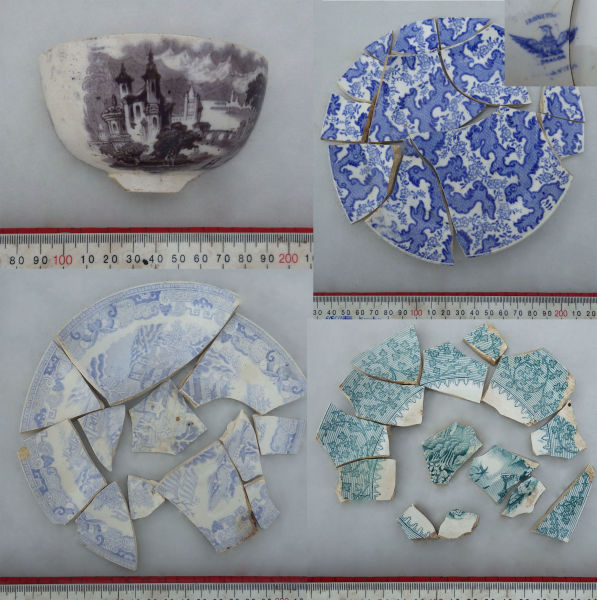
Ceramic artefacts from one of the rubbish pits on the section. Image: J. Garland.

Ceramic artefacts from one of the rubbish pits on the section. Image: J. Garland.

While it is difficult to associate the features found on the site with any one resident during the 19th century, it is almost certain that some of them were deposited by Hiorns and his family, including some of the 1037 artefacts found in the large depression to the rear of the building. That particular feature looks to have been used for the disposal of rubbish over an unknown period of time, based on the presence of small concentrations of objects within the feature as a whole, the size of the assemblage, and the wide range of manufacturing dates found among the artefacts. Many of the artefact dates, however, fit in well with the period in which Hiorns was resident on the section. On top of this, the assemblage contained a large number of alcohol bottles and several artefacts which are considered to be “higher status” items, or objects more often associated with people of reasonable wealth. It would make sense for the man who a) ran a hotel and wine bar and was in court more than once on alcohol related charges and b) later purchased the prestigious Linwood House, to have owned items like these.

Selected glass bottles from the site, including Rowland's Macassar Oil, a Piesse and Lubin perfume bottle and part of an infant feeding bottle. Image: J. Garland.

Selected glass bottles from the site, including Rowland’s Macassar Oil (mid-right), a Piesse and Lubin perfume bottle (top right) and part of an infant feeding bottle (top left). Image: J. Garland.

The assemblage also contained large quantities of ceramic tea and table wares, as well as household and hygienic items like chamber pots, wash basins and ointment pots, a quantity of shoes and fabric, food containers, pharmaceutical bottles and children’s artefacts. One of the most interesting finds, however, was a cluster of clay tobacco pipes that included pipes with political motifs as decoration. These pipes – bearing the name and bust of William Gladstone, liberal English politician, and the name of Garibaldi, famously nationalist and progressive Italian general – can easily be tied into Hiorns’ political engagement (which I sort of alluded to above, but haven’t had time to go into detail about) and the politically charged narrative of this entire Armagh Street site (which I definitely haven’t had time to go into). They’re an example of material culture that is actively entangled with the more intangible ideas and ideals of the people and society by which they are made and used (a topic for another day, I think).

Clay smoking pipes found in Feature 3 (the depression to the rear of the house). Image: J. Garland.

Clay smoking pipes found in Feature 3 (the depression to the rear of the house). The Gladstone pipe is the one in the top row, while the Garibaldi pipe is second from the right in the second row from the top. Image: J. Garland.

I may have started this post with a melodramatic paragraph that reads more as pulp fiction than historical narrative, but in truth, the story of Edward Hiorns (and all of the residents of this block of Armagh Street) is not all that sensational. What it is, however, is a tale we come across all the time in Christchurch. There are many interesting themes to be found in the archaeological and historical records of his life, but two of the most interesting from my perspective are the way he “improved” his situation in life, so to speak, and the way he involved himself so readily in the governance and development of the city in which he had settled. It’s a combination that we see again and again in the lives of Christchurch residents from the 19th century.

People talk a lot about the fluidity of class and social affluence in the 19th century, especially in colonial settlements like New Zealand, and the significance of the capitalist ‘entrepreneurial spirit’ in the prospering of Victorian society. These are both more than evident in the case of Mr Edward Hiorns (and Mr Jamieson, and Mr Ruddenklau and Reverend Fisher). What is just as evident, however, is the active engagement made by people like Hiorns with the present and future of the community in which they lived – be it at the local, national or global level. I could, with the aid of Mr Hiorns and others, very easily take you all down the rabbit hole with me here into the fascinating world of political and social change in 19th century Christchurch (the labour movement! radicalism! women’s suffrage!) and the lives of the people who fought to change the world around them, but that is too much for any one blog post, let alone this one. Nevertheless, it bears remembering that theirs were the hands that shaped a city and, though the city, helped to shape a nation.

Jessie Garland.

References

LINZ, c. 1850. Deeds Index – A – Christchurch town sections and town reserves. Archives New Zealand, Christchurch Office.

McAloon, J., 2000. The Christchurch elite. In Cookson, J. and Dunstall, G., eds). Southern Capital Christchurch: Towards a City Biography, 1850-2000., pp. 193-221. Canterbury University Press, Christchurch.

Wright, G. R. 1998. The Petty Bourgeoisie in Colonial Canterbury; A Study of the Canterbury Working Mans’ Political Protection and Mutual Improvement Association (1865-66) and the Canterbury Freehold Land Association. MA Thesis, University of Canterbury.

Papers Past. [online] Available at www.paperspast.natlib.govt.nz.