Theo Schoon- the matter of interpretation

Oh hi – if you are an avid reader of our blog a couple (ok a few) years ago one of our historians (me) went rogue writing about the artistic life of Tony Fomison – who was known as an archaeologist amongst the said historian’s archaeology peers. Amongst the tangent of found art and ramblings of an avid fan, mention was made of a very polarizing individual, Theo Schoon, who crossed paths and opinions with Fomison and pretty much everyone else. Such was the topic of Schoon that it was worthy of its own blog post, and a promise was wildly made to said colleagues. Well folks, here is the promise fulfilled; another art/archaeology crossover special – this time a controversial tale of a colonial childhood, a misaligned love of art form that resulted in cultural appropriation, and a white saviour mentality only to be topped off by a perceived bitter rejection. I know it sounds grim, but read on, these topics are relevant in our current climate and form a delicate balancing act, reflecting on our past to improve our future. For this blog post, we will be focusing on the archaeology lens of Schoon the polymath.

But before we ‘dig’ into the archaeology, here is a quick summary of the life and times of Theodorus Johannes Schoon (1915-1985) #youalwaysneedcontext. Schoon was of Dutch heritage and was born in Kebumen, Java, Dutch East Indies (which would become known as Indonesia). Schoon grew up as the child of a Dutch civil servant and, as a result, was educated alongside the children of Javanese nobility. It was within this environment that Schoon learnt classical Javanese dance. The Javanese way of life would permeate into many aspects of Schoon’s life as an adult. Schoon’s education continued in the Netherlands where he attended the Rotterdam Academy of Fine Arts during the 1930s (Skinner, 2000). Schoon returned to Java in 1936, establishing a studio creating photographic folios of the local environment, people and their lifestyles. In 1939 Schoon’s family immigrated to New Zealand, and Theo, aged 23, followed his family to New Zealand where they settled in Christchurch. Schoon ensconced himself into the New Zealand art world, briefly attending Canterbury University College School of Art, before a move to Wellington in 1941. If you imagine the art world that Schoon entered, you would have seen Schoon rubbing shoulders with the likes of Rita Angus, what we know as ‘The Group’ or ‘Bloomsbury South’, Gordon Walters, and Dennis Knight Turner (Skinner, 2000).

Portrait of Theo Schoon posed and wearing a Balinese costume. Image: Spencer Digby Studios, 1943.

The year 1946 brings us to our lens, a time and place of discovery for Schoon, and it is here where Schoon’s upbringing within the Javanese culture (albeit with a colonial perspective) and art education would colour his approach to and interpretation of his exposure to Māori rock shelter drawings. The Māori rock art would leave a permanent impression on Schoon, who recognised the significance of the work much earlier than many Pākehā, and for that we should acknowledge Schoon, but that of course comes with a caveat.

Cue Damien Skinner, biographer of Schoon. It is a role that Skinner is especially well equipped for; as a researcher and writer Skinner is acutely aware of the responsibility of reformatting Pākehā thinking. To quote: “I would call it decolonisation. Schoon is my problem” (Lopesi, 2019).

In Skinner’s biography, Schoon’s first encounter with Māori rock shelter art was reading an article in the Journal of Polynesian Society by historian G. B. Stevenson from 1943, which noted rock drawings observed in the Waitaki Valley, Te Waipounamu (Skinner, 2018: 94). To preface this interest, you must note Schoon’s art education in Europe, which had included the African and Pacific art that inspired the development of art movements such as Cubism. Schoon, cognisant of this link, also knew that Māori rock drawings were somewhat underrepresented (at the time) in anthropology and archaeology. New Zealand artists were preoccupied with establishing a New Zealand style of art based on regionalism and a sense of local identity that still had roots in Europe’s art movements (Ministry for Culture and Heritage, 2012).

Schoon travelled to South Canterbury to see the drawings for himself. As luck would have it, earlier in 1945 Roger Duff, the ethnologist at Canterbury Museum, had very recently surveyed the rock drawings in the area and concluded that the drawings he had observed required accurate protection and recording in the form of site photos, drawings, and tracings (Skinner, 2018: 94-98). Enter the ubiquitous Theo Schoon with his uncanny knack (here I quote Anthony Bryt from 2019, call him a ‘Zelig’ if you like) to suddenly appear at the scene of an opportunity (Byrt, 2019).  As a result, Schoon was employed on a project where he travelled to Gordon’s Valley, South Canterbury, with Duff and recorded the drawings. The resulting copies were in oil on canvas boards. Duff was impressed with the faithfulness and accuracy of the works. This initial work acted as a segue to recording rock art in the South Canterbury region. Funding for eight weeks was provided by the Department of Internal Affairs and was endorsed by no other than William Vance, the local department officer and author of High Endeavour (ok I sense another blog post), and the works were to be supervised by the Canterbury Museum.

What could go wrong? Māori rock art around Aotearoa was being accurately recorded and catalogued, and the project was fine until some of the rock drawings got “schooned”… WTF? Schooned (McCulloch, 1985)? Yeah, that was me too… read on dear reader for the term “schooned” exists within a context… although I could coin the phrase “schooned” for use in many a situation. So, to provide you with the said “context” I will cast you back to Duff from the Canterbury Museum mentioning in his initial survey that the drawings required protection measures…

Imagine heraldic triumphant noises and in rides from stage left, Theo Schoon and his trusty box of crayons, ooh and some red raddle, why not…to retouch the rock drawings complete with a flourish of his signature… you may now facepalm. It is here that we can concede that the state of the drawings was subject to agricultural and environmental conditions (Skinner, 2018: 130). You could argue that retouching the work was an act of ‘preservation’, not unlike the processes in place by museums and art galleries maintaining the condition of their artefacts. The difference was a lone restorer (yes, I know you are thinking of the Ecce Homo fresco), not aware of his material impacts on the original drawing, and not to mention the most important factor, lack of consultation with local iwi and professionals. By 1946, Duff was overseeing Schoon’s work in South Canterbury and Duff’s field books record accounts of Schoon’s retouching. This was referred to in Fomison’s report to the New Zealand Archaeological Association regarding the topic of ‘Theo Schoon and the Retouching of Rock Art’ (Fomison, 1987). To be honest, the retouching was something that Duff also struggled with if his field books are anything to go by. In October 1946 Duff notes that in a ‘judicious restoration’ Schoon had brought to light a ‘previously scarcely recognisable figure’ of Gould’s Taniwha cave. By March 1947, Duff had not been in the field with Schoon for four months, and his take on Schoon’s flagrant ‘schooning’ had time for reflection. Fomision’s report recounts Duff asking Schoon not to restore any figures in the future. Fomison went on to say that the retouching of the work in ‘grease crayon’ had so far proved ‘irremovable’. The crayons used were black and a red raddle (for marking sheep) – despite the fact the rock art varied from a ‘near-purple’ through to the ochre ‘yellow-orange’ (Fomison, 1987; Skinner, 2018: 102). Schoon also did not attempt to cover mark for mark (well here you could argue ICOMOS principles that you can delineate between the original work and the assumed restoration…? No, Nah, didn’t think so). Fomison’s report recounted that the retouching work was done prior to the photography that was also used to record the drawings (Fomison, 1987).

“Birdmen,” a recreation of Maori rock drawings in Frenchman’s Gully, Pareora, by Theo Schoon, at the Robert McDougall Art Gallery. Image: Press, 25/9/1985: 26.

It’s very conflicting stuff, right? Probably why it’s taken so long to write this blog (and my tendency to overthink things). Fomison’s report culminated in a description of a recorded interview of Schoon before he returned to Sydney for his final year . Fomison quipped:

‘In a matter of days, film footage and sound tapes had been used up; and Theo had picked enough fights to confirm his decision to return to Sydney, which he did.’

Schoon’s approach to recording and restoration was forthright, much like his approach to life in general. Schoon, I guess, held at one point a great certainty in himself and not much self-awareness, which I think enabled a type of clarity in his observations, especially that of Māori archaeology and art and its much-needed inclusion in the New Zealand narrative.’ (Skinner, 2018: 297).

By the 1960s, Fomison had become part of the emergence of recorded archaeology in New Zealand, surpassing Schoon’s efforts on a far more scientific level, with one very pointed observation that most of the Māori rock art was found not in caves but in undercuts/ledges in the bases of limestone bluffs (Skinner, 2018: 297). Schoon was given the chance to respond to Fomison’s findings and opinions on his preservation work, which was published in the New Zealand Archaeological Association Newsletter (it was edited as I guess you could imagine). Schoon acknowledged that the retouching was undesirable, but wetting the works did nothing to bring out the deteriorated drawings for the photography. Thus, Schoon stated that he resorted to retouching. Schoon was taking on a task that no one else was prepared to do, and he was willing to stand accused of vandalism if it meant some sort of record was preserved… #rescuearchaeology anyone (Skinner, 2018: 300)? It’s here I defer to one of my colleagues, the superstar archaeologist and inadvertent ‘found art’ artist T. Wadsworth, to explain that Schoon’s vandalism was also scientific:

“So we now have methods of analysing pigments and dating rock art based on charcoal content, but a recent study (O’Regan et al. 2019. Dating South Island Māori rock art: Pigment and pitfalls) found that Schoon’s retouching has resulted in false results and compromised such analysis. We also have new digital technology and better methods to record and identify faded rock art, which has also been complicated by Schoon’s retouching (pers comm. Wadsworth, 2023).”

Wadsworth’s morning teas have been exclusively photographed by A.E. Gibson as found art and have featured for the past three years on Instagram. Image: Gibson, 2021.

I guess the report and his rebuttal cemented Schoon’s malaise (well bitterness as the story goes) of New Zealand entirely, one of the final nails if you will (Skinner, 2018: 297). This negative perception of New Zealand blindsided his insight into Māori art. Schoon thought it should be preserved in time, and as such, his aggrieved conclusion of New Zealand did not account (or did he just not live long enough?) for Māori art to evolve into the current narrative, now firmly translated into New Zealand modernism. Sydney, Australia, was his next and final stop with his 34 boxes of possessions (Skinner, 2018: 300). It has to be noted that while Fomison’s account of Schoon’s interview in his report was articulate and focused on Schoon there was a typical artistic melee around the production of the audio and film. An ad hoc team assembled for the event at Fomison’s house, as Schoon’s accommodation was too small, but still, it was not a comfortable environment for the now-infirmed Schoon. In attendance were art historian Michael Dunn, John Edgar (stone carver) and David Simmons (anthropologist), all friends of Schoon and who managed to steer the conversation to bring out an informed and approachable flow. By Skinner’s account, this was interjected by a drunk foetal positioned Fomison and fellow (likely intoxicated) artist Allen Maddox playing stuck riffs of Jimi Hendrix records (Skinner, 2018: 300).

In Anthony Byrt’s review “Book of the Week: That total asshole Theo Schoon” of Skinner’s book as ‘a tortured biography’, Bryt’s opinion of Schoon is described as being ‘hinged on whether he’s master or mulch’ (Bryt, 2019).  I mentioned this in my last blog post in a more measured account… In Skinner’s biography, Schoon’s achievements in championing others are highlighted as are his drawing attention to traditional Māori art forms (rock drawing and gourd carving) for a ‘new New Zealand art’. Byrt sees Skinner’s struggle to navigate all the positives that Schoon’s perceptive eye was capable of uncovering only for Schoon to obfuscate it all with his infuriating personality. Ok yes, as Bryt says, he could be a right dick sometimes. Can I say that? Too late.

All this confusion around Schoon, and his misaligned, but nonetheless important contribution to archaeology, does raise questions about our own approach. Schoon is the unravelling thread. We too will no doubt in the future will be called to account around best practices in archaeology. It is that evaluation of our past to improve our future. It is part of being a historian, to be the recall in the current realm – reminding us we need balanced research so that we don’t repeat ourselves but also admit to our own ‘schooning’. Simply put, try not to make dick moves; you’ve got the benefit of hindsight.

The Artistic Historian

References

Byrt, Anthony, 2019. Book of the Week: That total asshole Theo Schoon. The Spinoff [online] Available at: <https://thespinoff.co.nz/books/28-02-2019/book-of-the-week-that-total-asshole-theo-schoon> Accessed June 2023.

Fomison, Tony, 1987. Theo Schoon and the retouching of rock art. Archaeology in New Zealand 30: 158-160. [online] Available at:  https://nzarchaeology.org/download/theo-schoon-and-the-retouching-of-rock-art. Accessed February 2023.

ICOMOS New Zealand Te Mana o Nga Pouwhenua o Te Ao, 2010. The ICOMOS New Zealand Charter, Te Pumanawa o ICOMOS o Aotearoa Hei Tiaki I Nga Taonga Whenua Heke Iho o Nehe. [online] <https://icomos.org.nz/charters/> Accessed June 2023.

Jones, Sam, 2018. How ‘Monkey Christ’ brought new life to a quiet Spanish town. The Guardian [online] Available at: <https://www.theguardian.com/world/2018/dec/28/how-monkey-christ-brought-new-life-to-a-quiet-spanish-town> Accessed June 2023.

Lopesi, Lana, 2019. The debate over Theo Schoon, who built his career on the backs of Māori artists. The Spinoff [online] Available at: <https://thespinoff.co.nz/art/08-08-2019/the-debate-over-theo-schoon-who-built-his-career-on-the-backs-of-maori-artists> Accessed June 2023.

McCulloch, Beverley, 1985. Maori Rock Drawings: A Matter of Interpretation. Robert McDougall Art Gallery and Canterbury Museum. [online] Available at: < https://christchurchartgallery.org.nz/media/uploads/2010_08/TheoSchoon.pdf> Accessed June 2023.

Ministry of Culture and Heritage, 2012. A new New Zealand art. [online] Available at: <https://nzhistory.govt.nz/culture/nz-painting-history/a-new-new-zealand-art> Accessed February 2023.

Press, 1861-1979. [online] Available at: <https://paperspast.natlib.govt.nz/> Accessed June 2023.

Skinner, Damian, 2000. ‘Schoon, Theodorus Johannes’, Dictionary of New Zealand Biography, first published in 2000. Te Ara – the Encyclopedia of New Zealand. [online] Available at:  <https://teara.govt.nz/en/biographies/5s4/schoon-theodorus-johannes> Accessed February 2023.

Skinner, Damian, 2018. Theo Schoon. A Biography. Auckland: Massey University Press.

Spencer Digby Studios, 1943. Portrait of Theo Schoon posed and wearing a Balinese costume. [online] Available at:  Te Papa Collections Online < https://digitalnz.org/records/176921/tn-theo-schoon> Accessed June 2023.


Where did that wood come from?

Archaeology is a broad discipline, with a multitude of subsects and specialisations. One of these is buildings archaeology, where we use archaeological methods to record and analyse buildings and see what that can tell us about the people that constructed them. We’ve written various blogs before about some of the different houses that we’ve recorded, and while this blog is also within the realm of buildings archaeology, it’s also quite different to those other blogs. Part of our work as archaeologists is to place things within the historical context of the period that they date to. If we were excavating a Roman villa and we found glass windowpanes, then we’d be interpreting that villa as probably belonging to a pretty wealthy individual. However, when we find window glass in Christchurch, that doesn’t really tell us anything about the status of the person that built that house, as window glass was readily available and used in the majority of buildings. We’re really lucky as historical archaeologists that there are large historical datasets that we can use to help us with determining the context of the period that our sites date to. However, there’s hours and hours of research that goes into building a database from raw historical data, and even more hours spent looking at patterns and trends to help us establish that historical context.

Returning to buildings archaeology, one of the key elements that we look at when we record a building is what it was made from. Here in Christchurch, that’s almost always timber. From our recording, we know what types of timbers were typically used here in Christchurch for houses, but that’s only half the story. By doing detailed historical research on the timber industry, we can find out if there were patterns in what species were available for purchase and then use that historical information to provide more context to what we find in the archaeological record. It all sounds so simple, but let me tell you it’s not. I’ve spent countless hours doing research into the Christchurch timber industry, and I’ve only gotten through the first 20 years. That period is going to be the focus of this blog.

That sure is some nice timber, I wonder where it came from?

Prior to 1850, the year that the city of Christchurch was founded, the Canterbury Plains were largely devoid of forests. Although opinion is divided on the exact extent of forested area in Canterbury at the time of Pākehā settlement, Roche (1990) estimates that the combined forest area in the Canterbury settlement added up to only 240,000 acres, or 12 % of the total land area (Roche 1990: 75). Near Christchurch there was a small forest of 54 acres where Christchurch’s most notable pioneers, the Deans brothers, established their Riccarton farm in 1843 (Orwin 2015: 25-26). The largest areas of forest were located some distance away. These included the native podocarp forest of Banks Peninsula, comprised mainly of matai (then known as black pine), kahikatea (white pine) and totara (for some reason just known as totara); and the mixed podocarp and beech forest at Harewood Forest, with kahikatea, rimu (red pine), matai and totara, with silver and black beech (they called it birch back then and were big time into their colour naming system; Roche 1990a).

Map of bush cover in Canterbury collated and reconstructed from 1850s and 1860s surveyor’s notebooks and maps by W. B. Johnson and redrawn for Pawson and Holland (2005: 171).

An 1851 sketch of the upper reaches of the Waimakariri River showing Harewood Forest, one of the largest areas of bush close to the city of Christchurch. Image: Fox, W. and Allom, T., 1850-1851.

Suitable building timber was not readily available in Christchurch and so Canterbury’s pioneer settlers built their houses from materials that they either brought with them from elsewhere, such as canvas, calico and sheets of iron to form tents and rudimentary temporary dwellings, or resources that might have been available on or near their chosen sections. These included volcanic stone, rammed earth, sod or mud brick for the walls and thatched or slab roofs made from raupo, toetoe, tussock, or bark (Bowman 1941, Isaacs 2015, Salmond 1986). In areas where timber was more plentiful wooden slabs or logs were used to build basic wooden structures, but even then, some timber had to be imported because of the difficulty in getting the logs milled once they were cut down.

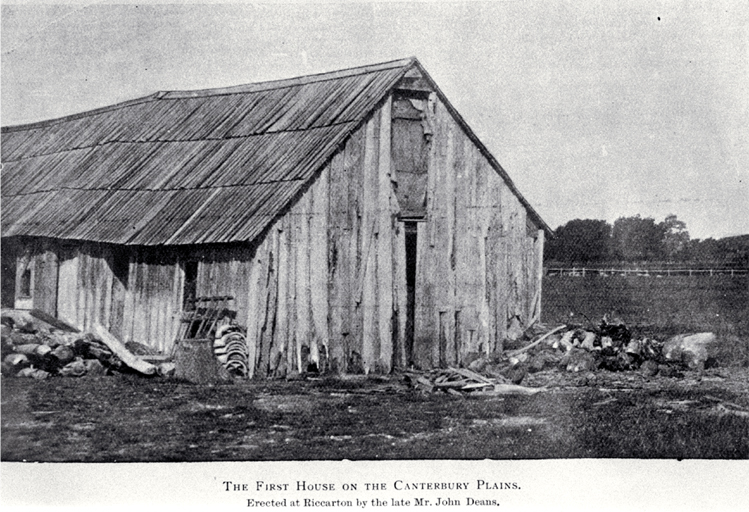
Although it was located right beside one of the largest stands of forest near Christchurch, Deans Bush, the first house on the Canterbury Plains built by the eponymous Deans brothers was constructed from framing timber that they brought with them from Wellington (Bowman 1941).

Photograph of the first house built by the Deans brothers near Riccarton Bush in 1843. The house was built with timber brought from Wellington but was dismantled in the late 1890s. Image: Canterbury Times, 1900.

With the founding of Christchurch city and the rapid expansion of its Pākehā population, an increasing number of settlers had to obtain the materials they needed to construct their permanent residences, fuel their fires, and fence their farms. Although Canterbury was comparatively bereft of a sustainable supply of timber, wood was still the dominant building material for houses in Canterbury in the nineteenth century (Government Statistician, Registrar-General’s Office 1874). This all led to the establishment of a burgeoning timber importation trade (Roche 1990).

Banks Peninsula was the largest and most easily accessible source of timber close to Christchurch, meaning this region was one of the major suppliers of building timber and firewood to the colony. If you want to read more about sawmilling on the peninsula and what happened after the timber arrived in Christchurch, I highly recommend that you read Lydia’s excellent post on the topic from earlier in the year. The timber supply from Banks Peninsula was, however, short lived and the capacity to saw and ship it was limited, so in this post we’re going to explore exactly where Christchurch got all its wood from.

By combining the magic of PapersPast and the dark arts of Excel, I tracked the ups and downs of the Canterbury’s timber economy over the first few decades of Pākehā settlement in Christchurch to figure out where the town was getting its timber from and how this changed over time.

January 11, 1851, was the first issue of the Lyttelton Times to be published and the first issue to include a list of vessels that had arrived in Lyttelton Port since the previous December, including the first four ships carrying the pioneer settlers and all of their possessions to Lyttelton (Lyttelton Times 11/1/1851: 5). Included was a schedule of the cargo each vessel carried, with the schooner, Phoebe, the first reported timber carrying vessel arriving from Wellington carrying a load of timber. For the first few years of settlement Wellington was to be the predominant supplier of Canterbury’s timber.

Not the Phoebe. Also not Lyttelton, but this is probably what it looked like when the first load of timber arrived in Lyttelton. Image: Frederick Nelson Jones.

Although several gangs of pit sawyers had established themselves in many of the bays of Banks Peninsula by this time, their contributions to the overall timber supply in the first years of settlement were negligible in comparison to other regions. Timber imports soon picked up though, as did the quantity of timber arriving in the city from Banks Peninsula. By the mid to late 1850s, imports from Tasmania were contributing a significant quantity of timber to the market, and from the early 1860s vessels from North America and the Baltic region were bringing large cargoes of Northern Hemisphere timber, such as Baltic pine, Douglas fir and cedar.

Within the first ten years of the arrival of the settlers, timber imports had increased considerably. This coincided with an increase in the population of Canterbury, as well as the number of wooden dwellings that were being built. This was a pattern observed across the study period, although population tended to increase in a more or less linear fashion, while timber imports fluctuated more but trended upwards almost exponentially overall.

A steep decline in the quantity of timber being imported to Christchurch and Lyttelton occurred in the late 1860s. There were several factors that probably contributed this. The population had continued to grow, and wooden dwellings were also being constructed at an increasing rate, so it was not likely a lack in demand for house building materials. The market commentary in the newspapers around this time suggests that the timber supplies were overstocked, likely due to huge shipments arriving from overseas and the from the Nelson and Marlborough region. On several occasions in 1866 newspaper correspondents reported that the timber market was depressed, Sales were low and likewise timber prices had tanked (Lyttelton Times 7/7/1866: 2, 2/11/1867: 2). This glut in the market likely caused timber merchants to refrain from importing new stocks until the oversupply had diminished and prices had increased. Due to the time lag between orders and shipment this reduction in imports was not fully realised until 1867-1868.

Customhouse Street wharf area, Wellington, circa 1868, with the harbour and Queens wharf in the background. The sailmaking premises of John S Burn, a boat under construction, and a timber yard, are visible.  Couchman, (Mrs), active 1967. Customhouse Street wharf area, Wellington. Ref: 1/2-029401-F. Alexander Turnbull Library, Wellington, New Zealand. /records/22751906

A notable shift in the regions supplying timber occurred after 1864. Shipments from the Wellington and Auckland/Northland regions declined towards the late 1860s, but were replaced with considerable supplies from the upper South Island. Imports from the West Coast were non-existent until around 1867, which coincided with the end of the gold rush in this region. The milling industry in Westland was initially established in order to supply the requirements of gold miners, but, after the rush was over, had expanded significantly. By the 1870s the West Coast milling industry was supplying sawn timber to other regions, including Canterbury, as well as a thriving trans-Tasman export trade (Roche 1990a: 179).

While mainland Australia was a consistent, albeit minor, contributor to timber imports over the study period, Tasmania remained an important supplier to the Canterbury timber economy, from the first cargoes that arrived with the pioneer settlers in 1850, up until at least the early 1870s. It is likely that most, if not all of the timber that was imported from Tasmania at this time was harvested by convict labour. From 1804 convicted felons were transported to Van Diemen’s Land, as it was then known, and forced undertake hard labour while also forming a founding population for the new British colonies. Convict labour was employed in the harvesting of timber, a task that served both as punishment and progressed the economic ambitions of the colony by generating an exportable commodity, which found a ready market in Christchurch (Tuffin and Gibbs 2020; Tuffin et al 2020).

The original human centipede? Convicts hauling a log at Port Arthur c.1836. Image: State Library of Victoria: ML 185. 

The predominant target species were varieties of Eucalyptus, mainly stringy bark and blue gum. Stringy bark was favoured for construction and blue gum was used as a general-purpose timber and for ship building (King 2019; Tuffin et al 2020). The Tasman Peninsula remained a timber production centre until the closure of the Port Arthur penal settlement and prison in 1877. Although Tasmanian timber was available on the Christchurch market, imports from there declined towards the 1870s, possibly as a result of the decline in the use of convict labour.

The number of inward arrivals and quantity of timber being imported dramatically increased again towards the mid-1870s when large quantities of timber began arriving from Auckland. Commonly known as ‘The Vogel Era’, the 1870s was a boom time for the New Zealand economy, stimulated by the flow of money from the gold rushes of the previous decade and the success of the wool export market, and accelerated by a public borrowing programme instituted by Julius Vogel (McLintock 1966). Vogel instigated heavy public investment in infrastructure, such as a roads and railways, which saw a corresponding expansion in timber milling, including the revival of milling at Harewood Forest (Roche 1990a). This increase in arrivals to Christchurch is, therefore, predictable, as millers geared up to supply timber for railways and ports.

Over the course of the entire study period Banks Peninsula supplied the greatest quantity and the highest proportion of timber in total, though this supply began to decline towards the end of the study period. Roche (1990a: 79) notes that the number of sawmills in operation on Banks Peninsula had dropped from at least ten in the late 1850s to just four by 1876; although those that remained were by all accounts “doing a brisk trade”. Milling on the Peninsula had all but ceased by the 1880s, and although the study period doesn’t cover these later years, the data for 1875 seems to reflect the decline of the milling industry on Banks Peninsula with a diminishing contribution to the Christchurch timber market.

Unfortunately, I wasn’t able to continue the shipping research beyond the latter 1870s. Scrolling through PapersPast collecting this data takes an extraordinary amount of time, but I really want to know what happened to the Canterbury timber economy in final decades of the nineteenth century, through the decline in milling on Banks Peninsula (and the regions that replaced this supply), the 1880s depressions era and the subsequent economic recovery. I probably wouldn’t get your hopes up, but one day I might write a sequel to this story.

Kirsa Webb

References

Bowman, A., 1941. The study of the historical development of domestic architecture in Canterbury, New Zealand. Thesis submitted for membership of the Royal Institute of British Architects.

Government Statistician, Registrar-General’s Office, 1874. Results of a Census of the Colony of New Zealand taken for the night of the 1st March 1874. Wellington, NZ: Government Printer.

Isaacs, N.P., 2015. Making the New Zealand House 1792-1982. Thesis submitted for the degree of Doctor of Philosophy. Victoria University of Wellington, Wellington, New Zealand.

King, S., 2019. The Architecture of Van Diemen’s Land Timber. Fabrications, 29(3): 338-358.

Lyttelton Times 1851-1920. Newspaper [online]. Retrieved from https://paperspast.natlib.govt.nz/newspapers/lyttelton-times. Accessed: April 2022.

McLintock, A. H. (ed.), 1966. “The Vogel Era: economic history”. An Encyclopaedia of New Zealand [online].Retrieved from: http://www.teara.govt.nz/en/1966/history-economic/page-3. Accessed: July 2022.

Orwin, 2015. Riccarton and the Deans Family – History and Heritage. Auckland: David Bateman Ltd.

Pawson, E. & Holland, P., 2005. Lowland Canterbury landscapes in the making. New Zealand Geographer, 61:167-175.

Roche, M., 1990. History of New Zealand Forestry. Wellington: New Zealand Forestry Corporation.

Salmond, J., 1986. Old New Zealand Houses 1800 – 1940. Auckland: Heinemann Reed.

Tuffin, R. and Gibbs, M., 2020. The Archaeology of the Convict Probation System: The Labor Landscapes of Port Arthur and the Cascades Probation Station, 1839–55. International Journal of Historical Archaeology, 24: 589–617.

Tuffin, R., Gibbs, M., Clark, D., Clark, M. and Rigozzi, P., 2020. ‘…One of the Most Severe Duties …’: Landscapes of Timber-getting at a Former Tasmanian Convict Station. Industrial Archaeology Review 42(2): 126-140.

Up in the Clouds: Aerial Archaeology

Today on the blog we are taking to the skies to talk about aerial archaeology; the investigation of archaeological sites and landscapes from a higher altitude. There is nothing quite like having a bird’s eye view, and, when investigating archaeological sites or considering the archaeological potential of an area, one of the first things we look at is aerial imagery. For much of the 20th century aerial imagery was recorded via a plane, but in our modern era we have access to high quality satellite imagery and drone footage. Aerial archaeology is just another everyday tool in the archaeologist’s belt, and today we are going to go through a bit of background before diving into some local examples.

If we go back to the very beginning, on a small farm outside of Temuka, a humble Kiwi farmer was one of the first people to fly and land a powered heavier-than-air machine (Figure 1). I’m talking of course about Richard Pearse, who flew in 1902, nine months before the Wright Brothers – not that I am keeping score. While our friend ‘Bamboo Dick’ (yes that’s what they called him) didn’t take any photographs from his ‘monoplane’, his inventions and trials mark the beginning of flight in New Zealand – it would be rude not to give him a shout out.

Figure 1: Richard Pearse and his ‘monoplane’ forever remembered on a limited edition stamp and in our hearts (New Zealand Post, 1990).

Once people were up the air, it didn’t take long before the first aerial photographs were taken, including those of archaeological sites. To begin with this largely took place in Europe and America with iconic sites such as Stonehenge being among the first to be photographed from the air (Figure 2). In New Zealand things were a little bit slower, but by the 1920s aerial surveys were being completed in specific areas throughout the country. Within Christchurch, the 1920s aerials are pretty much limited to the coastline and the Port Hills. Unfortunately, we don’t have coverage of the CBD at this stage, but we do have a great view of Lyttelton. The quality is actually really good, and you can easily see the contours of the topography and individual buildings. But one of the most striking things we can see, is the development of the Lyttelton Port over the past 100 years (Figure 3).

Figure 2: Stone Henge from a hot air balloon 1906 (Renfrew and Bahn, 2012:78).

Figure 3: Above: Lyttelton Port late 1920s. Below: Modern aerial imagery (Canterbury Maps, 2023).

The 1940s, and the advent of World War Two, resulted in widespread systematic aerial surveys of Canterbury and wider New Zealand, including Christchurch’s CBD (Figure 4). Photos from this era and much of the 20th century are black and white, which is preferential for us as archaeologists. Black and white photos clearly show contours, shadows, and topography, especially if they are oblique (at an angle to the landscape). In contrast vertical photos are much better for understanding spatial layout and are handy for mapmaking (Figure 5).

Figure 4: Christchurch within the four avenues, early 1940s (Canterbury Maps, 2023).

Figure 5: The two types of aerial image – yes, I took this from my first-year textbook (Renfrew and Bahn, 2012: 79).

Further aerial surveys were completed throughout the 20th century, with all of New Zealand photographed by the 1950s (Jones 1996: 25). By the 1990s we even had colour! But don’t get too excited as the quality is terrible, I tend to avoid the photos from 1995-2004 altogether (Figure 6).

Figure 6: A very blurry, but coloured, Christchurch Cathedral (Canterbury Maps, 2023).

By the 1950s and 1960s, the systematic use of aerial photographs for archaeological purposes had commenced and there are a few early reports and articles that talk about this ‘new’ technology (Gorbey, 1967). However, in the world of aerial archaeology in New Zealand, one person in particular comes to mind – the late great Kevin Jones. Kevin made both nationally and internationally significant contributions to aerial archaeology. I even learnt about him and his contributions while studying at university (and was just a tad starstruck when I met him). His book Ngā Tohuwhenua Mai Te Rangi: A New Zealand Archaeology in Aerial Photography is nothing short of quality research and sheer beauty. It showcases New Zealand’s archaeology much more eloquently than I could ever dream to discuss in a blog. For anyone who wants to check it out, his book is available digitally here (https://nzetc.victoria.ac.nz/tm/scholarly/tei-JonTohu.html). Thank you for all of your mahi Kevin <3

Figure 7: A key text typically found on most archaeologist’s bookshelf.

Let’s look at some archaeology!

Perhaps the most iconic archaeological site type we have in New Zealand is the pā. Many pā, particularly in the North Island, have been photographed and surveyed from the air, as their earthwork features are stunning from this viewpoint (Figure 8). Cascading pits, tumbling terraces, and extensive earthworks really shine in oblique black and white photographs. While pā are more common up north, we do have some spectacular pā here in Canterbury, including those accessible to the public. One example is Ngā Niho Pā on the Kaikoura Peninsula (Figure 9). Its location against the Peninsula’s rocky edge provides both a natural defence and clear viewpoint along the coastline. Another example a little closer to Christchurch is Ōnawe Pā, located at the head of Akaroa Harbour (Figure 10). Its long thin neck provides a natural defensive feature, and from black and white aerials we can clearly see further defensive earthworks on the interior of the pā (Figure 11). Make sure you stop in to visit these sites on your next road trip, just remember to be respectful and follow any outlined tikanaga. And, of course, if you want to learn more about these places, check out some indigenous resources like the Kā Huru Manu: the Ngāi Tahu Cultural Atlas.

Figure 8: Cascading pits at Kohukete, one of the largest pā in the Hawkes Bay (Jones, 1996: 27).

Ngā Niho Pā on Kaikōura Peninsula. Strategically located against the steep hillslope. This pā is open to public access (Canterbury Maps, 2023).

Ōnawe Pā – using the environment to its advantage (Canterbury Maps, 2023).

Close up of Ōnawe Pā – can you see the defensive ditches? (Canterbury Maps, 2023).

Within the Christchurch CBD, most of what we see in aerial photography is buildings – no surprises there. But through aerial photographs we can see changes, additions, and demolitions, which is all useful information we need to understand the history of a site. Sometimes all we need to see is the roofline of a house to better understand how it has been added to over time (Figure 12). Sometimes all we have left to physically indicate a building ever existed is the footprint or the foundations (Figure 13, Figure 14, Figure 15). And sometimes you are just being nosey and stumble upon something a bit more interesting and uncommon than usual (Figure 16).

Figure 12: A cluster of late 19th century houses in Christchurch that were demolished after the Canterbury earthquakes. Can you see all those lean-tos? (Canterbury Maps, 2023).

Figure 13: At first glance you may think this was another pā but no! This is the site of Christchurch’s first (of three) quarantine Stations. It’s located over in Camp Bay and those are the former building platforms. The cemetery is located on the headland (Canterbury Maps, 2023).

Figure 14: The concrete foundations of ‘Mansion House’ in Cheviot (Canterbury Maps, 2023).

Figure 15: A photo of ‘Manion House’ in Cheviot c. 1890 (unknown, 1890).

Figure 16: Ripapa Island – former pā, former quarantine station (the second one), Russian Scare fort, WW1 and WW2 defence. What an over achiever (Canterbury Maps, 2023).

From the air we also see scars of the former landscape and environment. A good Christchurch example is Horseshoe Lake over in Shirley. The lake is a redundant and cut off loop of the adjacent Avon River (Figure 17). It would have likely been cut off following a flood event where the Avon changed course, leaving the lake behind. Other former or remnant river channels are visible in aerial imagery throughout Canterbury, and they attest to the dynamic nature of our braided river systems.

Another major scar we see is the impact of the Canterbury Earthquakes. A review of aerial imagery from after 2010 is a particularly sobering experience. Collapsed buildings, liquefaction, spilling bricks, and sheer chaos can be taken in from above. Many of the gaps left behind in the city still lay vacant today and if we move outward into suburbia the rise of the Red Zone resulted in the death of many neighbourhoods (Figure 18).

Figure 17: Horseshoe Lake (top centre) now isolated from the main body of the Avon River(Canterbury Maps, 2023).

Figure 18: The extensive Burwood Red Zone (Canterbury Maps, 2023).

In contrast we also see the birth of new towns like Pegasus Town, to the north of the city (Figure 19 and Figure 20). When comparing different decades of aerial imagery, it can feel like these new towns and subdivisions spring up overnight. They may seem like a major change, but in reality, it’s just another step in the urban growth of the region and the start of a new story.

Figure 19: The location of Pegasus Town prior to development in the mid 2000s. Woodend is tucked in the bottom left corner (Canterbury Maps, 2023).

Figure 20: Pegasus as it stands today (Canterbury Maps, 2023).

I could go on for hours showing off more sites and explaining the uses of aerial archaeology, but I am nearing my word count. So, lets park it for now and maybe we can come back again and share more finds from the sky in future. In the meantime, check out some historic aerial imagery and have a snoop! These resources are free and online. You never know what you will find!

Alana Kelly

References

Canterbury Maps, 2023. Canterbury Maps Viewer. [online] Available at: https://canterburymaps.govt.nz/

Gorbey, G. 1967. ‘Aerial Photography in New Zealand archaeology’, New Zealand Archaeological Association Newsletter, 10(4): 167-175.

Jones, K. 1996. ‘Aerial Archaeology in New Zealand Archaeology’, Australasian Historical Archaeology, 14: 25-33.

New Zealand Post, 1990. Heritage – the Achievers stamp issue. [Stamp]. Available at: https://teara.govt.nz/en/postage-stamp/6562/commemorating-new-zealands-first-flight

Renfrew, C. and Bahn, P. 2012. Archaeology: Theories, Methods, and Practice. 6th edn. London: Thames and Hudson.

Unknown, 1890. Mansion House, Cheviot Estate. [Photograph]. Available at: https://ndhadeliver.natlib.govt.nz/delivery/DeliveryManagerServlet?dps_pid=IE57788&dps_custom_att_1=emu Accessed March 2023.


A Disturbing Discovery

Disclaimer: the topics discussed in this blog post include descriptions of murder, torture and rape. Reader discretion is advised.


It was around a year ago that Underground Overground Archaeology again hit the mainstream news, this time with stories about our excavations at the site of the new Court Theatre (a few of those stories here, here, and here). While it’s great when media outlets publish stories about the archaeological work that we do, there are definitely pros and cons to the pieces. The main pro is, of course, that a much wider range of people get to hear about the archaeological work that we do in Christchurch, rather than just those that follow us on social media or keep up with this blog. The cons are that because the journalists that are reporting the stories aren’t archaeologists and often have word or time limits to keep to, their stories can be quite brief and often focus in on the stereotype that the only thing us archaeologists are interested in is ‘treasure’. Now, don’t get me wrong, us archaeologists are the first to get excited when we find a rare or unusual artefact, but we’re not pirates. For us, the real ‘treasure’ is the stories that the artefacts tell us about the lives of people of the past, rather than the artefacts themselves. Working out those stories comes long after excavation is finished and only happens once we have gone through all of the information we’ve collected, the notes on the features that we took when we excavated them, the results of the artefact analysis, and the information that we can draw from the historical record, and see what these three information sources, along with anything else we might have access to, can tell us. A lot of the time when we’re getting mainstream media interest, it’s at the time of the archaeological excavation, meaning that we haven’t yet worked out all the interesting stories as we are only at the start of figuring them out. That was very much the case when we were being interviewed about the Court Theatre site, where one of the ‘treasures’ that the journalists were most interested in was a clay pipe. A year later, we are now at a point where we’ve done most of the artefact analysis and we can actually start to narrow down some of those stories that the artefacts from the site are able to tell us.

A classic example of the use of ‘treasure’ by the mainstream media. While they’re not wrong, it does perpetuate the stereotype of archaeologists as Indiana Jones type figures, which is very much not the case. Image: Otago Daily Times.

The clay pipe in question is probably the most violent and confronting artefact that we’ve had come out of an archaeological site in Christchurch, at least in recent years. The pipe was elaborately moulded and depicted a man, wearing a turban and Indian style dress, holding a sword above his shoulder, ready to strike. Next to him is a woman lying with one arm raised, her chest bare and her dress pooled at her waist. A baby lies at her feet. A woman is shown fleeing on the side of the bowl. Stamped on the stem of the pipe was “NA NA SAIB” and “DELHI”.

Image: C. Watson

The clay pipe is depicting an event known as the Bibighar massacre, which took place within the 1857 Indian Rebellion. This rebellion happened when sepoys, or Indian soldiers, mutinied against the East India Company. The East India Company had had a presence in India since the early 17th century, and by the 19th century was effectively responsible for the government of India and was employing sepoys within their army. The reasons behind the mutiny were complicated but were mainly a result of an accumulation of grievances, mostly around the structure of the army and treatment of the sepoys, and the treatment of landowners and high-status individuals by the British. Sepoys in Meerut and Delhi mutinied against the British officers in May of 1857, with the rebel sepoys taking control of Delhi. News of the mutinies spread, with sepoys in some regions also rebelling, while in other regions sepoys fought for the British. In June of 1857, the sepoys under the leadership of the British General Wheeler at Cawnpore (Kanpur) mutinied. This led to the Siege of Cawnpore, where General Wheeler, the British soldiers, and their families, were trapped by the rebel sepoys in an entrenchment for three weeks with little water or food. The siege came to an end on the 27th of June when Nana Saib, an Indian nobleman who was a prominent leader in the rebellion, offered safe passage to Wheeler and the British to the nearby river where they could board boats and leave Cawnpore. Wheeler trusted Nana, as prior to the rebellion he had been an ally to the East India Company. However, upon reaching the riverbank and beginning to board the boats, the Indian sepoys opened fire on the British, resulting in many casualties. The 120 women and children that survived the massacre were re-captured and taken as captives. They were taken to a local house, Bibighar, with a group of another 80 women and children captured from another town later also taken to the house. On July 15, this group of women and children were massacred in a brutal killing.

Sir Joseph Noel Paton painted In Memoriam in 1858 in honour of the victims of the Bibighar massacre. We suspect that this painting was one of the source works that inspired the design of the pipe, particularly the positioning of the central woman and child.

The Chamber of Blood’ is a tinted lithograph by Vincent Brooks after Lieutenant C W Crump, Madras Artillery, No. 2. It was part of the series ‘A Pictorial Record of the Cawnpore Massacre’ published by Henry Graves and Co., London, in 1858.

A memorial to the women and children killed in the massacre was erected by the British. The memorial is built over the well in which the women and children’s bodies were thrown.Image: S. Bourne.

Many reasons have been suggested for why the women and children were killed. Some historians have suggested that they were killed in the hope that it would stop East India Company forces from approaching Cawnpore. Others have suggested that it was to stop information from being leaked to the British if Cawnpore fell, or to undermine Nana Saib’s relationship with the British, or that it was simply an act of revenge for British murders of Indian civilians. Following the massacre at Bibighar, British soldiers retook Cawnpore and took the sepoys as prisoners. The British forced the sepoys to lick the blood that stained the walls and floors of the Bibighar as punishment. They were then hung, or ‘blew from the cannon’, a method of execution where the victim is tied to the mouth of a cannon, which is then fired. This method was used by the British in India as it destroyed the body and prevented Hindu and Muslim funerary rites from being carried out on the victim.  By the end of 1857, the British had largely regained control, with the final rebels defeated in June of 1858. The acts that took place as part of the Indian Mutiny included atrocious acts of violence by both sides. The rebellion resulted in the dissolution of the East India Company by the Government of India Act 1858, with the governing of India transferred to the British Crown.

Going back to the clay pipe that we found at the Court Theatre site, from an example in the Amsterdam Pipe Museum we know that the pipe was manufactured by French pipe manufacturers L. Fiolet. Louis Fiolet was a French pipe manufacturer based as St. Omer. Fiolet took over his grandfather’s business in 1834, adopting the usage of the ‘L. Fiolet’ mark at this time. Around 1885 Fiolet went into partnership with his son-in-law, George Audebert, as Fiolet and Audebert. Fiolet died in 1892 and the firm operated as Audebert Fiolet from 1893 onwards. Fiolet pipes are said to be second only to Gambier pipes in quality, and the company was one of the most prominent French pipe manufacturers in the 19th century, having a base in France and a shop in London (Hammond, 1987). While we can’t include a picture of the example from the Amsterdam Pipe Museum due to copyright, you can view it by clicking on the hyperlink. The Amsterdam Pipe Museum example shows that the pipe was coloured, with the Indian attacker’s skin coloured brown, and the British woman and the baby’s skin painted pink. Presumably our pipe was also painted, but that decoration  has weathered off our pipe due to it being buried in the ground for over 150 years.

At the time of our interviews a year ago, while we had worked out that the pipe was inspired by the Indian Mutiny, and we knew that it was made by L. Fiolet, we didn’t know the details of the Bibighar massacre that inspired the pipe. Having read the account of that massacre, it shines a new light on the brutality of the pipe. At the time of our interview, we made reference to how the pipe speaks to the globalised nature of the 19th century, the pipe being a French made pipe, inspired by Indian historical events, found in New Zealand. But it’s only now that we have done the more detailed research, that a more nuanced view appears.

The first reports of the Siege of Cawnpore and the massacre of British civilians were embellished by shocking tales of rape, torture and mutilation. Nana Saib, with his role in the munity and the massacre, became known as the ‘Tiger of Cawnpore’. Nana was the face of the massacre for the British public, and as a result of that became a pop culture villain who was referenced in tales about savagery and resistance to British authority within the empire. Plays, ballads, stories and paintings were quickly produced, with the sentiment of ‘remember Cawnpore’ an underlying message (Wallace, 2015). It is highly likely that Fiolet, with their presence in London and their targeting of the British market, were influenced by the popular culture of the period to produce the pipe, with the smoking pipe just one of several pop culture artefacts depicting the events of the mutiny and massacre. The depictions of Nana and the massacre in popular culture acted as propaganda, which was used by the British to generate public support for the British response to the rebellion, as well as justification for some of the atrocities carried out by British soldiers.

The design of the smoking pipe highlights the British view of the mutiny, and of Nana Saib as the ‘Tiger of Cawnpore’. The Indian sepoy’s skin is coloured brown, he is wearing a turban and Indian dress, and is armed with an Indian style sword, all clear indicators of his race and position. The woman is bare breasted, her clothes pooling at her waist and her hair loose. Her skin is painted pink, a clear reference to her ethnicity as British, and her half-nakedness both symbolises her vulnerability and gives connotations of rape. The baby at her feet is also painted pink and is naked, emphasising its vulnerability. The scene of the pipe depicts the atrocity of the Bibighar massacre and the most horrific of the actions by the Indians at the Siege of Cawnpore and is clearly designed for the British narrative of the events. The choice to depict women and children as the primary victims of the mutiny, rather than the largely male-dominated East India Company and military power structures the sepoys were rebelling against, was a deliberate one, and can be seen as the weaponization of white femininity in defence of the (patriarchal, European) imperial power structures at play in India at the time. Of course, historical events are often filled with contesting views. If the pipe manufacturer had been influenced by the Indian sepoy perspective on the Siege of Cawnpore, then the pipe might show the sepoys attacking the British, or the British forcing the sepoys to lick blood off the walls of the Bibighar, or tying them to cannons to execute them. In the 21st century we can’t ignore the power imbalances created by colonialism and the impossible standards that disempowered people were held to, where there was never a correct means of resistance. But we can acknowledge this and acknowledge that the British also committed atrocities, while still viewing what was done to the British women and children as a horrific act.

For the Victorian British and the perspective that was created through depictions of the mutiny in popular culture, Nana was the embodiment of the nightmare of British imperialism and empire building. He represented “the latent treachery of all subject races, the rejection of British Progress, the destruction of the sacred family unit” (Wallace, 2015: 611). The rubbish pit in which our smoking pipe was found dates to the 1860s, around the year 1866. In 1860s New Zealand, the New Zealand Wars were being fought in Taranaki and Waikato. By understanding the history of the events that the pipe depicts, and the image of Nana Saib in Victorian popular culture as the Tiger of Cawnpore, one has to wonder if the pipe’s presence in Christchurch was intended as a warning to British colonists living in the city, a reminder of what the local population can do when oppressed. The pipe is more than an example of the global trade connections that existed in the 19th century, it’s a symbol of British imperialism and the consequences of that. And understanding that history, and the relevance of that history to our current day society, is the true treasure that archaeology can uncover.

Clara Watson

References

Hammond, P., 1987. The London Commercial Agents of French Clay Pipe Manufacturers Fiolet and Audebert Fiolet. Society for Clay Pipe Research Newsletter. 15: 16-21.

Wallace, B., 2015. Nana Sahib in British Culture and Memory. The Historical Journal. 58 (2): 589-613.