In which the emanation of effluvia is offensive to one’s senses

Continuing on from last week’s blog, today’s post takes a look (or a sniff, if you will) at the aromas of everyday life inside a Victorian house. Smell is such an intrinsic part of human life, yet so fleeting that it can only be experienced directly in the present moment. The smells of the past, as Hamish mentioned last week, are only available to us indirectly, through written descriptions and the power of our imagination (itself based upon our own past olfactory experiences).

As far as the 19th century is concerned, many of the everyday scents and aromas experienced by people in Christchurch would still be familiar to us, even now. Others, however, have faded from daily life during the intervening decades as household products and technologies have gradually been replaced by modern, odourless, alternatives.

A lovely brass candlestick (used by Colonel mustard in the library, perhaps...). We think that the pieces of fabric stuck to the metal are just the remnants of the wrapping it was thrown out in, rather than a functional or decorative part of the candlestick itself. There's even a candle stub still visible inside the holder, near the base. Image: J. Garland

A brass candlestick found in Christchurch. Image: J. Garland

The smell of lighting, for example, is something that wouldn’t even register as a household smell now. Yet, in the 19th century, everything that produced light (with the exception of the sun, of course) – candles, kerosene lamps, gas lamps, wood or coal fires – would also have produced a smell.  Some of these have featured on the blog before, in the form of candle sticks and fireplaces found on Christchurch sites, but we’ve not really considered them in the context of their smell before.

Many of the fireplaces we’ve come across would not have ‘drawn’ well, meaning there would often have been coal or wood smoke in the room while they were lit. Kerosene lamps were notorious for their smell, to the point that advertisers made an effort to emphasise the less ‘distasteful’ smell of their own products (Wairarapa Daily Times 7/2/1913: 7). Candles were made from a variety of materials, from cheap tallow to spermaceti (a wax found in sperm whales) and paraffin wax, some of which gave off distinctive smells and some of which did not. Even ‘odourless’ candles, though, such as ‘sperm candles’, would still have contributed to the scents of the household through the smell of the wick as it was extinguished, or matches as it was lit.

Advertisements for household lighting and heat

Advertisements for household lighting and heat. Left to right: advertisement for gas lighting, which avoids the “soot, smell and sadness” of other lighting methods (Northern Advocate 6/8/1920: 4); advertisement for Apollo Sperm Candles (Evening Post 8/8/1903: 15); advertisement for clean Shell kerosene heaters (Wairarapa Daily Times 7/2/1913:7)

Article on the creation of an allegedly odourless 'super-cabbage'. Image:

Article on the creation of an allegedly odourless ‘super-cabbage’. Image: New Zealand Herald 21/5/1935: 4.

On the other hand, the smell of cooking – and food, in general – is one that we’re used to today, although perhaps not to the same extremes as in the 19th and early 20th centuries.  As well as the smell of coal ranges or cooking fires, people during the period seem to have been particularly concerned with the aromas of cooked vegetables and meat permeating through the house (Ashburton Guardian 31/3/1900: 4). Newspapers from the time are full of advice on how to prevent the smell of cooking from spreading, with noticeable emphasis on the smell of cooking cabbage, onion and other boiled green vegetables (North Otago Times 20/12/1906: 1New Zealand Herald 5/07/1930:7). Of course, some of the cooking smells of the time must have been more palatable than others: the aroma of fresh bread or baking, for example, is unlikely to have provoked such negativity.

Advice on how to prevent cooking smells from permeating through the house. Images:

Advice on how to prevent cooking smells from permeating through the house. Images: Evening Post 21/4/1939: 6Ashburton Guardian 31/3/1900: 4New Zealand Herald 7/9/1929: 7

However, food smells wouldn’t have been limited to cooking. Without the refrigeration that we have today, even the storage of food in a house would have generated a variety of smells – some good (spices, perhaps) and some bad. We talked about a few of the foodstuffs that we’ve found on sites in Christchurch a little while ago. Some of these – the anchovy paste, for example – probably smelled quite pungent to start with, let alone after they’d been sitting in unrefrigerated storage for any length of time. In fact, many of the food-related artefacts we find, from vinegar bottles to Bovril to jars of ground cheese, would have had fairly distinctive aromas that we tend to forget about when we’re looking at them.

An Anchovy Paste jar found in Christchurch and accompanying recipe from 1904. Image: J. Garland, Otago Witness 17/08/1904: 67.

An anchovy paste jar found in Christchurch, and recipe from 1904. Image: J. Garland, Otago Witness 17/08/1904: 67.

Perhaps the most obvious difference between the household smells of then and now is, as it was with the smells of the outside world, related to the management of human waste, sanitation and personal hygiene. Last week, Hamish mentioned one site with a crudely made drain, which might have contributed to the smell of the sewer travelling up the pipe and into a house. We don’t know how common an occurrence this might have been in 19th century Christchurch, but we do know that the smell of human waste would have been a strong presence in houses anyway, thanks to the use of chamber pots – a multitude of which have been found on sites in the city.

Part of a chamberpot decorated with the May Morn pattern. Image: J. Garland.

Part of a chamberpot decorated with the May Morn pattern. Image: J. Garland.

For many 19th century households, the toilet (or privy) would have been located outside, separate from the main house or attached to the rear of the dwelling (Butcher & Smith 2010). While this set-up would have been fine for use during the day, chamber pots were common household items for use during the night, when it was too cold or too dark to stumble outside to the privy. Even when emptied frequently, the smell must have been fairly pervasive and less than pleasant.

An 1870s article describing the use of coffee as a disinfectant and de-odouriser. Image:

An 1870s article describing the use of coffee as a disinfectant. Image: Southland Times 3/6/1870: 3

However, there were a number of methods and products available in the 19th century to combat the more unpleasant household smells, products that would have themselves contributed to the overall aromatic signature of the Victorian Christchurch home. Examples of 19th and early 20th century cleaning products from Christchurch sites have featured here on the blog before. All of these would have provided a fairly strong assault on the nostrils, particularly the disinfectants like Kerol, Lysol and Jeyes Fluid (New Zealand Herald 22/1/1912: 8). Other methods of preventing ‘noxious odours’ in the home included the cooking tips mentioned above, the careful placement of flowers or floral scented sachets (lavender or rose, usually; New Zealand Herald 26/10/1912: 6), or the use of coffee as a “powerful means…of rendering animal and vegetable effluvia innocuous” (Southland Times 3/6/1870: 3).


Kerol bottle found in Christchurch, along with 1920s poem singing the praises of the disinfectant. Images:  Colonist 24/02/1920; J. Garland.

Kerol bottle found in Christchurch, along with 1920s poem singing the praises of the disinfectant. Images: Colonist 24/02/1920; J. Garland.

Sadly, due to the constraints of space, in this post I’ve really only touched on the plethora of smells that would have defined a household in the 19th century. I’ve not mentioned the smell of the building itself (wallpapers, particular types of timber, the damp; Bruce Herald 23/10/1872: 9) or the smell of household animals or pets or many of the other scented household products (for better or for worse) that would have been in use (Evening Post 20/2/1930: 7). Not to mention the personal smells created by people themselves, from the smell of their clothing (washed and unwashed), the smell of leather shoes, individual perfumes or lack thereof, the smell of a person’s hair (which may have been washed with beetle juices!) or the soap that they used.

There are so many individual scents that make up the olfactory experience of our daily lives that it can be difficult to imagine that experience as a whole in the past, to combine all of the smells we’ve mentioned, this week and last, into an idea of what it was like to breathe in deeply in 19th century Christchurch. It can also be difficult to separate out the various smells that contribute to our own experience, especially the ones we’re so used to that we barely notice them anymore. You have to wonder if perhaps it was a bit like that for people in the 19th century as well: perhaps, so many of these smells were so common that they hardly registered in day to day life. For us, though, even imagining such smells has the power to make that daily life – those past scenes and experiences – more real, in a way that few other senses do.

Jessie Garland

References

Ashburton Guardian. [online] Available at www.paperspast.natlib.govt.nz

Bruce Herald. [online] Available at www.paperspast.natlib.govt.nz

Butcher, M. & Smith, I., 2010. Talking trash: classifying rubbish-bearing deposits from colonial New Zealand sites. Journal of Pacific Archaeology 1(1): 43-61.

Colonist. [online] Available at www.paperspast.natlib.govt.nz

Evening Post. [online] Available at www.paperspast.natlib.govt.nz

New Zealand Herald. [online] Available at www.paperspast.natlib.govt.nz

North Otago Times. [online] Available at www.paperspast.natlib.govt.nz

Otago Witness. [online] Available at www.paperspast.natlib.govt.nz

Southland Times. [online] Available at www.paperspast.natlib.govt.nz

“A few filthy features”

As archaeologists we almost exclusively describe and interpret the physical evidence of past human activity in visual terms, through maps, photos, and descriptions of what the archaeological features or artefacts look like. Although this makes perfect sense, lately I’ve come to ask myself:

“Okay, so if this is what life in 19th century Christchurch looked like, what on earth does this tell me about what life in 19th century Christchurch smelled like?”

Unfortunately, we can only learn about the smells of the past indirectly through archaeology. Smells are not physical things that can be dug up and most don’t stick around for very long anyways. The smells of times past have long since been replaced by the smells of the present.

Historical records such as 19th century newspaper accounts, however, point to a number of different urban smells that were nothing short of offensive in the extreme for both local authorities and the general public.  And, despite the best efforts of those authorities, many such smells simply refused to go away.

In this week’s blog, for your eye-watering olfactory pleasure, I present you with a ‘few filthy features’, bringing the 19th century alive in all its ‘stink and glory’. Enjoy!

Drains and sewers

Before the Christchurch Drainage Board was established in 1876, the Christchurch City Council and other local authorities dug a number of drains and ditches, and built culverts, sewers, and roadside channels to remove stagnant and polluted surface waters. Draining mostly into the Avon and Heathcote rivers, these conduits were never intended to carry sewage and other offensive matter, although they inevitably did.

Image:

A newspaper clipping from the …., outlining local legislation on the disposal or rubbish and waste in city drains. Image: Press 01/04/1871: 3

The gently flowing Avon soon became an open sewer by proxy. As one observer noted, it “oozed a mass of putrid and decaying animal and vegetable matter” (Star 21/11/1872: 3).

Box culvert Image: H. Williams

Part of an 1870s timber culvert found underneath Ferry Road. Image: H. Williams.

We have found some evidence of these early drainage conduits, such as a boxed timber culvert that carried the Ferry Road drainage ditch beneath Ferry Road (above), and early pipe drains, which were crudely constructed by modern standards. One such pipe drain, found on Oxford Terrace, was laid on a flat gradient, meaning that the filth and water it once carried can’t ever have been able to drain away freely (a factor that no doubt contributed to its eventual silting up). Worse still was a crudely made and un-trapped connecting house drain, which may well have resulted in the sewer stink travelling up this drain and entering the house. Yuck!

Image: H. Williams

An earthenware pipe drain sewer with an un-trapped house connection, and sediment build-up found inside. Image: H. Williams.

By 1882 the Drainage Board had helped to remove some of the sewage stink from Christchurch through the construction of a sewerage system that carried waste eastwards out of town towards the estuary, and stormwater via a separate network of sewers into the rivers. Many of these sewers, of brick and concrete construction, have been relined and are still in use today. We also know that for some disgruntled 19th century ratepayers, the sewers, and the Drainage Board itself, carried with it the reek of corruption. Although he never publically admitted it, the Drainage Board’s Engineer Mr Charles Napier Bell was accused of profiteering from a 5% commission on all the earthenware sewer pipes the Board was importing from Britain (Wilson 1989: 18).

One of the old sewer outfalls into the Avon River, still in use today. Image: E. Clifford.

One of the old sewer outfalls into the Avon River, still in use today. Image: E. Clifford.

Cesspits

Despite the expansion of the sewer network, many households did not connect to the sewers and instead continued the medieval practice of using backyard latrines/privies with subsurface cesspits for disposing of their bodily wastes. Typically unlined, these cesspits were directly implicated in the transmission of fatal water borne diseases such as typhoid and dysentery, with seepage contaminating the groundwater of nearby wells. Emptied by hand (before they were later abandoned and filled in with rubbish, much to the excitement of us archaeologists), ‘night soil’ was carted away and dumped on the fringes of town. From 1886 in Christchurch,  a specially converted tram was employed between the hours of midnight and 5am to take tanks of ‘night soil’ waste out to the Council’s newly established ‘rubbish reserve’ in Linwood  (Alexander 1985:11).

We have excavated a surprisingly small number of cesspits in Christchurch, the deepest of which was 1.8 m deep. The bottom of this deep cesspit was stained a light tan colour and was of a puggy, sticky consistency, which we have interpreted as the residues of decomposed poo. Layers of ash, and a white powdery substance (probably lime) found within one of these pits may represent deodorising agents.

Julia sitting in the cesspit feature she just excavated. Image: H. Williams.

Julia digging out a cesspit feature in the Christchurch CBD. Image: H. Williams.

Rubbish and rats

As we have mentioned before on the blog, rubbish disposal was a continual problem in early Christchurch. Although in some areas the council did operate a household rubbish collection system in the 19th century, and employed ‘scavengers’ to clean the streets of rubbish and horse poo on a semi-regular basis, many households continued to dig pits in their backyards for disposing of their rubbish, or simply dumped it out of sight under the house or on a vacant section, thereby avoiding the collection fee.

With particularly large rubbish pits, I have always wondered to what extent they may have smelled bad, as they were filled up over time with the household’s food and kitchen scraps and other offensive organic wastes, left to putrefy in the summer sun. To date, we have not found any clear evidence of layers of dirt or sand dumped in pits in Christchurch that would have helped to minimise any bad smells. Pits may have been covered in some way, however, perhaps with lengths of timber or sheet metal, which would have helped to suppress any nasty smell, and we hope, have kept the rats out.

With all the filth and rubbish in, around, and underneath Christchurch buildings, it is not difficult to imagine how easily a population of rats could get out of control. Many a subfloor space in built-up Christchurch may have sheltered a rat family or two, safe out of the cold and with a ready supply of food scraps about to sustain them.

By 1900 the rodent menace reached a crisis point, as civic authorities prepared for the coming of the plague, which had appeared in New South Wales and threatened to spread to New Zealand on infected stowaway rats (Star 27/2/1900: 2). Although the plague never arrived in Christchurch, the threat contributed to a greater awareness about the dangers of filth, and the eradication of urban rat populations.

Advertisement for O'Kearney's rat poison. Image:

Advertisement for O’Kearney’s rat poison. Image: Star 06/11/1888: 2

A wide variety of strychnine, phosphorus, and arsenic-based rodent poisons were available from chemists to deal with rat infestations. Because they were implicated in a number of suicides and murders across the country, after 1895 purchase of these products required a signed declaration from a Justice of the Peace as to their intended purpose, as well as the payment of a government fee (Press 23/10/1895: 4).

At a site on Victoria Street we found two pit features like nothing we have ever seen before, features we have interpreted as archaeological evidence of 19th century rodent eradication activity. This took the form of two hand dug pits, each of which contained only rat bones – the remains of 34 rats in one pit and 21 in the other.

Rubbish pit filled with the remains of numerous rats, and some of the skull and jaw fragments found within. Image: H. Williams.

Rubbish pit filled with the remains of numerous rats, and some of the skull and jaw fragments found within. Image: H. Williams.

Whether both these pits were dug, filled, and covered over in the same day we will never know, nor what stinky state of decomposition these rat corpses may have been in when buried, nor whether these rats succumbed to poison, traps, or the resident tabby cat. What both these rat bone features do tell us, however, is that at the end of the day, it was the people of Christchurch who not only through their individual actions or inaction contributed to the filth and the stink, but were ultimately also the individual agents of change who helped play their part in cleaning it up. Such is the sweet retrospective smell of history.

Hamish Williams

References

Alexander, M., 1985. Rails in the roads – the steam and horse tram era in Christchurch. Christchurch NZ: Christchurch Transport Board / Tramway Historical Society.

Press.  [online] Available at: http://paperspast.natlib.govt.nz.

Star. [online] Available at: http://paperspast.natlib.govt.nz.

Wilson, J., 1989. Christchurch: swamp to city. A Short History of the Christchurch Drainage Board. Christchurch NZ: Christchurch Drainage Board.

Oh, you pretty things!

Today for your viewing pleasure, we present a selection of interesting, unusual and aesthetically pleasing ceramics from Christchurch sites. Enjoy!

This lovely plate was made by Thomas Dimmock and sons, who operated from 1828 to 1859 in Hanley, Stoke-on-Trent, Staffordshire.

First up! This lovely plate was made by Thomas Dimmock & Co, who operated from 1828 to 1859 in Hanley, Stoke-on-Trent, Staffordshire. The impressed maker’s mark features the Dimmock & Co monogram and the label ‘pearl ware’. Although the pearl ware designation references a type of white bodied earthenware pottery popular in the first half of the 19th century, it has been suggested that its use as a label is not always accurate and may indicate a later, post c. 1845 date of manufacture (Brooks 2005: 31). The pattern itself, with its Classical themes, is fairly typical of that mid-century period.  Image: J. Garland.

This plate fragment, decorated with the Vignette pattern, was also made by Thomas Dimmock & Sons (evident from the D in the maker's mark and the imprinted initials), dating its manufacture to the same 1828-1859 period. Image: J. Garland.

This plate fragment, decorated with the Vignette pattern, was also made by Thomas Dimmock & Sons (evident from the D in the maker’s mark and the impressed monogram), dating its manufacture to the same 1828-1859 period. The same pattern has been found in other New Zealand archaeological sites, including green examples found during the Street family homestead excavations in Taranaki (Adamson &  Bader 2008: 82) Image: J. Garland.

A side plate transfer printed with the 'Lucerne' pattern. This plate was made by ....

A side plate transfer printed with the ‘Lucerne’ pattern. This plate was made by J W. Pankhurst & Co, Staffordshire potters who were in business from 1850 until 1882. The pattern has been described as a ‘typical romantic scene’, of the type popular during the 19th century (Coysh & Henrywood 1982: 232). Image: J. Garland.

A small cup, printed with the words "A PRESENT FOR MY DEAR GIRL" and a rabbit motif. Image: J. Garland

A small cup (probably for a child), printed with the words ‘A PRESENT FOR MY DEAR GIRL’ and a rabbit motif. Children’s cups like this one were common in the 19th century and featured all kinds of designs and statements (some more appropriate than others).  Image: J. Garland

A side plate, decorated with the Cable pattern and made by Pinder Bourne & Co (1862-1882).

A side plate, decorated with the Cable pattern and made by Pinder, Bourne & Co (1862-1882; Godden 1964: 495). Interestingly, this is the second variation of the ‘Cable’ pattern we’ve come across. Image: J. Garland.

Part of a chamberpot decorated with a picnic scene. Image: J. Garland.

This chamber pot fragment is decorated with the ‘May Morn’ pattern, and was likely made by J & M. P. Bell & Co, a Glasgow pottery firm in operation from 1848-1928. The interior rim of the chamber pot is also decorated, with a wide border of hawthorn (Coysh & Henrywood 1982: 241). Image: J. Garland.

This piece is particularly interesting, marked as it is with 'Sydenham House, Christchurch' on the base, along with the name of the manufacturer (Copeland) and pattern registration diamond. Image: J. Garland.

This piece is particularly interesting, marked as it is with ‘Sydenham House, Christchurch’ on the base, along with the name of the manufacturer (Copeland) and pattern registration diamond. The registration diamond indicates that this pattern was registered in 1861 (R in the top corner), on the 17th or 27th (number in right corner) of September (D in the left corner). Most interestingly of all, though, Sydenham House refers to a shop operated by Charles Prince in the 1860s that sold, among other things, crockery and fine china. And, according to this 1864 advertisement, that china included pieces made by the Copeland pottery. Sydenham House also provided the inspiration for the naming of the Sydenham Borough (now the suburb of Sydenham) in the 1870s . Image: J. Garland.

Something about pattern..... Image: J. Garland

A plate decorated with the ‘Eton College’ pattern, depicting a man, woman and child in front of a lake or river, with a building in the distance. It’s not clear if the building was actually intended to be Eton College or not. Known manufacturers of this pattern include Edward & George Phillips (1822-34), George Phillips (1834-48), Nicholson & Wood (pre-1854) and George F. Smith (1855-60), although it is likely to have been made by many other potters (Coysh & Henrywood Vol 1: 130; Godden 1964). Image: J. Garland.

Unknown pattern, but pretty.

A bowl decorated with an unidentified classical pattern, featuring a classically decorated urn within a mountainous (and non-British) landscape in the background. Unfortunately, no maker’s mark was found on this vessel, leaving both the maker and pattern unknown. Image: J. Garland.

This J. J. & Co plate is decorated with the delightfully named Spangle pattern. The plate dates to....

This J. J. & Co plate is decorated with the delightfully named ‘Spangle’ pattern. The plate dates from c. 1870-1887 and was made by the firm of J. Jackson & Co, potters at the Holmes Pottery in Yorkshire (Godden 1964: 349). Image: J. Garland.

A set of three saucers and at least one teacup, decorated with..... Image: J. Garland.

More classical motifs! These three saucers and tea cup all feature the same, unknown pattern and, again, had no maker’s marks with which we could identify the manufacturer. Image: J. Garland.

This saucer, decorated with the Foliage pattern, was made by Pinder, Bourne & Co (1862-1882). Image: J. Garland.

This saucer, decorated with the Foliage pattern, was made by Pinder, Bourne & Co (1862-1882; Godden 1964: 495). Image: J. Garland.

We found the same pattern (made by the same potters) on another vessel from the same feature, only in green this time. Image: J. Garland.

We found the same pattern (made by the same potters) on another vessel from the same feature, only in green. Image: J. Garland.

Side plate decorated with the Doric pattern and made by the Davenport Pottery of Staffordshire. Seems to date to c. 1815-1850. Image: J. Garland.

Moving away from the elaborate scenic and floral central motifs, this side plate is decorated very simply with the ‘Doric’ pattern. The plate was made by the Davenport Pottery of Staffordshire and seems to date to c. 1830-1860 (Coysh & Henrywood 1982: 102; Godden 1964: 190). Image: J. Garland.

Decorated with the Chantilly pattern and made by ...

And last, but not least, another delightfully named pattern. This ‘Chantilly’ (which makes me think of this) decorated soup plate was made by Francis Morely & Co, Staffordshire potters in business from 1845-1858 (Godden 1964: 449). Image: J. Garland.

Jessie Garland

References

Adamson, J. & Bader, H-D. 2008. Archaeological Excavation Report on the Street Homestead, Penrod Drive, Bell Block, Taranaki.  Unpublished Report prepared by Geometria Ltd.

Brooks, A., 2005. An Archaeological Guide to British Ceramics in Australia 1788-1901. Australasian Society for Historical Archaeology and the La Trobe University Archaeology Program, Sydney & Melbourne.

Coysh, A. W. & Henrywood, R. K., 1982. The Dictionary of Blue and White Printed Pottery, 1780-1880, Vol 1. Antique Collectors Club, Suffolk.

Coysh, A. W. & Henrywood, R. K., 1989. The Dictionary of Blue and White Printed Pottery, 1780-1880, Vol. 2. Antique Collectors Club, Suffolk.

Godden, G., 1964. Encyclopaedia of British Pottery & Porcelain Marks. Herbert Jenkins, London.

The Potteries, 2014. [online] Available at www.thepotteries.org

A penny for your thoughts…

Money, as Liza Minnelli has told us, makes the world go around. It is such an intricate and constant part of the societies we live in, a factor upon which so many of our actions – collectively and individually – are based. It is also, as so many television shows and books have taught me, an excellent source of information about people and their motivations.

We don’t often find money in archaeological sites, for the simple and entirely obvious reason that people tend not to throw their coins away (except in the figurative sense of the phrase, clearly). Those examples of currency that we do find, however, are curious reminders of past values and costs of living, as well as the physical differences of living with a currency that is so different from the way our financial exchanges work now.

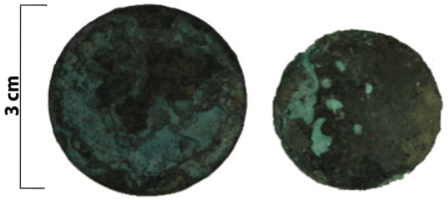
A Victorian penny minted in 1863. The top image shows the penny found in Christchurch, while the bottom image shows a cleaner example of an identical coin. Image: J. Garland.

A Victorian penny minted in 1863. The top image shows the penny found in Christchurch, while the bottom image shows a cleaner example of an identical coin. Image: J. Garland.

Most of the currency used in New Zealand in the 19th century was British, naturally, by virtue of this country being a British colony. We’ve found several British pennies and at least one halfpenny in sites in Christchurch and Lyttelton. Pennies, such as the one shown to the right were embossed with the likeness of Her Majesty, Queen Victoria on the obverse and variations of the image of the figure Britannia, seated in her chariot, on the reverse. The particular likeness used on the penny in the image to the right is known as the ‘bun head’ likeness, in reference to her hairstyle. The bun head design was preceded by what is known as the ‘young head ’, used from 1838-1859/60, and followed by the ‘old head’ (also known as the ‘veiled head’, used from 1895 until Victoria’s death in 1901). Not the most flattering of names for Her Majesty’s head that I’ve heard…

During the 19th century (and for much of the 20th), it took 12 pence to equal a shilling, and 20 shillings to equal a pound, meaning that a single penny was 1/240th of a pound. To put that in perspective, in 1863 (when our bun head penny was made), a person could buy, at wholesale prices, a dozen quart bottles of pickles for one pound,  a pound tin of ground coffee for one and half shillings, or a pound of sultanas for eight pence (Lyttelton Times 13/6/1863: 3). It can be problematic to relate the value of money in the past to the value we give it now, thanks to inflation and the constantly shifting values of different currencies and market values, but it’s interesting to consider the relative cost of these items today. For example, a 400g bag of Sultanas costs c. $3 at Countdown now, while the equivalent amount of ground coffee is around the $10 mark.

An advertisement from 1863, showing wholesale prices for goods in Lyttelton. Image: Lyttelton Times

An advertisement from 1863, showing wholesale prices for goods in Lyttelton. Image: Lyttelton Times 13/6/1863: 3.

Pennies, and other 19th century coins such as these, provide an interesting link, not only to the monetary system and values of the 19th century, but to the physical production of royal currency.  In 1860, for example, the Royal Mint ceased  to manufacture pennies from copper (which they had done since the first minting of the cartwheel penny in 1797) and began to make them of bronze instead. The size of the coin also changed, from 34 mm in diameter to 31 mm. The process of minting coins, particularly the penny, is one that ties into other technological developments of the time (including the switch to a steam-powered mint in the late 18th century) and the achievements of famous figures (such as Matthew Boulton; Selgin 2003). It’s also a process that is integral to the economic growth of the British empire and her colonies, like New Zealand (Royal Mint Museum 2014).

The bronze penny (left) and half-penny (right) recovered from Grubb cottage.

A bronze penny (left) and half-penny (right) recovered from Grubb cottage. These coins were particularly interesting due to their association with Masonic ritual. Image: R. Geary-Nichol.

However, as well as British coins, we’ve also found alternative forms of currency in Christchurch’s archaeological sites.  A Belgian ’10 centimes’ coin was found in Lyttelton following the earthquakes, manufactured in 1863 (again!). Of course, the presence of coins in archaeological sites is not always related to their primary use as currency, as we’ve mentioned before on the blog in reference to Masonic rituals . A Belgian coin found in Christchurch doesn’t necessarily hold any meaning as money in this context, but may instead provide other avenues of information – such as a connection between Belgium and Christchurch, be it familial, commercial or otherwise.

The 1863 Belgian '10 centimes' coin found in Lyttelton. Image: L. Davies.

The 1863 Belgian ’10 centimes’ coin found in Lyttelton. Image: L. Davies.

One alternative to British currency that does relate directly to the monetary system of Christchurch, though, is the humble Christchurch token. We’ve found a couple of these on sites in the city now: flat circular pieces of metal that bear every resemblance to coins, except for the insignia of local merchants embossed into the surface.

For much of the early decades of Christchurch’s settlement, it seems, small currency was difficult to come by. Local businesses and settlers combated this shortage of actual money by creating their own, known as ‘trade tokens’. Tokens became recognised as legal tender in Christchurch and were used as currency in the city from 1857 until 1897, when they were demonetised by the government. Interestingly, many (if not most) of these tokens only had value in Christchurch and were considered worthless in other cities in the country (Thomas & Dale 1950: 11).

An example of a Henry J. Hall halfpenny token, identical to the one found in Christchurch. Image: Victoria Museum.

An example of a Henry J. Hall halfpenny token, identical to the one found in Christchurch. Image: Museum Victoria.

Although they were struck in Australia, and then shipped to Christchurch, tokens were stamped with the names and insignia of local traders and businesses. One such example found on an archaeological site in the city bears the mark of Henry Joseph Hall, reading “HALF PENNY / HENRY J. HALL / CHRISTCHURCH COFFEE MILLS” on one side and “H.J.HALL / FAMILY GROCER / WINE & SPIRIT MERCHANT” on the other.

Henry Joseph Hall was an agriculturalist and pastoralist turned grocer who arrived in Christchurch in 1857. He opened a grocery business in Cashel Street west in 1864, subsequently converting the Wesleyan Chapel on High Street into a large store in 1865. During his time as a grocer, he issued a total of 19 varieties of penny tokens and three varieties of halfpenny tokens in Christchurch, struck by the Melbourne medallists W. J. Taylor and Thomas Stokes, as well as W. J. Taylor of London. These tokens were circulated throughout the city as money in relatively large numbers and could be used, not only with  the issuing firm, but with all other traders in the city (Thomas & Dale 1950 56-61; Museum Victoria).

We’ve talked about the entrepreneurial spirit of 19th century Christchurch a few times here on the blog, in reference to so many of the individuals and businesses that contributed to the economic and social growth of Christchurch as a city. It strikes me now, that in people like Henry Hall and other manufacturers of trade tokens – people who made their own money – that entrepreneurial spirit is even more pronounced.

Money is a curious thing, so vital to our everyday existence in this world and yet so completely a construction that we, as a society, have created to be necessary in our lives. It can be very easy, I think, especially in this age of electronic transactions, to forget where our money came from in the first place. Artefacts like these – be they royally issued coins or locally struck tokens – are a somewhat disconcerting reminder that we made it ourselves.

Jessie Garland

References

Lyttelton Times. [online] Available at www.paperspast.natlib.govt.nz

Museum Victoria. [online] Available at www.museumvictoria.com.au

Royal Mint Museum. [online] Available at www.royalmintmuseum.org.uk

Selgin, G., 2003. Steam, hot air, and small change: Matthew Boulton and the reform of Britain’s coinage. The Economic History Review, 56, 478-509.

Thomas, E. R. & Dale, L. J. (eds.), 1950. They made their own money: the story of early Canterbury traders & their tokens. Canterbury Branch of the Royal Numismatic Society of New Zealand.

A few of our favourite things…

Over the last few weeks, we’ve been excavating a site in the CBD that’s yielded some of the most interesting artefacts we’ve see for a while. So, today on the blog, we’ve selected a few of these fascinating things for your viewing pleasure. Clay pipes, candlesticks, pepper shakers and bowler hats: scroll down for a veritable feast of pictorial splendour! Or something along those lines.

A bowler hat! This hat is made of felt and may have been worn by either a man or a woman (women used to wear hats like these with riding outfits in the lat 19th century). If you look very closely at the rim of the hat, you can see the remnants of the ribbon trim that once decorated it. Image: J. Garland.

First up, a bowler hat! This hat is made of felt and may have been worn by either a man or a woman (women used to wear hats like these with riding outfits in the late 19th century). If you look very closely at the rim of the hat, you can see the remnants of the ribbon trim that once decorated it. Image: J. Garland.

A lovely brass candlestick (used by Colonel mustard in the library, perhaps...). We think that the pieces of fabric stuck to the metal are just the remnants of the wrapping it was thrown out in, rather than a functional or decorative part of the candlestick itself. There's even a candle stub still visible inside the holder, near the base. Image: J. Garland

A lovely brass candlestick (used by Colonel Mustard in the library, perhaps…).The pieces of fabric stuck to the metal are  probably just the remnants of the wrapping it was thrown out in, rather than a functional or decorative part of the candlestick itself. There’s even a candle stub still visible inside the holder, near the base. Image: J. Garland

This lovely little saucer is decorated with a Chinese motif, known as 'Chang'. It appears to show one man cooking, while another stands around smoking a pipe. Not such an unfamiliar scene, is it? Image: J. Garland.

This lovely little saucer is decorated with a Chinese motif, known as ‘Chang’. It appears to show one man cooking, while another stands around smoking a pipe. Not such an unfamiliar scene, is it? Image: J. Garland.

This is really, really cool. This clay tobacco pipe appears to have been made locally, here in Christchurch, by or for the Trent Brothers. The Trent brothers were coffee, flax and chicory merchants based in Christchurch in the second half of the 19th century. The lovely people over at the Lost Christchurch blog have an excellent series of posts on the brothers and their business.  As far as we're aware, no other pipes like this one have been found before in New Zealand.  Image: J. Garland.

This is really, really cool. This clay tobacco pipe has a local connection, being made by or for the Trent Brothers, Christchurch. The Trent brothers (Frederick and James) were coffee, flax and chicory merchants based in Christchurch in the second half of the 19th century. The lovely people over at the Lost Christchurch blog have an excellent series of posts on the brothers and their business. As far as we’re aware, no other pipes like this one have been found before in New Zealand. Image: J. Garland.

We found another New Zealand branded pipe at this site, this time stamped with the mark of Twentyman & Cousins. Messrs Twentyman & Cousins (wonderful names!) were Christchurch retailers

Surprisngly, we found another New Zealand branded pipe at this site, this time stamped with the mark of Twentyman & Cousin. Messrs Twentyman & Cousin (wonderful names!) were Christchurch retailers originally based in Cathedral Square. In the 1880s they moved to new premises at what is now 93 Cashel Street, into a building designed by renowned architect B. W. Mountfort (Press 17/06/1882:1). Image: J. Garland.

This Willow patterned salt/pepper shaker is a surprisingly unusual find: they're not often found in Christchurch's archaeological sites. It's one of my personal favourites from this assemblage. Image: J. Garland

This transfer printed salt/pepper shaker is a surprisingly unusual find: they’re not often found in Christchurch’s archaeological sites. It’s one of my personal favourites from this assemblage. Image: J. Garland

A pig snout gin bottle with a prunt or blob seal on the shoulder.

A pig snout gin bottle with an anchor decorated prunt or blob seal on the shoulder. Seals like these were most common in the first half of the 1800s, although they were still being added to bottles at the end of the century (usually to gin bottles like this one). This particular prunt is embossed with ‘Van Dulken Weiland & Co/ Rotterdam’, well-known 19th century Dutch gin manufacturers. Image: J. Garland.

A child's plate! We've featured plates like this before on the blog, although none quite like this one. It reads "...in passing along they beheld on the ground/ ... man stretch'd along in a sleep most profound". Image:  J. Garland

A child’s plate! We’ve featured plates like this before on the blog, although none quite like this one. It reads “…in passing along they beheld on the ground / … man stretch’d along in a sleep most profound”. Image: J. Garland

And to finish….

These gorgeous shoes are in excellent condition. The adult size one (top)

Shoes! We’ve found a surprisingly large number of shoes (adult and child size) and fabric artefacts from this site, all in fairly good condition. Both the child sized shoe (bottom) and adult lace up shoe shown here (top) are among the only examples we’ve found with the complete upper portion of the shoe intact. Usually, we’re only recovering heels and soles. Aren’t they gorgeous!  Images: J. Garland.

Jessie Garland