The acclimatisation affair (or how we learned not to underestimate the power of the possum)

The first feeling that strikes everyone on coming to New Zealand is its intense want of animal life. Mountains, plains, rivers, – mere features without a soul; for you can hardly dignify the miserable ground lark, the wailing weka, or the ghoul-like eel with such a title.

– Lyttelton Times 18/02/1864: 5

When I first read the above quote, taken from a letter to the editor of the Lyttelton Times in 1864, I will admit to doing a double take. Then, to a sense of outrage and a strange urge to defend the ‘soulless’ landscape and wildlife of New Zealand from this 150 year old attack on its very being (despite the author of that sentence being unable to hear – or, I suspect, care about – my opinion). It’s such an odd, jarring statement to read about a country that now considers its natural landscape and native wildlife to be a source of pride, a country that places its mountains and plains and rivers at the heart of its national identity. Yet, this sentiment and others like it formed the impetus for one of the most influential colonial endeavours of the 19th century, one that irrevocably changed the land in which we live – to an extent that most of us don’t fully realise.

The wailing weka and the ghoul-like eel. Just not good enough, apparently. Image: Wikimedia Commons.

The wailing weka and the ghoul-like eel. Just not good enough, apparently. Image: Wikimedia Commons.

It went by the name of ‘acclimatisation’ and consisted of the deliberate introduction of “beasts, birds, fishes, and vegetable productions, of such species as may be acclimatised with probable advantage to this province and to the colony” (Lyttelton Times 8/03/1864: 2). In New Zealand, and the rest of the British colonial world, the acclimatisation movement was largely driven by ‘Acclimatisation Societies’, who made it their mission to improve the plant and animal life of the lands they had chosen to settle. Basically, they imported a bunch of animals into the country from all over the world in a venture that seems to have been part scientific curiosity[1], part hunger[2], part boredom[3] and part an apparently inescapable need to rectify the “remarkable deficiency” of local wildlife.

There is perhaps no country in the world the natural zoology of which supplies so little to the subsistence or enjoyment of its inhabitants, as New Zealand. Of game there is almost none; quail, formerly plentiful, have nearly disappeared; pigeons and kakas are to be found only in the woods; ducks, eels and wild pigs complete the list. And if there are so few useful animals, those which add to the grace and enjoyment of life are scarcer still; of singing birds there are but the tui tui and the bell bird; neither of them ever heard, except in the neighbourhood of the forests…If, however, we turn from land to water, the inducements to engage in this enterprise are greater still. Our great snow rivers are absolutely without fish…At present, such rivers as the Waimakariri, the Rakaia or the Rangitata are worse than useless, obstructing travelling without assisting navigation.

– Press 17/08/1861: 1 (emphasis mine)

The Canterbury Acclimatisation Society was first formed in 1864, modelled on the example of the London society, which aimed to introduce animals from the colonies into England, and the Victorian society, which aimed to introduce English and other colonial animals into Australia. Societies already existed in Auckland and Otago and the Canterbury branch followed in their footsteps, with the same stated intention of improving the fauna of the new colony (Lyttelton Times 8/03/1864: 2).

Excerpts from a letter about a proposed Acclimatisation Society in Canterbury.

Excerpts from a letter about a proposed Acclimatisation Society in Canterbury. Press 17/08/1861: 1.

Early supporters and members included some of the more well-known names of the early settlement, including Edward Wakefield, Sir John Cracroft Wilson, William Guise Brittan, Joseph Brittan, W. L. Travers, William Rolleston, William Sefton Moorhouse and John Edward Fitzgerald. Some of these men had already made their own individual efforts to introduce new species to New Zealand. William Guise Brittan had imported several ‘English singing birds’, as had John Watts-Russell. Sir John Cracroft Wilson had apparently made “an attempt…on a scale of oriental magnificence to introduce the game from the North of India” (Press 17/08/1861: 1). While their stated intention included the practical provision of food for the colony, their emphasis seems to have largely been on the aesthetic and sporting (i.e. hunting and fishing) advantages of acclimatisation.

crazy menu image

The Acclimatisation Society of Victoria, on the other hand, while also interested in the practical and sporting advantages of new animals, seem to have also had an intense interest in eating as many creatures as they could. This menu, if I may draw your attention to some of the more unusual dishes, included patty of frogs, curried opossum, jugged kangaroo and ‘fricandeau of wombat’. Image: Lyttelton Times 4/12/1861: 4. 

It is worth noting – in fact, important to note – that the acclimatisation societies of New Zealand weren’t the first to introduce new animals into New Zealand. Sealers, whalers, missionaries and early European visitors to the country brought with them chicken and pigs and sheep and other animals for food and companionship. Sir George Grey, the early governor of the colony, had his own collection of exotic birds and other creatures that he had imported into the country. And, of course, long before all of this, Māori had brought kiore (the Pacific rat), kurī (dog), kūmara and the ‘Polynesian suite’ of cultigens with them when they first arrived on these shores. For as long as humans have been moving around the world, they’ve been modifying the fauna and flora of the places they visit. The thing about the acclimatisation societies, though, that I think is worth emphasising, is that they were part of an organised, concerted and deliberate effort to change – to improve – the ecology of the country. It wasn’t just a hobby or a side effect of human migration. It was a bonafide movement.

Here in New Zealand, the species they introduced (and must take the blame for) include a selection of birds, fish, mammals, rodents and other creatures (bees!) – many of them now considered pests. Many of them were considered pests within a one or two decades of their introduction, to be honest. Some of them were creatures you might not have thought of as imported species, such as Ligurian bees (from Italy), bumble bees (sometimes referred to as ‘humble bees’) and lobsters. The article I found on lobsters begins with the sentence “Mr Purvis, chief engineer of the Iconic, has succeeded in bringing nine lobsters alive out of twelve” (Star 19/10/1892: 3). Well done, Mr Purvis, well done.

Ligurian bees and a picture of Patrick Stewart in a lobster costume (barely relevant, yet hilarious). Images: Wikimedia Commons and Twitter.

A Ligurian bee and a picture of Patrick Stewart in a lobster costume (barely relevant, yet hilarious). Images: Wikimedia Commons and Twitter.

Birds seem to have been a particular area of interest and focus, which seems odd for an ecosystem already constructed around avian life. As well as game birds, like pheasants, quail, ducks and geese, there was an effort to introduce singing birds (clearly, Joseph Banks’ deafening dawn chorus of 1770 had lost its voice by the 1860s) and, to be honest, as many birds as they damn well could. Interestingly, the introduction of birds wasn’t a one-way street: there’s at least one account in 1872 of a shipment of 1000 tui, wax-eyes and parroquets from New Zealand to England (and a return shipment of English birds to this country).

Some of the birds introduced to New Zealand included the chukor (an Indian game bird), the magpie (thanks Australia, thanks a lot), the laughing jackass (amusingly mentioned in the papers as the Australian jackass), Virginian quail, Canadian geese, Teneriffe grouse, chickens from Kansas, swans, sparrows and German owls. The German owls are possibly my favourite, because the acclimatisation of German owls in the 19th century had turned into the GERMAN OWL MENACE by the 1930s (and yes, the caps are entirely necessary). So much so that the Canterbury association was indignant when the papers suggested that they were responsible for releasing more owls into the wild. A close second would have been the “peculiarly inoffensive” emu named Jack, who terrorised horses by trying to fraternise with them all the way back in 1865.

GERMAN OWL MENACE

GERMAN OWL MENACE. Image: Press 19/07/1935: 22.

There was also a strong emphasis on the introduction of fish, especially trout and salmon, into the otherwise “useless” rivers of the Canterbury plains. Millions of fish were “liberated” into the streams and rivers of the district , born from ova shipped into Lyttelton from all over the world and raised in purpose-built fish ponds in the Christchurch Botanic Gardens. We excavated the site of the fish-ponds a while back, but there was nothing left of what was once the gateway for Canterbury’s freshwater fish populations (the Otago ones do still exist, though, and have been the subject of some cool archaeological projects over the last few years).

A survey plan of the Canterbury Acclimatisation Society grounds in 1913, including the fish ponds.

A survey plan of the Canterbury Acclimatisation Society grounds in 1913, including the fish ponds. Source: Land Information New Zealand (LINZ) and licensed by LINZ for re-use under the Creative Commons Attribution 4.0 International licence (link is external).

As well as the birds and the fishes, however, there were the beasts. Let us not forget the beasts. Possums and rabbits and deer, oh my. Polecats, even. There appear to have been wildly differing levels of success with mammals and rodents. Some, like the kangaroo or the “game from the north of India” attempted by Cracroft Wilson, weren’t hugely successful. Others, like rabbits (described as ‘evil’ as early as the 1870s), possums, hares, deer and, of course, sheep, took to New Zealand in a flash. Most of them were imported as game, rather than food (with a couple of obvious exceptions). Yes, that’s right. We have so many possums and rabbits because it seemed like a fun idea at the time.

TS18930819.2.45-a2-424w-c32

Yep. Good plan. Image: Star 19/08/1893: 5.

And when I say ‘in a flash’, it’s almost an understatement. Some of their greatest successes very quickly became their greatest headaches. By 1876, the New Zealand government had to pass the Rabbit Nuisance Act in response to the success of that species. By 1882, societies were recommending that hares be killed all year round rather than just during specific seasons. By 1898 they were suggesting that people could do so without a license. By the turn of the century there were suggestions for some measure of governmental control over the power of societies and individuals to import “animals or birds that might become nuisances to the community” (Press 23/05/1894: 5) and by the mid-20th century it was generally acknowledged that many of these introduced species had done irreparable damage to the native and other introduced species of New Zealand. Let’s not forget the German Owl Menace, everybody. At the same time, despite the increasing awareness of the problems of introduced species evident among acclimatisation societies as the decades progressed, they didn’t stop doing it, even importing other species to deal with problematic ones (why hello, stoats and ferrets).

I find the whole notion of acclimatisation societies quite weird to wrap my head around, to be honest. Especially in light of the biosecurity that is now so much a part of New Zealand life. Yet, the effects of their work are everywhere. If we look at it from an archaeological perspective the efforts of these societies are present in every assemblage of animal bones we excavate from 19th century sites in Christchurch – chicken, duck, sheep, cow, pig, horse, turkey, cat, rat, goose or dog, they’re all there.

bones

Bones, bones, bones. Image: Underground Overground Archaeology.

We don’t even blink at them most of the time, because we’re so used – so ‘acclimatised’ – to having these species around. They’re a part of our normal, a statement that says as much about how much the Acclimatisation Society of Canterbury (and its brethren throughout the country) changed and constructed our present day world as anything else I’ve written here.  Because 150 years ago, like the settlers who brought them here, these animals were very much strangers in a foreign land. And their impact, like the impact of the colonial settlement itself (and all colonial settlements), has changed this land forever, for better or for worse. You be the judge.

Jessie Garland

[1] “Hmm, I wonder if these ones will survive?”

[2] “They wanted practically to benefit the country by increasing the food of the people, and a plant or an animal that would not thrive on the ordinary conditions of English life and cultivation was of no use to them” (Lyttlelton Times 4/12/1861: 4).

[3] “What ho, old chap, where’s all the fish and game at?”

Keys to the city

Did you ever wonder where the concept of locking things up came from? The reality of human nature seems to be that ever since people have owned things that are deemed valuable, they need to be protected from theft. Not to mention the need for personal protection – locking yourself in away from harm, or locking away those things or people that have been deemed unsafe to others.

Interestingly, but perhaps unsurprisingly, it is thought that the Egyptians, Greeks and Romans developed mechanical locks independently from each other – highlighting the collective unconscious need to protect one’s valuables and person from this unseemly side of human nature. The idea evolved from the use of simple knots to detect if anyone had attempted to tamper with a locked place, and as time went on, locks made from wood and metal were developed and the security that they provided increased (History of Keys 2016).

Alexander the Great 'unlocks?' the Gordian knot. Image

Alexander the Great unlocks? the Gordian Knot. Image: Rugs 4.

We find several types of locks in the work that we carry out in Christchurch. Door locks from the pre-1900 houses that we record, and padlocks from excavations of pre-1900 material. The concept of a padlock is a great one! We have the Chinese from about 1000 BC to thank for the invention of a portable apparatus, the size and uses of which are so versatile that we can lock all manner of things up and away. The idea travelled to Europe via trade with the Romans several centuries later and the heart cast type became popular for locking up railway cars and controls, as they were durable in dirty and freezing conditions (History of Keys 2016).  These days we’re not just using them for railroads – they work well to secure static latches that have been fixed to the outside of a door or cupboard to keep it closed, or on the inside of a door to lock yourself in a room. How convenient! Latch and lock types that work well for this are hasp latches, and sliding bolt locks – the kind you might use on your garden shed, or on a public locker.

A hasp latch (Image: Priess 2002: 66).

A hasp latch (Image: Priess 2002: 66).

A sliding bolt is a bar which can be attached to a door and slid into a catch on the door frame to hold a door closed (Image: Priess 2002: 66).

A sliding bolt is a bar which can be attached to a door and slid into a catch on the door frame to hold a door closed (Image: Priess 2002: 66).

Padlocks consist of an enclosed body (housing), and curved bar (shackle) that is passed through a loop and secured (Priess 2002: 79). The housing shapes can vary, being symmetrical or asymmetrical, and some had key hole covers. These covers were originally attached with hinges, which were later replaced by pivoted examples. These keyhole covers can also offer additional dating and origin information as they were often stamped with maker’s marks. A popular mark was “VR”, after Queen Victoria during her reign 1837-1901 (Priess 2002: 81). Padlocks are a lock type which have been favoured historically for their flexibility, and because they are simple to make, with few working parts. But on the flip side, their simple structure means they are also easy to break open (Priess 2002: 82).

Cast iron padlock from an archaeological deposit west of the central city.

Cast iron padlock from an archaeological deposit west of the central city.

Door locks are more complicated in manufacture and form. The idea is simple – “A lock is any key-operated device attached to a door and equipped with a bolt or other member to keep the door closed” (Butter 1968: 163). But the 19th century saw many innovations in door lock technology. The most notable were the changes in material used – from wrought iron to cast iron, brass or steel, when it began to be economically viable (Priess 2002: 92).

Wooden and wrought iron rim lock. Image: K. Webb.

Wooden and wrought iron rim lock. Image: K. Webb.

Without delving into the tedious technical details – the locks that were available in the 19th century consisted of two main types – ones that are attached to the surface of the door and ones that are placed into a cavity that has been cut into the door. The surface locks consist of ‘stock locks’ and ‘rim locks’ and the cut locks are ‘flush locks’ (which were cut into the surface of the door) and ‘mortise locks’ (cut into the edge of the door).

These types are easily distinguished as the surface locks have their strike plates attached to the surface of one side of the adjacent wall, and the strike plates of a mortise or flush lock are placed within the door jamb. Also, only the front plate of the housing (lock cover) is visible with these mortise and flush locks. Sounds simple? Not always – lock reuse can make identification and dating of locks complicated, as broken locks were often replaced with new types.  Wrought iron examples could also be fixed and reworked into other things (Priess 2002: 92). Darn those thrifty Victorians!

Of the types mentioned above, rim locks and mortise locks are commonly found on the doors of Christchurch houses that were built during the 19th century. Some examples that some of our buildings archaeologists have found are pictured below.

Rim lock from a central city house. Image: P. Mitchell.

Rim lock from a central city house. Image: P. Mitchell.

 Mortise lock in situ and mortise lock close-up. Images: J. Garland and P. Mitchell.

Mortise lock in situ and mortise lock close-up. Images: J. Garland and P. Mitchell.

Mortise locks were more labour intensive to install than rim locks, as the mortise cavity in the door had to be cut. This lock type didn’t become popular until the late 19th century for this reason. But by the beginning of the 20th century mortise locks formed a major portion of the locks offered by prominent lock companies like Yale and Towne, and Sargent and Company (Priess 2002: 99). Flush locks are more commonly seen on furniture or closets, as they are inserted into the interior surface of a door or drawer, and they are usually out of sight when the drawer or door is closed (Priess 2002: 90).

The works of a few of the same lock makers are seen over and over again in our local examples – particularly the makers James Carpenter, Willenhall, England and H.&. T. Vaughan Standard Works, Willenhall (P. Mitchell and K. Webb, pers. comm.). Carpenter’s No. 60 patented lock was mentioned in the blog a few weeks ago, and this lock type was so popular that the design was counterfeited by rival lock-makers (Switzer 2013).

Jason Carpenter No. 60 rim lock and maker’s mark. The strike plate is shaped like a key! This maker was popular from the 1840s until the early 20th century (Sydney Living Museum 2016). Image: K. Webb.

Jason Carpenter No. 60 rim lock and maker’s mark. The strike plate is shaped like a key! This maker was popular from the 1840s until the early 20th century (Sydney Living Museum 2016). Image: K. Webb.

H. & T. Vaughan lock maker's mark. This company was founded in 1856, and was later responsible for the invention of the cylinder pin tumbler lock in 1910 – the easy self-locking kind which are still commonly used today (Evans 2002). Image: K. Webb.

H. & T. Vaughan lock maker’s mark. This company was founded in 1856, and was later responsible for the invention of the cylinder pin tumbler lock in 1910 – the easy self-locking kind which are still commonly used today (Evans 2002). Image: K. Webb.

So we have talked about the locks, what about the keys? They’ve enabled us to take better control of our locks and make them more exclusive as only the key holder can operate them. The first of their kind were made with wooden pins, but we can credit the Romans again for the production of metal keys – the strength of the material made it possible to make keys smaller than before and hence, more potable (History of Keys 2016). We find keys less commonly in the archaeological record, as it’s likely that the 19th century owners of these keys did not often discard them on purpose – the abundance of advertisements for locksmiths in 19th century Canterbury newspapers suggests that the skill of breaking locks was one in demand.

And who were these lock breakers behind the scenes? If you lost your key or if something went wrong with one of your locks, you’d need someone to pick it, break it, or blow it up (if you’re that desperate). Locksmiths seem to have been ‘a jack of all trades’ in New Zealand during the 1800s – they often moonlighted as plumbers, engineers, guns smiths, tinsmiths, bell hangers and gas fitters to name a few (Star 29/09/1873: 3). They appear to not only have had varied careers, but also exciting ones – among the many instances of getting called out on false alarm missions (having to open safes that were never locked, or even closed in the first place (Star 23/10/1897: 2). There were also many examples of locksmiths being the first called to the scene of a crime (often murders) to break through a locked door (Temuka Leader 16/12/1882: 3). They were also commonly called in as expert witnesses at court trials to prove if locks had been tampered with – a sort of 19th century forensics expert (Star 4/04/1900: 3). I’ve LOCKED in an example of one of these turbulent tales – it may be the craziest story I have ever read in the New Zealand newspapers – so I’ll leave it with you. Until next time.

Temuka Leader 5/5/1883: 3

Temuka Leader 5/5/1883: 3

Chelsea Dickson

References

Butter, F. J. 1968 An Encyclopaedia of Locks and Builders Hardware. Josiah Parkes, WillenhaIl, England.

Evans, J. 2002. A Gazetteer of Lock and Key Makers. [online] Available at: http://www.historywebsite.co.uk/Museum/locks/gazetteer/gazv.htm

History of Keys 2016 [online] http://www.historyofkeys.com/ [Accessed July 2016]

Press, P. J. 2000 ‘Historic Door Hardware’ in Karklins, K. 2000. (Ed) Studies in Material Culture Research.

Star [online] Available at www.paperspast.natlib.govt.nz. [Accessed July 2016]

Switzer, R., R. 2013. The Steamboat Bertrand and Missouri River Commerce. University of Oklahoma Press. Norman.

Temuka Leader [online] Available at www.paperspast.natlib.govt.nz. [Accessed July 2016]

The Big House in a little town

The degree of civilisation in a society can be judged by entering its prisons

– Fyodor Dostoevsky

One of the challenges faced by any new colony is what to do with the non-conformists, renegades, and criminals. The ideal, of course, is that your new paradise will be carefully designed to have eliminated these undesirable elements. The reality, however, is far from the ideal. The first lock-up in the Canterbury (consisting of three blockhouses) was located in Akaroa, a significant distance away from the growing towns of Christchurch and Lyttelton (Gee 1975: 5). These blockhouses appear to have been used until John Godley arrived on the scene in April 1850 and was appointed as the resident magistrate of Lyttelton (Gee 1875: 7). With his appointment, the location of the lock-ups/gaols moved to the fledgling port-town instead. The earliest gaols in Lyttelton were improvised and, for some enterprising fellows, rather portable. One particularly slapstick story of a runaway gaol involves some opportunistic pranking by the future gaol warden, Edward Seagar:

One night the prisoners in the lock-up, a flimsy, A-frame construction, took up the floor boards, lifted the building and walked away with it. Seagar arranged ropes and stakes in such a way that the escapees unknowingly headed towards the police station further down the hill (Young 2014).

The landing of passengers from the Charlotte Jane, Randolph, Cressy, and Sir George Seymour in Lyttelton c. 1850. Plenty of open space for pranks. Image: Alexander Turnbull Library.

The landing of passengers from the Charlotte Jane, Randolph, Cressy, and Sir George Seymour in Lyttelton c. 1850. Plenty of open space for pranks. Image: Alexander Turnbull Library.

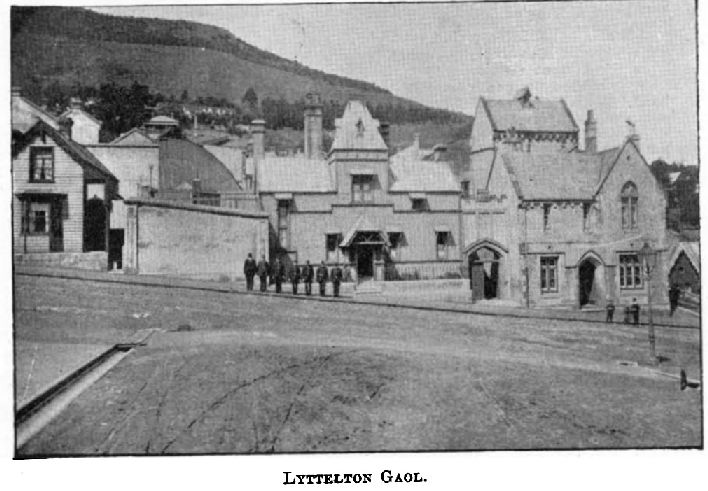
The first permanent gaol buildings in the settlement were constructed between 1851 and c.1857-1861 on Oxford Street, using both hired and prison labour (Gee 1975: 8, 10). Later buildings followed the design of B. W. Mountfort, who also designed the Sunnyside Lunatic Asylum (Heritage New Zealand 2016). The decision to construct a gaol in a small town like Lyttelton may seem odd to us today, but the reasoning was fairly straightforward. Lyttelton was the bigger town at the time and the new buildings replaced the earlier makeshift prisons near the contemporary police station and court (Gee 1975: 10).

The Lyttelton Gaol, date unknown. Image: Cyclopedia Company Limited 1903. A later image of the gaol c. 1900 can be viewed here.

The Lyttelton Gaol, date unknown. Image: Cyclopedia Company Limited 1903. A later image of the gaol c. 1900 can be viewed here.

Early conditions in this gaol, according to some commentators, had something of a Dickensian feel:

The early days were those of the cat [of nine tails whip] and the triangle, of the 70lb dragging irons, the days of scanty clothing, poor food, the days when the warder was king (Gee 1975: 2).

Others have argued that, in light of the standards at the time, the treatment of the prisoners was not quite as cruel as it may seem to us today (Gee 1975: 10). Conditions were hampered by one major issue which arose in this early period – the swelling gaol population. This population growth was exacerbated by the incarceration of debtors and the mentally ill. The housing of the mentally ill at the gaol was particularly concerning to many (Young 2014). The young townships of Lyttelton and Christchurch simply did not have the facilities to deal with these patients at the time. To their credit, it was intended that the patients be housed in the new Christchurch Hospital, until there was a furore in response to this plan (Gee 1975: 35). The population pressures eased with the construction of Sunnyside Asylum in 1863, and the opening of the prison in Addington in the 1870s (Gee 1975: 30, 87).

Sunnyside Lunatic Asylum. Image: Te Papa O.034082.

Sunnyside Lunatic Asylum. Image: Te Papa O.034082.

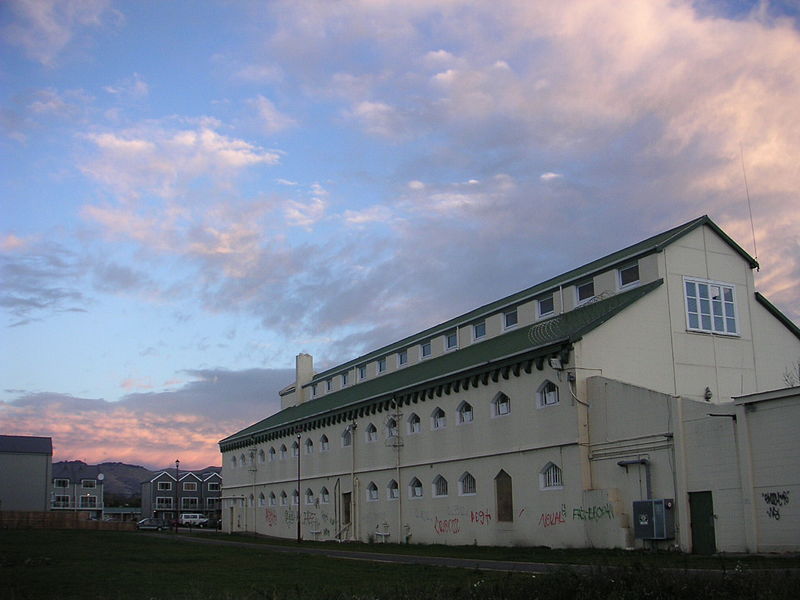
Part of the Addington Prison complex, c. 2005. Image: Wikimedia Commons. The prison is now a backpackers.

Part of the Addington Prison complex, c. 2005. Image: Wikimedia Commons. The prison is now a backpackers.

The position of the gaol within town life is quite interesting. As illustrated in the image above, the large Gothic style buildings were quite a dominating feature of the town. In addition to this, the prisoners were involved with a number of town works (discussed further below) and services which ensured a high public presence (Heritage New Zealand 2016). These services included a printing shop, a laundrette for the Lyttelton Hospital and Orphanage and the Immigration Department, and a baking contract for the orphanage (Gee 1975: 17). However, one comment from a resident regarding the communities’ view of the gaol (made after the demolition of the gaol in the 1920s) is particularly telling:

We never thought about the gaol.  We just knew it was there and that was it. But many people couldn’t have been pleased about it because there are few photographs of it and no paintings as far as I have found (C. Fletcher in Gee 1975: 87).

A rather macabre aspect of the prison, which feels particularly repugnant to us today, is that between 1868 and 1918 seven men convicted of murder were executed at the gaol. This was an aspect of the gaol that was a source of curiosity for some of the younger residents, but of dread for most. One resident stated: “In a little place like Lyttelton the knowledge of an impending execution used to hang like a pall over the whole town” (I. Gray in Gee 1975: 47). It is quite a stretch for me to imagine a community continuing with their daily lives in the anticipation of such an event. Executions appear to have been so entrenched in the town’s psyche that despite the fact that the bell did not toll for the last execution in 1918, many residents insist they remember it ringing (Gee 1975: 47).

A poem by Basil Dowling. The role of the hangman was a necessary part of the justice system, which carried a heavy stigma for the men who did the job. There are a number of cases where officers had to smuggle the hangman in to avoid the curiosity and/or anger of the general public.

A poem by Basil Dowling. The role of the hangman was a necessary part of the justice system, but carried a heavy stigma for the men who did the job. There are a number of cases where officers had to smuggle the hangman in on the eve of the execution to avoid the curiosity and/or anger of the general public.

The archaeological legacy of the prison and prisoners remain visible in many aspects of the town today. All that remains of the gaol itself are concrete retaining walls, a small block of cells, pedestrian pathways and concrete steps. These remains are an important archaeological site, particularly as they are demonstrative of some of the earliest use of concrete in New Zealand (Heritage New Zealand 2016).

The remaining cells and concrete walls of the prison. Image: A. Bulovic, 2013 Peeling Back History.

The remaining cells and concrete walls of the prison. Image: A. Bulovic, 2013 Peeling Back History.

However, we can also see the influence of the gaol on the Lyttelton settlement through other features of the town. Prisoners sentenced to hard labour were part of gangs put to work on public works, such as road formation and retaining wall construction. In particular, the red volcanic retaining walls constructed during this period have been described as a distinctive part of the townscape. Unfortunately, as with much of Lyttelton’s heritage, a number of these walls have been repaired or replaced after the damage from the earthquakes.

Earthquake damaged walls at the corner of Coleridge Terrace and Dublin Street. Image: M. Hickey, 2015.

Earthquake damaged walls at the corner of Coleridge Terrace and Dublin Street. Image: M. Hickey, 2015.

 The newly constructed concrete wall on Sumner Road, with partial re-facing using the volcanic stone from the demolished wall. The re-facing will occur on as many of the key retaining walls across the town, as funding allows. Image: M. Hickey, 2016.

The newly constructed concrete wall on Sumner Road, with partial re-facing using the volcanic stone from the demolished wall. The re-facing will occur on as many of the key retaining walls across the town as funding allows. Image: M. Hickey, 2016.

A collapsed wall at 61 St Davids Street. Image: M. Hickey, 2016.

A collapsed wall at 61 St Davids Street. Image: M. Hickey, 2016.

The same wall after deconstruction and reconstruction work (all completed by hand). Image: M. Hickey, 2016.

The same wall after deconstruction and reconstruction work (all completed by hand). Image: M. Hickey, 2016.

The port also benefited from convict labour in the form of reclamation construction and wharf building (Gee 1975: 17). Another notable site of works is the fortifications at Ripapa Island, which were constructed in the 1860s and 1870s by the Hard Labour Gang and were even used to house some prisoners (Gee 1975: 22). Prisoners housed on the island reportedly included members of the Parihaka resistance movement in Taranaki in 1880s (Donna R 2014). These men are remembered today during a service on the 5th of November each year and a memorial at Rapaki (Lyttelton Community House Trust 2013).

In many ways, the Lyttelton Gaol was a product of its time; the morality of Victorian Britain, the realities of a new colonial land and the challenges of a growing society. However, the legacy of the gaol should not be limited to a grim spectre of past principles. Prisoners made a considerable contribution to the development of the town through the construction of infrastructure. Despite the recent changes to the townscape, the influence of the gaol remains a visible part of Lyttelton’s heritage.

Megan Hickey

References

Gee, D. 1975. The Devil’s Own Brigade: A History of the Lyttelton Gaol 1860-1920. Wellington: Millwood Press Ltd.

“A healthy mind and human happiness”

Here in New Zealand, we like to think ourselves as a nation of outdoor enthusiasts, always off tramping, kayaking, mountain biking, etc. But it wasn’t always thus. Our love affair with the outdoors began in the mid-late 19th century and was part of a movement seen throughout much of the western world, as people began to use their increased leisure time – and the wonders of the railways – to explore the world around them. This isn’t the time to dwell on the other factors that led to this movement, but there were a number of spurs, including increasing industrialisation and urbanisation (both of which were linked to an increasing awareness that the natural environment was threatened by these processes), and the rise of the middle class.

Locke Stream Hut. Image: K. Watson.

Locke Stream Hut. Image: K. Watson.

This post continues the theme of exploring Christchurch’s hinterland and, somewhat more explicitly than the other posts in the series, documents some of the factors that led to New Zealand’s increasing engagement with the outdoors in the early-mid 20th century. The exploration, development and use of Aoraki and Kura Tāwhiti were both related to this theme but in many ways, Locke Stream Hut epitomises it. It’s also an intriguing example of attempted social engineering, and the development of our network of back country huts and tracks. The hut lies (as its name suggests) on Locke Stream, on the true left of the Taramakau River, just below Harper Pass.

Location map. Image: Google.

Location map. Image: Google.

Like Aoraki and Kura Tāwhiti, Māori were here long before Pākehā. The area was used particularly by Māori from Tai Poutini as a trail when travelling via Harper Pass with pounamu (Brailsford 1996: 99). Well-known 19th century Māori journeys across the pass include parties fleeing up the Hurunui River and over Harper Pass to Tai Poutini following the Ngāti Toa raid on Kaiapoi pā in 1832 (Pascoe 1955). And Māori were instrumental in the Pākehā ‘discovery’ of the route to the West Coast via Harper Pass. Many gold miners would subsequently use this route, until it was superseded by the Arthurs Pass route, after which it seems to have been little used by Pākehā. The route would return to prominence (of a sort) in the early-mid 20th century.

The kitchen/dining area, Locke Stream Hut. Image: K. Watson.

The kitchen/dining area, Locke Stream Hut. Image: K. Watson.

Pākehā exploration of the outdoors was initially led by the elite (as seen at Aoraki), as they had both the time and money to make the long journeys required. By the early-mid 20th century, New Zealand had developed to the point where tourism had spread beyond the preserve of the wealthy few. The development of the railway network had a significant part to play in this, as did legislation enshrining the 40 hour week, passed in 1936. Now not only were people able to reach the outdoors easily, they also had a weekend in which to be able to explore further afield. Histories of outdoor pursuits in New Zealand give a sense of the sheer unbridled joy that the young men and women who took advantage of these opportunities found in them – try the wonderful Shelter from the Storm or any of the histories of club ski-fields (I’m sure Tramping covers this too, but unfortunately I’ve not read it yet).

One of the wonderful spikes used in the construction of the hut. Image: K. Watson.

One of the wonderful spikes used in the construction of the hut. Image: K. Watson.

At the same time that weekends became real and official, one William Parry – known as Bill – was becoming increasingly concerned about the health and fitness of New Zealanders (he was also quite big on vegetarianism, too). Parry was a member of the Labour government during the Depression (as well as being one of the founding members of the Labour Party) and, from 1935, Minister of Internal Affairs (Gustafson 2012). He used this position to tackle his concerns about the nation’s health and well-being, arranging a conference in August 1937 to discuss ways “to judiciously guide the people in the wiser use of the increased leisure time at their disposal.” (AJHR 1938 H22). Amongst other things, the conference concluded that physical fitness and recreation were vital for “a healthy mind and human happiness” (AJHR 1938 H22). As a result, the Physical Welfare and Recreation Act was passed in November 1937, which led to the establishment of the Department of Internal Affairs’ Physical Welfare and Recreation Branch and the National Council of Physical Welfare and Recreation (AJHR 1938 H22).

The hand-adzed timber framework. Image: K. Watson.

The hand-adzed timber framework. Image: K. Watson.

The newly established Physical Welfare and Recreation Branch set about encouraging ‘group travel’ (which sounds a bit like my idea of hell) – which it defined as low-cost and low-stress recreational activity by groups in the natural environment, a policy that had apparently been very successful elsewhere in the world (AJHR 1939 H22). The Branch decided that mountain tracks – “quiet pathways into the country where people could rest from the noise and bustle of the modern city” (EP 28/12/1944) – were the ideal destination for group travel. But many existing tracks were deemed to be unsuitable for this low-cost low-stress travel, being overcrowded, too expensive and/or too arduous (none of which would be good for your stress levels). The Branch felt its duty was to “provide recreation for New Zealand people on the lower levels of income, people who would be pleased with a less luxurious and much less expensive track system that young workers can afford…to reduce the cost while easing the degree of exertion and increasing the comfort.” (EP 28/12/1944). And from this grew the Mountain Huts and Tracks programme, which led to the reopening of the Harper track, and the construction of Locke Stream Hut (along with several other huts). The other track opened up as a result of this programme was the Tararua track.

The Harper Pass track was re-cut in 1939-40, with the plan being that there were would be five huts on it. Huts No. 1 (Lake Taylor Hut) and 2 (Lake Sumner Hut) were extant by early 1940 (AJHR 1940 H22). Hut No. 4 – Locke Stream Hut – was built shortly afterwards, with some of the materials packed in by horse and the timbers cut on site. Which means that the hut has fabulous hand-adzed tōtara floor slabs, which are a thing of beauty. It’s also got a timber framework (kawaka and tōtara) and, respecting the sensibilities of the era, a central common area with two bunkrooms either side, one for men and one for women (no longer enforced!). As is typical of back country huts all over New Zealand, it’s clad in corrugated iron (original) – less typically, it’s lined with ply (not original). All in all, the hut is a wonderful example of the use of traditional construction methods and consequently, full of character. I highly recommend a visit!

The rather fabulous floorboards! Image: K. Watson.

The rather fabulous floorboards! Image: K. Watson.

If you do decide to visit the hut, stop and think for a moment about the social and political processes that led to its construction. And put aside thoughts about a paternalistic government to reflect on the freedom experienced by those who took advantage of these opportunities during the early-mid 20th century. Because, for many of those who did, it wasn’t just an opportunity to escape the city, it was also – in many cases – an opportunity to escape their elders, and some of the social norms of the day. I’m not suggesting that people went completely crazy (although I’m sure some must have), but there’s a wonderful sense of freedom that permeates social histories of outdoor activities during this period.

Katharine Watson & Rosie Geary Nichol

(& with thanks to the Department of Conservation, who funded this work)

References

Appendices to the Journals of the House of Representatives. [online] Available at: www.atojs.natlib.govt.nz.

Brailsford, B., 1996. Greenstone Trails: The Maori and pounamu. Stoneprint Press, Hamilton.

Evening Post. [online] Available at: www.paperspast.natlib.govt.nz.

Gustafson, B., 2012. Parry, William Edward – Parry, William Edward. [online] Available at: www.TeAra.govt.nz/en/biographies/3p12/parry-william-edward.

Pascoe, J., 1955. The Maori and the mountains. Te Ao Hou: The New World No.12. Held in DOC file on Locke Stream Hut.

The heady nature of pseudo-science

One of the most interesting things about being an archaeologist or a historian is seeing the development of ideas and knowledge throughout the ages. We are reminded, time and time again, that the ideas and theories that we consider primitive or even ridiculous in hindsight were the cutting edge of scientific enquiry or social theory at the time. It follows that at least some of the things we consider to be cutting edge here and now will be primitive or ridiculous to our children and grandchildren in the decades to come.

comparativephysi00redf_0067

Comparative physiognomy. One of the more, uh, interesting theories humans have come up with. Image: J. Redfield 1852, Public Domain Review.

At the same time, it is easy to see the foundations of our current knowledge base and thinking in those same primitive or ridiculous ideas. Every theory or discovery that was later proven to be wrong or misapplied was still, in fact, part of a conversation – a social, philosophical and scientific discourse – that came to inform our understanding of the world in the present day. They either provided the building blocks for the development of an idea (the four humours of the body to miasma theory to germ theory, for example); a point of contention which forced the development of a more accurate theory; or used approaches and ideas that later proved to be useful, even if they were misapplied at the time. From geocentrism, the four elements of all matter (earth, fire, wind, water…heart! Oh wait…) and Copernican astronomy to the miraculous cough curing properties of heroin, our history is littered with theories and ideas that were wrong, but without which our current knowledge base would not be what it is.

One such subject – and the thing that got me thinking about this in the first place – is the now much maligned science of phrenology, a subject brought to our attention a while back by the discovery of a crumpled up poster inside the walls of a 19th century house in Christchurch. The poster depicted the head of a man in profile, with the skull divided into a quilt of small images, numbered and labelled with various character traits, including sublimity (“conception of the grand, awful and endless”), mirthfulness (“wit”), causality (“desire to know the why and wherefore of things”) and alimentiveness (“appetite”). Above this arresting image, a headline read “Phrenological Head of Charles Peace, The Burglar.”

The Phrenological Head of Charles Peace. Image: J. Garland.

The Phrenological Head of Charles Peace, The Burglar, 1879. Image: J. Garland.

As it turns out, Charles Peace was quite the well-known figure in the late 19th and early 20th centuries, a sort of combination of Sherlock Holmes’ master of disguise and Catwoman (this is not at all an accurate description, but it amuses me). His fame – or infamy – was on par with what we now attribute to Jack the Ripper or Bonnie and Clyde and his story has all the elements of a great melodrama (which, indeed, it became later on). A cat burglar with a limp who “could scale a wall like a fly”, the “man with many faces”, a master of disguise who “could change his face in a moment”, the “prince of housebreakers”, betrayed by his mistress after a daring near-escape from the police, having evaded the police as a wanted man for years. It’s a blockbuster in the making. Probably starring Peter Sellers (or the current equivalent – Steve Carrell?).

Peace was a Sheffield-born criminal executed in 1879 for two murders and a long, long list of burglaries committed during his adult life. Having plied his thieving trade in Sheffield and its environs during the 1860s and 1870s, he shot the husband of a couple that he had befriended and fled to Peckham, London. There, he continued to rob the houses of the wealthy, while living under a pseudonym (and under the very noses of Scotland Yard). He was arrested in 1878 after an altercation with police during a robbery, and eventually hanged (Auckland Star 14/05/1932: 3).

charles peace joke

Image: Cromwell Argus 20/05/1918: 7.

Contemporary and later newspapers described him as the “cleverest burglar that ever lived”, a figure so famous that “even Dick Turpin could not hold a candle to him” (Alexandra Herald and Central Otago Gazette 4/12/1929:1). He became the subject of waxworks, of crime fiction, a stage play (which outraged society by depicting his hanging on stage, carried out by an actual retired executioner) and increasingly outrageous and dramatised depictions and characterisations in popular culture. One 1930s newspaper, for example, said of him “Peace is shown as he was, a dwarf of phenomenal strength, a colossal braggart, repulsive in mind and body and a perfect burglar.” Another went even further and called him “almost a monkey of a man…an unrestrained savage.” More interestingly, from the perspective of our phrenological head, is an article that equates his prominent ears and “head of enormous size”, with his criminal proclivities.

cropped

“Peace’s greatest asset…was an immense lower jaw which he could manipulate at will.” Image: Dunstan Times 14/03/1927: 7.

And this is the thing. It is no wonder that, notorious as he was, Charles Peace became the subject of phrenological investigation. The science of phrenology, particularly in its heyday, was often associated with criminals and criminal behaviours, used in an attempt to make sense of why certain people did such unreasonable things – and perhaps, to impose an order on a world that didn’t always seem to make a whole lot of sense.

The ‘science’ was first ‘discovered’ in the late 18th century, by Franz Joseph Gall, a German neuroanatomist and physiologist. It was based on the premise that the various personality traits of a person corresponded to different parts of their brains, the size and shape of which could be ‘read’ in the bumps and indents of their skull. While ultimately discredited, Gall’s theories influenced the development of neurological science as we know it today, particularly when it comes to different parts of the brain being used for different functions (not a neuroscientist – am hoping I’ve paraphrased this correctly!).

description cropped

A description of the science of phrenology, as told in a lecture in 1865. Image: North Otago Times 20/07/1865: 3.

(On a side note, I had great plans to apply the phrenological model to our office full of archaeologists in an attempt to determine the most criminal amongst us. However, as it turns out, practicing the science of phrenology involves feeling for the bumps and cavities of a person’s skull with your palms and fingertips, which seemed like it would cross a boundary from which there is no going back. We’re all friends here, but there’s a line, right?)

1895-Dictionary-Phrenolog

The various phrenological organs and how to find them. A full how-to of phrenology is available here, if you feel like trying it out on yourself/someone whose scalp you’re comfortable exploring. Image: Wikimedia Commons. 

Phrenology was most popular during the mid-19th century, but continued to be given credence by a small fringe of society through into the early 20th century. During the height of its popularity in various parts of the world, it was applied to criminal proceedings – both to understand the criminal defendant and to be assured of the character of the jurors, recommended to ladies as a subject of study that would ensure happiness in marriage and suggested as a way to “determine what should be restrained, what cultivated and the pursuit of in life best adapted” in children. One account even has it used to determine which of a lady’s suitors she ought to marry. It was also, in its most infamous applications, used to reinforce racial stereotypes, equating negative cultural and behavioural traits with physical – and racial – appearance. Essentially reducing human people, cultures and personalities to bumps on a skull.

Untitled-1

This one cracks me up. Image: Vaught’s Practical Character Reader (1902).

In New Zealand, phrenology makes an appearance here and there throughout the 19th century, with varying degrees of sincerity and skepticism. French naturalist and phrenologist, Pierre-Marie Dumoutier, for example, took four casts of Māori heads during his travels with Durmont d’Urville around the country in 1840, adding them to a collection of phrenological busts of indigenous peoples that he later displayed in Paris (photographic portraits of two of those busts, of rangatira Takatahara and Piuraki, are currently on display in the Christchurch Art Gallery). Several phrenological professors and consultants were active throughout the country, including in Christchurch, throughout the latter half of the century (sometimes these consultants also offered palmistry readings and séances, for what it’s worth). Demonstrations using “a large collection of the sculls of murderers, bushrangers, Maoris and notorious and eminent characters” were incredibly popular. And phrenological assessments of criminals and famous figures continued to turn up in popular culture well into the early 20th century.

p-besomo-phrenological-chart-of-the-head-of-sir-george-grey-sydney-builder-print-1891-sir-george

An 1891 phrenological chart of Sir George Grey, Governor of New Zealand. Image: Auckland Libraries.

At the same time, in the 1840s and 1850s, jokes about the empty skulls of those who believed in phrenology and long arguments over the merits of the ‘science’ were being published in New Zealand newspapers. The lectures of a vocal and eminent phrenologist, Mr A. S. Hamilton, were treated and reviewed with a healthy degree of skepticism (and an appreciation for the appeal of spectacle) in the 1860s. In the 1870s, demonstrations of phrenology also included lectures on mesmerism, palmistry and electrical psychology. By the 1890s and early 1900s – both in New Zealand and throughout the rest of the world – it seems to have been more of a novelty than a science.

NZCPNA18430331.2.14-a6-559w-c32

Image: New Zealand Colonist and Port Nicholson Advertiser 31/03/1843: 3.

There’s this great argument printed in the letters to the editor of the Colonist in the 1850s about the merits of phrenology as a science that really brings home the weird juxtaposition of ideas that it encapsulated in the subject. Because the arguments made in favour of it ring just as true to a modern scientific mind as those made against.

For example: “Phrenology depends neither on speculation nor on theory…it is essentially the science of observation, like chemistry and botany. It was discovered by observing facts, was perfected by comparison and induction, and every man with sufficient capacity may with his own eyes, test and verify its truth.” – Colonist 9/02/1858: 3.

It’s just that as far as the application of phrenology went, those arguments simply weren’t true. Rather than being a ‘science of observation, like chemistry and botany’, it was actually a system of flawed assumptions and correlations, used to perpetuate a very narrow perspective of character and personality that failed to account for the effects of experience, cultural background, social upbringing and any of the other myriad factors that make a person who they are. Whoops, got a bit ranty there.

Enough said. Image:

Enough said. Image: Colonist 29/01/1858: 3.

The truth is, as an anthropologist and an archaeologist, phrenology both intrigues and terrifies me. Intrigues, because it is ultimately about understanding people, about trying to understand why and how people work. Because the analytical approach that it incorporates also forms the foundation of much of what I do as an artefact analyst, what so many analysts and scientists do (even little social scientists like us). But terrifies, because it is also so narrow, so rigid, so structural that it fails to employ the holistic approach necessary to truly understand a person – or, in our case, a culture or society. It sees correlation as cause, takes something – character – that is the result of a myriad of factors and experiences and distills it down to a series of boxes to check.

But it is, ultimately, part of that progression of ideas and knowledge that I talked about at the beginning of the post (remember that, doesn’t that seem like ages ago?). Call it a pathway, a tree, a foundation, whichever analogy or metaphor suits – however much of a misstep it was (and it really, really was), phrenology had its part to play in this ongoing human struggle to – and, ironically, I believe the definition of phrenological causality sums it up best – “understand the why and wherefore of things.”

Jessie Garland

References and Acknowledgements

Jeremy Habberfield-Short, for excavating and sharing his excellent discoveries.