The dilapidatedly grand villa

This week we are treating you to a photographic tale of the life of a Cantabrian abode. Come with us now on a journey through time and space, to the wonderful world of dilapidated Victorian villas…

FOH

Between 1904 and 1905 Mr. Andrew McNeil Paterson, a salesman, built this rather grand residence. In its former glory the house had a total of eight rooms, including a scullery, pantry and bathroom. Image: Kirsa Webb.

dining

Mr. Paterson’s dining room with faceted bay windows. Image: Kirsa Webb.

cornice

Detail of decorative cornice in the dining room. Image: Kirsa Webb.

P1060130

The perforated ceiling rose in the dining room. Perforated ceiling roses helped ventilate rooms with fireplaces. This one was the most decorative ceiling rose that remained in the villa. Image: Peter Mitchell.

turret

The turret bay window of the drawing room. The door on the left led to the modern addition of a bathroom, where the original verandah would have run. Image: Kirsa Webb.

P1060132

Detail of unperforated ceiling rose in drawing room. Image: Peter Mitchell.

Untitled-1

Original perforated ceiling rose in the hallway. Image: Peter Mitchell.

P5050081

Ornate cornice detail of the original hallway. Image: Kirsa Webb.

P1060242

Detail of a perforated ceiling rose in a bedroom, which was significantly smaller than the other remaining ceiling roses in the house. Image: Peter Mitchell.

Despite its grandiose design, Mr. Paterson soon grew tired of the villa and sold the house just four years later. Over the next couple of decades the dwelling was home to a collection of different occupants. However, as was common practice in Christchurch during the Depression, this ornate villa was eventually divided up into a jigsaw puzzle of single bedroom flats.

plan

2011 plan of Mr. Paterson’s former residence divided into four flats. Image: Francesca Bradley.

And it was this jigsaw of four derelict flats Underground Overground Archaeology had to piece together to bring you the story of Mr. Andrew McNeil Paterson and his once grandiose residence.

Francesca Bradley

Blowing smoke: clay pipes, advertising and other things in the 19th century

As the study of human history, it comes as no surprise that archaeology can be an exercise in contradictions. Humans are, after all, complex and paradoxical creatures. From a material culture perspective, one of the most obvious and frustrating incongruities lies in the dissonance between a profession with classification at the heart of its investigative method and a subject – a world – that defies easy classification. People, and the things we create, the objects we use, are not easy to put into tidy little boxes, however much we might like to do so.

This is particularly obvious when it comes to understanding the role of objects in the past, specifically, the different ways in which we have used them. Many of the artefacts we find in the archaeological record are likely to have had more than one function during their ‘uselife’. Sometimes this is a result of re-use: a teacup repurposed as a measuring cup, a beer bottle base used as a preserving jar, a coin turned into jewellery. Sometimes an artefact can have several different purposes, depending on how you look at them and why they are being used: ointments with both medical and cosmetic qualities, for example, or coffee cans that are as much souvenirs as they are objects for drinking out of. Children’s ceramics that were simultaneously intended to be vessels for children to eat off and objects which reinforced educational and social ideals.

Polyfunctional-artefacts-for-web

Artefacts with more than one use. Left: souvenir cups, functioning as both drinking vessels and mementos. Right: alcohol bottles with the tops cut off to turn them into preserving jars. Image: J. Garland & G. Jackson, K. Bone.

Another good example of this is the humble clay pipe, an object which, on the surface, has a fairly definitive and obvious purpose – smoking tobacco (or flammable substance of your choice, I suppose). Yet there are numerous recorded instances in the past of clay pipes being used for activities that have nothing to do with smoking. Archaeological investigations in the United States have discovered clay pipe stems converted into penny whistles through the addition of drilled holes, while other accounts describe the use of stems as hair curlers (when warmed, of course), gardening aids (for killing bugs in carnations, specifically) and even murder weapons (Walker 1976). One record recounted the use of clay pipes as a prop in dancing, “where about a dozen pipes were laid close together on the floor and the dancer placed the toe of his boot between them while keeping time to the music” (Walker 1976: 125). Our own New Zealand newspapers advertise their use as bubble-blowing instruments for children and the occasional adult (Observer 17/05/1902: 7). There’s even an excellent and somewhat disturbing illustration of their use in the application of horse enemas for the treatment of ‘lilac passion’ in the 17th century (I kid you not).

A selection of alternative uses for clay smoking pipes. The expression on the horse's face is priceless. Images:

A selection of alternative uses for clay smoking pipes (the expression on the horse’s face is priceless). Images: Auckland Star  19/11/1936: 26,Observer 17/05/1902: 7, Society for Clay Pipe Research 1984.

With the exception of the bubble blowing, which used new pipes, all of these alternative uses were, presumably, carried out after the pipe in question had been smoked (although in the case of the horse enemas, all bets are off). They’re cases of re-use, the 19th century (or earlier) recycling of an object that was no longer wanted or needed for its original purpose. We see this with quite a few artefact types, but most often with glass bottles and jars (we’ve talked about it a little on the blog before). There’s another use for clay pipes, however, that relates directly to their nature as a highly visible and easily available object on which any motif, slogan or name can be displayed. This function was exploited by people in the 19th century for all kinds of political, social and commercial objectives including, as is evident in Christchurch’s archaeological record, advertising.

We recently found a large assemblage of clay pipes on one of our sites in central Christchurch, including fourteen pipes bearing an oval mark with HEYWOOD / LYTTELTON / NZ impressed on the bowls. The mark refers to the business of Mr Joseph Martin Heywood, general commission agent, insurance agent, customs agent, goods transporter and all around 19th century entrepreneur. Heywood first set himself up in business as a general commission agent in Lyttelton in 1851 in partnership with Messrs. Tippetts and Silk, which I think sounds like the name for a detective agency and my co-worker argues sounds like a tailor’s shop (crime fighting tailors?; CCL 2013). The partnership dissolved, and Heywood went on to expand his business into Christchurch: in addition to his premises on Norwich Quay in Lyttelton he also had a building on the corner of Colombo Street and Cathedral Square in the city (Star 22/10/1897: 2, Press 19/12/1908: 8). His business interests expanded as well, going from ‘general commission agent’ to operating a customs house and a ‘cartage’ company, involved with the storage and transportation of goods between Lyttelton and Christchurch. He was exceedingly successful, securing the railway contract for the delivery of goods between the two towns in 1879 and holding it until 1896 (Cyclopedia of New Zealand 1903).

Selection of Heywood pipes found on one site in Christchurch. Image: J. Garland.

Selection of Heywood pipes found on one site in Christchurch. Image: J. Garland.

We’ve found pipes with his mark on them on a couple of sites in the city, dating from the 1860s to the 1880s. All of them refer to the Lyttelton store, suggesting to me that this was the premises most closely associated with Heywood or the one from which the pipes were sold (although they could easily have been sold from the Christchurch store). At least one advertisement for the Norwich Quay store lists “pipes, meerschaum washed (Heywood’s)” available for purchase, telling us that, although the ones we’ve found aren’t meerschaum, Heywood definitely sold pipes bearing his name in his store (Lyttelton Times 31/07/1861).

A close up of the Heywood / Lyttelton mark found on the pipes. Image: J. Garland.

A close up of the Heywood / Lyttelton mark found on the pipes. Image: J. Garland.

All the pipes that we’ve found with the Heywood mark were also made by Charles Crop, a prolific London pipe maker, making it likely that Heywood commissioned pipes exclusively from the one manufacturer. It’s not likely to have cost him very much: one price catalogue from 1875 for D. MacDougall and Co. gives a price of 2 pence for a gross extra (12 dozen or 144) of “pipes stamped with name on bowl or stem” (Sudbury 1978: 106). He also wasn’t the only one to do it. We’ve featured pipes bearing the mark of Twentyman and Cousin and Trent Brothers here on the blog before. This suggests to me that not only was this a common thing for pipe-makers to offer, but it was a relatively common thing for Christchurch businesses to commission and use clay smoking pipes as a means of advertising for their own companies. Not just Christchurch businesses, either: we’ve found at least one pipe with the name of an Australian tobacconist business on it as well.

Two clay pipes marked with the names of local Christchurch retailers. Image: J. Garland.

Pipes marked with the names of Trent Brothers and Twentyman & Cousin, local Christchurch businesses. Image: J. Garland.

It’s not that surprising, when you think about it. As a cheap and disposable item (one of the 19th century’s first truly disposable objects), clay pipes provided an excellent medium for advertising a range of products and businesses throughout the European world. They were everywhere: pipe smoking was exceedingly popular during the 19th century, and was one of the few activities that crossed almost all social and status boundaries in society. Anyone could smoke a pipe. They were highly visible: marks or decoration on the front of a pipe bowl would be seen by anyone in conversation with or even just sight of the smoker, while marks on the back of the bowl were in the eyeline of the smokers themselves. Even their fleeting existence was an advantage: being disposable items allowed advertisers to not only continue to sell or distribute them, again and again, but also to change or update their marks, emblems or decoration as they wished.

They were most often used to advertise the associated paraphernalia of smoking, as one would expect, from tobacco and tobacconists’ shops to the pipe makers themselves (Walker 1976). Increasingly, though, as the 19th century unfolded, they were used to advertise the general businesses of merchants and agents, locally and internationally, and it’s interesting that this is the only type that we’ve found in Christchurch. All three of our locally commissioned pipe examples relate to businesses that have nothing to do with the smoking industry itself. Heywood had many fingers in many pies, but none of them were specifically related to tobacco, while Trent Brothers operated a chicory farm and Twentyman and Cousin were wholesale and retail ironmongers. I suspect that this simply reflects the fact that by the time these businesses were operating, the value of pipes as merchandise had begun to equal their value as smoking paraphernalia, resulting in their commissioning by a wider variety of business types.

There are all kinds of directions we could go in with these pipes and what they tell us. The use of mass-produced disposable items as an advertising medium is both something that relates to the modern day (basically the 19th century equivalent of the tote-bag?), as well as to the rise of modern consumerist culture and the huge role advertising played in the development and maintenance of that culture. As commissioned objects they tie into the increasingly globalised nature of international trade and goods production, representing in physical forms the relationship that existed between colonial businesses and British manufacturers. Their simultaneous function as an implement of smoking and a form of advertising also has implications for how we look at and understand the role of objects in our lives, both in the past and in the modern day. They fulfil certain purposes in our own lives, but they’re also part of wider social and cultural phenomena that we may not even think about which shape, and have shaped, the world around us.

Jessie Garland

References

CCL (Christchurch City Libraries), 2015. [online] Available at www.christchurchcitylibraries.com. 

Cyclopedia Company Ltd., 1903. Cyclopedia of New Zealand: Canterbury Provincial Distict. Cyclopedia Company Ltd., Christchurch. [online] Available at www.nzetc.victoria.ac.nz.

Lyttelton Times. [online] Available at www.paperspast.natlib.govt.nz. 

Observer. [online] Available at www.paperspast.natlib.govt.nz. 

Press. [online] Available at www.paperspast.natlib.govt.nz. 

Star. [online] Available at www.paperspast.natlib.govt.nz. 

Sudbury, B., 1978. Additional Notes on Alternative Uses for Clay Tobacco Pipes and Tobacco Pipe Fragments. Historical Archaeology, Vol. 12: 105-107.

Walker, I., 1976. Alternative Uses for Clay Tobacco Pipes and Tobacco Pipe Fragments. Historical Archaeology, Vol. 10: 124-127.

In which monkeys have mirrors, battles are fought and hair is oiled.

In writing an introduction to this post, I found myself straying unexpectedly into alliteration. This happens sometimes. I decided to run with it.

So, as an aside from our accustomed analysis of antiquity, we’ve assembled an array of artefacts for the the amusement and appreciation of archaeologist and amateur alike. Enjoy!

asvtaVDsetra

A lovely little milk jug recovered from one of our larger sites on Lichfield Street. We don’t often find jugs like these in such complete condition: we’re far more likely to find just the spout or part of the handle. Image: J. Garland.

sejsrnaeags

A Christchurch trade token, issued by Hobday and Jobberns, a drapery firm based at Waterloo House on Cashel Street. Tokens like these were used in place of government issued money for much of the late 19th century due to the shortage of actual currency in New Zealand during this period (Thomas & Dale 1950: 42-46). Image: J. Garland.

dsnsrynsv

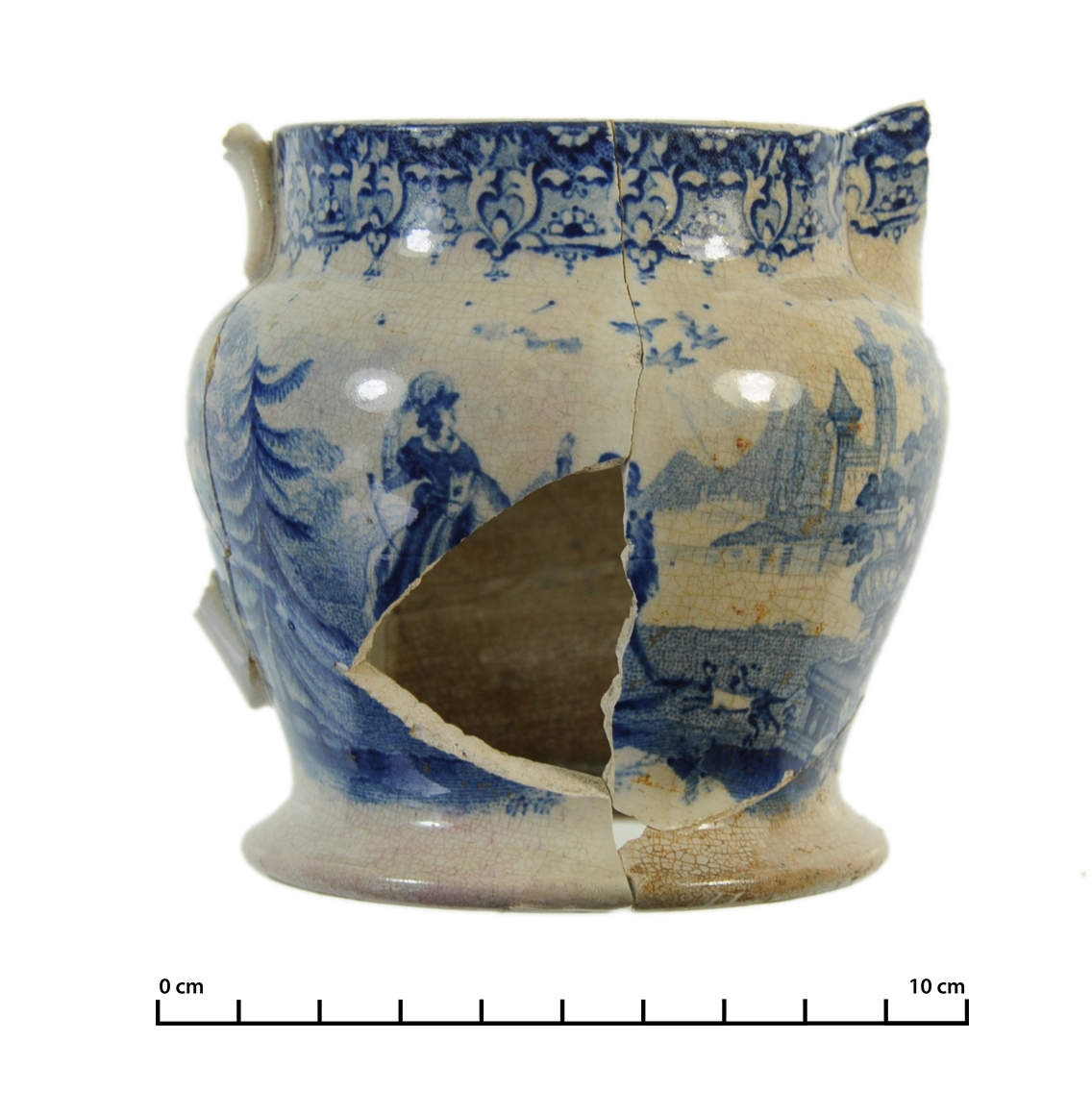
A blue and white transfer printed saucer featuring three figures meeting under an arch. Unfortunately, no maker’s mark was evident on this piece, meaning we were unable to trace it to its original manufacturer. Image: J. Garland.

qiuu4htqo9huga

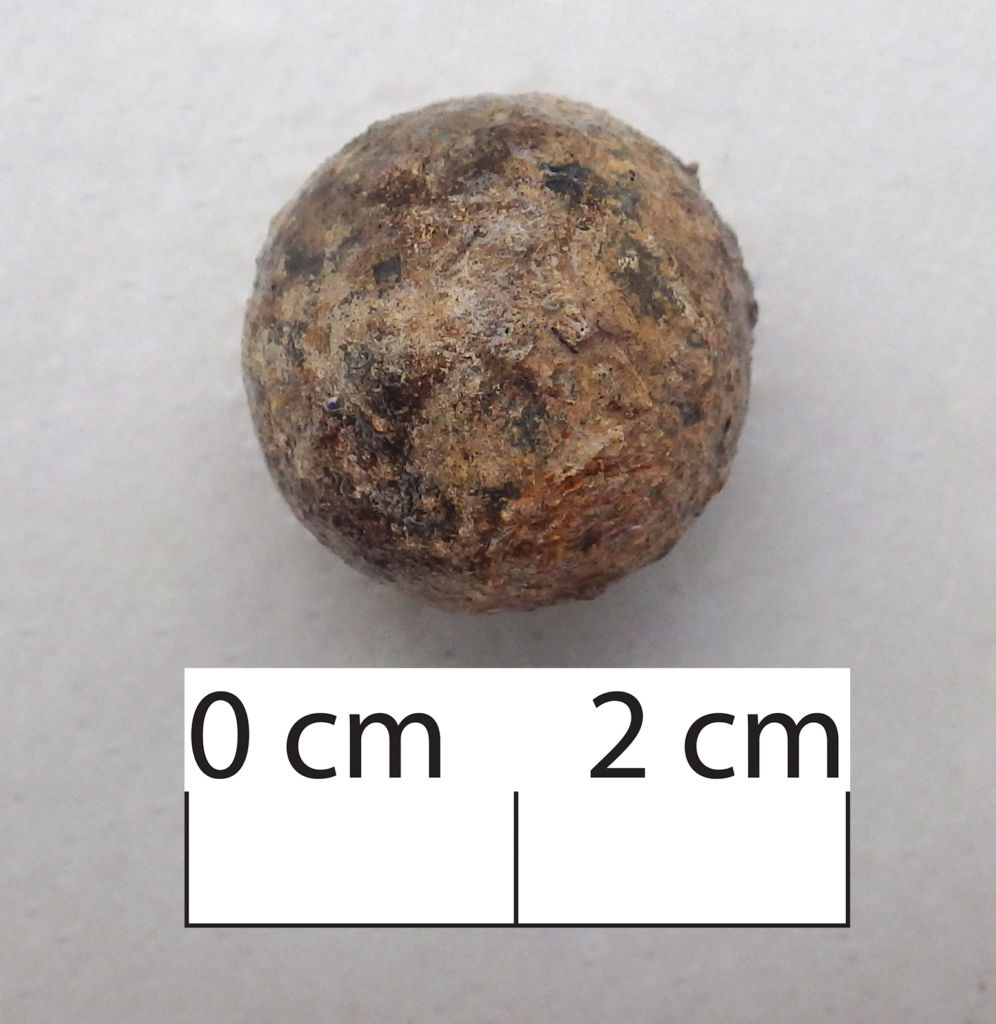
A musket ball! This was a pretty unexpected find: musket balls are not common finds, particularly in the context of 19th century Christchurch. It probably wasn’t used for an actual musket, but may have been intended for a smaller calibre gun. Image: J. Garland.

ma;leignao;rjnv

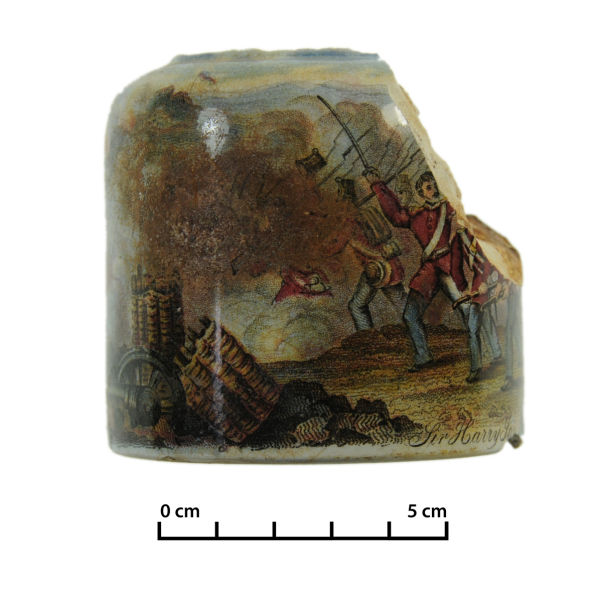
This ‘Pratt ware’ jar  is decorated with a scene from the Crimean war, featuring Sir Harry Jones, a well known British military figure. Sir Harry, who rose to the status of general, commanded the British forces and then the Royal Engineers during the Crimean war, having previously fought in several other campaigns, including one with the Duke of Wellington. Image: J. Garland.

k;bvkutgck

A beautiful gilt decorated and transfer printed candle holder, or ‘chamber stick’, as they were known during the 19th century. The cone feature to the top left of the vessel was there to hold the candle-snuffer, keeping it within easy reach. Image: G. Jackson.

.mbukctjfc

This wee bottle originally contained Rowland’s Macassar Oil, a hair restorative and beautifier. It was first introduced during the late 18th century by Alexander Rowland, a barber (a very expensive barber, apparently) based in St James, London. It was then marketed by his son, Alexander Rowland Junior, who did so to great success (Rowland 2013). Macassar oil was in use throughout the 19th century and well into the 20th century and is the origin of the term ‘antimacassar’, referring to the piece of fabric thrown over the top or back of arm chairs. Apparently, antimacassars were developed in response to the oily residue people wearing the oil would leave on furniture. Who knew! Image: J. Garland.

oiuygvoutcn

A teacup fragment, on which the image of a monkey examining itself in the mirror is displayed. Because, why not? Image: K. Bone.

sgbswtrns

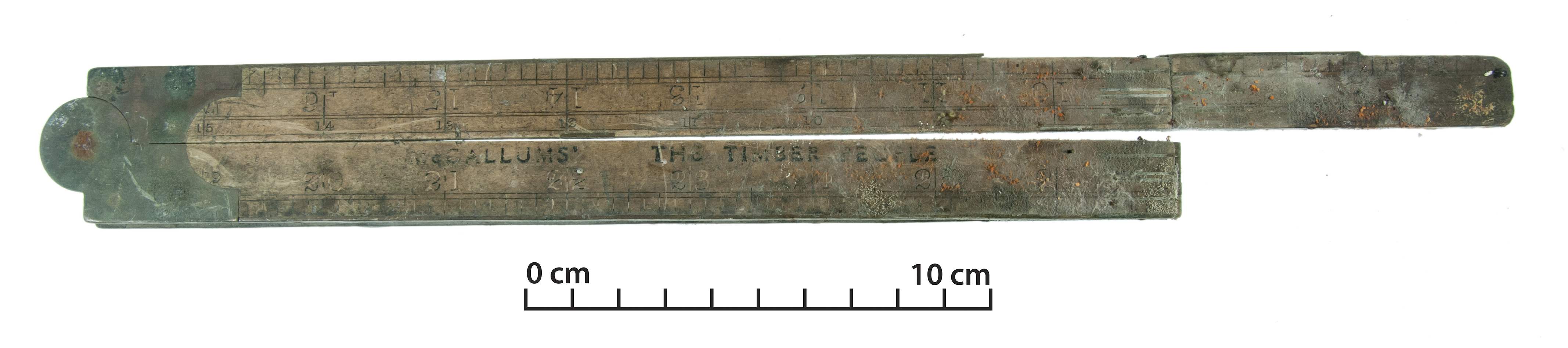
A wooden ruler found under the floorboards of a 19th century house in Christchurch, with “McCallums The Timber People” printed on the front. McCallum & Co were an Invercargill based timber company, who were established prior to 1864. By the early 20th century, the company was run by a partnership between William Asher and Archibald McCallum, with branch offices in Dunedin, Gore, Oamaru, Kelso and Winton (Cyclopedia of New Zealand 1905). They appear to have been purchased by Fletcher’s at some point during the 20th century. Image: J. Garland.

IMGP3307-fixed-background-removed-for-web

A beautiful Alma patterned plate, found on a site on Armagh Street. There isn’t really much to say about this particular plate. I just think it’s pretty. Image: J. Garland.

kjncliqurgbf

It can be pretty easy to forget that there was another British monarch between the end of George IV’s reign and the beginning of Queen Victoria’s time on the throne. There’s the Georgian period, then there’s the Victorian period and those seven years between them when William IV was the King of England get sort of forgotten about. This coin, a half-crown, was minted in 1835, during William’s reign, and it is his slightly smiling profile that adorns one side, jaunty hair and all. Image: J. Garland.

skehfvbakEBFz

The royal bust on this artefact isn’t quite as affable seeming as William IV’s. In fact, if I may say so, the smudges of dirt don’t do anything for the shape of her nose (a bit beak like, isn’t it?). This pipe celebrates Queen Victoria’s Royal Jubilee, which she had two of – one in 1887 (50 years) and one in 1897 (60 years). It’s unclear exactly which one this pipe is referring to. Image: J. Garland.

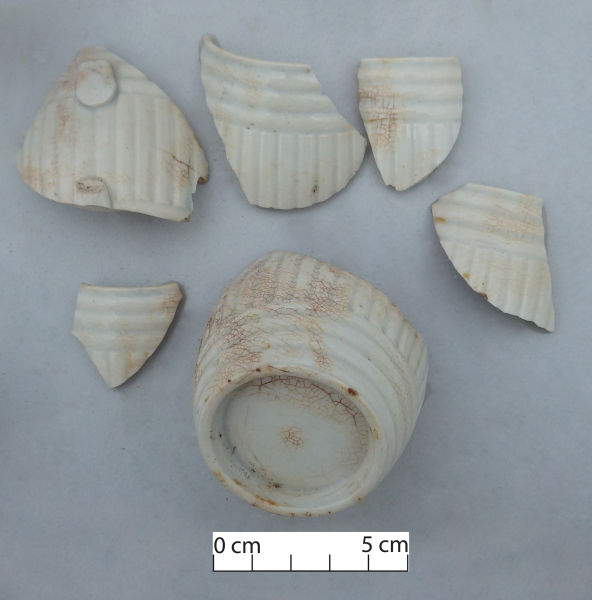
rbrwhsrnzar

And lastly, here is a teacup shaped like a barrel. Image: J. Garland.

Jessie Garland

References

Cyclopedia Company Limited, 1905. Cyclopedia of New Zealand [Otago and Southland Provincial Districts]. Cyclopedia Company Ltd., Christchurch. [online] Available at www.nzetc.victoria.ac.nz. [Accessed May 2015]

Rowland, R., 2013. Fifteen Generations of the Rowland Family. [online] Available at www.rowlandgenerations.org. [Accessed May 2015]

Thomas, E. R. & Dale, L. J., 1950. They Made Their Own Money: the Story of Early Canterbury Traders & Their Tokens. Royal Numismatic Society of New Zealand, Canterbury.

Just what the doctor ordered!

When it comes to the weird and wonderful in 19th century life, it’s hard to go past the field of medicine: specifically, pharmaceutical and ‘self-care’ remedies. Health-related products can be some of the wackiest and most interesting things we find in the archaeological record, especially when they’re put into the context of contemporary advertising and marketing strategies. They also offer us the opportunity to understand the health concerns of people in the past: not just what they actually suffered from and how they treated it, but what they thought they suffered from and what they considered to be healthy.

Mostly, though, they’re fascinating. And often hilarious.

With that in mind, the following are some of our favourites. Enjoy!

akebgaw

Lamplough’s Effervescing Pyretic Saline. A ‘cure-all’ patent medicine, Lamplough’s Saline was made by Henry Lamplough, based in Holborn, London, in the latter half of the 19th century. It was advertised as a remedy for SO many ailments, from cholera and smallpox to ‘eruptive skin’, sea sickness and headaches. Several of the advertisements emphasise its efficacy in preventing tropical and colonial diseases, which suggests that it was aimed more at the export market than the local one. Image (clockwise, from top left): G. Jackson, Wikimedia, Otago Witness 19/10//1888: 40, Wanganui Herald 19/09/1887:2.

asjhbfawe

St Jacobs Oil, the “Great German Remedy”, was advertised primarily as a pain reliever. One article describes it as a “standard pain remedy for bruises, sprains or sores in man or beast” (Otago Witness 26/04/1893: 3) and the “conquers pain” tagline was common in advertisements for the oil. According to the British Medical Journal in 1894, St Jacobs Oil was 84% turpentine with traces of camphor 10% ether, 5% alcohol, 2% carbolic acid, 0.4% capsicum and 0.01% aconite. While aconite (and capsicum, to a degree) is known to have pain-relieving properties, particularly for rheumatism and as an anti-inflammatory, turpentine and carbolic acid are more commonly used as antiseptics or disinfectants. Carbolic acid, in particular, is now considered to be fairly toxic. Image: J. Garland, Otago Witness 28/04/1883: 3.

awegarg

Eucalyptus oil was a popular remedy during the 19th century as, to a degree, it still is now. Although this particular bottle is embossed with the name of R. G. Bosisto, no information could be found about this person. It’s possible that the bottle was associated with Joseph Bosisto, a well-known eucalyptus oil manufacturer who began harvesting and selling the oil in 1853, either as a derivative of his product or an imitation. Advertisements for the oil provide an interesting example of how medical advertising can reflect the health concerns of the past as much as the properties of the actual medicine.. In the 1880s, many of the advertisements emphasise the usefulness of eucalyptus oil as a remedy for cholera, while in the early 20th century, at the height of the influenza epidemic, the advertisements were all about its use in alleviating colds and influenza. Image: J. Garland, Southland Times 8/08/1883:2Dominion 18/09/1919:2.

jhvktgcv

Bishop’s Granular Citrate of Lithia and Citrate of Magnesia, the creations of Alfred Bishop, a London chemist established in 1857. The magnesia was advertised for stomach ailments, as a product “surpassing the ordinary seidletz powder”, while the lithia seems to have primarily been advertised as a remedy for gout. One recipe for the citrate of magnesia suggests that it contained a mixture of sodium bicarbonate and tartaric acid (which is awfully close to baking powder, when you think about it…). Image: J. Garland, Otago Daily Times 12/01/1900: 8, Otago Witness 01/02/1868: 10.

esnsrtn

Holloway’s Ointment and Pills, advertised as ‘cure anything’ products, listed everything from asthma and cancer to ‘female complaints’ within the scope of their curative abilities. They were the brainchild of Thomas Holloway, who began selling his ointment and pills in the 1830s in England. He was something of an advertising pioneer, an approach that paid off for him: by the mid-19th century Holloway’s products had become hugely popular and he had amassed a significant fortune. Although it seems to be unclear exactly what was in the ointment, the pills were later discovered to contain non-medicinal, but harmless ingredients like ginger, soap and castor oil. Image: J. Garland, Poverty Bay Herald 21/04/1884: 4Tuapeka Times 22/12/1870: 10Clutha Leader 25/06/1880: 7.

.kdfnvakje

Charles Hockin, chemist, was based in London in the early to mid-19th century. He retired in 1859, although the company continued under the name of Hockin, Wilson/Welson & Co. The firm produced a variety of products, including digestive drops, ginger beer powder, essence of Rennett, “inexhaustible salts” and liver pills. Chief among them though, was a product called Seidlitz Powder, a “gentle medicine” that was somehow also a “purgative salt”, marketed as long lasting and a remedy for day to day ailments (including the ever present bilious attacks!). Image: J. Garland, Thames Adviser 13/04/1878: 4Lyttelton Times 14/01/1857: 12.

dtnsrtgn

This bottle, embossed with “PRESTON SALTS” appears to have contained Mounsey’s Preston Smelling Salts, the type of salts used to revive fainting ladies (or men, one supposes). Recipes published in 1854 and 1892 indicate that the salts were largely ammonia based, containing a solution of ammonia, powdered chloride of ammonia and powdered carbonate of ammonia in addition to powdered carbonate of potassium, oil of bergamot, oil of clove and sometimes oil of lavender. Several types of smelling salts existed during the 19th century, but Preston Salts seems to have been among the higher quality ones available. It was advertised in New Zealand from the 1850s onwards. Image: J. Garland, Lyttelton Times 12/02/1853: 3.

wrtger

Ford’s Pectoral Balsam of Horehound was first patented by Robert Ford in 1816. The original mixture contained horehound (a plant with medicinal qualities), liquorice root, water, spirit of wine, gum camphore, Turkish opium, “benjamin” (actually benzoin), squill (another medicinal plant), oil of aniseed and clarified honey. The recipe was later modified by his successor, Thomas Ford, in 1830, although the modifications seem to have been minimal. It was advertised as a remedy for respiratory ailments, including influenza, asthma and coughs. Image: C. Dickson, Wellington Independent 17/10/1865: 8.

agvaerga

The “unequalled and invincible” Woods Great Peppermint Cure claimed to cure coughs and colds and was the creation of chemist W. E. Woods, a New Zealand chemist. Woods first set up shop in Hastings, Hawkes Bay, in 1881 before moving to Wellington and eventually to Sydney, where he died in 1927. W. E. Woods & Co., New Zealand, however, remained active his death. Image: C. Dickson, Hawkes Bay Herald 13/06/1895: 2, 13/06/1895: 4.

erhgq45h

The one and only Califig, “nature’s own laxative”. Advertised primarily for bowel complaints, the California Syrup of Figs also claimed to alleviate the problems of heartburn, bad breath and loss of appetite. It was particularly targeted at mothers, as a remedy for unhappy children, with one advertisement bearing the tagline “once ‘touchy’ and tearful, now full of fun, his system cleansed with Califig.” Image: J. Garland, Bottlepickers,  New Zealand Herald 8/02/1942: 3.

Jessie Garland

On the right track: tramways archaeology in Christchurch

How did people get around Christchurch in the 19th century? People certainly walked, or rode, perhaps on a horse, or in a wheeled vehicle pulled by a horse, such as a dray, gig, hackney, or hansom. And let’s not forget that by the later 19th century many people were certainly racing around on bicycles . From early 1880 however, the people of Christchurch were given the option of travelling by tram. During the course of horizontal infrastructure rebuild we have come across lots of old tram lines, and in the process have become tramways archaeologists.

Trains versus trams

What’s the difference between a train and a tram? Both are flange wheeled vehicles that operate atop a permanent way  of iron rail: mostly it’s a question of scale. Trains are a heavy rail transportation system and trams are a light rail transportation system. Trains run on specially built lines that are always separate from other traffic, whereas trams run along lines (called tramways) that are built into public roads, a space they have to share with other traffic.

All the rage across the world in the 19th century, once trams finally arrived in Christchurch they proved to be a big hit. Before the Christchurch Tramway Board was formed in 1903 to municipalise, modernise, and electrify the network (the first electric trams ran in 1905), the tramways of 19th century Christchurch were owned and operated by private companies. The Canterbury Tramway Company was the first of these: formed in 1878, it opened its first passenger service in March 1880, and by the end of 1888 had 17 miles (more than 27 kilometres) of tramway in operation (Alexander 1985: 8).

Off the rails: rail types

Three different types of iron rail were used in the 19th century to carry Christchurch trams. Thin flat grooved rails were used in the early years – these were attached to longitudinal timber beams fastened to timber sleepers. This first type of rail (not surprisingly) wasn’t very robust – it cracked along the inside of the groove, and was soon replaced with other rail types (Anderson 1985: 29). Loubat’s grooved tramrail proved to be the best choice: with the flanges of the tram wheels running safely within the groove or ‘flangeway’ of the upper surface of the rail, Loubat’s rail could be easily set flush into the road surface where they didn’t pose such a hazard to other road users (except possibly unfortunate cyclists with narrow tires).

aveva

The three different types of rail that carried Christchurch trams in the 19th century. From left to right: the early flat grooved rail used by the Canterbury Tramway company, the flat bottomed Vignoles rail, and the Loubat grooved tram rail. Image: Anderson 1985: 29.

Mostly we have found Loubat’s grooved tramway rail in situ below Christchurch’s roads, though all the examples we have found so far have been associated with 20th century electric trams.

With the transition to electric trams all the tramlines of the private companies had to be replaced. Although the new electrics were of the standard gauge like their steam and horse powered predecessors, most of the tramlines were in poor condition, and the rail was too light to handle the much heavier electric tramcars, so had to be dug up and replaced. The standard method of tramway formation in the electric era involved bedding the sleepers on compacted shingle, and fixing the rails with big spike nails (Alexander 1986: 52). A good example of this was uncovered in 2012 on North Avon Road – you can read all about it here. From the 1920s this method was improved, with concrete being used instead of compacted shingle. Last week I spotted a fine example of this in the side of a sewer trench crossing Colombo Street.

agre

An improved concrete tramway foundation of the 1920s period, as exposed in the side of a sewer trench crossing Colombo Street. It had some fine steel mesh reinforcing at a lower level. Image: H. Williams.

A later method involved completely embedding the rail in reinforced concrete (Alexander 1993: 78-79). We have come across lots of this type of tramway in the central city, just below the road surface. It’s easy to see why these tramways were simply covered over after the last of the trams stopped running in 1954, as removing them is lots of hard work!

aeraer

A 20th century reinforced concrete tramway foundation, with the embedded Loubat grooved rail still in situ. Colombo Street, Sydenham. Image: H. Williams.

The tramway on Tuam Street

We have found the remnants of only one 19th century tramway. This was on Tuam Street, and formed part of the Canterbury Tramway Company’s Addington line, which opened to the public on 5 January 1882 (Star 5/1/1882: 2). Unlike most of the other 19th century tram routes, when the tramway network was electrified the Addington route was slightly altered, and Tuam Street bypassed. Because of this, remains of this 19th century tramline survived, unlike the lines of other routes that were dug up and relaid.

At three different locations on Tuam Street we found timber tramway sleepers, but sadly no rail. Presumably the well-worn rail was removed and scrapped, but it may have found another use. On Main Road near McCormacks Bay last year we looked at a trio of Vignoles rails exposed during road widening works. These had been embedded vertically in the ground, to support part of the seawall. We guess that these old rails had once been part of the adjacent roadway, where they carried the Sumner tram.

akdjvnaiuerw

An alignment of old Vignoles type tram rails exposed on Main Road, McCormacks Bay during road widening works in February 2015. Image: H. Williams.

akldjbver

Close up of one of the well-worn and salt-spray corroded Vignoles type tram rails used to support the sea wall. The height of the rail is 116 mm, and you can see that the upper surface is well worn from contact with the tram wheel. Image: H. Williams.

Most of the sleepers of the Addington line had been removed; in over 300 metres of trenching on Tuam Street we found just eight sleepers, probably left there because their condition was too poor to justify their removal for reuse. Knowing that vast numbers of hardwood sleepers were being imported from Australia for our railway construction at the time (Press 8/9/1891:5), I was interested to learn that the timber was of a native species – rimu.

afjnvoarew

The remnants of two 19th century tramway sleepers of the Addington Line exposed on Tuam Street. They had been laid directly atop the sandy clay subsoil, rather than on top of any supporting ballast. Image: H. Williams.

sfgbsrt

An alignment of sleepers uncovered at the Tuam and Colombo Street intersection, laid not at right angles to the road, but on an angle, to carry the tram around the corner. Image: H. Williams.

There are so many social and cultural related tramway things that sadly we haven’t been able to touch upon in this week’s blog – such as the rules for riding a Christchurch tram in the 19th century (no playing musical instruments without the permission of the [tram!] conductor), or the saga of the council’s tramway hearse that never carried a single corpse and ended up a houseboat (Alexander 1983: 11).

Because of the context in which we have found these tramway features (located on public rather than private land) it’s been a different sort of archaeology than what we have been used to – representing one not of past peoples ‘in their place’, so to speak (be it in their former home, workplace, or backyard, the kind of contexts where we end up doing most of our archaeology), but of past peoples ‘between places’; neither here nor there but ‘on the way somewhere’ – a most ephemeral archaeology of people in transit, people in motion.

sfser

Although she rides the rails at Ferrymead, 134 ‘Kitty’, one of the eight Kitson steam tram motors imported by the Canterbury Tramway Company made a special trip back into town some years ago to blaze up a few laps on the city circuit. At left, Kitty leaves Cathedral Junction, October 2003, and at right, in the distance, the Invercargill Tramways No. 15 Birney electric tram, April 2015. Both trams were restored by the Tramway Historical Society. Image: D. Hinman (left) and H. Williams (right).

Thanks to Dave Hinman from the Tramway Historical Society for providing the photo of Kitty, and to Dr Rod Wallace for timber identification.

Hamish Williams

References

Alexander, M., 1985. Rails in the Roads: the steam and horse tram era in Christchurch. Christchurch NZ: Christchurch Transport Board and Tramway Historical Society.

Alexander, M., 1986. The Wire Web: the Christchurch Tramway Board & its early electric tramways, 1903-1920. Christchurch, N.Z: Christchurch Transport Board and Tramway Historical Society.

Alexander, M., 1993. Tram to the Terminus: the Christchurch Tramway Board and its electric tramways 1921-54. Christchurch N.Z: A&M and Tramway Historical Society.

Press. [online] Available at www.paperspast.natlib.govt.nz

Star. [online] Available at www.paperspast.natlib.govt.nz